Poetry Friday: “I Am Poetry”

poetry-friday-1-1

I have spent the past week at the Teachers College Reading and Writing Project’s Summer Reading Institute. My brain is bursting with all I have learned from my amazing section leaders and the keynote speakers. My senses are overwhelmed by the sights and sounds of New York City in August. My life is richer because of people I have met and friends I have made. It has been a glorious week.

How could I possibly choose a poem to share today that reflects my week? By focusing on one small piece of my experience.

Each teacher was given a book at the beginning of the week to use as a mentor text for the work of the Institue. I received Becoming Naomi León (Scholastic Press, 2004) by Pam Muñoz Ryan. I have loved every book I’ve read by Ryan, but somehow, I had missed this beautiful story about a young girl finding her true self. Pam Muñoz Ryan’s writing is so lyrical, I wondered if she’d written any poetry. A quick search reminded me about The Dreamer, Ryan’s lovely book about the young Pablo Neruda and led me to this poem:

“I Am Poetry”

by Pam Muñoz Ryan

I am poetry,

waiting to seize the poet.

I ask the questions

for which all answers

exist.

I choose no one.

I choose every one.

Come closer…

…if you dare.

I am poetry,

lurking in dappled shadow.

I am the confusion

of root

and gnarled branch.

I am the symmetry

of insect,

leaf,

and a bird’s outstretched wings.

Read the rest of the poem here.

If you haven’t read Becoming Naomi León, The Dreamer, or any of Ryan’s other novels for children, read one today. You’ll be glad you did. 

Please be sure to visit Heidi at My Juicy Little Universe for the Poetry Friday Round Up.

Slice of Life: Recipe for a Perfect Summer Day

11454297503_e27946e4ff_h

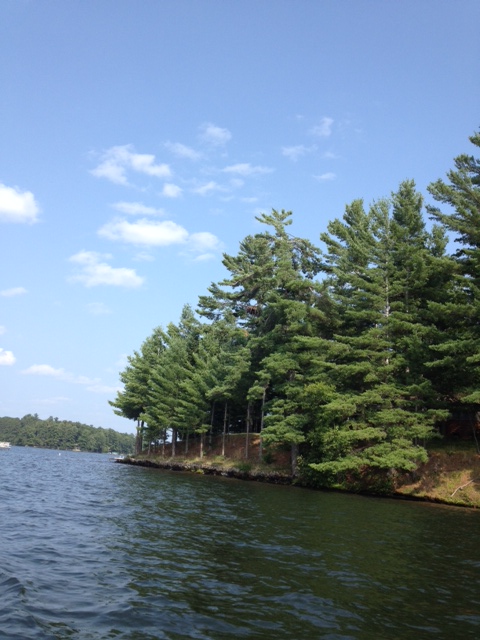
Last week I was lucky enough to spend four wonderful days at a lake in northern Wisconsin with my son, daughter-in-law, and her family. Inspired by the beauty surrounding me, and a poem I read recently by Laura Purdie Salas, I decided to write a recipe poem about my visit to Lake Minocqua.

photo-2

“Recipe for a Perfect Summer Day”

Take one lake filled with calm, clear water,

sun-warmed and sparkling.

Surround it with towering pine trees,

where bald eagles nest and perch.

Fill it with musky and largemouth bass,

walleye and northern pike.

Add:

pairs of loons, warbling their mournful cry,

graceful herons, still as statues on the shore,

iridescent dragonflies, darting over the surface.

Mix in families and friends who spend the day:

swimming and kayaking,

biking or hiking;

your choice.

Top with a campfire,

toasted marshmallows,

and gooey, chocolatey s’mores,

under a star-filled sky.

© Catherine Flynn, 2014

Thank you, as always, to StaceyTaraDanaBetsyAnna, and Beth for hosting Slice of Life each Tuesday. Be sure to visit Two Writing Teachers to read more Slice of Life posts.

Poetry Friday: “The Picnic”

poetry-friday-1-1

“The Picnic”

We brought a rug for sitting on,

Our lunch was in a box.

The sand was warm. We didn’t wear

Hats or shoes or socks.

Waves came curling up the beach.

We waded. It was fun.

Our sandwiches were different kinds.

I dropped my jelly one.

by Dorothy Aldis

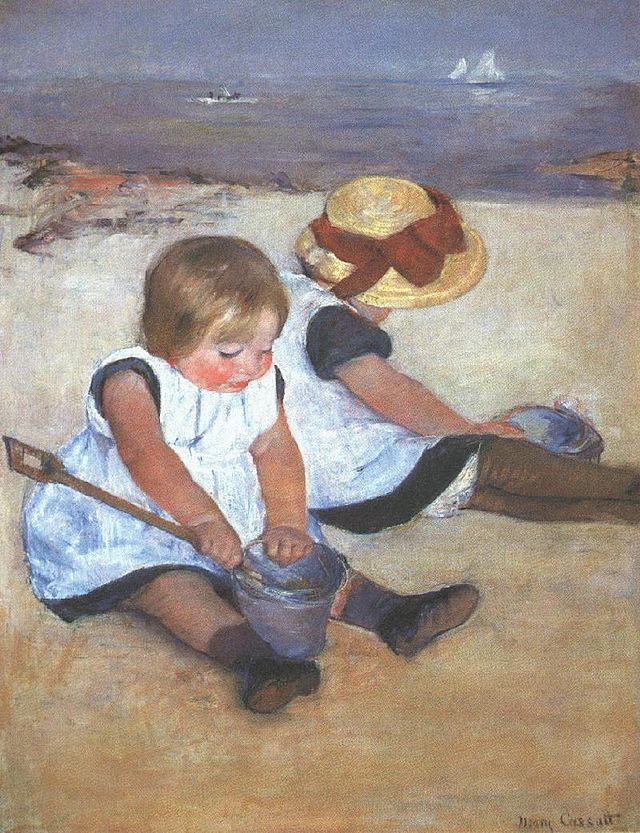
I discovered this poem years ago in Jack Prelutsky’s wonderful anthology, Read-Aloud Rhymes for the Very Young. (Knopf, 1986) And although Dorothy Aldis wrote it almost 100 years ago, children can relate to this simple depiction of a picnic at the beach just as easily today as they did then. First graders love this poem, and the concrete details help those kids who don’t automatically visualize learn to create images from a poet’s words.

"Cassatt Mary Children on the Beach 1884". Licensed under Public domain via Wikimedia Commons - http://commons.wikimedia.org/wiki/File:Cassatt_Mary_Children_on_the_Beach_1884.jpg#mediaviewer/File:Cassatt_Mary_Children_on_the_Beach_1884.jpg
“Cassatt Mary Children on the Beach 1884”. Licensed under Public domain via Wikimedia Commons

Hope you all have time for one more picnic at the beach before summer ends! Please be sure to visit Mary Lee at A Year of Reading for the Poetry Friday Round Up.

Poetry Friday: Flowers of the Ocean

poetry-friday-1-1

When I was a kid, my family always spent a week camping in Rhode Island. We spent many days at the beach, but we also spent time at Beavertail State Park in Jamestown. My parents loved to sit and watch the waves crashing over the rocks and the ships in the bay. My favorite part of being at Beavertail was examining the many tide pools that dotted the rocks when the tide was out. I imagined that I was a marine biologist, studying the seaweed and mollusks that braved the harsh conditions of these rocky oases.

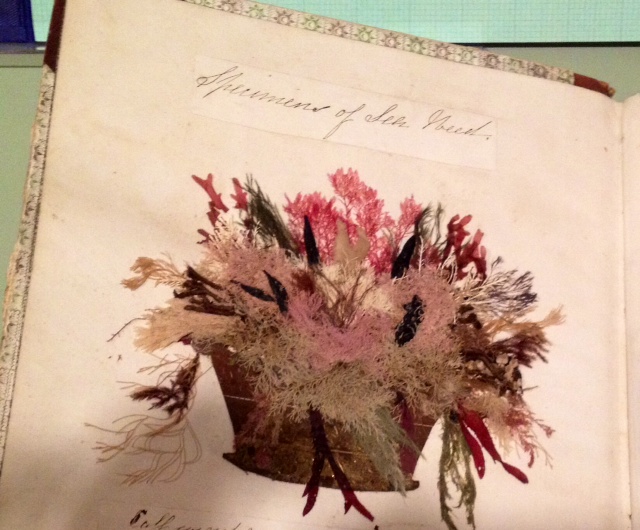
I was reminded of these tide pools last week when a friend and I visited the Yale Center for British Art to see “‘Of Green Leaf, Bird, and Flower’: Artists’ Books and the Natural World,” an exhibit which celebrates the work of “self-taught naturalists and artists [who] recorded and observed the natural world around them from the sixteenth century to the present.” The variety of artistic responses and creativity on display was stunning. In addition to traditional sketches and watercolors, there were collages, works of cut paper, dioramas, and mixed media.

Specimens of Sea Weed, ca. 1840 Yale Center for British Art
Specimens of Sea Weed, ca. 1840
Yale Center for British Art

I found this collage of sea weed specimens especially charming. Apparently creating this kind of sea weed collage was a popular activity in the 19th century, and E.L. Aveline’s poem, “Flowers of the Ocean, often accompanies such pieces. The poem appeared in The Mother’s Fables, in Verse, Designed, Through the Medium of Amusement, to Convey to the Minds of Children Some Useful Precepts of Virtute and Benevolence in 1812. The title page of this volume urges readers to “Find tongues in trees, books in running brooks/Sermons in stones, and good in every thing.” Not bad advice, and the artwork in this exhibit demonstrates that many people followed it faithfully.

Flowers of the Ocean

Call us not weeds—we are flowers of the sea;

For lovely, and bright, and gay-tinted are we,

Our blush is as deep as the rose of thy bowers;

Then call us not weeds—we are Ocean’s gay flowers.

Not nursed like the plants of a summer parterre,

When gales are but sighs of an evening air;

Our exquisite, fragile, and delicate forms

Are nursed by the ocean, and rocked by its storms.

by E.L. Aveline

“Of Green Leaf, Bird, and Flower” is on display until August 10. If you’re near New Haven, it’s worth the trip. Please be sure to visit Janet and Sylvia at Poetry for Children for the Poetry Friday Roundup.

Poetry Friday: Dirge Without Music

poetry-friday-1-1

Dirge Without Music

by Edna St. Vincent Millay

I am not resigned to the shutting away of loving hearts in the hard ground.

So it is, and so it will be, for so it has been, time out of mind:

Into the darkness they go, the wise and the lovely. Crowned

With lilies and with laurel they go; but I am not resigned.

Lovers and thinkers, into the earth with you.

Be one with the dull, the indiscriminate dust.

A fragment of what you felt, of what you knew,

A formula, a phrase remains, –but the best is lost.

The answers quick and keen, the honest look, the laughter, the love–

They are gone. They are gone to feed the roses. Elegant and curled

Is the blossom. Fragrant is the blossom. I know. But I do not approve.

More precious was the light in your eyes than all the roses in the world.

Down, down, down into the darkness of the grave

Gently they go, the beautiful, the tender, the kind;

Quietly they go, the intelligent, the witty, the brave.

I know. But I do not approve. And I am not resigned.

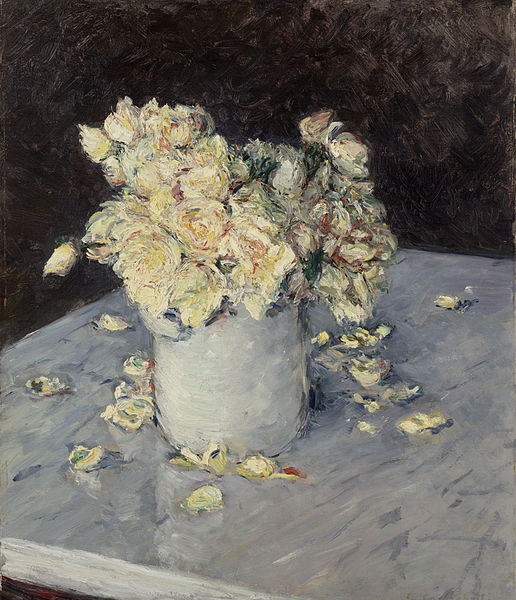
Yellow Roses in a Vase, 1882 Gustave Caillebotte Dallas Museum of Art, The Eugene and Margaret McDermott Art Fund, Inc., via Wikimedia
Yellow Roses in a Vase, 1882
Gustave Caillebotte
Dallas Museum of Art, The Eugene and Margaret McDermott Art Fund, Inc., via Wikimedia

Please be sure to visit Linda at Write Time for the Poetry Friday Round Up.

 

Slice of Life: Cultivating Creativity

11454297503_e27946e4ff_h

I am not an artist. But over the past year or so, drawing has been nudging its way into my brain. At NCTE, Linda Rief spoke about incorporating several different art techniques into a poetry project. Linda’s presentation inspired Vicki Vinton to invite readers of her blog, To Make A Prairie, to do “something creative” in response to a poem they love. So when I was offered the opportunity to attend an art “camp” for adults, I jumped at the chance. For the past two days, I have been sketching and painting and making collages.  This experience has been everything I hoped it would be and more.

One of yesterday’s activities found us out in the garden, gathering images. It was a classic summer day: bright blue sky, puffy white clouds, insects buzzing from flower to flower, birds chirping from the tree tops. It was lovely just to sit and soak in the beauty of the moment. Our teacher instructed us to do just that, but to write and/or sketch the images surrounding us.

Back in the studio, we were given time to turn our thoughts into haiku, then time to capture the image in watercolor or colored pencil.

I drafted two poems based on my observations:

1.

serene summer day

breezes whisper through pine boughs

lilies trumpet joy

photo-5
First try–tiger lilies are hard to draw!

2.

hidden sweetness

clover blossoms pink as dawn

bees hover and buzz

This experience has been quite an eye-opener, and I’ve had some interesting insights into my writing process through drawing. Driving to the studio yesterday, I was filled with anxiety about this experience. Now I wish I had more than four days to continue to forge what Julia Cameron, in The Artist’s Way, calls “pathways into [my] consciousness through which creative forces can operate.”

Thank you, as always, to StaceyTaraDanaBetsyAnna, and Beth for hosting Slice of Life each Tuesday. Be sure to visit Two Writing Teachers to read more Slice of Life posts.

Poetry Friday: Walt Whitman’s “Miracles”

poetry-friday-1-1

Before I began student teaching, my cooperating teacher invited me to the class Christmas party so I could meet the kids. One boy wanted to know what was my favorite holiday. I didn’t hesitate a minute. “Summer,” I replied.

So even though the solstice isn’t until tomorrow, here’s to the miracle that is summer!

Miracles

by Walt Whitman

Why, who makes much of a miracle?

As to me I know of nothing else but miracles,

Whether I walk the streets of Manhattan,

Or dart my sight over the roofs of houses toward the sky,

Or wade with naked feet along the beach just in the edge of

   the water,

Or stand under trees in the woods,

Or talk by day with any one I love, or sleep in the bed at night

   with any one I love,

Or sit at table at dinner with the rest,

Or look at strangers opposite me riding in the car,

Or watch honey-bees busy around the hive of a summer 

   forenoon,

Or animals feeding in the fields,

Or birds, or the wonderfulness of insects in the air,

Or the wonderfulness of the sundown, or of stars shining so

   quiet and bright,

Or the exquisite delicate thin curve of the new moon in spring;

These with the rest, one and all, are to me miracles,

The whole referring, yet each distinct and in its place.

To me every hour of the light and dark is a miracle,

Every cubic inch of space is a miracle,

Every square yard of the surface of the earth is spread with 

   the same,

Every foot of the interior swarms with the same.

To me the sea is a continual miracle,

The fishes that swim—the rocks—the motion of the waves—

   the ships with men in them,

What stranger miracles are there?

Don’t miss this gorgeous video inspired by Whitman’s words:

Be sure to visit Jone at Check It Out for the Poetry Friday Round Up. Happy summer, everyone!
A Saturday Celebration

celebrate-image

Thank you, Ruth, for providing this space and giving us the opportunity to pause and celebrate the joys from our week.

June can be a bittersweet time for teachers as we let go of children we have grown to love. This week, I want to celebrate one of these students.

I began working with this second grade girl at the end of November. She had struggled with reading in first grade, but by last September it was clear that she wasn’t making progress. Her parents consented to testing to see if she was eligible for special education, but these revealed that she had average skills and abilities, and therefore not eligible. But she was eligible for the Tier 3 reading support I provide.

When we began working together, she was reading at a level about a year behind where most second graders are in November. She came to our lessons eager to to her best, and began to make slow but steady progress.  

As I wrote earlier in the week, I usually have a short read-aloud time during my intervention lessons. About a month ago, I began reading Firefly July (Candlewick Press, 2014), Paul B. Janeczko’s wonderful collection of short poems, to this little girl. She was entranced by Melissa Sweet’s whimsical illustrations and several of the poems quickly became favorites. This line from Robert Wallace’s “In the Field Forever” even inspired her to write her own poem:

Sometimes the moon’s a scythe, sometimes a silver flower.

Here is her poem:

The Colors of the Moon

Sometimes the moon looks like a golden banana.

Sometimes it looks like a white hammock.

Sometimes it looks like a ripe orange.

Sometimes the moon looks like a cookie with a splash of milk.

Sometimes it looks like a red apple.

Isn’t that lovely?

All her hard work has paid off. She is leaving second grade only one level below our end-of-year expectation, and she is no longer mixing up lowercase “b” and “d”. But best of all, she is leaving second grade a poet and a much more confident and enthusiastic reader. Hooray for her!

Poetry Friday: “Carentan O Carentan”

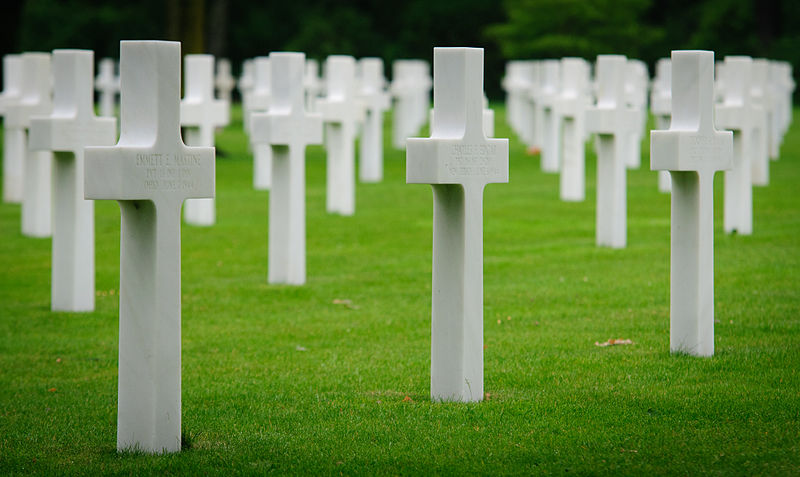
Normandy_American_Cemetery_and_Memorial_(6032771638) “What happened on this day?” my father would often ask as we sat down to dinner. Today, of course, the answer would be D-Day. The invasion of Normandy. The beginning of the end on World War II. Even if we knew the answer to these questions, an impromptu history lesson usually followed. My father wasn’t a scholar or historian, but he had been a small boy during the war, and he revered the soldiers who fought it. And although he never said as much, I think these supper-time history lessons were his way of ensuring my sister and I shared his reverence.

My father isn’t here to ask that question today. But if he were, I know he would be honoring the brave men who landed on the beaches and parachuted into the French countryside seventy years ago.

One of those soldiers, Louis Simpson, captured the horrors endured and the sacrifices made by the courageous souls who fought to liberate “Fortress Europe” in “Carentan O Carentan.”

“Carentan O Carentan”

by Louis Simpson

Trees in the old days used to stand

And shape a shady lane

Where lovers wandered hand in hand

Who came from Carentan.

This was the shining green canal

Where we came two by two

Walking at combat-interval.

Such trees we never knew.

The day was early June, the ground

Was soft and bright with dew.

Far away the guns did sound,

But here the sky was blue.

The sky was blue, but there a smoke

Hung still above the sea

Where the ships together spoke 

To towns we could not see.

Read the rest of the poem here or listen to actor Charles Durning recite the poem:

To read more about D-Day and see photos of Omaha Beach today, visit Remember D-Day by walking the beaches of Normandy by John Hanc.

Please be sure to visit Carol at Carol’s Corner for the Poetry Friday Round Up.
Poetry Friday: A Spicing of Birds

poetry-friday-1-1

One of my earliest memories is finding the remnants of a robin’s egg under a tree in my grandmother’s front yard. When I showed her my treasure, she “oohed” and “ahhed” and told me all kinds of interesting things about robins. 

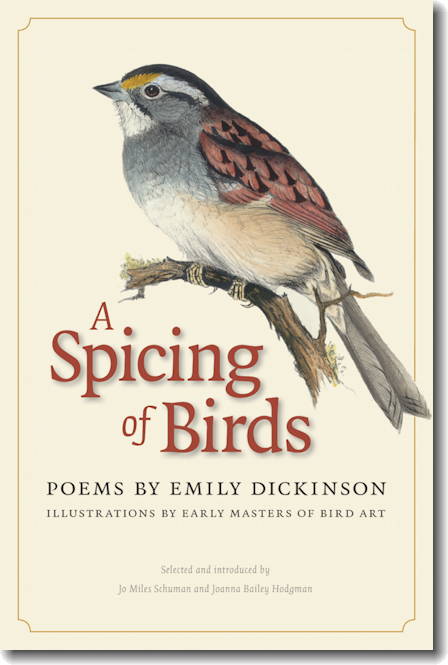
I’ve been thinking about birds a lot these past few days. Now that spring is finally here, birds start singing in the tree outside my window before my alarm goes off. I don’t know as much about birds as my grandmother did, but they still fascinate me. So yesterday, when I stopped in at the library, my eye was immediately drawn to this book on the new book display shelf:

Schuman comp_final.indd A Spicing of Birds (Wesleyan University Press, 2010) is a gorgeous book. Jo Miles Schuman and Joanna Bailey Hodgman have selected thirty-seven of Emily Dickinson’s poems about birds and paired them with illustrations “by late eighteenth century to early twentieth century artists/ornithologists.” An introduction describes Dickinson as an “intimate of birds;” someone who “observed them closely and knew intimately their songs, habits, and characteristics.” Her poetry is filled with the fruits of her noticings. Here is one of my favorite poems from this lovely collection.

The Robin is the One

That interrupt the Morn

With hurried—few—express Reports

When March is scarcely on—

The Robin is the One

That overflow the Noon

With her cherubic quantity—

An April but begun—

The Robin is the One

That speechless from her Next

Submit that Home—and Certainty

And Sanctity, are best.

Please be sure to visit Jama at Jama’s Alphabet Soup for the Poetry Friday Round Up.