Missing you, the star at the center of their universe, the cats wander the apartment, their orbit thrown off kilter by your sudden departure.
They sniff the rug, the sofa cushions wondering, “Where is she?” “Did she sit here a minute ago?”
They wrap around my legs, seeking, searching. They nibble at their food, lap up water with their rough, pink tongues that long to kiss your beautiful face, then meander back to the bedroom, hoping to find you waiting there,
where you belong.
Thank you, everyone, for your all your kind words and understanding last week. My daughter-in-law Julia was a beautiful woman who will be dearly missed by everyone who knew her.
The Poetry Friday Round Up is here today, but I hope you’ll all forgive me and let the comments serve as the round-up. We had a sudden death in our family yesterday, and I am distraught. I promise next time I host I will be in a more festive spirit.
Lead by Mary Oliver
Here is a story
to break your heart.
Are you willing?
This winter
the loons came to our harbor
and died, one by one,
of nothing we could see.
A friend told me
of one on the shore
that lifted its head and opened
the elegant beak and cried out
in the long, sweet savoring of its life
which, if you have heard it,
you know is a sacred thing.,
and for which, if you have not heard it,
you had better hurry to where
they still sing.
Children’s first reading experiences are usually through picture books, and for this reason, people have fond memories of them and are passionate about their favorites. Because of the role picture books play in introducing the magic of reading to children, they are worth celebrating.
Picture Book 10 for 10 is the brainchild of Cathy Mere of Reflect & Refine: Building a Learning Community and Mandy Robeck of Enjoy and Embrace Learning. During this annual event, now in its sixth year, teachers, librarians, and book lovers create lists of 10 essential picture books. Cathy and Mandy collect and share these lists, and everyone is richer because of their efforts. Be sure to visit their blogs to see their lists, and check out dozens of Picture Book 10 for 10 lists here. Thank you, Cathy and Mandy, for organizing this celebration of picture book love.
Many children are introduced to picture books through collections of nursery rhymes. The rhythm of poetry is soothing and the rhymes give kids the foundation they need to become independent readers. But most importantly, reading nursery rhymes and poetry to children is fun.
Creating this list was quite a challenge, as there are many, many beautiful poetry picture books available these days. For any one of the poets listed below, there are one or two or ten other books that are just as worthy of inclusion on this list.
1.Bookspeak: Poems about Books, by Laura Purdie Salas, illustrated by Josée Bisaillon(Clarion Books, 2011)
What could be better than a collection of poems celebrating books? Laura Purdie Salas gives voice to all parts of books, including the cover, index, and the end. You can watch the trailer for Bookspeak, listen to Laura read two poems, and read the teacher’s guide here.
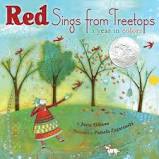
2. Red Sings From the Treetops: A Year in Colors by Joyce Sidman, illustrated by Pamela Zagarenski (Houghton Mifflin Books for Children, 2009)
Joyce Sidman is one of my favorite poets, and I love Pamela Zagarenski’s whimsical style, so this book was a shoe-in for this list. I have written about it before here.
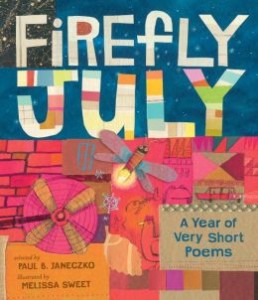
3. Firefly July: A Year of Very Short Poems, selected by Paul B. Janeczko, illustrated by MelissaSweet (Candlewick Press, 2014)
This award-winning anthology, illustrated with whimsical perfection by Melissa Sweet, includes poems celebrating each season and is not to be missed. Julie Roach, writing in School Library Journal described Sweet’s illustrations this way: “Colors and shapes with willowy details expertly blur or bring bits of the images into focus to create a magical sense of place, time, and beauty.”
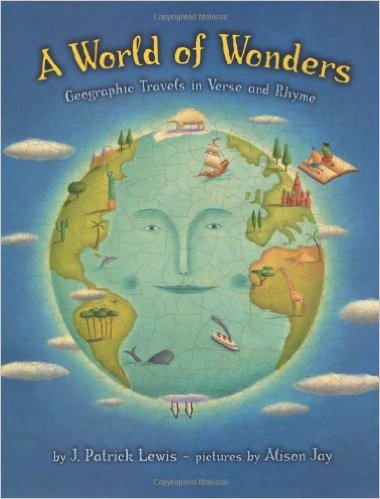
4. A World of Wonders: Geographic Travels in Verse and Rhyme, by J. Patrick Lewis, pictures by Alison Jay (Dial Books for Young Readers, 2002)
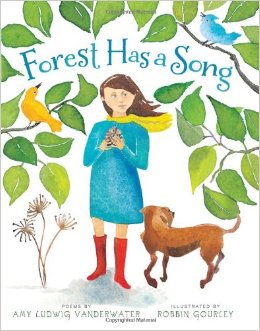
5. Forest Has a Song, by Amy Ludwig VanDerwater, illustrated by Robbin Gourley (Clarion Books, 2013)
Amy Ludwig VanDerwater turns her keen poet’s eye to the forest landscape throughout the year. Gourley’s delicate watercolors are the perfect complement to VanDerwater’s evocative poems.
6. On the Wing: Bird Poems and Paintings by Douglas Florian (Harcourt, 1996)
Douglas Florian’s sophisticated humor and word play make his poetry perfect choices for any elementary classroom. Find out more about Florian and his other poetry collections here.
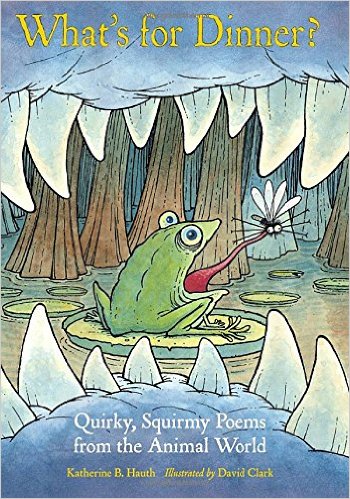
7. What’s for Dinner? Quirky, Squirmy Poems from the Animal World, by Katherine B. Hauth, illustrated by David Clark (Charlesbridge, 2011)
This NSTA/CBC Outstanding Science Trade Book is chock-full of hilarious poems about the very serious subject of how animals capture their prey. Hauth includes factual information about each animal, as well as a list of suggested reading. David Clark’s cartoon-like illustrations add to the humor.
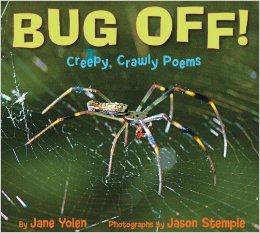
8. Bug Off! Creepy, Crawly Poems, by Jane Yolen, photographs by Jason Stemple (WordSong, 2012)
Jane Yolen is one of my favorite authors of all time. In fact, my 2013 Picture Book 10 for 10 post was devoted to her work. Yolen has published many volumes of poetry, but her collaborations with her photographer son, Jason Stemple, are my favorites. Stemple’s photographs are full of incredible details, and Yolen’s poetry captures the “beauty and mystery” of “these tiny living beings.” (From Yolen’s author’s note.)
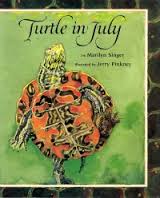
9. Turtle in July, by Marilyn Singer, illustrated by Jerry Pinkney (Macmillan, 1989)
Marilyn Singer is the 2015 winner of the NCTE Award for Excellence in Poetry for Childrenand has long been one of my favorite poets. You can read a previous post about Marilyn’s poetry here. This collection, filled with Jerry Pinkney’s stunning illustrations, is a must-have for any elementary classroom.
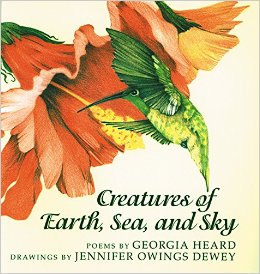
10. Creatures of the Earth, Sea, and Sky, by Georgia Heard, drawings by Jennifer Owings Dewey (WordSong, 1992)
Georgia Heard has written that “poets find poems in hundreds of different places” (Awakening the Heart: Exploring Poetry in Elementary and Middle School, Heinemann: 1999), and in this wonderful collection, which has long been a staple in my classroom, she has found poems throughout the animal kingdom. Dewey’s detailed, realistic drawings add to the beauty of this book.
This poem was recently featured in The New York Times Magazine. It was exactly the poem I needed to read at that moment, and I’ve been carrying it with me ever since.
“The Word That Is A Prayer”
by Ellery Akers
One thing you know when you say it:
all over the earth people are saying it with you;
a child blurting it out as the seizures take her,
a woman reciting it on a cot in a hospital.
What if you take a cab through the Tenderloin:
at a street light, a man in a wool cap,
yarn unraveling across his face, knocks at the window;
he says, Please.
By the time you hear what he’s saying,
the light changes, the cab pulls away,
and you don’t go back, though you know
someone just prayed to you the way you pray. Please: a word so short
it could get lost in the air
as it floats up to God like the feather it is,
A friend recently asked me, “But what makes it a poem?” I confess I was stumped for a minute, then resorted to a fairly dry, textbook definition. This bothered me, so I went in search of a better answer. I’m not at all surprised that I found one in Mary Oliver’s A Poetry Handbook: A Prose Guide to Understanding and Writing Poetry. Oliver ends her analysis of “The Red Wheelbarrow,” by William Carlos Williams with this brilliant description:
“It is, above all, a poem that celebrates not only a momentary enchantment plucked out of the vast world but the deftness and power of the imagination and its dazzling material: language.”
Isn’t that a wonderful explanation of a poem? I have been enchanted by fresh peaches this week, and found this dazzling celebration of them to share with you today:
From Blossoms by Li-Young Lee
From blossoms comes
this brown paper bag of peaches
we bought from the boy
at the bend in the road where we turned toward
signs painted Peaches
From laden boughs, from hands,
from sweet fellowship in the bins,
comes nectar at the roadside, succulent
peaches we devour, dusty skin and all,
comes the familiar dust of summer, dust we eat.
I once held on my knees a simple wooden box
in which a rainbow lay dusty and broken.
It was a set of pastels that had years before
belonged to the painter Mary Cassatt
and all of the colors she’d used in her work
lay open before me.
I’m immersed in a poetry project that is challenging me in every way imaginable, so I’ve been reading stacks of poetry books for guidance and inspiration. Over the past week, I’ve returned to Joyce Sidman’s Ubiquitous: Celebrating Nature’s Survivors (Houghton Mifflin Books for Children, 2010) again and again, savoring Sidman’s masterful use of language and form.
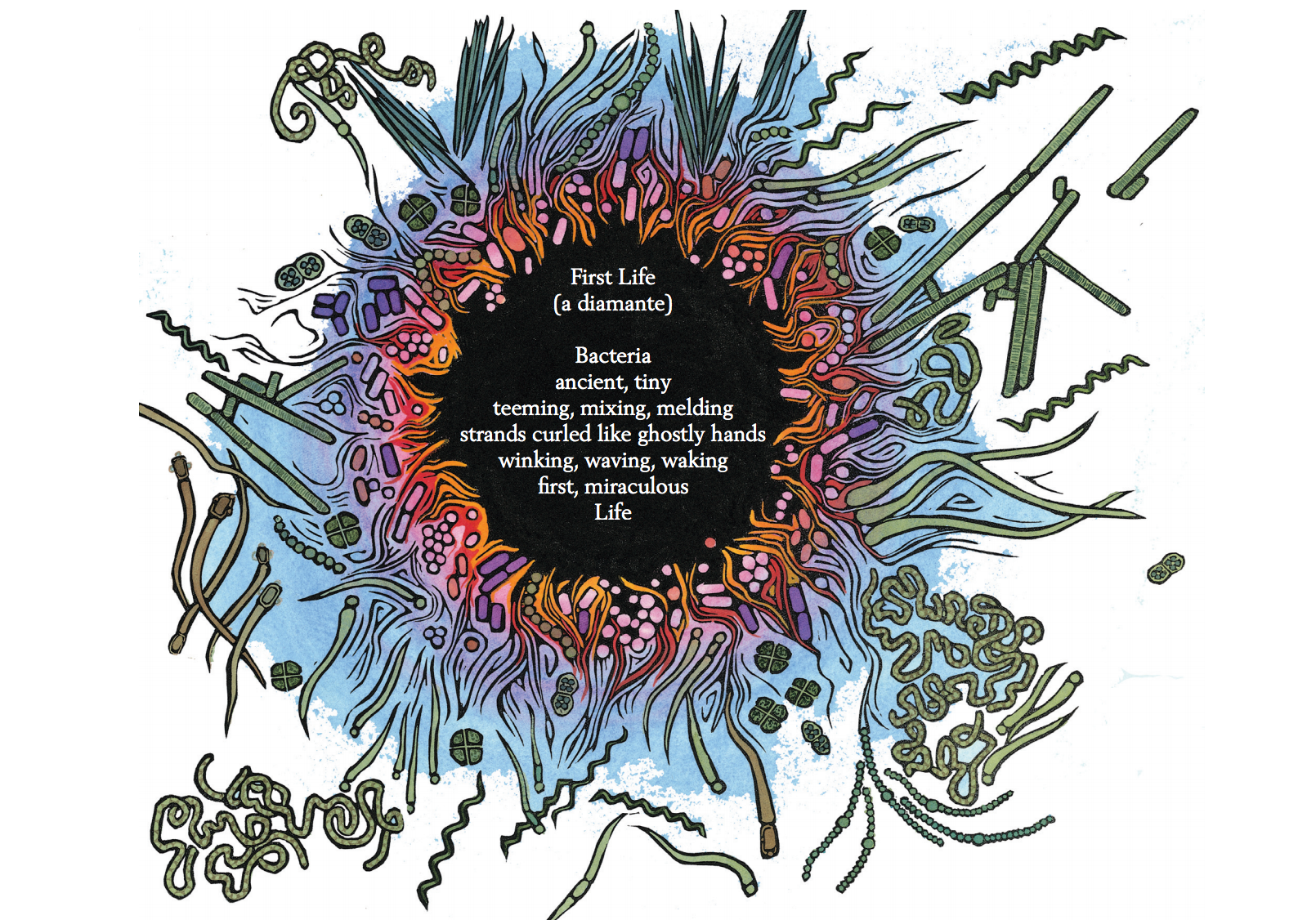
The book’s opening poem, “First Life” has become one of my favorites.
This screen shot comes the excellent Teacher’s Guide Joyce wrote, which is available here.
Sidman finds beauty and wonder in all these species, from the lowliest bacteria to wolves, sharks, and humans. The poems in this collection truly are celebrations of these survivors. In her author’s note, Sidman tells readers that “…99% of all species that have ever existed are now extinct…the ones who made it, and are thriving, are indeed remarkable.
Please be sure to visit Katie at The Logonauts for the Poetry Friday Round Up.
Yesterday, Kate kicked off the 2015 season with an invitation to wonder. Kate writes that wondering is where authentic writing starts, that “Wonder is essential for writers, but sometimes, we don’t leave time for it in our daily task-finishing, dinner-making, laundry-sorting lives.” Unfortunately, this is often true in our classrooms, too.
I usually make time for wondering during my drive to work and when I’m walking my dog, so it didn’t take me long to come up with a list, which soon morphed into a poem:
What wonders does the world behold? a chirping robin greeting the dawn a mighty river carving stone a million stars shining in the sky above the ringing of a telephone the warmth of your hand in mine finding a friend in the pages of a book.
Not sure what I would do with this list, I went about my morning. Within an hour, I heard a story on NPR about the NASA’s New Horizons mission to Pluto. Of course I started wondering what discoveries will be made about this most-mysterious non-planet. The similarities between the word “planet” and “Pluto” popped out at me, and I started thinking about how to work this into a poem.
J. Patrick Lewis says that in poetry, like architecture, “form follows function.” My work-in-progress has me thinking a lot about poetic forms. Lately, I’ve been working on a diamante (Which J. Patrick Lewis doesn’t consider a true verse form; read why here.) because it seemed like the form might help me accomplish my purpose for writing. This form also seemed like it might work for a planet/Pluto poem. Here’s a draft:
Planet celestial, spherical orbiting, rotating, reflecting rock, solar system, outcast freezing, wandering, eluding distant, mysterious Pluto
While there are parts of this I like, I wasn’t thrilled with it. Still wondering, I did a little research. Tricia Stohr-Hunt’s blog, The Miss Rumphius Effect is a treasure-trove of poetic resources, so I checked her site for more information. Coincidentally, Tricia’s post yesterday was about cinquains, another short form with a strict pattern. So I decided to try the Pluto poem as a cinquain.
Frozen, rocky mystery wandering at the edge of our solar system; outcast: Pluto
I’m still pondering this one, but playing around with different forms was fun. It also helped me see a new possibility for a poem that’s been challenging to write. In addition, a few implications for teaching became clear as I was writing.
Asking a child, “What are you wondering about?” is such simple act, yet how often do teachers do it? What a gift it would be to ask our students this fundamental question each morning! What a list kids would generate! If we did this, then all the moaning about not knowing what to write about or groaning about making revisions might fall by the wayside. When you’re truly invested in what you’re doing, it doesn’t feel like work. And who knows where their questions will lead?
Thank you Kate, and everyone at Teachers Write! for the inspiration, and thank you to Stacey, Tara, Dana, Betsy, Anna, and Beth for this space for teachers and others to share their stories each Tuesday. Be sure to visit Two Writing Teachers to read more Slice of Life posts.
“If war is nothing more than lists of battles then human lives count less than saber rattles.” ~ J. Patrick Lewis ~
As we gear up to celebrate our nation’s birthday tomorrow, its seems appropriate, this year especially, to pause and remember the battle of Gettysburg, which ended 152 years ago today after Pickett’s disastrous charge.
It is impossible to recall this battle today without thinking of the profound words spoken by Abraham Lincoln four months later at the dedication of the Soldier’s National Cemetery:
“Four score and seven years ago, our fathers brought forth on this continent a new nation, conceived in liberty, and dedicated to the proposition that all men are created equal.”
Equal. How is it that after all this time, our nation is still grappling with this issue? I don’t like to get political in this space, but I do think Lincoln’s words are a reminder of how pernicious and divisive the public display of the Confederate flag truly is. The conclusion of Lincoln’s remarks further remind us that we still have far to go to reach this ideal:
“It is rather for us to be dedicated to the great task remaining before us—that from these honored dead we take increased devotion to that cause for which they gave the last full measure of devotion—that we here highly resolve that these dead shall not have died in vain—that this nation, under God, shall have a new birth of freedom—and that government of the people, by the people, for the people, shall not perish from the earth.”
Lincoln’s speech is a masterpiece, full of poetic and rhetorical devices that move us, but “the honored dead” of whom he speaks are nameless and faceless to 21st century readers. Jane Kenyon’s poem, “Gettysburg: July 1, 1863” does for this bloodiest battle of the war what poetry does best: it shines a light on one anonymous soldier’s death, and helps us see the humanity of the 7,863 soldiers who died over those three days.
The young man, hardly more than a boy, who fired the shot had looked at him with an air not of anger but of concentration, as if he were surveying a road, or feeding a length of wood into a saw: It had to be done just so.
The bullet passed through his upper chest, below the collar bone. The pain was not what he might have feared. Strangely exhilarated he staggered out of the pasture and into a grove of trees.
He pressed and pressed the wound, trying to stanch the blood, but he could only press what he could reach, and he could not reach his back, where the bullet had exited.
He lay on the earth smelling the leaves and mosses, musty and damp and cool after the blaze of open afternoon.
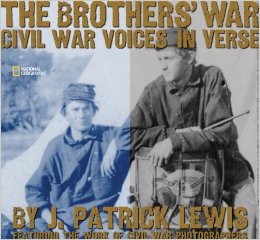
To bring this conflict to life for younger readers, turn to J. Patrick Lewis’s fine collection, The Brother’s War: Civil War Voices in Verse (National Geographic Society, 2007). Lewis’s poems give voice to soldiers, slaves, and abolitionists. Accompanied by period photographs, Lewis looks beyond the romantic notions of the nobility of warfare, and offers a compelling introduction to the stark realities faced by the rank and file during this brutal war.
Here are the final two stanzas of the last poem in the collection, “Passing in Review.”
Salute the boys You never knew For valor. It’s long overdue. Young men still passing in review
Do not require A great parade, A big brass band or cavalcade To sing the sacrifice they made.
Please be sure to visit Donna at Mainely Write for the Poetry Friday Roundup.
How to teach poetry? “This has always worked: find the material in your own life.” ~ Naomi Shihab Nye ~
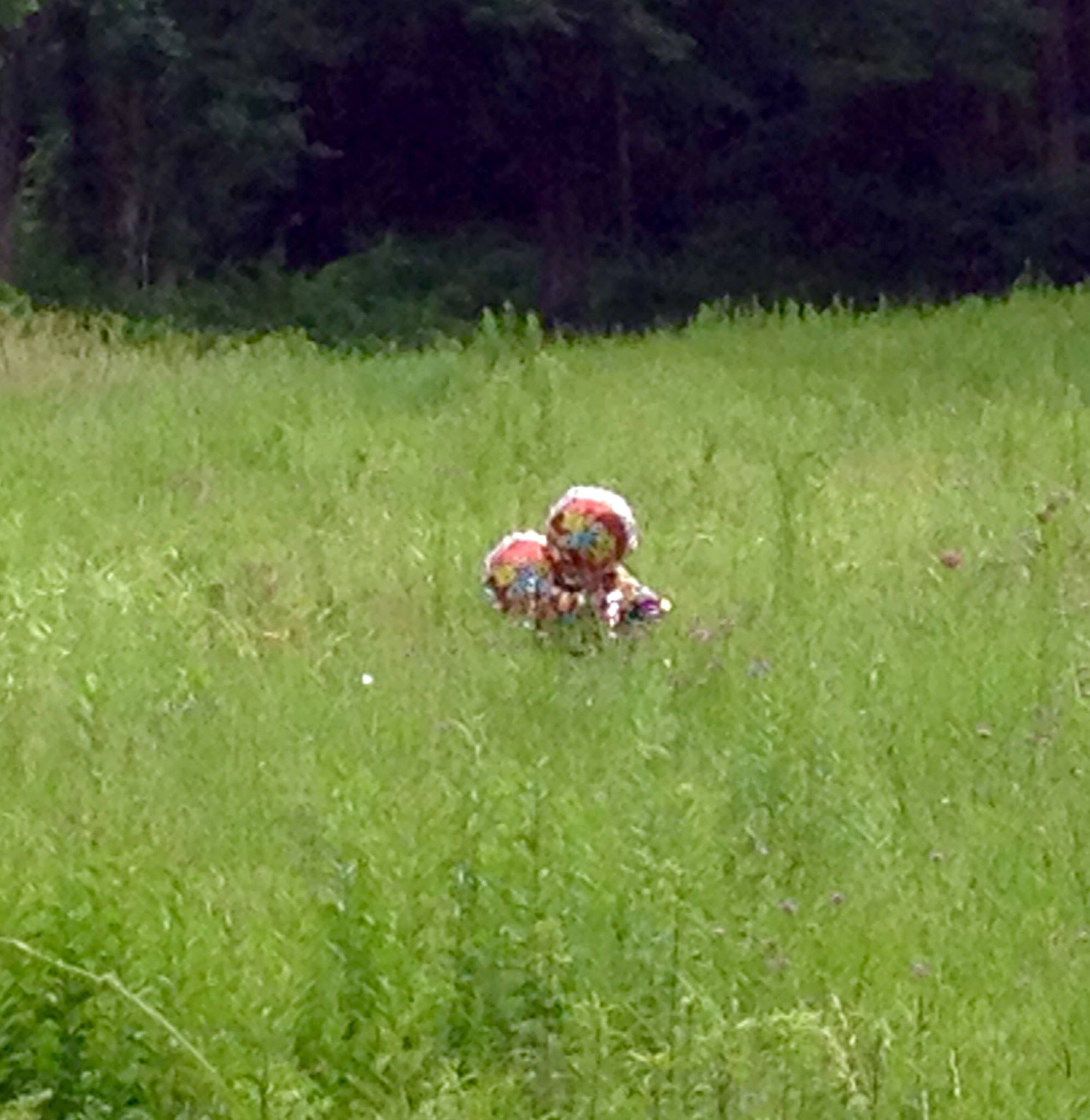
Penny Kittle tweeted this last night from the Boothbay Literacy Retreat, quoting a line from Naomi Shihab Nye, the evening’s “Distinguished Lecturer.” I had been thinking about this very idea earlier in the afternoon after I saw this on my way home:
Needless to say, I did a double take. So I drove home, parked the car, and the dog and I walked back to the field to capture the moment. The camera on my phone really doesn’t do justice to the scene, so I’ll try to paint a picture with words.
A balloon bouquet, astray on a summer breeze, touched down in a sun-drenched meadow to dance with butterflies.
I hope you all have a chance to enjoy a few sun-drenched afternoons this summer!
Thank you to Stacey, Tara, Dana, Betsy, Anna, and Beth for this space for teachers and others to share their stories each Tuesday. Be sure to visit Two Writing Teachers to read more Slice of Life posts.




!["Harrow Beauty Peaches at Lyman Orchards" By Sage Ross (Own work) [CC BY-SA 3.0 (http://creativecommons.org/licenses/by-sa/3.0) or GFDL (http://www.gnu.org/copyleft/fdl.html)], via Wikimedia Commons](https://readingtothecore.com/wp-content/uploads/2015/07/1280px-harrow_beauty_peaches_at_lyman_orchards_2009-08-30.jpg)
![Mary Cassatt [Public domain], via Wikimedia Commons](https://readingtothecore.com/wp-content/uploads/2015/07/cassatt_mary_sara_holding_a_cat_1908.jpg)