Slice of Life: Prospecting for Poetry

11454297503_e27946e4ff_h

I’m still in Virginia visiting my son, so writing time has been limited. But I did have time to go out for a walk this morning.

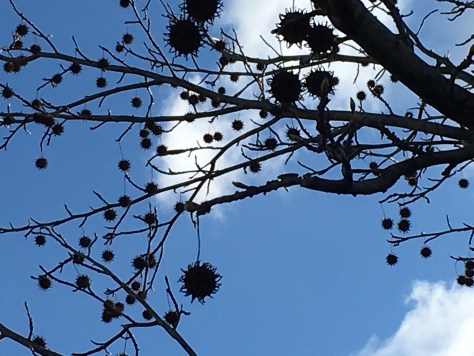
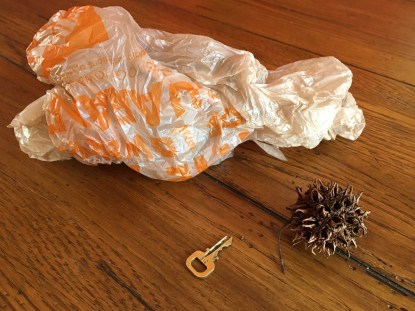
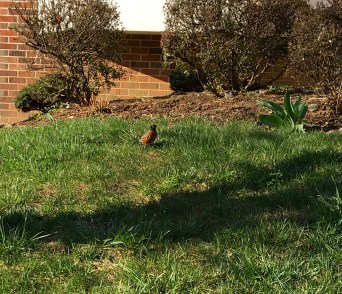
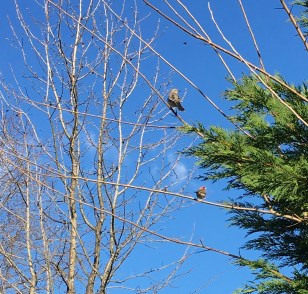
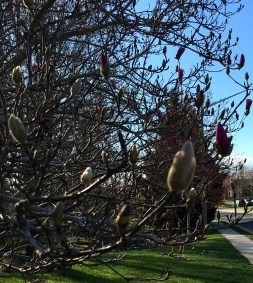
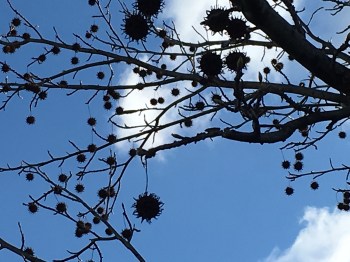
Taking walks is like going on a treasure hunt. I never know what I’ll find or what I’ll see that will spark an idea or a line of what might turn out to be a poem. I have my phone with me so I can take pictures so images will be fresh in my mind. My phone is new and I’m not completely used to it yet, so I ended up taking short videos as well as photos. This is a happy accident because now I have sounds to go along with my images.

Objects I found on my walk this morning.

It’s quite breezy here this morning, and any left over leaves from last fall were skittering across the road as I began my walk. Forsythia is in bloom, crab apple, pear, and weeping cherry trees are blossoming, grass is turning green, and magnolias are loaded with fat buds. Birds are busy doing what birds do: singing, soaring, feathering, flocking.

IMG_0018  IMG_0039

         IMG_0050 IMG_0057

When I get home to Connecticut, I’ll sift through these ideas and images, like a miner panning for gold. I’m pretty sure there’s a nugget of something bigger in here. 

This is a perfect activity for students of all ages. Every season is unique, but what better time than spring to go out and see nature in all its glory, when, in the words of Mary Oliver, “the world offers itself to [the] imagination” of poets young and old.

Thank you to StaceyTaraDanaBetsyAnnaBeth, Kathleen, and Deb for this space for teachers and others to share their stories each Tuesday throughout the year and every day during the month of March. Be sure to visit Two Writing Teachers to read more Slice of Life posts.

Slice of Life: “Breakfast of the Birds”

11454297503_e27946e4ff_h    poetry-friday-1-1

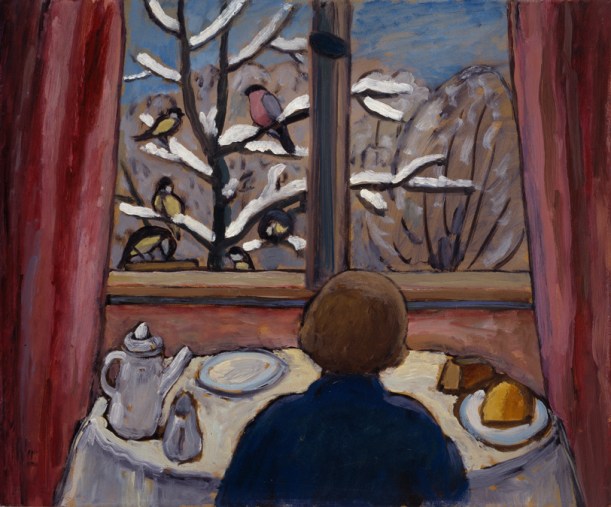
Earlier this week, Tricia Stohr-Hunt posted this painting, by Gabriele Münter, on her blog, The Miss Rumphius Effect:

Gabriele Münter, Breakfast of the Birds, 1934; © 2012 Artists Rights Society (ARS), New York / VG Bild-Kunst, Bonn - See more at: http://nmwa.org/works/breakfast-birds#sthash.eKbv2uZn.dpuf
Gabriele Münter, Breakfast of the Birds, 1934; © 2012 Artists Rights Society (ARS), New York / VG Bild-Kunst, Bonn – See more at: http://nmwa.org/works/breakfast-birds#sthash.eKbv2uZn.dpuf

Tricia invited her readers to write an ekphrastic poem to go along with this painting. I was intrigued by the contrast between the birds socializing outside and the woman sitting down by herself inside. Here is my response:

This morning our old
chestnut tree,
the one you planted
all those years ago,
is wrapped in a cloak
of fine white snow.

Goldfinches and robins,
like confetti scattered in
celebration of the coming spring,
brighten its branches
as they serenade me:
“cheer-up, cheer-up, cheer-up.”

How do they know
that some days are worse than others,
and that this morning,
I miss you more than ever?

© Catherine Flynn, 2016

Thank you to StaceyTaraDanaBetsyAnnaBeth, Kathleen, and Deb for this space for teachers and others to share their stories each Tuesday throughout the year and every day during the month of March. Be sure to visit Two Writing Teachers to read more Slice of Life posts. Also, be sure to visit Robyn Hood Black at Life on the Deckle Edge for the Poetry Friday Roundup.

Slice of Life: Time to Read

11454297503_e27946e4ff_h

“The greatest part of a writer’s time is spent in reading, in order to write;
a man will turn over half a library to make one book.”
~ Samuel Johnson ~

I thought of this quote when I read “Unbalanced Literacy: Reflections on the Common Core” by Thomas Newkirk in the March issue of Language Arts yesterday. If you have access to this journal, I highly recommend reading this piece. Newkirk includes this quote from Michel de Montaigne, which I love:

“Bees ransack flowers here and flowers there: but then they make their own honey, which is entirely theirs and no longer thyme or marjoram. Similarly the boy will transform his borrowings; he will confound their forms so that the end-product is entirely his.”

Newkirk included this quote to support his view of reading as a “transaction between reader and text,” but it applies to writing also.

Halfway through this month-long challenge, I feel desperate for time to just sit and read, for time to “ransack” a book, to borrow words and transform them into something entirely mine. My morning waiting for the furnace repairman yesterday made me crave this even more. When you have a taste of something delicious, you want more! (Furnace is working again, by the way.) The slices I’ve been reading are amazing and full of inspiration, but I miss having time to read a book. What to do? Write a quick slice about what I’m reading, then go read.

I usually have three or four books going at the same time. Here’s what’s on my nightstand today:

Silver People: Voices from the Panama Canal, by Margarita Engle (Houghton Mifflin Harcourt, 2014)

61P3a50eg6L._SX341_BO1,204,203,200_

Echo, Echo: Reverso Poems about Greek Myths, by Marilyn Singer (Dial Books for Young Readers, 2016)

9780803739925

The Poetry Home Repair Manual: Practical Advice for Beginning Poets, by Ted Kooser (University of Nebraska Press, 2007)

51U0fnAsTLL._SX309_BO1,204,203,200_

What book(s) is/are on your nightstand? Happy ransacking (reading), everyone!

Thank you to StaceyTaraDanaBetsyAnnaBeth, Kathleen, and Deb for this space for teachers and others to share their stories each Tuesday throughout the year and every day during the month of March. Be sure to visit Two Writing Teachers to read more Slice of Life posts.
Slice of Life: A Found Poem

11454297503_e27946e4ff_h

I was really stuck for an idea of what to write about today, so I visited the “Writing Prompts” page on the Poets & Writers website. There are prompts for creative nonfiction, fiction, and poetry. This poetry prompt appealed to me:

Begin at the End 
posted 2.23.16

“If you’re having trouble starting a poem, begin at the end. Take a single collection of poems and make a list of the last two words from each poem. Then write your own poem using only these words. Be vigilant at first utilizing just the vocabulary from the list. After a couple of drafts, stray from the limited words to help bring the poem to its full realization.”

Inspired by Amy Ludwig VanDerwater’s challenge to write a poem about small object, I’ve been rereading and studying Valerie Worth’s All the Small Poems and Fourteen More, so I turned to the first set of small poems for my list of words. Here they are:

among friends
she stops
like zinnias
to rest
and purr
worth something
and stay
is managed
set stone
brown grasshopper
of mice
loose skin
to us
slithering gold
poor clock
to keep
passing here
is cooked
of gold
find it
the beehive
for sleep
fences forever
whispers alone

Here is my first draft. The words and letters in bold were not on the original list.

She stops
among friends,
like zinnias
of gold,
fences set in stone,
and brown grasshoppers,
to sleep
and purr
and dream
of cooked mice…

To us, it is
worth something
not to be managed
by the clock;
to keep
passing here alone
and,
hearing whispers,
find it,
the beehive,
slithering gold,
and stay
for rest.

This was a fun exercise, despite the fact I have three unused words: poor, loose, and skin. Maybe I can work those into my next draft. The second stanza makes me happy because it reminds me of “The Lake Isle of Inisfree,” by William Butler Yeats, one of my all-time favorite poems.

I’d like to try this with students. It would be a great way to build vocabulary and would also help reinforce grammar skills like subject-verb agreement, tense, and more. Maybe I’ll save it for National Poetry Month.

 Thank you to StaceyTaraDanaBetsyAnnaBeth, Kathleen, and Deb for this space for teachers and others to share their stories each Tuesday throughout the year and every day during the month of March. Be sure to visit Two Writing Teachers to read more Slice of Life posts.
Slice of Life: A Poem for Pi Day

11454297503_e27946e4ff_h

This pie bird is another small object from my kitchen. (I wrote more about these objects here.) He’s been baked into more apple pies than I could ever count. He seemed like a worthy subject of a poem this Pi day.

FullSizeRender

The Pie Bird

No squawks or caws
from this blackbird,
nestled in a puddle
of fruit and spice.
But the swirls of steam
escaping the “o”
of his yellow mouth
send out the signal
loud and clear:

Pie is ready!
Deliciousness awaits!

© Catherine Flynn, 2016

 Thank you to StaceyTaraDanaBetsyAnnaBeth, Kathleen, and Deb for this space for teachers and others to share their stories each Tuesday throughout the year and every day during the month of March. Be sure to visit Two Writing Teachers to read more Slice of Life posts.
A Poetry Friday Slice of Life

11454297503_e27946e4ff_h         poetry-friday-1-1

There are collections of one sort or another in every room in my house. The tops of the kitchen cabinets are filled with antique and vintage crocks and kitchen wares. Baskets filled with seashells are everywhere. Bottles, books, McCoy pottery line bookcases and shelves. Is there a word for serial collectors?

Some of these items are quite small, and as I dusted a shelf in my kitchen yesterday, I started thinking about Amy Ludwig VanDerwater’s challenge to readers of Michelle Heidenrich Barnes’s blog, Today’s Little Ditty, to “write a poem about something small, an animal or object you see every day and do not usually give much thought.”

I’ve been working on a poem for this challenge for most of the week and had hoped to share it today but it’s not ready. However, the objects on this shelf made me wonder if I’d chosen the right subject for my poem. Then I realized that it didn’t matter. I could write more than one poem if I wanted to. I certainly have enough small objects to write about!

Here’s a draft inspired by a ceramic figurine that sits on a shelf in my kitchen.

“Pig”

A ceramic pig
sits in a shiny
green wash tub,
his ears and nose
the pale pink
of a winter sunrise.

Like Wilbur
as he licked
the buttermilk
trickling
into his mouth,
a blissful smile
spreads across his face.

© Catherine Flynn, 2016

IMG_3756

Thank you to StaceyTaraDanaBetsyAnnaBeth, Kathleen, and Deb for this space for teachers and others to share their stories each Tuesday throughout the year and every day during the month of March. Be sure to visit Two Writing Teachers to read more Slice of Life posts. And don’t forget to stop by Irene Latham’s lovely blog, Live Your Poem, for the Poetry Friday Roundup.
Slice of Life: Forgotten Treasures

11454297503_e27946e4ff_h

When my grandmother went to live in a nursing home, we were faced with the daunting task of emptying the house she’d lived in for over sixty years. Our work was rewarded, though, with countless forgotten treasures, including this:

FullSizeRender-1

The back of this box is stamped with the logo to the Kibbe Bros. Co., Springfield, Mass. and is inscribed to my grandmother, from Pat J. Lillis, Christmas, 1919. I wasn’t surprised to find an old candy box among my grandmother’s things. She saved everything. But I wasn’t prepared for the treasure that lay inside the box. Inside were hundreds of paper dolls and women modeling dress patterns cut from magazines. Because they’d been hidden away from both my mother and her sister and my cousins and me, they were in perfect condition. 

My grandmother wrote "Loretta Lane, age 14" on the back of this doll.
My grandmother wrote “Loretta Lane, age 14” on the back of this doll.

Everything was cut precisely, including characters from nursery rhymes and Alice in Wonderland. There was even small brown envelope filled with just hats. Most of the dolls, which included girls, women, and boys, were given names and ages and are all part of a large family.

All that remains of "The Three Bears"
All that remains of “The Three Bears.” Don’t you love the look on the bear’s face?

When we asked my grandmother about them, she said she and her younger sister had cut them out and played with them for hours. This is how I imagine them:

Dust motes dance in light
streaming through windows
so old the glass
ripples and flows.

Bathed in this golden sunshine,
a nook beneath the stairs
becomes a refuge from collecting eggs,
fetching cows from the far pasture.

Two heads lean together,
brown hair woven into tight braids,
bowed in concentration,
imaginations running wild.

Four hands snip and cut,
a family of paper dolls grows.
Names bestowed,
adventures dreamed,
lives created out of thin air.

© Catherine Flynn, 2016

 Thank you to StaceyTaraDanaBetsyAnnaBeth, Kathleen, and Deb for this space for teachers and others to share their stories each Tuesday throughout the year and every day during the month of March. Be sure to visit Two Writing Teachers to read more Slice of Life posts.
A Slice of Life for Poetry Friday: Quilting a Garden

                         11454297503_e27946e4ff_h   poetry-friday-1-1

I had good intentions when I decided to participate in Laura Shovan’s Found Object Poetry Project last month. Sadly, about halfway through the month, life intervened and writing a poem every day just wasn’t possible. I kept hoping to catch up though, so I downloaded Laura’s photos and jotted notes.

All of the photos were intriguing, but some spoke to me more than others. And although her sewing machine was much more utilitarian, this reminded me of my grandmother.

Photo by Matt Forrest Esenwine

My grandmother raised three children during the Depression, so most of her sewing was out of necessity. But she also made gorgeous quilts out of feed bag fabric for my mother and my aunt that are still treasured family possessions.

I thought this poem might be a villanelle, but oh my, what a mess that was! So I took the lines I liked the best, rearranged them a little, kept some of the rhyme, and came up with this draft.

“Quilting a Garden”

After she finishes chores and demands,
a young woman cuts precise patches,
arrays them in patterns,
harmonious and grand.

Coarse cotton brightens hard times gloom
A young woman sews with a patient hand,
quilts a garden into bloom.

Stitch after stitch, thread becomes plume,
weaving her story strand by strand,
quilting a garden into bloom.

© Catherine Flynn, 2016

Please be sure to visit Linda Baie at TeacherDance for the Poetry Friday Roundup.

Thank you to StaceyTaraDanaBetsyAnnaBeth, Kathleen, and Deb for this space for teachers and others to share their stories each Tuesday throughout the year and every day during the month of March. Be sure to visit Two Writing Teachers to read more Slice of Life posts.
Slice of Life: My Morning View

11454297503_e27946e4ff_h

On the way home yesterday I listened to Scott Kelly, the astronaut who just returned to Earth after a year on the ISS, being interviewed on NPR. When asked how he kept himself going day after day, Kelly replied that “focusing on the small milestones along the way…helped break up a very long duration flight.”

Artists of every type know this is just as true here on Earth. Routines can dull our senses to the beauty of the world around us. We have to be on the lookout for the extraordinary everywhere. As Mary Oliver says, “the world offers itself to your imagination.”

Here’s a snapshot of what the world offered to my imagination this morning:

This blustery winter day
an apple tree,
the lone remnant of an orchard,
it’s limbs leafless and craggy,
is adorned by birds.
Blue jays, raucous and loud,
dressed for a party with jaunty crests
and black collars,
their wings,
folded like intricately patterned fans,
create a mosaic of vibrant blues
against the morning sky.

© Catherine Flynn, 2016

 Thank you to StaceyTaraDanaBetsyAnnaBeth, Kathleen, and Deb for this space for teachers and others to share their stories each Tuesday throughout the year and every day during the month of March. Be sure to visit Two Writing Teachers to read more Slice of Life posts.

Poetry Friday: Penelope’s Ditty

poetry-friday-1-1

Each month, Michelle Heidenrich Barnes of Today’s Little Ditty shines the spotlight on a noted children’s poet. February’s featured poet, David L. Harrison, left readers with a challenge to compose a poem inspired by the word “ditty.” David explained that “I’m always entertained by how many poems come spinning out of the same word, and they arrive in all sorts of packaging.”

My brain started spinning and something made me remember this stuffed parrot, a baby gift from a friend for my oldest son:

618128b2-02c9-45ce-828d-4e89e44af964

I named her Penelope and hung her over Brian’s changing table. I made up stories about her and used to sing “Penelope the parrot is such a pretty girl…” to him as I dressed and changed him. He used to laugh and eventually sang along with me. After almost thirty years in the attic, she’s a little worse for the wear. She used to have black button eyes, and her colors aren’t quite as vibrant as they once were, but here she is, ready for her updated ditty.

“Penelope’s Ditty”

A parrot named Penelope
grew restless, bored, and fluttery.

She longed to soar over the ocean blue,
not sit in a cage like a stuffed statue.

Spreading her silky feathers wide,
she caught the breeze and began to glide.

Above an island, volcanic and steamy,
she met her mate, oh so dreamy!

Now nestled on her balcony
in the lush rainforest canopy,

she primps, she preens and looks so pretty,
visits with friends, is charming and witty.

Happy to be footloose and free,
Always singing her sweet little ditty!

© Catherine Flynn, 2016

Please be sure to visit Elizabeth Steinglass for the Poetry Friday Roundup.