My week has been filled with birds. (If you’re a frequent reader, you might be asking yourself, “What else is new?”) At the beginning of the week, I made may way to a new Audubon Center near my home for an early morning bird walk. Then I finished Mozart’s Starling (which I wrote about here). I really loved this book. Haupt ends by deftly weaving the threads of her starling Carmen, Mozart, and artists of every stripe into a reflection on the nature of creativity. “And what is this wild summons?” Haupt asks. “To listen with changed ears and sing back what we hear.”
Inspired by these words, here is a tanka filled with the sounds from my week.
As the last stars fade, robins and cardinals sense dawn’s approaching warmth. Trills and cheeps float from treetops chasing away night’s shadows.
How often do we go down rabbit holes in search of one thing, only to come out on the other side with something else altogether? Maybe not as often as we should.
This week I’m reading Lyanda Lynn Haupt’s captivating book, Mozart’s Starling. (Little, Brown, 2017). At one point, she quotes French poet Paul Éluard: “There is another world, but it is in this one.” This idea launches Haupt into a rumination on wonder. Did you know the root of “wonder” is an Old English word, wundrian that means “to be affected by one’s own astonishment”? Isn’t that lovely? Haupt ends this brief passage with this: “For us, the song of the world so often rises in places we had not thought to look.” These are the words of a poet.
Curious about her, I discovered that Haupt “is a naturalist, eco-philosopher, and speaker whose writing is at the forefront of the movement to connect people with nature in their everyday lives.”
But no poetry.
Back to Paul Éluard. The Poetry Foundation has two of Éluard’s poems, but neither of them really appealed to me. What did catch me eye was the poem of the day by Linda Pastan. Pastan is a favorite, so I clicked on the link to find this:
Even before I finished reading, I could feel my own poem taking shape. The ideas in this poem had been floating around my brain for the last month or so, but hadn’t settled on a form.
Thank you for following me down the rabbit hole! Please be sure to visit my friend and critique group partner, Linda Mitchell, at A Word Edgewise for the Poetry Friday Roundup.
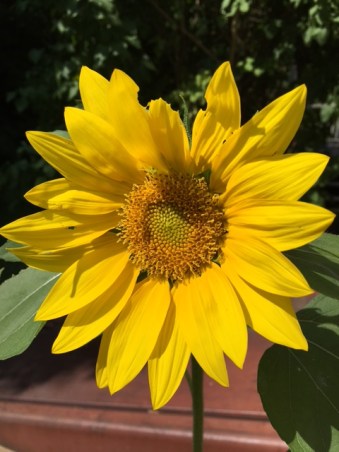
We haven’t filled our bird feeders for months because we don’t want bears wandering through our yard, but that doesn’t mean they aren’t still bringing us beauty and inspiration. I found this lovely visitor tucked into a corner that doesn’t get mowed. What better form than a Fibonacci for a poem about a sunflower?
A
dropped
seed, long
forgotten,
grows summer surprise:
one blossoming, buttery sun.
Happy National Macaroni and Cheese Day! Last week, Tabatha Yeatts, today’s PF Roundup hostess, suggested we celebrate this delectable dish in verse. Coincidentally, I had just read Rita Dove’s prompt, “Your Mother’s Kitchen” in The Practice of Poetry. Dove directs writers to include “the oven… and also something green.” My draft deviates from the instructions slightly by not including “something dead,” and not having a female relation “walk into the kitchen during the course of the poem.” My sister doesn’t like to cook and wouldn’t have been anywhere near the kitchen while my mother was cooking!
Healing Hands
My mother’s hands were healing hands. After standing all day helping doctors stitch broken bodies back together, she came home to tend and mend us.
When she was seven, my sister suffered from chronic strep. Soft and smooth on her raw throat, my mother’s macaroni and cheese was all she’d eat.
In the kitchen, my mother gathered milk, butter, and cheese. Velveeta was the cheese of choice. She took the foil-wrapped brick from its bright yellow box, diced it into chunks.
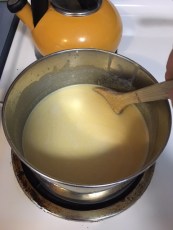
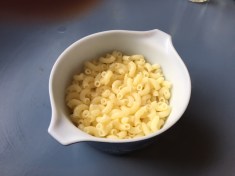
Standing in front of the avocado green stove, she whisked the mornay sauce, stirred until the liquid was smooth and golden, then poured it over steaming macaroni waiting in a pyrex dish. Into the oven it went, where it transformed into a creamy, bubbling concoction.
To this day, whenever I see a box of Velveeta, I can taste the macaroni and cheese my mother used to make with her healing hands.
According to Marcel Gleiser, Carlo Rovelli’s Reality is Not What It Seems: The Journey to Quantum Gravitiy “is a gem. It’s a pleasure to read, full of wonderful analogies and imagery and, last but not least, a celebration of the human spirit, in ‘permanent doubt, the deep source of science.’” What it is not, however, is a beach read. (Krista Tippett’s interview with Rovelli here is worth listening to.) That didn’t stop me from picking it up at the library a few weeks ago. While some of the science confused me, the poetry of Rovelli’s prose was immediately apparent. I decided right away that this book was perfect for the “Collaborative Cut-Up” exercise, shared by Anne Waldman in The Practice of Poetry, that my critique group partner, Margaret Simon, shared on her blog last week.
Rovelli’s text definitely “utilize[s] a vocabulary not [my] own.” Less apparent was what lines of my own I would “intercut” them with. Then, as I sat on my porch one afternoon, the answer was obvious. My yard and the woods and fields around it are a riot of green at this time of year, and I asked the question out loud. Lucy, my trusty beagle, looked up at me, but had no reply.
How Many Greens Can One Day Hold?
How many greens can one day hold? I’m not sure.
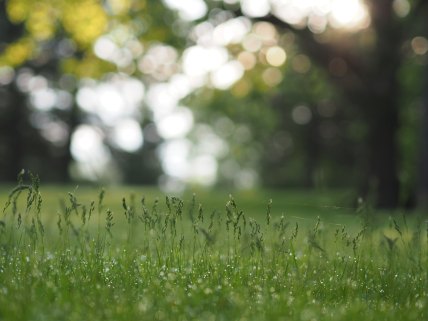
As many greens as blades of grass, lit by sun- light falling on a surface like a gentle hail shower? Or ferns, reaching toward the sky, forming small diaphanous clouds of vibrant, growing green.
Nothing stays still. Glossy green treetops tremble like the surface of the sea.
Step into the unknown, where coolness hides. The truth is in the depths of shadowy green pines.
Fireflies’ neon green signals speak with the voice of nature, blink on and off, whisper goodnight, accept living immersed in mystery.
If quantum gravity isn’t a topic you’re anxious to learn more about, this book isn’t a good choice. But in the last chapter, “Mystery,” Rovelli asks some serious questions about the nature of knowledge and what we can know with certainty. He states “to seek to look further, to go further, seems to me to be one of the splendid things that gives sense to life.” Splendid, indeed.
Photo by Aaron Burden via Unsplash.com
Please be sure to visit Carol Varsalona at Beyond Literacy Link for the Poetry Friday Roundup.
I was incredibly fortunate to spend four days this week at the Yale Center for British Art‘s Summer Teacher Institute. The goal of this Institute was to provide teachers with strategies for incorporating visual literacy into their classrooms. This is something I have been working on for many years, but my experience at Yale opened my eyes to new ways of supporting literacy with visual arts. In my final reflection, I stated that although school has just ended, I can’t wait for school to begin again so I can share all I learned with my colleagues and students.
The entire, vast collection at YCBA resonates with poetry. We spent hours with individual paintings, delving into the stories they tell. I’m still a little overwhelmed with all I saw and learned, and am grateful to have a few uninterrupted weeks to process the information and strategies the amazing instructors shared with us. This poem, by Thomas Hardy, begins to capture my experience.
“In a Museum”
by Thomas Hardy
I
Here’s the mould of a musical bird long passed
from light,
Which over the earth before man came was winging;
There’s a contralto voice I heard last night,
That lodges in me still with its sweet singing.
II
Such a dream is Time that the coo of this ancient bird
Has perished not, but is blent, or will be blending
Mid visionless wilds of space with the voice that
I heard,
In the full-fuged song of the universe unending.
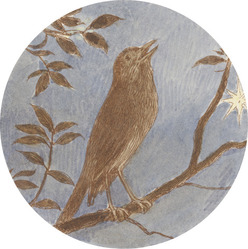
“Tail piece to The Nightingale” by Alfred W. Cooper, via Yale Center for British Art, Paul Mellon Collection
Please be sure to visit Diane Mayr at Random Noodling for the Poetry Friday Roundup.
Summer is a time to kick back and relax, but for teachers it is also time to work on projects we don’t have time for during the school year. This summer, I’m excited that my critique group and I are reading The Practice of Poetry and completing the writing exercises as a way to build our poetry muscles. Our first “assignment” was “Experience Falls Through Language Like Water Through a Sieve” by Susan Mitchell. (You can read Margaret’s thoughts about this exercise here.)
The gist of this exercise is to “use similes and/or metaphors to convey a feeling, an idea, a mood, or an experience you have never been able to communicate to anyone because each time you tried it seemed that you were being untrue to the experience.” My response, as usually happens when we write, took me to an unexpected place. I haven’t ever shared this memory from high school and still feel guilty that I stood by while a guy I was trying to impress was so mean to a stranger. In her directions, Smith writes that “we often write ahead of our own understanding.” Sadly, we often live our lives ahead of them, too. And, as with writing, our “conscious thinking [has] to catch up.” Writing and reflecting hastens this process, but some lessons take longer than others. Thankfully, this was a lesson I only had to endure once. Figuring out that “simile and metaphor are functional, rather than decorative” and using them effectively may take me a little longer.
The Laws of Motion
The first time I saw you, your face reminded me of the scarred, pock-marked surface of Io, Jupiter’s volcanic moon.
How brave you were to walk into that unknown space, carrying a plastic tray filled with tater tots, as if that would shield you from the shining stars of our little galaxy.
A comet sailed among us that year, pulled me into his orbit, blinded me to right and wrong, caused me to wobble on my axis until I was so off-kilter that I didn’t say a word when he turned to you, pelted you with cruelty and insults.
To this day, I’m ashamed I wasn’t strong enough to pull free of his hold on me. Ashamed that I didn’t have your strength, that I looked away, as you strode by with your head held high.
This post is part of “DigiLit Sunday,” hosted by Margaret Simon at Reflections on the Teche. This week’s topic is Problem Solving. Please be sure to visit her there to read more Digilit Sunday contributions.
“Every problem is a gift—without problems we would not grow” Anthony Robbins
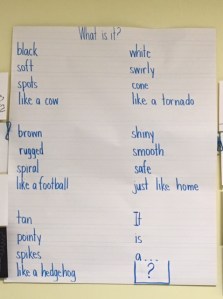
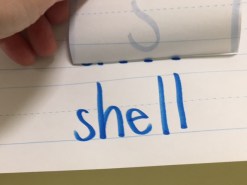
One afternoon a few weeks ago, one of our Kindergarten teachers stopped me in the hall as she was taking her students to the buses. She explained that her class was writing a poem about seashells. “But we’re stuck on the ending, and since you’re a poet, we we’re hoping you could help us.” Then one of the students chimed in, “Yeah, you’re a perfect poem maker.”
Blushing, I thanked them for their confidence and told them I’d love to help them with their poem. Then I immediately panicked and thought, “What if I have no idea how to help them?”
When I arrived in their classroom the next day, they were eager to read their poem to me. I was impressed with the description and similes they had already come up with. But there wasn’t much emotion in the poem. I explained that adding feelings is one way poets improve their work. To help them come up with their own ideas and words, we discussed what shells are for. We talked about how different the inside of a shell is from the outside. Through this conversation, they came up with a final stanza that followed the pattern of the previous stanzas, but changed it just enough. They were very happy with the result.
This exchange with these Kindergarten poets certainly would have played out differently if I didn’t write regularly. Having my own writing practice let me know exactly how these writers felt, knowing their poem was missing something but not knowing what that something was. Because I have worked through problems with my own writing, I was able to help them work through their problem.
By tackling my own knowledge gaps, whether about reading or writing, I’ve acquired (and continue to acquire!) the the tools I need to help students when their stuck. Learning from MY mentors*, whether through their brilliant books or at conferences and workshops, has equipped me with ideas and understandings I can use as a starting place when approaching a problem.
Reading, writing, listening, and learning has not only made me a better problem-solver and teacher. They have made me a better person.
*Thank you to ALL my mentors. You are too numerous to name and I’m afraid I’ll forget someone.
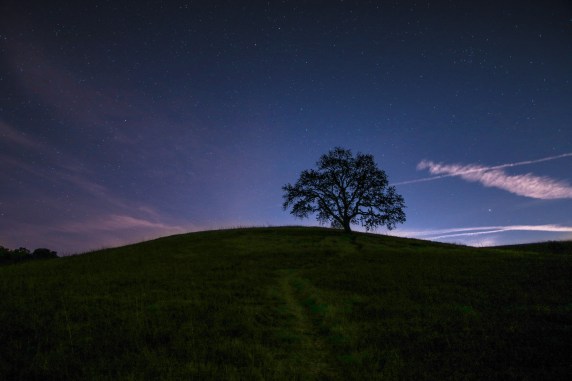
I’ve been neglecting this blog lately, but as school winds down and I can (fingers crossed) devote more time to writing, I decided to dust things off a bit and offer you this most perfect poem by Lisa Jarnot.
“This Most Perfect Hill”
by Lisa Jarnot
On this most perfect hill
with these most perfect dogs
are these most perfect people
and this most perfect fog
In this most perfect fog
that is the middle of the sea
inside the perfect middle of
the things inside that swing
In this most perfect rhyme
that takes up what it sees,
with perfect shelter from the
rain as perfect as can be,
In this most perfect day
at the apex of the sun
runs this most perfect
frog song that is roiling
from the mud


 Reading to the Core