SOL: Finding Ourselves in Others

11454297503_e27946e4ff_h

I think the first Patricia Polacco book I ever read was Pink and Say (1994), but I can’t be certain. I do know that Chicken Sunday was in the literature anthology my school adopted in 1996.  At once I knew Patricia Polacco was a master storyteller whose books conveyed important themes through stories of intergenerational and multicultural friendship and caring. These themes evoked compassion and allowed readers to see “the other” in themselves.
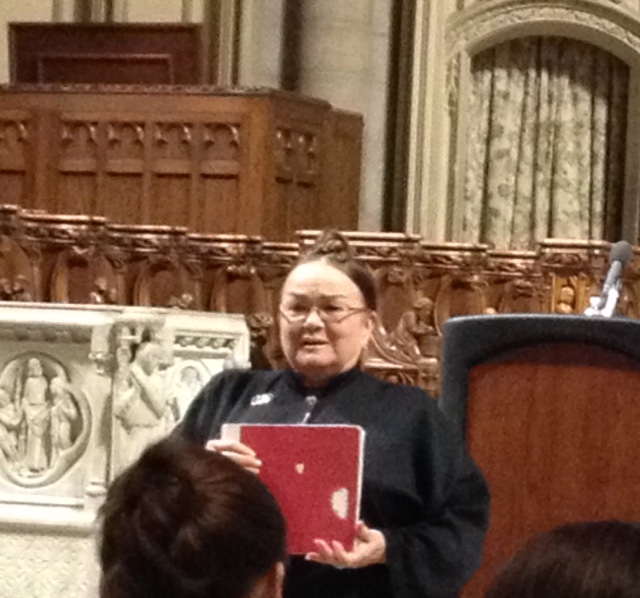
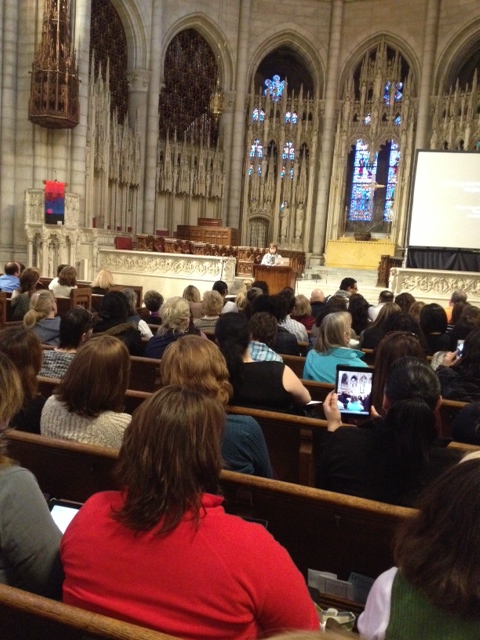
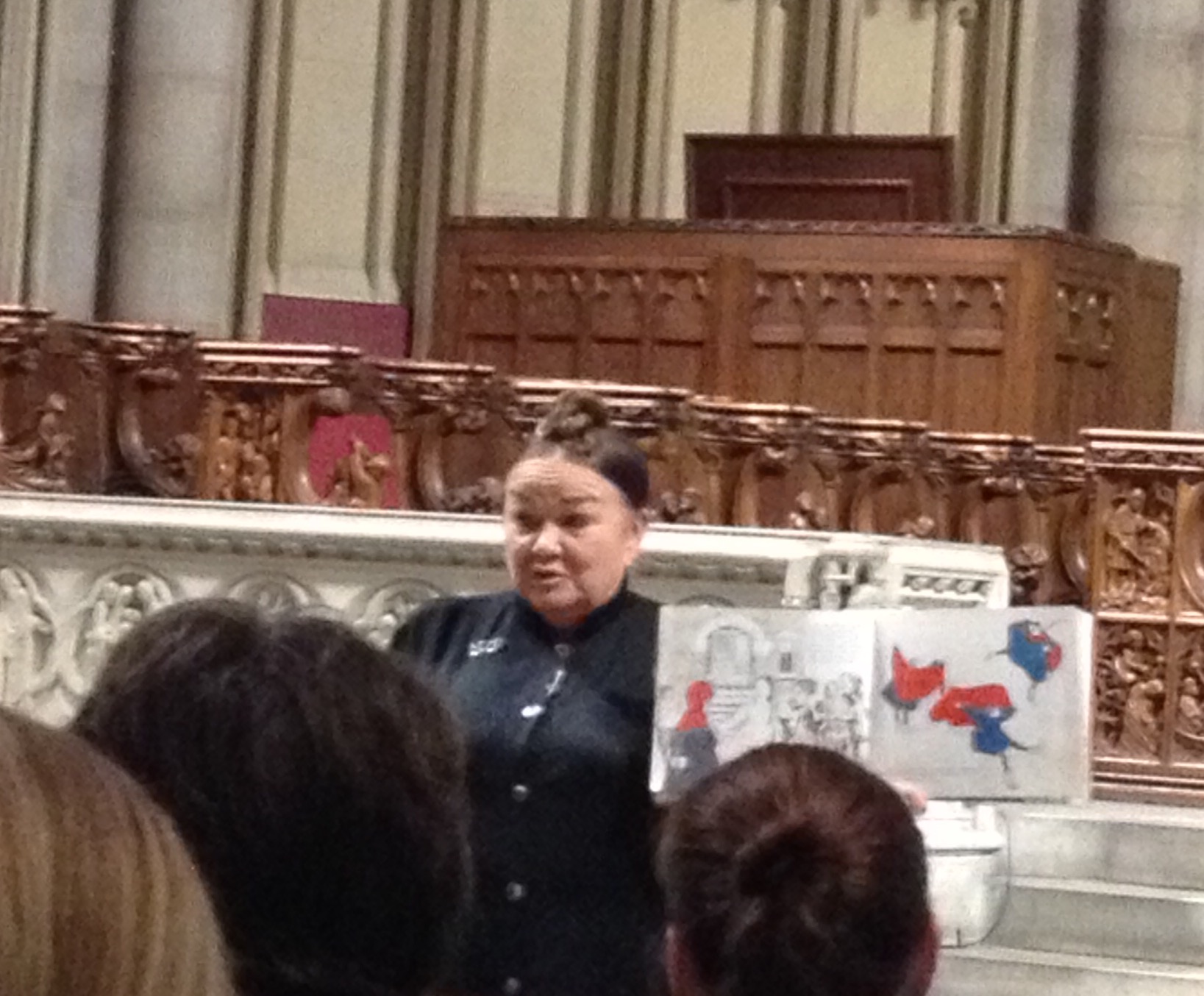
FullSizeRenderAt the 88th Teachers College Reading and Writing Project Saturday Reunion, held yesterday, teachers from across the country braved swirling snow and freezing temperatures to hear Patricia Polacco deliver the opening keynote. She told us that “the greatest heroes in our counry are classroom teachers.” She shared the story of her hero, George Felker, the real Mr. Falker. Mr. Felker was the first teacher to recognize Patricia’s dyslexia and was instrumental in getting her the help she needed to learn to read. Polacco described him as a man who was “beautiful in his heart.”
FullSizeRender-1

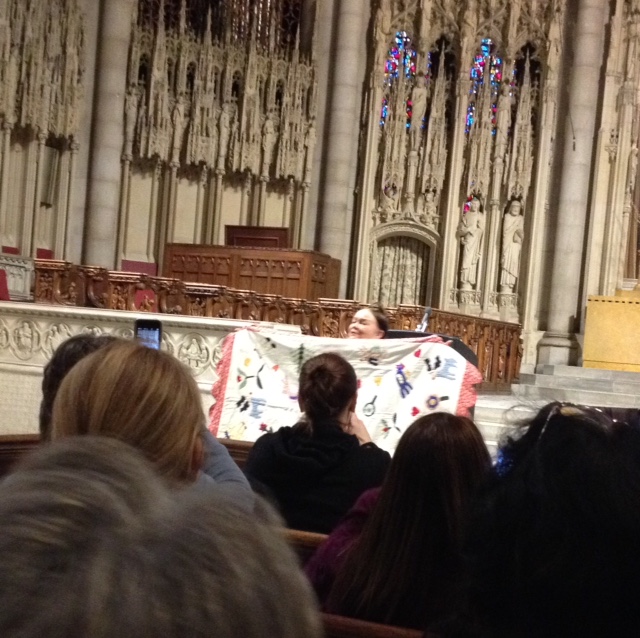
Polacco also shared the story of The Keeping Quilt. I know I wasn’t the only member of the audience moved to tears as Patricia told of her great-grandmother, Anna, who left the Ukraine as a small child. The dress and headscarf, or babushka, she wore eventually became part of the keeping quilt. Anna’s mother sewed the quilt so that when Anna felt homesick she could “just touch the quilt, and you’ll keep home” in your heart.
FullSizeRender-2

Hearts were the thread running through Polacco’s speech. She thanked the thousands of teachers filling Riverside Church for devoting “our lives to educating the minds and hearts of others.” In closing, Polacco told us that she was proud to “walk this earth” with us, and that she holds our hearts in her good keeping. 

Kylene Beers’s closing keynote, “What Matters Most,” was the perfect bookend to Polacco’s opening address. Kylene began by talking about how literacy is about power and privilege. She went on to say that “power is the ability to reach someone with your message” and that “power is about being connected.” What connects us better than stories? Stories like The Keeping Quilt and Dear Mr. Falker.

Beers also told us that “we must have more compassion” and that we “get to compassion best and easiest through the teaching of literature.” Brain research supports this, as well as the role of literature in creating empathy, something that is sorely lacking in our society today. “The humanities should humanize us,” Beers said, and the best way to achieve this is to read. Children should read widely and read books of their choosing, because “want-ability will always be more important that readability.” Children should read widely because through literature “we learn how to navigate our lives by navigating the lives of others.”
FullSizeRender-3

With characters as diverse as a slave and soldier of the Civil War, Russian immigrants, Holocaust survivors, and everyday African-American kids, Patricia Polacco has given us literature that enables us to, as Kylene Beers put it, “become what we are not.” Great teachers will share these books with their students because they will help children become curious, creative, and compassionate. They will share them because “great teachers are our best hope for a better tomorrow.”

Thank you to Lucy Calkins and everyone at the Teachers College Reading and Writing Project for making the Saturday Reunion possible, and thank you to Patricia Polacco and Kylene Beers for your confidence, faith, and above all, your words of inspiration.

Thank you also to StaceyTaraDanaBetsyAnna, and Beth for this space for teachers and others to share their stories each day during the month of March and on Tuesdays throughout the year. Be sure to visit Two Writing Teachers to read more Slice of Life posts.
Slice of Life: Opening Doors

11454297503_e27946e4ff_h

I spent the day yesterday at the Rhode Island Convention Center where The Teaching Studio at The Learning Community, a public charter school in Central Falls, Rhode Island, held their 2nd Annual Educators’ Institute. Hundreds of teachers spent the day with noted educators Vicki Vinton, Cornelius Minor, and Sharon Taberski, learning new ways to improve their practice.

Opening doors to new possibilities was a thread that wove its way through all of the wisdom shared by Vicki, Cornelius, and Sharon. I’m excited to return to school tomorrow and talk with my colleagues about some of these ideas. Today, I want to share a peek inside those doors that were opened for me.

Vicki Vinton shared her latest work, which centers around three strands of meaning making: comprehension, understanding, and evaluation. Vicki talked about how we can help kids “make their thinking visible through a handful of simple charts,” and she urged us to share books that are accessible and “get kids involved doing the thinking right from the get go.” For those of you who don’t know Vicki, she is co-author with Dorothy Barnhouse of What Readers Really Do: Teaching the Process of Meaning Making and shares her brilliance regularly on her blog, To Make a Prairie.

During lunch, Cornelius Minor, a staff developer at Teachers College Reading and Writing Project, talked about empowering kids to be the superhero of their own lives. He urged us to get rid of the idea of “my kids can’t…” because “we are the people who say the awesome things that help kids be awesome.” We have to respect kids and find ways to give them “a chance to live in text that is compelling and sustaining.” He cautioned us to be patient with this process, that learning is messy, and that kids will not get it right the first time. But through a cycle of doing, feedback, and encouragement, they will accomplish great things.

In the day’s final keynote, Sharon Taberski, author of On Solid Ground and Comprehension from the Ground Up, shared “Five Ways to Grow Critical, Engaged Thinkers.” Sharon urged us to “embrace the workshop model and its abundant opportunities for both balance and differentiation.”  She reminded us that brain research shows that both explicit instruction and time to practice are critical if students are to master the skills they need to be independent readers, writers, and thinkers. Sharon also emphasized the need to “let the students do the heavy lifting” and to teach kids to be “purposeful and strategic.” Finally, she talked about aligning our “belief systems about teaching and learning” with our goals for student learning and to design our classrooms in ways that are physical manifestations of what we value.

Each of these keynotes and the breakout sessions presented by Vicki, Cornelius, and Sharon deserve their own post. But each opened a door in my mind, and I’ll be thinking and writing more about these ideas in the weeks to come.

Thank you to StaceyTaraDanaBetsyAnna, and Beth for this space for teachers and others to share their stories each day during the month of March and on Tuesdays throughout the year. Be sure to visit Two Writing Teachers to read more Slice of Life posts.
Slice of Life: Close “Reading” in Kindergarten

11454297503_e27946e4ff_h

Be curious always! For knowledge will not acquire you; you must acquire it.

~ Sudie Back ~

It’s hard to believe NCTE was almost a month ago! Amidst the chaos of the holidays, I’ve been reading books snagged in the Exhibition Hall (thank you, publishers!), reviewing my notes, and sharing the wealth of knowledge I gained from the terrific sessions I attended.

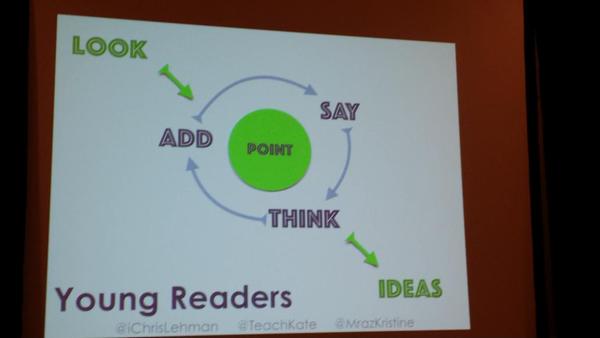
I was lucky to get into Chris Lehman, Kate Roberts, and Kristi Mraz’s standing-room-only session, CLOSE READING AND THE LITTLE ONES: HOW IT’S DIFFERENT (AND INCREDIBLY FUN AND EFFECTIVE) IN EARLY ELEMENTARY GRADES. With their characteristic blend of common sense and humor, these three inspiring educators shared routines K-3 teachers can use to capitalize on the natural curiosity of kids.

Chris, Kate, and Kristi pointed out that close reading in these early grades is akin to close study, or observation, “something that little ones are doing already.” Giving students opportunities to engage in close observation accomplishes many goals that support young learners, including opportunities to talk to others about their ideas. It also encourages students to “open up” their thinking through “meaningful, enjoyable experiences”

Close reading is only one part of “a balanced diet of reading instruction” that should

  • serve a specific purpose
  • focus on details in high success texts
  • allow kids to discover new meaning through carefully looking at details

Adapting the paradigm for middle and high school readers Chris and Kate laid out in their book Falling In Love With Close Reading (Heinemann, 2013) for young readers resulted in this structure, or instructional routine, which should be repeated so often that it becomes a habit, which leads to independence.

Photo courtesy of Fran McVeigh

Kristi, Kate, and Chris emphasized that this close reading isn’t about teaching kids how to read, nor should everything be read closely. Rather, this routine is about “teaching kids a way of looking at a text or an image or an object so they can develop ideas about it.

This makes so much sense! I was excited to get back to school to share this thinking with my wonderful Kindergarten colleagues. Using Kristi, Chris, and Kate’s ideas about “close looking,” we designed an object study that coordinated with the Kindergarten’s current unit on the animal kingdom AND laid the foundation for daily close observation. As Kristi so wisely pointed out, “If you want to do strong work in reading, you have have to do strong work in other places.”

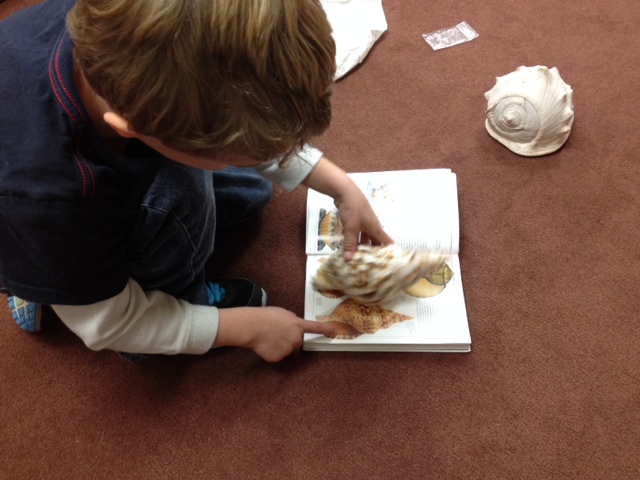
So we began by closely observing seashells. I modeled the cycle by looking closely at a shell, pointing to its surface and saying something about the color. Then I thought more about the color, and added more details about the variations of color on the shell. The kids couldn’t wait to get their hands on a shell to observe with their partners.

photo 1

Soon the room was filled with the hum of the children’s voices. They talked about the colors and the shapes and the textures. They noticed that some shells had bumps on the outside and others had spikes. They ran their hands along the smooth surface on the mouth of the shell and wondered why the texture was so different from the top of the shell. And they talked about the sounds they heard when they held the shells to their ears.

When we came back together so the kids could share their findings, it was clear they had developed some “big ideas” through their observations. Several children mentioned protection and camouflage when they talked about the colors of the shells or how hard they were. They all wanted to spend more time with the shells, comparing them and “getting to know [them] better.”

This is work we will return to daily. There are countless opportunities for close observation throughout the day, opportunities for kids to look at the world and say     “Wow!”

Thank you, Chris, Kate, and Kristi, for sharing your insights and pushing me as a teacher! Thank you to StaceyTaraDanaBetsyAnna, and Beth for this space for teachers and others to share their stories each Tuesday. Be sure to visit Two Writing Teachers to read more Slice of Life posts.

Slice of Life: The Gift of Words

11454297503_e27946e4ff_h

Last Saturday morning I sat in the nave of Riverside Church—a soaring space of beauty beyond words—as David Booth addressed the thousands of teachers gathered for TCRWP’s Fall Saturday Reunion. He reminded us that “everyone is making their own story” and that all stories deserve to be heard. It’s our job to help children reveal their story, and Booth encouraged us to “weave a blanket of words to cover our children.” He urged us to give them words we love, words we sing, words we puzzle over. He urged us to “give them as gifts.”

Each session I attended throughout the day gave me the gift of words. Audra Robb shared her wisdom about teaching students how to locate places in their writing for strong verbs and precise nouns, the kinds of words that can fill their writing with details that matter. She told us to read mentor texts closely with our students to help them become aware of the techniques authors use to create specific effects, effects they can try out in their writing. Practicing and experimenting with these techniques empowers them to find their own voice.

Brooke Geller presented a standing-room only crowd with a variety of strategies for building vocabulary. Use words, she told us, in writing, in conversations, and across our lives. Give our children opportunities to use words, think about meanings, and to read them in many different contexts. Soon the words will be part of them.

Finally, Carl Anderson urged us to ask kids questions, but then to be quiet and give them a chance to “get their thoughts together.” He reminded us to prompt them by asking them to “say more about that.” When we do this, “we nudge them to reach for more specific language.” He compared this process to Russian nesting dolls—“Each time you ask, more thinking comes out.” Most importantly, by taking the time to ask kids these questions, we’re giving kids “the gift of thinking about their thinking.”

We create our world with words. Lucille Clifton once said “We cannot create what we cannot imagine.” We can’t imagine what we can’t name. For this reason, children need as many words as we can possibly give them. We need to fill them up, so they’ll have the words they need to imagine the best possible world for us all.

Thank you to Lucy Calkins and everyone at the Teacher’s College Reading and Writing Project for the gift of the Saturday Reunions and all you’ve done for teachers and students around the world.

Thank you, StaceyTaraDanaBetsyAnna, and Beth for the gift of this space for teachers and others to share their writing each Tuesday. Be sure to visit Two Writing Teachers to read more Slice of Life posts.
Slice of Life: This Post Is Not Perfect!

11454297503_e27946e4ff_h

I thought about starting a blog for at least two years before I finally took the plunge with Reading to the Core. Many questions plagued me before I started. What would I write about? Would anyone read my ramblings? But the loudest and most persistent question was this: What if it’s not perfect?

Perfection paralysis (not my phrase, but I can’t remember where I first read it), I’ve since discovered, is quite common among writers and bloggers. And it seems that teachers with blogs are the most seriously afflicted. Many teachers are perfectionists to begin with, and the thought of sharing a piece of writing that might not be perfect with the whole world is sometimes more than we can take.

Here’s the thing about perfection paralysis, though. Paralysis is not a good thing. We are meant to move and learn and grow. This lesson has played out in my life a number of times over the last year, most recently during my week at the TCRWP Reading Institute.

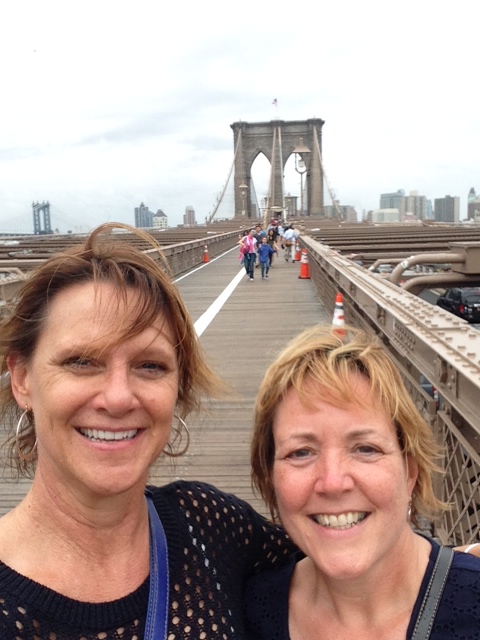
Last week I shared the story of my trek over the Brooklyn Bridge with Dayna Wells. When I got back to my hotel that night, it occurred to me that our adventure was an apt metaphor for the situation many teachers find themselves in these days. Neither of Dayna or I had ever been to the Brooklyn Bridge, and the windy, rainy weather was less than perfect. But we ventured out anyway.

We took a risk that paid off not because we were lucky, but because we set ourselves up for success. First of all, we were together, supporting each other along the way. We had several tools at our disposal, namely the apps on our phones. We did head off in the wrong direction at the start, but our instincts helped us realize our mistake and we quickly turned around. And finally, we had a positive attitude, and set off ready to succeed.

Today, teachers around the country are at the foot of the bridge into the future. We have many tools and resources at our disposal to help us on this journey. We have instincts and knowledge to help us know when we veer off the right path. It’s up to us to bring a positive attitude to this challenge; one that will help us when we get discouraged. It’s critical, though, that we support one another along the way. In her keynote that kicked off the Institute, Lucy Calkins urged us all “to lift up the level of the people” we work with. We have to help one another improve our teaching so our students can learn and grow at higher levels.

Starting my blog and becoming part of the amazing community of teacher-bloggers on Two Writing Teachers, Poetry Friday, Twitter, and more has lifted the level of my teaching in ways I could never have imagined two years ago. So as we begin a new school year, if you have perfection paralysis about joining Twitter, starting a blog, or even trying a new unit, let it go. You may have a false start, and there will be bumps along the way. But the view from the top of the bridge is spectacular!

Photo via everystockphoto.com

Thank you, as always, to StaceyTaraDanaBetsyAnna, and Beth for hosting Slice of Life each Tuesday. Be sure to visit Two Writing Teachers to read more Slice of Life posts.
Slice of Life: Over the Brooklyn Bridge

11454297503_e27946e4ff_h

One of the things I miss the most about having a class of my own is the chance to talk with the kids each morning about what they did the night before. I loved hearing about their soccer games, ballet lessons, or time spent with their family. This kind of talk is essential to creating relationships and developing friendships.

Unfortunately, in our busy lives, it’s sometimes hard to find time to maintain relationships and friendships we already have, let alone make new ones. But that’s exactly what happened last week when I was in New York for the TCRWP Reading Institute.

Fellow slicer and tweep Julieanne knew I was going to be at the Institute and told her friend, Dayna, to look me up. Miraculously, she found me as we were leaving Riverside Church after Lucy Calkins’ inspiring keynote. We agreed to meet at the end of the day and make plans for dinner.

We hit it off immediately, and decided to meet again after our sessions on Tuesday. That morning, my section leader, Annie Taranto, mentioned that one of her favorite things to do in the city was walking over the Brooklyn Bridge. This idea appealed to me immediately, and I hoped Dayna would want to come along.

She loved the idea. So even though it was windy and threatening to rain, we set off, armed with the apps on our phones and our sense of adventure.

We got off the subway at the City Hall station, and proceeded to walk a block in the wrong direction. We soon realized our mistake, turned around, and found the entrance to the pedestrian walkway leading from Manhattan to Brooklyn. Despite the weather, many people were out enjoying the views. The Empire State Building towered over the city to the north.  To the south, the Statue of Liberty came into view.

Then there was the bridge itself. The distinctive gothic arches of the towers and the web-like steel cables give the bridge a graceful beauty. We peered down onto the cars and trucks below and agreed we were glad not to be sitting in the tangle of traffic beneath us.

Without a doubt, though, the best part of the whole evening was spending time with Dayna and getting to know her. We talked about our families, our histories, and our jobs. We shared ideas from the sessions we’d been in that day and talked about books we love. It felt like we were long-lost friends.

On the bridge with Dayna, wind-blown but having a great time.

By the time we arrived back in Manhattan, it had started to rain and it was getting late. We found a pub not far from City Hall and continued to talk through dinner. It was much easier to find our way back to the subway, and soon we were headed back uptown to our hotels, tired and happy from our trek to Brooklyn and back. Happy to have found a new friend along the way.

Thank you, as always, to StaceyTaraDanaBetsyAnna, and Beth for hosting Slice of Life each Tuesday. Be sure to visit Two Writing Teachers to read more Slice of Life posts.
Poetry Friday: “I Am Poetry”

poetry-friday-1-1

I have spent the past week at the Teachers College Reading and Writing Project’s Summer Reading Institute. My brain is bursting with all I have learned from my amazing section leaders and the keynote speakers. My senses are overwhelmed by the sights and sounds of New York City in August. My life is richer because of people I have met and friends I have made. It has been a glorious week.

How could I possibly choose a poem to share today that reflects my week? By focusing on one small piece of my experience.

Each teacher was given a book at the beginning of the week to use as a mentor text for the work of the Institue. I received Becoming Naomi León (Scholastic Press, 2004) by Pam Muñoz Ryan. I have loved every book I’ve read by Ryan, but somehow, I had missed this beautiful story about a young girl finding her true self. Pam Muñoz Ryan’s writing is so lyrical, I wondered if she’d written any poetry. A quick search reminded me about The Dreamer, Ryan’s lovely book about the young Pablo Neruda and led me to this poem:

“I Am Poetry”

by Pam Muñoz Ryan

I am poetry,

waiting to seize the poet.

I ask the questions

for which all answers

exist.

I choose no one.

I choose every one.

Come closer…

…if you dare.

I am poetry,

lurking in dappled shadow.

I am the confusion

of root

and gnarled branch.

I am the symmetry

of insect,

leaf,

and a bird’s outstretched wings.

Read the rest of the poem here.

If you haven’t read Becoming Naomi León, The Dreamer, or any of Ryan’s other novels for children, read one today. You’ll be glad you did. 

Please be sure to visit Heidi at My Juicy Little Universe for the Poetry Friday Round Up.

It’s Monday! What Are You Reading?

IMWAYR

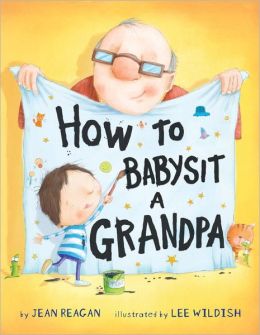
How to Babysit a Grandpa (Alfred Knopf, 2012), by Jean Reagan, with illustrations by Lee Wildish, is a charming story. The book opens with these words of wisdom from a little boy who is about to spend the day with his grandpa.

“Babysitting a grandpa is fun–if you know how.”

Our nameless hero goes on to explain all the highlights of a five-year old’s day: snacks, going outside, playing games, and more. He even suggests “bouncy music” to make clean up easier. Every other page or so provides additional tips for would-be grandpa-sitters, such as snack suggestions and ideas for lots of creative play. (I love that there is a T.V in one illustration, but it is never mentioned, let alone turned on.)

Adding to the appeal of Reagan’s text are Lee Wildish’s digital illustrations. His characters remind me of Melissa Sweet’s non-collage work–imbued with love and a sense of humor about the realities of life as a child. There are crumbs all over the table, and the boy’s tongue is set firmly in the corner of his mouth as he draws a picture for grandpa.

     9780375867132_p0_v1_s260x420   9780385753845_p0_v2_s260x420

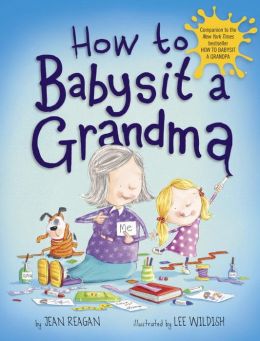
Reagan and Wildish have teamed up again for How to Babysit a Grandma (Alfred Knopf, 2014), and it is every bit as engaging as How to Babysit a Grandpa. The style and tone are the same (the boy and his grandpa even make a cameo appearance at the park), but our heroine has her own ideas for activities to “keep a grandma busy.”

Both of these books are perfect mentor texts for Kindergarteners and first graders learning to write how-to books. Children could also come up with their own versions of the lists Reagan has included, or add their ideas to hers. These books could just as easily be enjoyed as read-alouds, or shared in September in honor of Grandparents Day. The possibilities are endless. One thing is certain, though. If you have a 4-6 year old, know one, or teach them, these books should be on your list of How to Entertain a Child.

Don’t forget to visit Jen at Teach Mentor Texts and Kellee at Unleashing Readers to find out what other people have been reading lately. Thanks, Jen and Kellee, for hosting!

SOLC 2014: Most Likely to Improve

11454297503_e27946e4ff_h

Bowling alleys have a culture all their own. The sound of balls hurtling down the polished alleys, the crashing of the pins. The funny shoes, the smell of fries. For some people, bowling is serious business. Those in leagues have handicaps and custom-made balls. For many, though, bowling is a fun night out with friends, maybe once or twice a year, with nothing really at stake. I am this kind of bowler.

By David Castillo Dominici, freedigitalphotos.net

Friday afternoon was our annual staff “Bowling Tournament of Champions.” Teachers and other staff members sign up and teams are assembled at random. Each team comes up with a silly name and matching silly attire. I love these afternoons because it gives us a chance to chat with colleagues we don’t often see. We’re outside of school, and for the most part, school stays out of the conversations. Everyone cheers each other on, no matter which team they’re on, although sometimes a hidden competitive streak reveals itself. There are prizes for the team with the most spirit, the best costumes, and, of course, the champions. It’s all good fun.

Until it isn’t

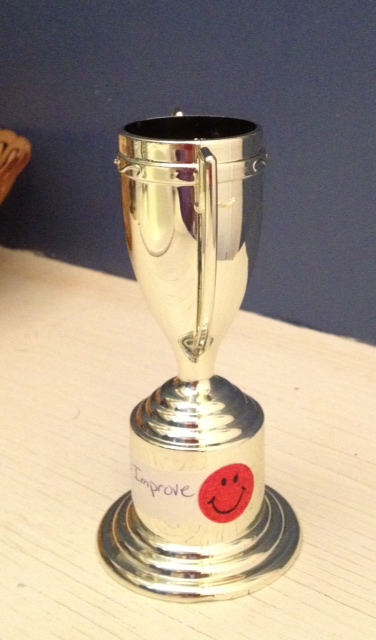
I know I’m not great a great bowler, but I usually can hold my own at these tournaments. But Friday wasn’t my day. I’d been up much too late the night before, and I didn’t sit down for lunch until after two o’clock. Add this to the fact that I bowl once a year and you get this: a trophy for  “Most Likely to Improve.” (Code for: lowest score) The smiley face sticker on the trophy didn’t help.

photo-1

Now I’m not really that upset about all this. I had a good time. But it made me think about the chances of doing well in any kind of activity that you do only once a year.

Maybe you can see where I’m going with this, but don’t misunderstand. I am not, in any way, saying that with more test preparation kids would do better on standardized tests. In fact, I think exactly the opposite is true.

Diane Ravitch pointed out, in her keynote address at the Teachers College Reading and Writing Project Saturday Reunion yesterday, that the tests our children are taking as part of the PARCC and SBAC pilots “have no diagnostic value” and serve only to give “numbers to students.” What does this have to do with ensuring that a child is “college and career ready,” the stated goal of the current education reform movement? How does that help a teacher know her students and understand how to help them learn and grow?

If the Department of Education and the reformers working so hard to destroy public education truly cared about children and were interested in ensuring that every child reached his or her full potential, they would do everything in their power to help teachers enrich instruction. They would do everything in their power to ensure that teachers have time to, in Stephanie Harvey’s words, “teach kids to think so they can acquire and use knowledge” and “solve problems on their own.” They would do everything in their power to lower the rate of childhood poverty, the highest in the developed world.

If the reformers in power took only these steps, then would be on our way to giving all our children the education they deserve. Then we really would be the “Most Likely to Improve.”

Thank you, as always, to StaceyTaraDanaBetsyAnna, and Beth for hosting the Slice of Life Challenge. Be sure to visit Two Writing Teachers to read more Slice of Life posts.
SOLC: My Day at the Teachers College Saturday Reunion, 2014 Edition

11454297503_e27946e4ff_h

This morning, I left my house at 6:30 and drove to Teachers College at Columbia University for their spring Reading and Writing Project Saturday Reunion. I spent the day with thousands of dedicated teachers soaking up the wisdom of the amazing presenters. Because I am now quite tired, here is my day in pictures.

Diane Ravitch delivering the opening keynote.

Diane Ravitch’s keynote was a call to arms. Lucy Calkins, in her introduction, described Ravitch as “the single most important defender of public education” and “our hero, inspiring all of us to speak out and tell the truth.

Anna Gratz Cockerille sharing strategies to help children improve their informational writing.
Fellow Slicer Anna Gratz Cockerille sharing strategies to help children improve their informational writing.
Cynthia Satterlee had great advice for helping kids craft personal opinion essays.
Stephanie Harvey shared her wisdom about nonfiction.
Stephanie Harvey reminding teachers that “there’s a difference between thinking and knowledge. We have to teach kids to think so they can acquire and use knowledge.”
Kathleen Tolan describing how to "take an ordinary idea about a character and make it extraordinary."
Kathleen Tolan describing how to “take an ordinary idea about a character and make it extraordinary.”
The wisdom of Kathy Collins: "Children should believe that  when they give something to texts, they will get something back from the text."
The wisdom of Kathy Collins: “Children should believe that when they give something to texts, they will get something back from the text.”
photo-9
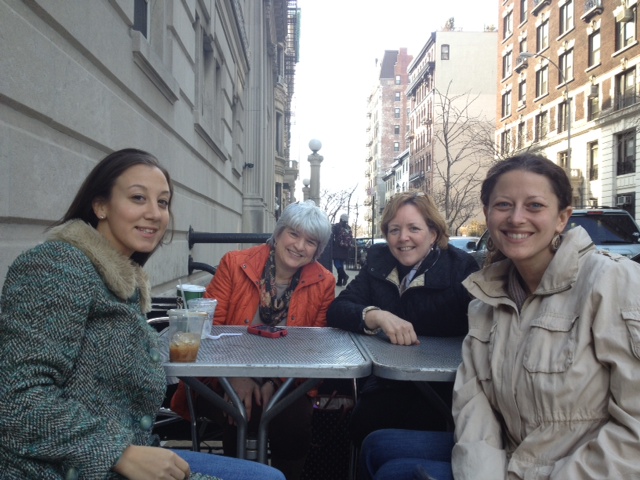
Having coffee with friends and talking about our wonderful day.
photo-10
On my way to Brooklyn, my first view of the Freedom Tower.
photo-11
The view from Brooklyn.
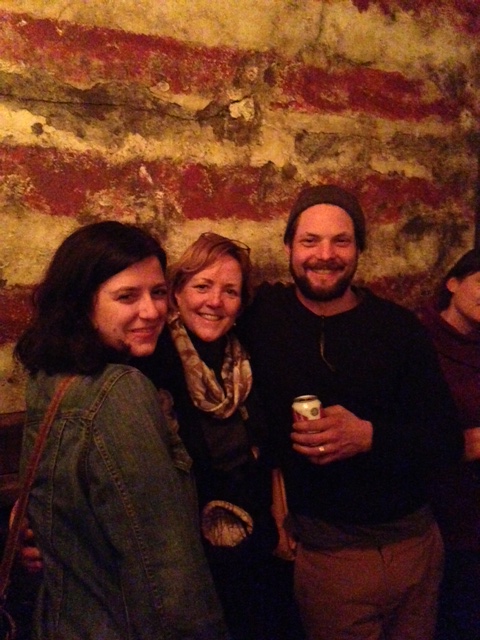
Dinner with my son and his girlfriend.

What an amazing day, filled with learning, laughter, family, and friends. Thank to everyone at Teachers College for hosting this amazing event!

Thank you, as always, to StaceyTaraDanaBetsyAnna, and Beth for hosting the Slice of Life Challenge. Be sure to visit Two Writing Teachers to read more Slice of Life posts.