Slice of Life: Why Do Children’s Books Matter?

Image

“There are no good books which are only for children.” W.H. Auden

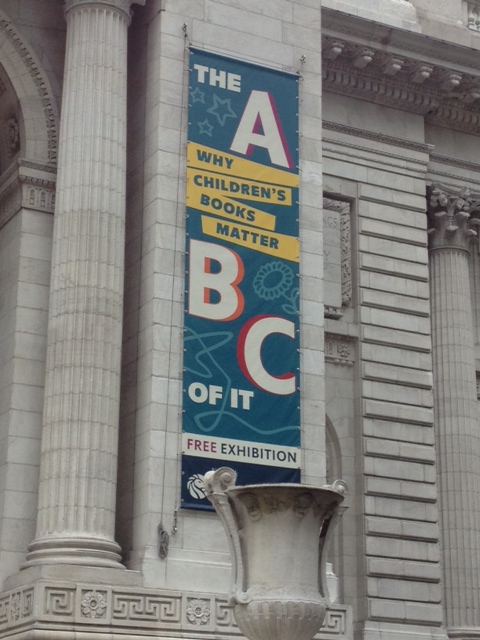
It’s no secret to anyone who knows me or reads this blog that I love children’s literature. I have always loved to read, but it wasn’t until my first son was born that I truly understood the importance of sharing books and reading with children. I’ve written about this before, but I’ve been thinking about it again after visiting the outstanding exhibit at the New York Public Library, The ABC of It: Why Children’s Books Matter, curated by Leonard S. Marcus, one of the most respected scholars of children’s literature today.
Image

When I was little, people cared about me enough to read to me and to see that I had books to read to myself. How sad it was for me to realize that this is not true for every child. My love of books and my passion to share them with children is what led me to teaching and is what drives me still.

And yet, there are always new discoveries to be made. Earlier this summer I was at a local library’s book sale. I love going to these sales; they’re like treasure hunts to me. What unappreciated book has someone casually discarded? What long lost favorite of childhood is waiting for me to discover it among the many copies of yesterday’s fad? Among other treasures, I found The Quiet Noisy Book, by Margaret Wise Brown and illustrated by Leonard Weisgard. The bright, bold illustrations are distinctly mid-century, but I was captivated by Brown’s text.
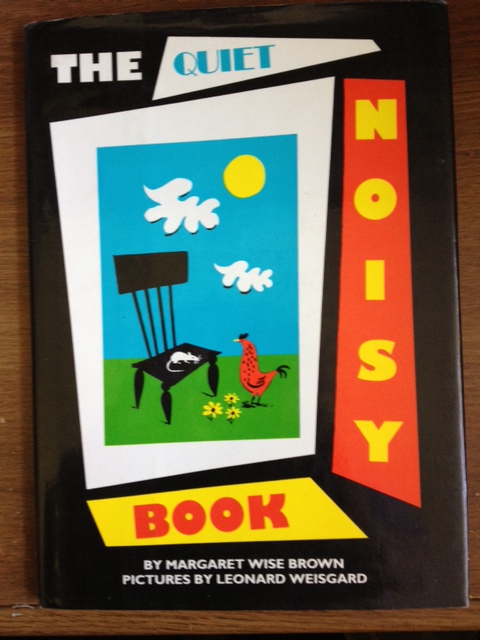
ImageIt was a very quiet noise.

Such a quiet noise.

As quiet as quietness.

It was a very quiet noise.

As quiet as someone eating currant jelly.

As quiet as a little kitten lapping milk.

The teacher in me was very excited at all the possibilities for using this as a mentor text for writing. In an instant, this book was in my bag and I felt a rush of excitement that I had rescued it from oblivion. I also had a new Margaret Wise Brown book to add to my collection.

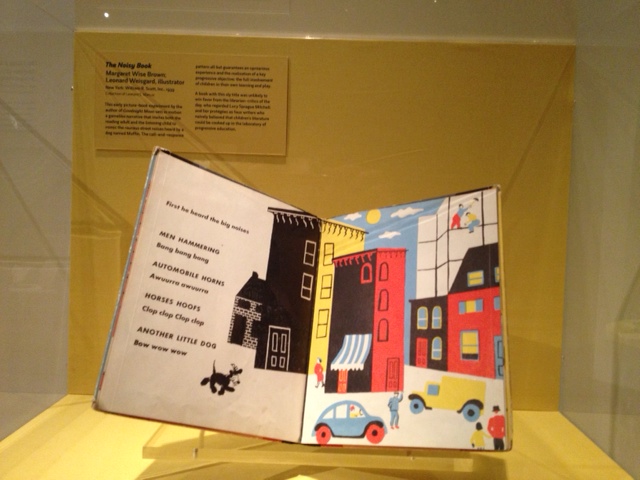
So last Saturday at the New York Public Library, I was surprised to see this in the section of the exhibit devoted to Lucy Sprague Mitchell, the Bank Street Writers Laboratory and it’s impact on children’s literature.
Image

I recognized the style of the illustration right away, but didn’t think it was the same book. When I got home, I checked on-line and discovered that Brown and Weisgard had created a series of Noisy books. How had I never heard of them?

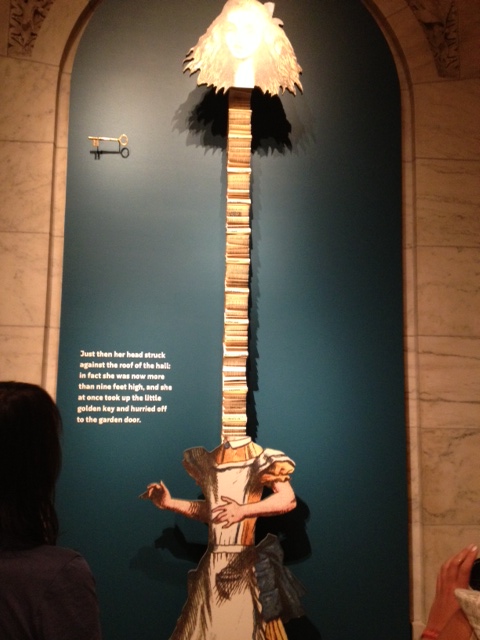
Another section of the exhibit highlighted Alice in Wonderland. Among the items on display here are a photo of Alice Liddell, her own copy of Carroll’s book, and a charming carving of Tweedledee and Tweedledum that was used as a parasol handle. The highlight for me, though, was this Alice, whose neck would lengthen and then shrink back to it’s normal size.
Image

How fitting that her neck was made of books! To me, Alice’s extended neck represents the endless possibilities to be found in books. One book leads to another, which leads to the next, and on and on forever. It also represents how books connect us, one to another, each one leaving a piece of itself within us. Why do children’s books matter? Because, in the lovely words of  Julius Lester, they “link our souls like pearls on a string, bringing us together in a shared and luminous humanity.”

Thank you, as always, to Stacey and Ruth at Two Writing Teachers for hosting the Slice of Life Challenge.
Slice of Life: The Birth of Sunset’s Kittens

Image

“Our abilities are limited only by our perceptions.”

~ Debbie Millman~

On her blog, Read, Write, Reflect, Katherine Sokolowski recently wrote about her childhood impression that authors were a “chosen few” who “lived in magical worlds.”

This got me thinking about my experience with authors as a child. The town where I grew up (and am lucky enough to still live) is only about an hour and a half from New York City. When I was a kid in the sixties there were at least 10 working farms in town (3 on my road alone) and there was exactly one “development.” Needless to say, it was a pretty peaceful place. The perfect place for writers to get away from the hustle and bustle of the city, yet close enough to go in when they had to.

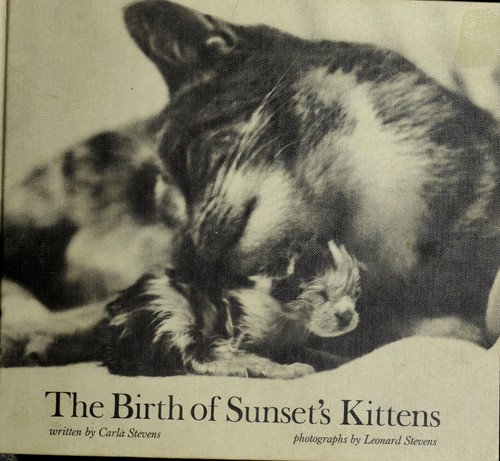
Because the mother of one of my classmates was a writer, I was lucky enough to know a “real” author. I remember Mrs. Stevens bringing Where the Wild Things Are into school one day. It was still in great big sheets, just as it had come off the printing press, and she showed us how it was cut and assembled into a book. In 1969, her book, The Birth of Sunset’s Kittens, was published. I loved this book and I checked it out of the library many times. To me, Mrs. Stevens was very sophisticated and glamorous, and reading her book made me feel that way, too.

Image

Imagine my delight, then, when I found a copy of this book at a local book sale! I scooped up this precious find and reread it on the spot. It is longer than I remember, and includes more details than I imagine our librarian was comfortable reading to us, but it’s as charming as ever. (And it smells like it’s been in a library for 35 years! Heavenly!)

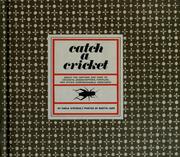
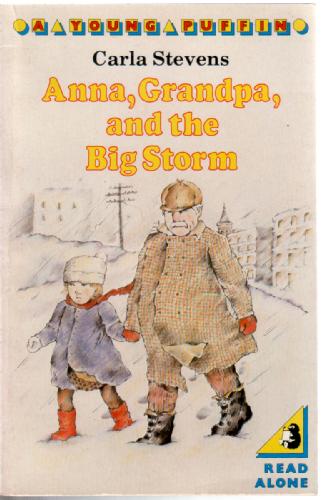
This isn’t the first time I’ve found a book written by Mrs. Stevens at a book sale. One year I found a copy of Catch a Cricket, a title I wasn’t familiar with. And I’ve found several copies of Anna, Grandpa, and the Big Storm over the years, all of which are now in my book collection.

Image          Image

My husband thinks I’m nuts to keep all these books. He doesn’t understand that I keep  them because of what they represent: a portal to my childhood and the person I was. I look back on that awkward, self-conscious nine-year-old and am grateful beyond words to Mrs. Stevens for writing these books, and for being such a great role model. Her books helped fan the flames of my passion for reading. A passion that helped me become the person I am today.

Thank you, as always, to Stacey and Ruth at Two Writing Teachers for hosting the Slice of Life Challenge.
Routines, Writing, and Excellence

Image

“We are what we repeatedly do. Excellence then, is not an act, but a habit.” Aristotle

Phil Jackson was interviewed on NPR about his new book not too long ago. He talked about the importance of practicing the fundamentals of basketball and how his teams  always started practice by working on the nuts and bolts of the game. Jackson related this to a story about Pablo Casals, one of the greatest cello players ever. When asked about his playing, Casals stated “I go through my fingering for an hour before I start playing a piece of music.”

This got me thinking about the fundamentals of writing. I don’t think we give students enough time to really practice the basics or build stamina for writing. We need to be more mindful of our established routines and ask ourselves “Is this activity/assignment helping the students become better writers?” If the answer is no, then we need a different routine.

The importance of keeping a writer’s notebook/journal has been underscored for me recently. For the past week, I’ve been participating in TeachersWrite! by responding to daily prompts. Some of this writing had nuggets taken from my journals, thoughts I’d jotted down without any specific purpose. Giving our students time to write each day about what interests them gives them the opportunity to practice the fundamentals in an engaging, meaningful way. Who knows what nuggets they’ll come up with when given the opportunity.

Providing our students with a daily opportunity to write about topics of their choice has the added benefit of getting them to think like writers. Since I’ve been writing regularly, I find myself observing the world differently. Telling students that they should see the world with “wide awake eyes” (Did Lucy Calkins write that? I can’t remember where I read it.) and actually getting them to do it are two different things.

A daily writing routine, one that offers students a period of time to just write, whether they respond to a prompt, take that prompt in their own direction, or just write about what’s on their mind, is critical if we want our students to be writers. Not just effective writers, but passionate writers. Writers who learn about themselves and the world through writing.

After I first heard the Phil Jackson interview and started drafting this post, I got side-tracked by work. In the meantime, Kate Roberts and Maggie Beattie Roberts posted “The Do-Re-Mi of Writing,” a thoughtful and practical piece about students improving their writing by having them go through their “scales,” just as musicians do. Be sure to read their terrific post.

Maria Popova also recently wrote about the importance of habit in “The Pace of Productivity and How to Master Your Creative Routine” on Brain Pickings. She gives lots of examples of famous creators, their daily routines, and the excellence they achieved through habit.

Thank you to Stacey and Ruth at Two Writing Teachers for hosting this weekly Slice of Life Challenge!

Sometimes…

Image       Image

Mary Oliver’s “Instructions for Living a Life” advises that we should “Pay attention. Be astonished. Tell about it.”

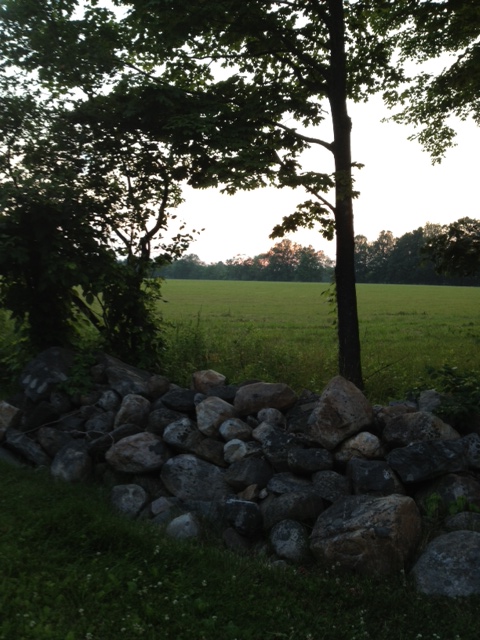
I thought of this when I read today’s quick-write on Kate Messner’s Teacher’s Write blog post. I’m often astonished by the beauty of the fields around my house, especially in summer. I’ve written about this in my journals over the years, and Kate’s post inspired me to turn these observations into a poem.

Sometimes, on a summer morning

Grandpa Stuart’s fields are touched

by the rays of the rising sun

so just the top of the grasses

glow in the yellow light.

Goldfinches perch on purple thistles,

breakfasting on seeds.

Sometimes, a deer wanders into the field,

interrupting their feast.

Startled, they rise as one

into the air, darting and diving,

chittering as they fly

before settling down

to the business at hand:

harvesting the glorious sunshine

captured in those thistles.

Image
One of Grandpa Stuart’s fields at sunset. It was hayed this week, so there are no thistles.

What astonished you today?

This post is doing double duty for today’s Slice of Life Challenge at Two Writing Teachers. Thank you, as always, to Stacey and Ruth for hosting!

Slice of Life: I’d Rather Be Reading

               Image       Image

The last day of school is June 21st for students; the last day for teachers is the 24th. After that, I’ll be working with middle school English/Language Arts teachers to align our curriculum to the CCSS. As everyone knows, this is an incredibly busy time of year. A former principal once compared the end of the school year to water draining out of a tub. At first the swirl is manageable, but the closer it gets to the final day, ready or not, you are sucked into that swirling vortex. I’m trying to keep my head above water while I get orders completed, assessment data entered, and on and on. So what am I doing this evening? Reading.

Image

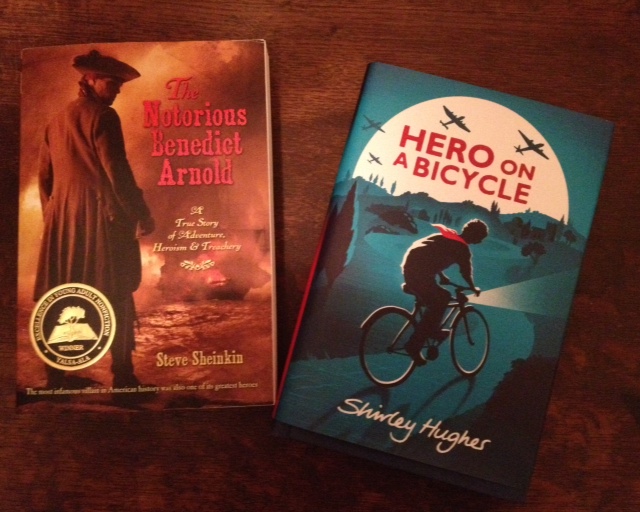
I ordered these books on Sunday, thinking it would take at least a week for them to arrive. Imagine my surprise when they were waiting for me on my porch this afternoon! Hero on a Bicycle, (Candlewick Press, 2013) by Shirley Hughes, has gotten lots of praise this spring. Stories of the citizens of Europe resisting and rebelling against the terrors of the Nazis have always fascinated me, so this book caught my attention right away.

The American Revolution has long been the subject of much historical fiction. I recently finished listening to Sophia’s War (Beach Lane Books, 2012) Avi’s recent addition to this tradition. The fictional heroine, Sophia Calderwood, becomes involved in the historical treachery of Benedict Arnold. I know very little about Arnold and his plans to turn West Point over to the British, and Sophia’s War piqued my curiosity. Having recently read Bomb: The Race to Build–and Steal–the World’s Most Dangerous Weapon, Steve Sheinkin’s excellent account of the Manhattan Project and the people involved, I knew Sheinkin’s The Notorious Benedict Arnold: A True Story of Adventure, Heroism & Treachery (Flash Point, 2010) would answer all my questions about this infamous figure from our history.

Who can resist the allure of brand new books? Not me! Everything I have to do for school will be waiting for me in the morning. You’ll forgive me if I say goodnight. I have some books to read.

Thank you to Stacey and Ruth at Two Writing Teachers for hosting this weekly Slice of Life Challenge!

Slice of Life: The Gift of Books

Image

“A book is a gift you can open again and again.” Garrison Keillor

This morning on her blog extraordinaire, A Fuse 8 Production, Betsy Bird announced a contest. The prize? “A hand-wrapped parcel from Sophie Blackall,” illustrator of Matthew Olshan’s just published The Mighty Lalouche (Schwartz & Wade, 2013). Take one look at the  photos on the post and you’ll understand that this will be a treasure. It made me want to wrap up a package and send it to someone! The rules for entering this contest? Just post a comment on Betsy’s blog telling her about the best present you ever received in the mail.

I’ve wracked my brain about this all day. I honestly don’t remember getting that many presents in the mail. I grew up in the same town where my grandparents and mother grew up, and my father grew up in the town next door. We were always together on gift giving occasions.  My mother certainly loved me, but she worked full time, so any care package sent when I was in college was most likely a check. (Which was greatly appreciated!)

Image

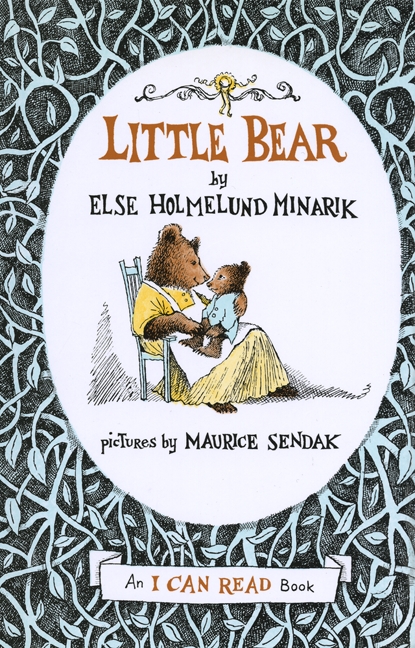
So what was the best present I ever got in the mail? A book, of course! I had a great-aunt who lived on Long Island who didn’t always come to Connecticut for Christmas, so she must have mailed our gifts from time to time. She had an uncanny knack for always choosing the perfect book for me. The first book I remember getting was Little Bear when I was 3 or 4. I still have this book, and read it to my children. They loved it just as much as I did. One of the last books she ever gave me was Little Women when I was 12 or 13. I thought I was much too old for such a book. How wrong I was!

Image

In between were other books, many of which I still have. But those are the two that stand out. What is best book you ever got as a present?

Thank you to Stacey and Ruth at Two Writing Teachers for hosting this weekly Slice of Life Challenge!

SOLC: Dakota Dugout

sols_6

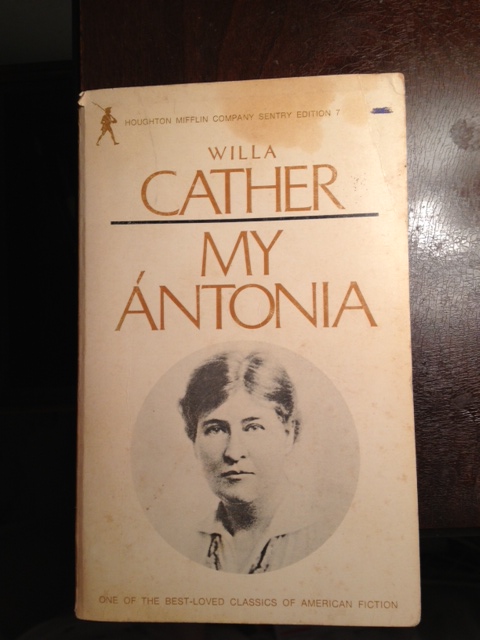
Sunday’s New York Times Book Review featured Tom Perrotta’s review of The Selected Letters of Willa Cather on the front page. Cather’s Death Comes for the Archbishop is one of my favorites, so I was interested right away. Perrotta quotes an irresistible line from one of Cather’s letters describing the prairie: “The whole great wheat country fairly glows, and you can smell the ripe wheat as if it were bread baking” As soon as I finished reading the review, I was off the couch and heading for the bookcase where I knew my copy of My Antonia waited. Although I’d had it for ages, I’d never read this book. No time like the present.

Image

I was immediately drawn into the story of Antonia’s immigrant family as told by her friend and neighbor, Jim Burden. Everything about the prairie is new to Jim, and Cather’s language transports us there. “The light air about me told me that the world ended here: only the ground and sun and sky were left,” Jim declares as he explores his new home for the first time.

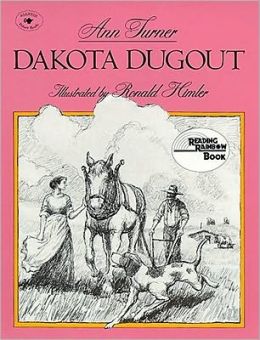
As I read, another book came whispering to me on that prairie wind. Ann Turner’s Dakota Dugout (Macmillan, 1985) is the story of a young couple trying to build a life in a sod home near the end of the 19th century. Told as a flashback from the wife’s point of view, Turner’s poetic text gives the reader an insight into a way of life few of us today can imagine. At the end of the book, the narrator tells her listener “talking brings it near again, the sweet taste of new bread in a Dakota dugout, how the grass whispered like an old friend, how the earth kept us warm.” The echoes of Cather’s letter are striking, aren’t they?

Image

I have used Dakota Dugout with fourth graders in the past to teach a number of reading strategies. It is a challenging text, but a worthy choice, as it is rich with details about a region of the country most of the students in my New England community have never experienced. Thinking about this book in light of the CCSS, the possibilities seem endless.

Reading Literature standards 1-3 could easily be taught using Dakota Dugout. Turner’s language makes this book a good choice for addressing the Language standards related to vocabulary (4-6) as well as Reading Literature standard 4, “Determine the meaning of words and phrases as they are used in a text…”

Teaching with primary sources isn’t something we’ve done a lot of in fourth grade, but because there are so many pioneer letters and diaries available, it makes sense to pair some of these with Dakota Dugout.  Reading Informational Text standard 6 states that students should “Compare and contrast a firsthand and secondhand account of the same event or topic; describe the differences in focus and the information provided.” The Library of Congress has a remarkable collection, Prairie Settlement: Nebraska Letters & Family Photographsthat are a perfect complement to this book. There is even a Standards alignment chart available.  The National Museum of American History also has resources to use with Dakota Dugout, including an online sod house building simulation.

The pioneers who settled the Great Plains are gone. But their spirit lives on in Willa Cather’s novels, scores of letters and diaries, and in books like Dakota Dugout. Through them we can “Tell you about the prairie years? I’ll tell you, child, how it was.”

Thank you to Stacey and Ruth at Two Writing Teachers for hosting this weekly Slice of Life Challenge!

Slice of Life: The Taming of Me

Image

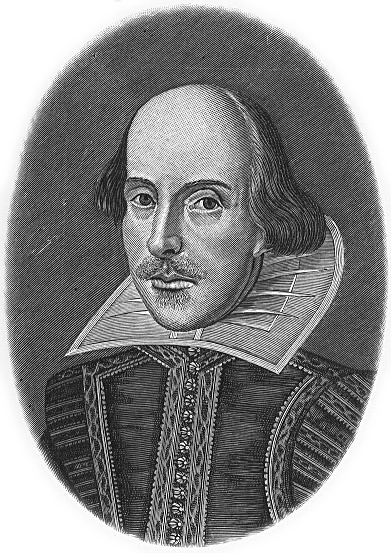
Today is William Shakespeare’s 449th birthday. To honor him, I’m sharing a reminiscence of my first encounter with the Bard.

Image

I was a very energetic child. I’m not sure that irrepressible is exactly the right word, but I did love to run and jump and talk and…well, you get the idea. My teachers didn’t see the charm of all this energy. They were very specific about how misplaced it was. My report cards were filled with comments like “If Catherine spent less time talking…” or “If Catherine focused more on her work…”

By the time I got to sixth grade I was beginning to get the idea that maybe I could be good at school if I put in some effort. Part of what was different about sixth grade was Miss Morency. She brought Drama to our school. The first play we put on an adaptation of The Tempest. I played the part of Stefano, a drunken sailor. The only thing I remember about the play was staggering onto the stage with an empty wine bottle in my hand. Can you imagine? But I also know that I LOVED being onstage.

We were a huge hit, and we begged Miss Morency to put on another play. She agreed, and before long we had the script for an adaptation of The Taming of the Shrew in our hands. Needless to say, I wanted the part of Katherine! I practiced and practiced. All my hard work paid off, and, in the spring of 1972, I starred in Burnham School’s production of Shakespeare’s comedy.

Image
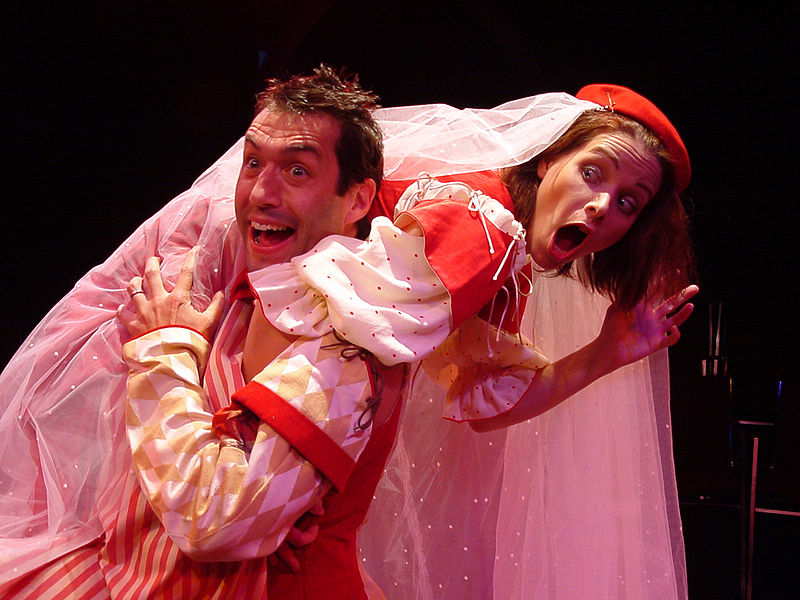
Petruchio (Kevin Black) and Kate (Emily Jordan) from a Carmel Shakespeare Festival production of “The Taming of the Shrew” at the outdoor Forest Theater in Carmel, CA., Oct, 2003. Via Wkipedia Commons

This experience was a turning point in my young life. I had never been very successful at anything in school. People were happy to remind me of this on a daily basis. Suddenly, I was good at something! I started putting more effort into school. I started to get better grades. I started to like school.

I performed in a few other productions throughout middle and high school, but I never matched my success as Katherine. But my performance in The Taming of the Shrew gave me the confidence I needed to pursue other dreams.

It seems like the arts are always under fire, the first programs to be cut when budgets are tight. And yet the value of theater, music and the fine arts to education is clearer than ever. The National Task Force on the Arts in Education, in a report to The College Board, states “Studies consistently show that the arts are effective in keeping students in school, engaging students in learning and promoting high achievement.” (p. 5)

Shakespeare knew that “It is not in the stars to hold our destiny but in ourselves.” I was lucky to have teachers who helped me find that destiny in myself. I pay tribute to them every day by helping my students find their destiny.

Thank you to Stacey and Ruth at Two Writing Teachers for hosting this weekly Slice of Life Challenge!