Slice of Life: A Spring Poetry Retreat

11454297503_e27946e4ff_h

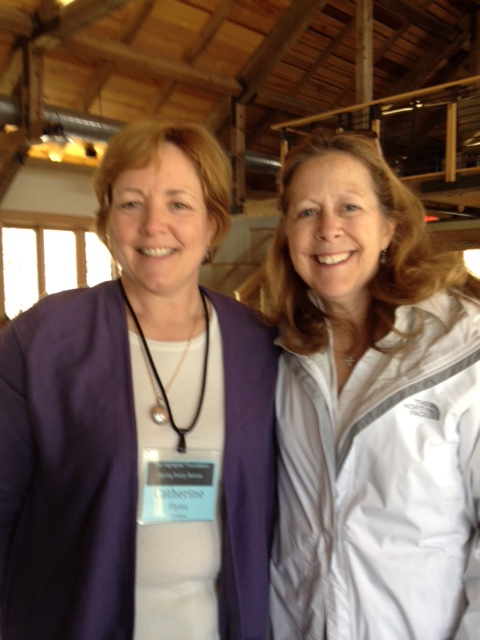
Last week I was fortunate enough to spend four days at the Highlights Foundation in northeastern Pennsylvania to study the craft of poetry with celebrated poet Rebecca Kai Dotlich. To say that this was an incredible experience is an understatement. To be immersed in poetry for four days, and to learn from a master poet, as well as from my fellow students, was an incredible gift. I kept pinching myself to make sure I wasn’t dreaming.

Rebecca is the author of many poetry collections, including In the Spin of Things (WordSong, 2010), and, with Jane Yolen, Grumbles in the Forest (WordSong, 2013). Her poems have appeared in many anthologies, including The Poetry Friday Anthology (2012), Falling Down the Page (Roaring Brook Press, 2009), and My America: A Poetry Atlas of the United States (Simon & Schuster, 2000). Rebecca’s graciousness and warmth put us all at ease, and she shared dozens of poems, both her own and by other children’s poets, as she taught us about the craft of poetry.

Stressing the importance of looking at objects in a new way, Rebecca sent us outside to collect anything that struck our fancy. She encouraged us to look at our object from different angles, with a magnifying glass, to think about its color and texture, in order to find those “precise details” that help make poetry powerful.

We learned about the power of revision when Rebecca Davis, a senior editor at Boyds Mills Press and WordSong, joined us on Saturday afternoon. She and Rebecca took turns reading drafts and revised versions of poems from an upcoming collection. Some of the revisions were subtle; some were significant, but all of the revisions improved the poems. Ms. Davis reiterated the message Rebecca had been stressing throughout our time at Highlights: “Work at your craft.” Nothing can replace the time you put in to drafting and revising, then revising again to “make your work as tight as possible.”

Another highlight of this Poetry Retreat was a Skype visit with poet Janet Wong, who co-edits the Poetry Friday Anthologies with Sylvia Vardell. Janet talked about her path to becoming a poet, as well as steps we could take to improve our chances of being published. Janet also emphasized the importance of writing daily. She encouraged us to “write a poem a day; it’s a sit up for your brain.”

It was easy to be inspired at the Highlights Foundation in the seclusion of the Pennsylvania countryside, but it was also impossible not to bring that inspiration home with me. One of the last pieces of advice Rebecca gave us on Sunday morning was to “let your imagination feed you.” Thank you, Rebecca Kai Dotlich, Janet Wong, Rebecca Davis, Kent Brown, and everyone at the Highlights Foundation for feeding my imagination and my soul!
IMG_2749

Thank you to StaceyTaraDanaBetsyAnna, and Beth for this space for teachers and others to share their stories each Tuesday. Be sure to visit Two Writing Teachers to read more Slice of Life posts.

Slice of Life: A Villanelle

11454297503_e27946e4ff_h

One of my favorite poetry blogs is Tricia Stohr-Hunt’s The Miss Rumphius Effect. Tricia is an assistant professor of Elementary Education at the University of Richmond, as well as a blogger, poet, and all-around wonderful person. Each April, Tricia chooses a poetry theme, then writes daily posts based on her theme. These posts are incredibly thorough, informative, and inspiring. Yesterday’s post on ekphrastic poetry was no exception.

I had already been thinking about writing some ekphrastic poetry this month because of Irene Latham’s amazing National Poetry Month project, ARTSPEAK! and this painting, Mary Cassatt’s “Children in the Garden (The Nurse)” April’s image on the calendar hanging in my kitchen. The more I studied these people, the more they seemed like the perfect subjects to give voice to.

"Children in the Garden (The Nurse)" Mary Cassatt, 1878 [Public domain], via Wikimedia Commons
“Children in the Garden (The Nurse)” Mary Cassatt, 1878 [Public domain], via Wikimedia Commons
As I began jotting ideas about what each person in the painting might be thinking, or dreaming about, it became clear that there would be echoes between the three. Again inspired by Tricia and her compatriots, The Poetry Seven, I decided to try a villanelle. This form has a specific rhyme scheme and pattern of repetition. I’m not in love with the word “done” to describe when lunch is over, but it had more rhyme options than other choices, so I kept it for this draft.

Children in the Garden,
after “Children in the Garden (The Nurse)” by Mary Cassatt, 1878

On a June afternoon, when lunch is done,
baby dreams a sweet milk dream
as she dozes in the warm summer sun.

As she knits yellow wool, finely spun,
nurse’s eyelids droop in the sun’s bright gleam
on a June afternoon, when lunch is done.

I play in the garden, watched by no one.
Tipping my watering can, I pour a stream
of water, glistening, into the warm summer sun.

Bumblebees dart in and out, their work just begun;
welcomed by iris and roses; it’s part of nature’s scheme
this June afternoon, when lunch is done.

Spying a cricket, I give chase. I won!
My prize safe in my palm, my smile’s a beam
as bright as the warm summer sun.

Breezes stir; I’ve had my fun.
I snuggle next to nurse, soft as cream,
on a June afternoon when lunch is done
and doze in the warmth of the summer sun.

© Catherine Flynn, 2015

Small-Blue-RGB-National-Poetry-Month-Logo_0

Thank you to StaceyTaraDanaBetsyAnna, and Beth for this space for teachers and others to share their stories each Tuesday. Be sure to visit Two Writing Teachers to read more Slice of Life posts.

Slice of Life: Poetry is Everywhere!

11454297503_e27946e4ff_h When the weather cooperates, my weekend routine includes a walk with my dear friend, Colette, of Used Books in Class. After a winter of snow, cold, and wind, we were happy to walk every day over the Easter weekend.

Our walk takes us through the fairgrounds behind the firehouse, and as we rounded a corner on Saturday morning, this unusual sight caught my eye:

FullSizeRender

Maxine Greene urged people to see the world with “wide-awake eyes.” Naomi Shihab Nye wrote that  “poems hide. In the bottoms of our shoes…” I always share these wise words with my students and try to follow this advice myself. So of course I had to take a picture and write a poem.

A bumper crop of used commodes
Sit in the morning sun.
And although the fair is months away,
They’re ready for some fun.

Outside the information booth,
They form a jagged line,
Looking for the exhibition tent,
Ready for a turn to shine.

Alas, no ribbons will they win;
A sad, cruel fate awaits.
Their usefulness is now long passed.
They are ushered through the gate.

Last stop: the dump.

© Catherine Flynn, 2015

Small-Blue-RGB-National-Poetry-Month-Logo_0

Thank you to StaceyTaraDanaBetsyAnna, and Beth for this space for teachers and others to share their stories each Tuesday. Be sure to visit Two Writing Teachers to read more Slice of Life posts.

Slice of Life: A Month of Discoveries

11454297503_e27946e4ff_h


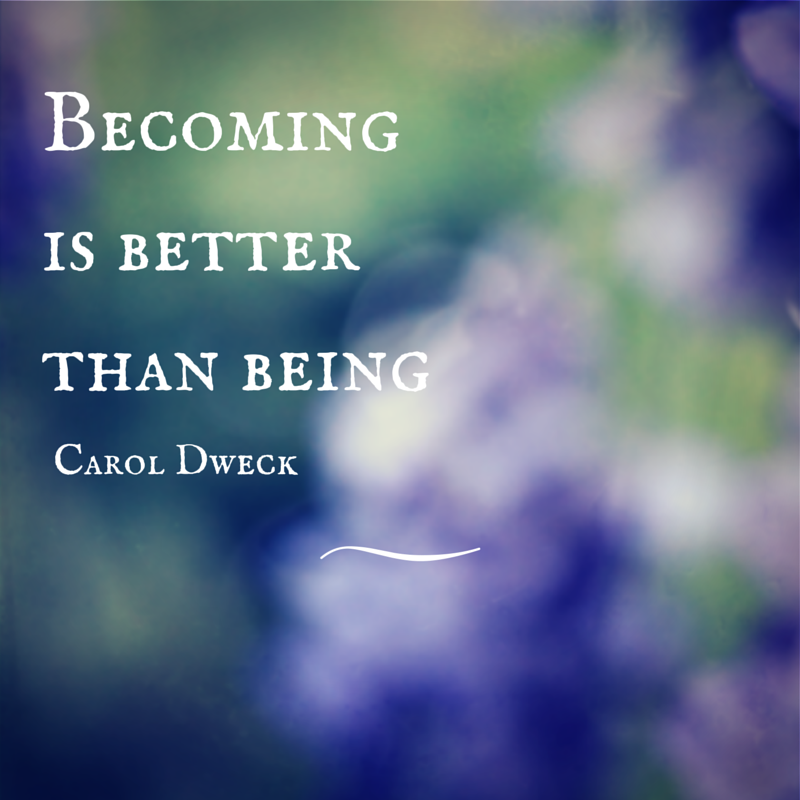
My One Little Word for this year is discover. What have I discovered over the past month? Many things, but I have to confess this slice has eluded me for the past two days. It’s been hiding, making me work to discover what I wanted to say about a month of blogging every day. In the end, I thought about what is necessary to being open to and making discoveries. Carol Dweck’s “Growth Mindset” came to mind, so I decided to frame it in terms of Dweck’s basic tenets.

WRITING 101
Created with Canva

Embrace the challenge. We made it! Thirty-one days, thirty-one slices.

Be inspired by the success of others. I am in awe of the talented writers who have shared their writing this month. Your writing has inspired and humbled me. I have discovered several new blogs and new voices and am excited to continue to learn from all of you.

Thrive on feedback. I cannot thank you all enough for your kind and encouraging comments. I feel so fortunate to be part of this incredible, supportive community!

Support and encourage each other. I have loved reading all your slices and have left as many comments as possible. But one of the downsides of this challenge is that there just isn’t enough time to do my own writing AND read all the slices that sound so interesting.

Expect excellence. I have strived each day to create a piece of writing that was worth sharing with you. This has given me more insight into my writing. Sometimes I feel pretty slow about these discoveries and think, “Duh, you’re just figuring this out now?” But at least I figured it out, right? After all, that’s what this journey is about.

Be resilient and overcome obstacles. Many times this month, I’ve started a piece of writing with one idea in mind, but ended up with something very different from what I envisioned. This was often frustrating and never easy. But I did it.

Accept hard work, effort, & deliberate practice. Like all of your, over the course of the month I have struggled to find the right word, rearranged a paragraph after I thought a piece was finished, and tried new forms I wasn’t comfortable with. But all those struggles were worth it.

Congratulations, everyone, for this incredible accomplishment!

Thank you to StaceyTaraDanaBetsyAnna, and Beth for your dedication and the hard work it took to make this challenge possible. You are all an inspiration to me!

Be sure to visit Two Writing Teachers to read more Slice of Life posts.

SOL: Interactive Writing with Natalie Louis

11454297503_e27946e4ff_h

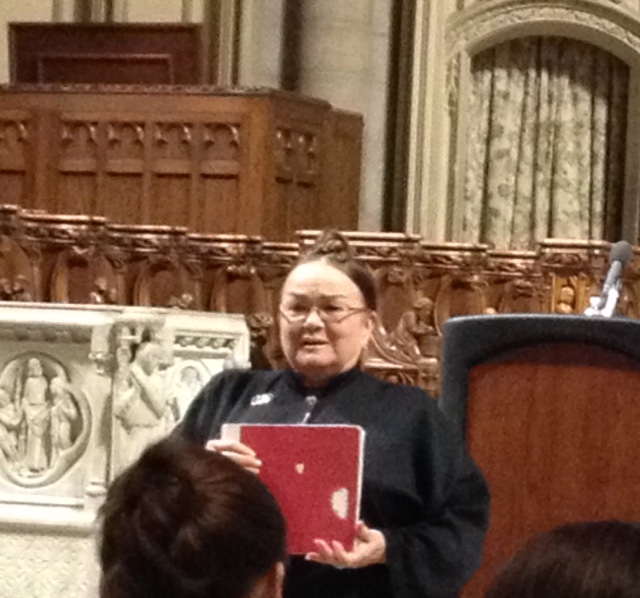
I have been attending Saturday Reunions for almost ten years and I am always amazed at how much information and inspiration Lucy Calkins and her team of staff developers manage to pack into six short hours. Natalie Louis is now a Lead Staff Developer, but when I first heard her present, she was fairly new at the project. Her passion, intelligence, and practicality was apparent immediately, though, and I have attended as many of her sessions as possible over the years. I am a much better teacher because of what I have learned from Natalie.

      Final_RWPLogo-18kom4s FullSizeRender

So on Saturday morning, I made my way to the 10th floor of Riverside Church for her session, “Tap the Power of Interactive Writing to Help Readers Surge Forward.” One thing you should know about Natalie Louis. She could have had a career in stand up comedy. She has a terrific sense of humor, but when it comes to doing what best for children, she’s absolutely serious.

Natalie began her session acknowledging the reality of first grade: we have students with a wide range of abilities and background knowledge, and sadly, many who have little experience with books and little motivation to read them. But they love to write. She encouraged us to get in there and “make stuff” with our students. “What kids doesn’t want to make stuff?” Louis wanted to know.

Interactive writing was on the schedule every day in Louis’s classroom because writing is a natural way to teach reading. Writing with first graders (or Kindergarteners or second graders) is developmentally appropriate because kids at this age love to tell stories about themselves. It’s also appropriate because there is an entry point for every child, regardless of their skill level. If they can only draw pictures, then they draw. If they know initial consonants, that’s what they write, and so on.

“The beginning of literacy is all about talk and finding meaning in our lives,” Louis reminded us. We have to help students find “stuff in their life that worth writing down.” This may mean creating a shared experience to talk and then write about. This helps kids learn that “when we do things in our lives, we have to remember them, we have to tell the story about what we did.”

Once you and your students have a shared experience, tell the story orally, for “talk is the basis of all writing.” Natalie assured us that at first “only the talkers will talk,” but that’s okay. By listening to the talkers, the “ummers” are internalizing the structure and language of the story.

After the kids have told the story many times, maybe as long as a month, write the story down. Louis urged us to “talk a rich picture book, but write it more like a leveled text.” This will ensure that students will be able to read it on their own. Say the sentence and reinforce the idea that “here’s our message.” Then count the words together.

Because this is interactive writing, share the pen with children, but only when the word is in their zone of proximal development. If a word is too hard, you should write it, and if a word is too easy, such as a word wall word, direct their attention to the word wall to find the word.

Louis had a great list of suggestions of how to keep the kids who aren’t writing engaged. You can lead them in skywriting the word or lip syncing the letters in the word. Other options include writing the word on their hand, on the rug, or whispering to a partner. Natalie said she only used white boards on Friday because it takes time to distribute and collect them, and they can be  distracting. She assured us not to worry about the child with the pen, they will probably make a mistake, but then you’ll help them fix it.

Corrections can be made after each word is written down. Louis suggested that “amazing intellectual work” is done when we give kids a chance to analyze their mistakes. She recommended that we say “Can I show you all the things you did right?” This is especially helpful if other children are laughing and an error. Rereading the sentence after each word is written is excellent reinforcement and practice.

Natalie’s realism about teaching our youngest readers and writers was clear when she advised us not to “be obsessed with levels. Level growth is not the only measure of growth; we have to look at the skills within the levels.”

Thank you, Natalie Louise, for sharing your wisdom with us last Saturday. I can’t wait to get back into the classroom to “do stuff, tell stuff, write stuff,” with kids.

Thank you also to StaceyTaraDanaBetsyAnna, and Beth for this space for teachers and others to share their stories each day during the month of March and on Tuesdays throughout the year. Be sure to visit Two Writing Teachers to read more Slice of Life posts.

SOL: Finding Ourselves in Others

11454297503_e27946e4ff_h

I think the first Patricia Polacco book I ever read was Pink and Say (1994), but I can’t be certain. I do know that Chicken Sunday was in the literature anthology my school adopted in 1996.  At once I knew Patricia Polacco was a master storyteller whose books conveyed important themes through stories of intergenerational and multicultural friendship and caring. These themes evoked compassion and allowed readers to see “the other” in themselves.

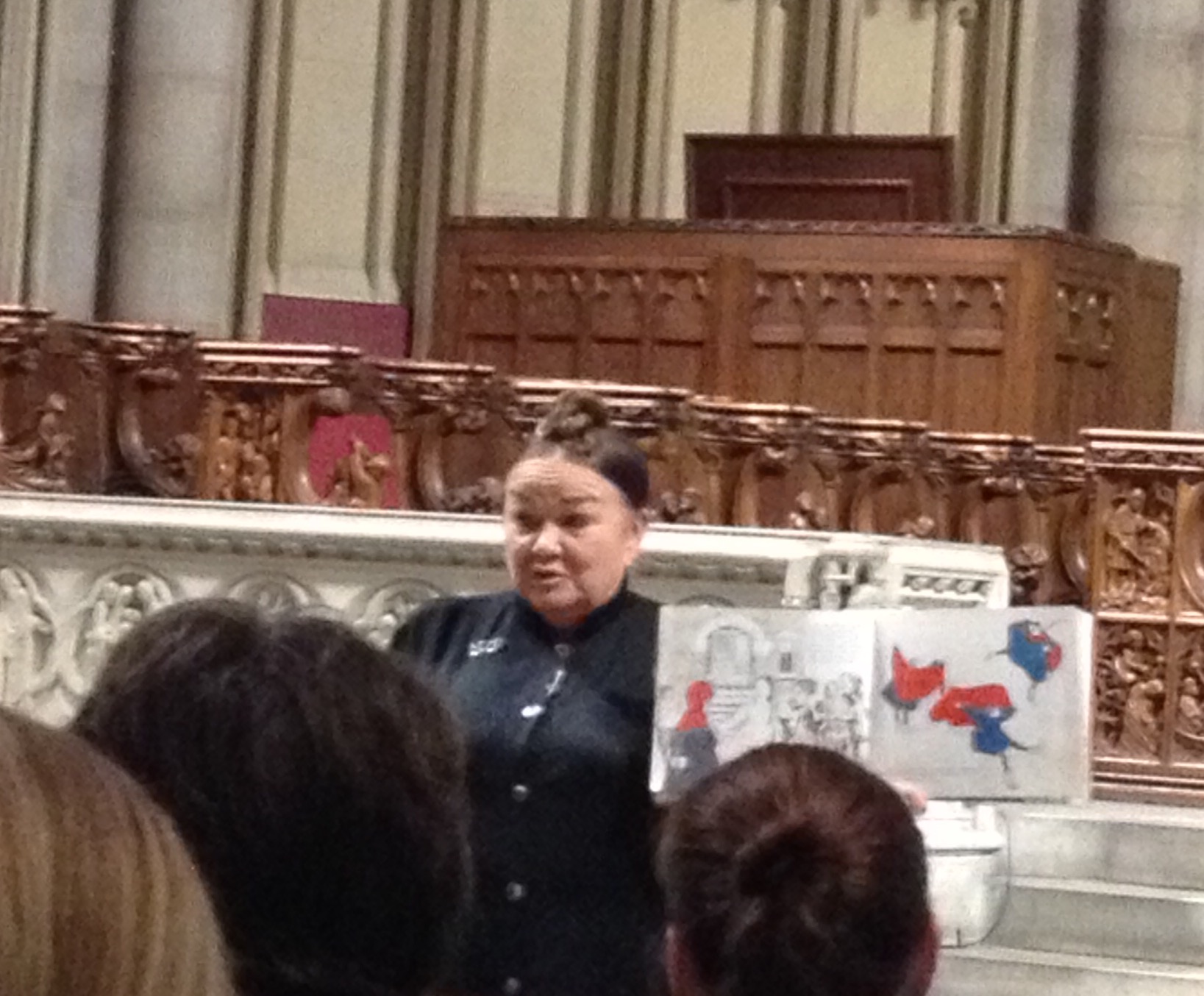
FullSizeRenderAt the 88th Teachers College Reading and Writing Project Saturday Reunion, held yesterday, teachers from across the country braved swirling snow and freezing temperatures to hear Patricia Polacco deliver the opening keynote. She told us that “the greatest heroes in our counry are classroom teachers.” She shared the story of her hero, George Felker, the real Mr. Falker. Mr. Felker was the first teacher to recognize Patricia’s dyslexia and was instrumental in getting her the help she needed to learn to read. Polacco described him as a man who was “beautiful in his heart.”

FullSizeRender-1

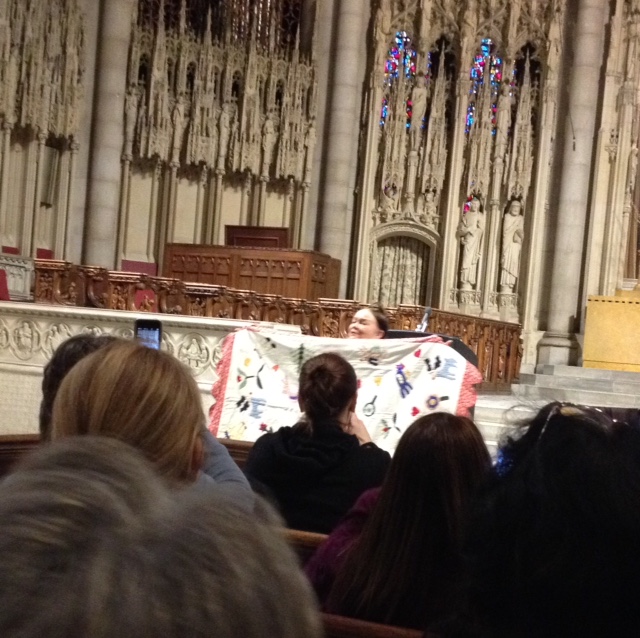
Polacco also shared the story of The Keeping Quilt. I know I wasn’t the only member of the audience moved to tears as Patricia told of her great-grandmother, Anna, who left the Ukraine as a small child. The dress and headscarf, or babushka, she wore eventually became part of the keeping quilt. Anna’s mother sewed the quilt so that when Anna felt homesick she could “just touch the quilt, and you’ll keep home” in your heart.

FullSizeRender-2

Hearts were the thread running through Polacco’s speech. She thanked the thousands of teachers filling Riverside Church for devoting “our lives to educating the minds and hearts of others.” In closing, Polacco told us that she was proud to “walk this earth” with us, and that she holds our hearts in her good keeping. 

Kylene Beers’s closing keynote, “What Matters Most,” was the perfect bookend to Polacco’s opening address. Kylene began by talking about how literacy is about power and privilege. She went on to say that “power is the ability to reach someone with your message” and that “power is about being connected.” What connects us better than stories? Stories like The Keeping Quilt and Dear Mr. Falker.

Beers also told us that “we must have more compassion” and that we “get to compassion best and easiest through the teaching of literature.” Brain research supports this, as well as the role of literature in creating empathy, something that is sorely lacking in our society today. “The humanities should humanize us,” Beers said, and the best way to achieve this is to read. Children should read widely and read books of their choosing, because “want-ability will always be more important that readability.” Children should read widely because through literature “we learn how to navigate our lives by navigating the lives of others.”

FullSizeRender-3

With characters as diverse as a slave and soldier of the Civil War, Russian immigrants, Holocaust survivors, and everyday African-American kids, Patricia Polacco has given us literature that enables us to, as Kylene Beers put it, “become what we are not.” Great teachers will share these books with their students because they will help children become curious, creative, and compassionate. They will share them because “great teachers are our best hope for a better tomorrow.”

Thank you to Lucy Calkins and everyone at the Teachers College Reading and Writing Project for making the Saturday Reunion possible, and thank you to Patricia Polacco and Kylene Beers for your confidence, faith, and above all, your words of inspiration.

Thank you also to StaceyTaraDanaBetsyAnna, and Beth for this space for teachers and others to share their stories each day during the month of March and on Tuesdays throughout the year. Be sure to visit Two Writing Teachers to read more Slice of Life posts.

SOL: Knowing and Wondering With Fifth Graders

11454297503_e27946e4ff_h

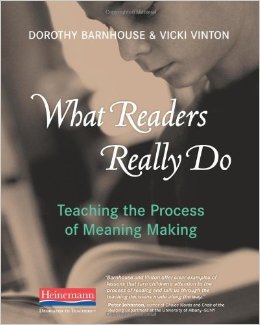
I’ve been a fan of Vicki Vinton and Dorothy Barnhouse’s “Know/Wonder” chart since I first discovered it on Vicki’s blog a few years ago. Since then, I have read and learned much from Vicki and Dorothy’s book, What Readers Really Do: Teaching the Process of Meaning Making (Heinemann, 2012). If you aren’t familiar with Vicki & Dorothy’s book, a Know/Wonder is a simple tool students use to chart their thinking as they read.

A few weeks ago, I was lucky enough to spend the day at the Educator’s Institute in Rhode Island and hear Vicki speak about comprehension. She focused on ways we can help students think deeply about complex texts independently. I always feel like I gain new understanding when Vicki shares her ideas. She articulates her thinking about reading comprehension in such a way that I say, “Of course!”

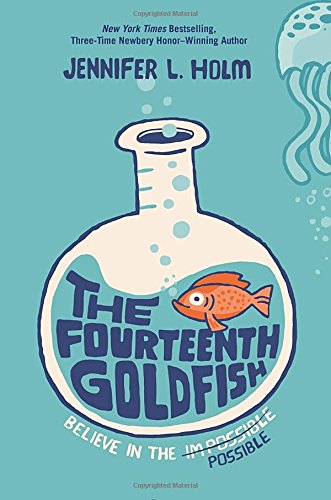
     51MGRQ28D0L._SX258_BO1,204,203,200_     51TzuMPYTPL

Earlier this week, I took Vicki’s advice and got “kids involved doing the thinking right from the get go.”  After a very brief introduction, I began reading The Fourteenth Goldfish (Random House, 2014), by Jennifer L. Holm, to a group of fifth graders. The first chapter generated a number of unanswered questions. The narrator isn’t named, and there is only one clue as to whether it’s a boy or a girl.  We find out that the goldfish who just died is really goldfish number thirteen. “So why is the book called The Fourteenth Goldfish?they wanted to know. Right away, they were:

  • gathering information
  • asking questions
  • making predictions
  • thinking about the plot—which has to come first in order to be able to problem solve for deeper understanding—both at the inferential level and the thematic level

In Vicki’s words, they were engaged in a “productive struggle” to make sense of this book.

Engagement is key. How often have you shared a book that you absolutely love, only to find that your students don’t love it? We take it personally, right? Vicki reminded us that “kids have to be engaged with their thinking about a book, not our love of it.”

So book choice is important. Vicki suggested that it isn’t Lexile levels that make a text complex; “texts are complex because they interact in unpredictable ways.”

Unpredictable things happen in the first three chapters of The Fourteenth Goldfish, but because students were engaged and were charting their thinking, a chorus of “I KNEW IT” erupted spontaneously at the end of one revealing chapter.

I will be working with these students over the next week or so. We will continue to “pay close attention to the details,” and develop ideas about this book. Once we have done that, we can start the next phase of this work by looking for patterns. Then we can “develop a line of inquiry” from these patterns and follow it as we continue reading.

Vicki ended her talk with a reminder that “kids can notice a lot if we open the door for them to notice.” Who knows where their thinking will lead us?

Thank you to StaceyTaraDanaBetsyAnna, and Beth for this space for teachers and others to share their stories each day during the month of March and on Tuesdays throughout the year. Be sure to visit Two Writing Teachers to read more Slice of Life posts.

Slice of Life: Pen Pals

11454297503_e27946e4ff_h

Throughout the movie Julie and Julia, Julia Child, played by Meryl Streep, keeps up a correspondence with Avis DeVoto. Late in the film, Julia and her co-author, Simone Beck, or “Simca,” travel to Boston to meet with a potential publisher. The two have this exchange when they arrive at the station:

Julia: “Avis said she’d be here…wearing a plaid jacket. That’s how I’m to recognize her.”

Simca: “What do you mean, ‘recognize her?’ Has she changed?”

Julia: (pulling out then reading from a letter) “Look for the middle-aged woman in the plaid jacket.”

Simca: (with some alarm in her voice) “You and Avis have never met?”

Julia: “We’re just pen pals.”

Simca: “You don’t know each other?”

Julia: “Well, we do. We write.”

“We write.” That sums it up, doesn’t it? Through their letters, Avis and Julia have become devoted friends. And when Avis runs into the station, she and Julia embrace like the old friends they are.

I had a pen-pal once. I have the vaguest memory of getting a post card from a girl in France. What a thrill it was to receive mail! When I was in college, my grandmother wrote to me almost every day, and I got letters from high school friends who were all far away. After college, I moved back to my home town, so there was no need to write to my family any longer. But now my high school and college friends were far flung. We wrote from time to time, but we were all busy getting our lives off the ground. The letters became few and far between.

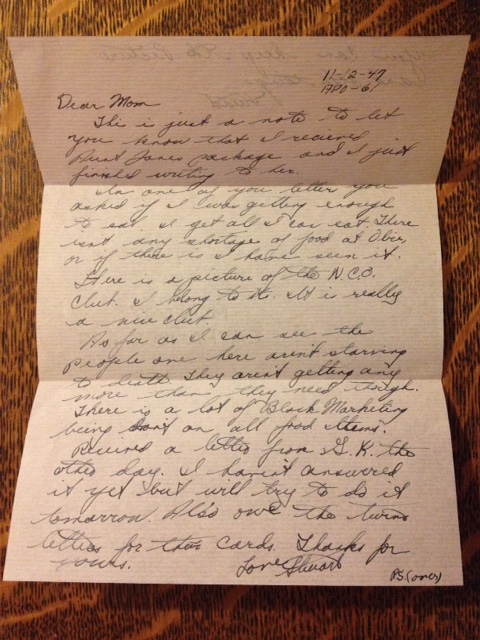
My grandmother got letters from her sister and other relatives throughout her married life. When we cleaned out her house, it seemed as if she had saved every letter she ever received! As I read through some of these recently, and was struck by how similar the contents of these letters are to what we write these days in texts, Twitter, Facebook, and blogs.

In a letter my uncle wrote from Oberpfaffenhofen Air Depot in Oberpfaffenhofen, Germany in 1947, he says, “In one of your letters you asked if I was getting enough to eat I get all I can eat. There isn’t any shortage of food in Ober.” (Mothers never change!)

FullSizeRender-4

Another letter from Uncle Stuart reports that he and his girl “ went to Munich to the opera…we saw ‘Carmen.’ It was all in German, but I enjoyed it anyway. The Red Cross takes a group every Sat. afternoon.”

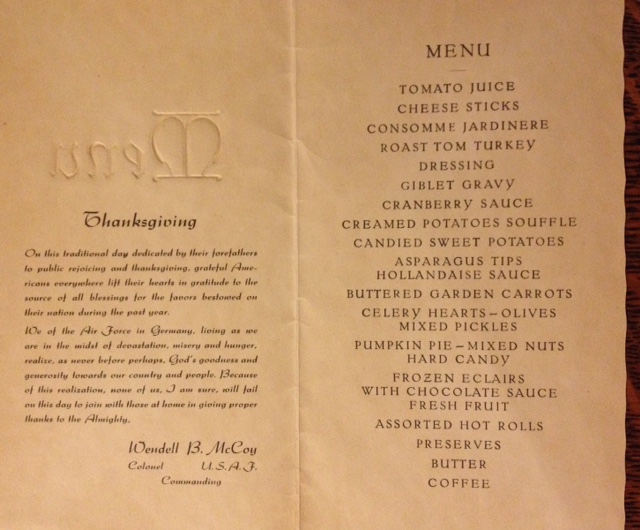
Later that year, my uncle included the Thanksgiving menu served at Oberpfaffenhofen Air Depot. Printed on creamy, heavy paper, the airmen were served quite a feast.

FullSizeRender-3

A postcard from my grandmother’s aunt, dated November 11, 1955 reads, “I drove 349 miles today from Cheraw, S.C. to Waynesboro, GA.”

FullSizeRender-2

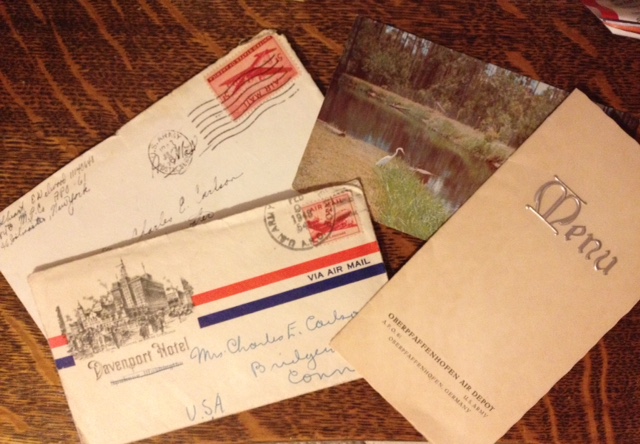
On stationary from the Davenport Hotel in Spokane, Washington, someone named Flo wrote to tell my grandmother that she “had a private cabin with Mrs. Taber” and that they are “1st class passengers.”

I know many people lament the decline of physical letters and snail mail, and certainly the old fashioned kind of pen-pal has gone the way of the dodo. But no matter what medium is being used, the stories of our lives emerge through our writing and friendships are maintained or forged. I have made so many friends and acquaintances online who I would never have met otherwise. I feel like so many of you are my pen-pals. I know about your children and grandchildren, husbands and jobs. Like Avis and Julia, we support and encourage one another.

You have enriched my life in countless, unimaginable ways.

Thank you.

Thank you to StaceyTaraDanaBetsyAnna, and Beth for this space for teachers and others to share their stories each day during the month of March and on Tuesdays throughout the year. Be sure to visit Two Writing Teachers to read more Slice of Life posts.

Slice of Life: Book Spine Poetry

11454297503_e27946e4ff_hApril is right around the corner, bringing with it showers, baseball, and National Poetry Month! Creating book spine poems is a great way to get your (and your students) poetic juices flowing.

FullSizeRender-1


Look! Look! Look!
What do you do with an idea?
Draw!
It’s a book!


IMG_2555

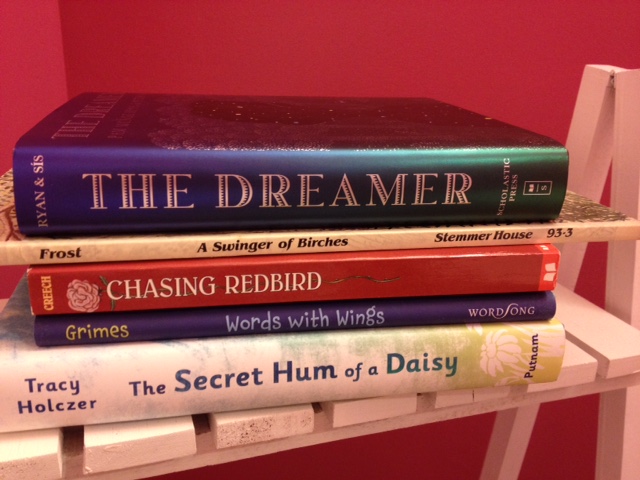
The dreamer,
A swinger of birches
Chasing redbird,
Words with wings,
The secret hum of a daisy

IMG_2551

Dragons love tacos,
Alphabet soup,
Apples & oranges.
Delicious!

FullSizeRender

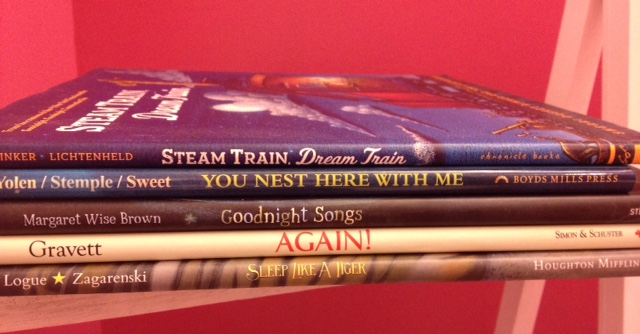
Steam train, dream train,
You nest here with me,
Goodnight songs,
AGAIN!
Sleep like a tiger.

Thank you to StaceyTaraDanaBetsyAnna, and Beth for this space for teachers and others to share their stories each day during the month of March and on Tuesdays throughout the year. Be sure to visit Two Writing Teachers to read more Slice of Life posts.

Slice of Life: What I Didn’t Write About Today

11454297503_e27946e4ff_h

What I didn’t write about today:

Driving to work this morning…
Thinking about a poem for Heidi’s MarCH challenge. Today’s word was clutch.

Clutch—
of eggs,
fancy purse,
exciting baseball,
get a grip!

Won’t let go
changing gears…

I need a dictionary.

Or a thesaurus.

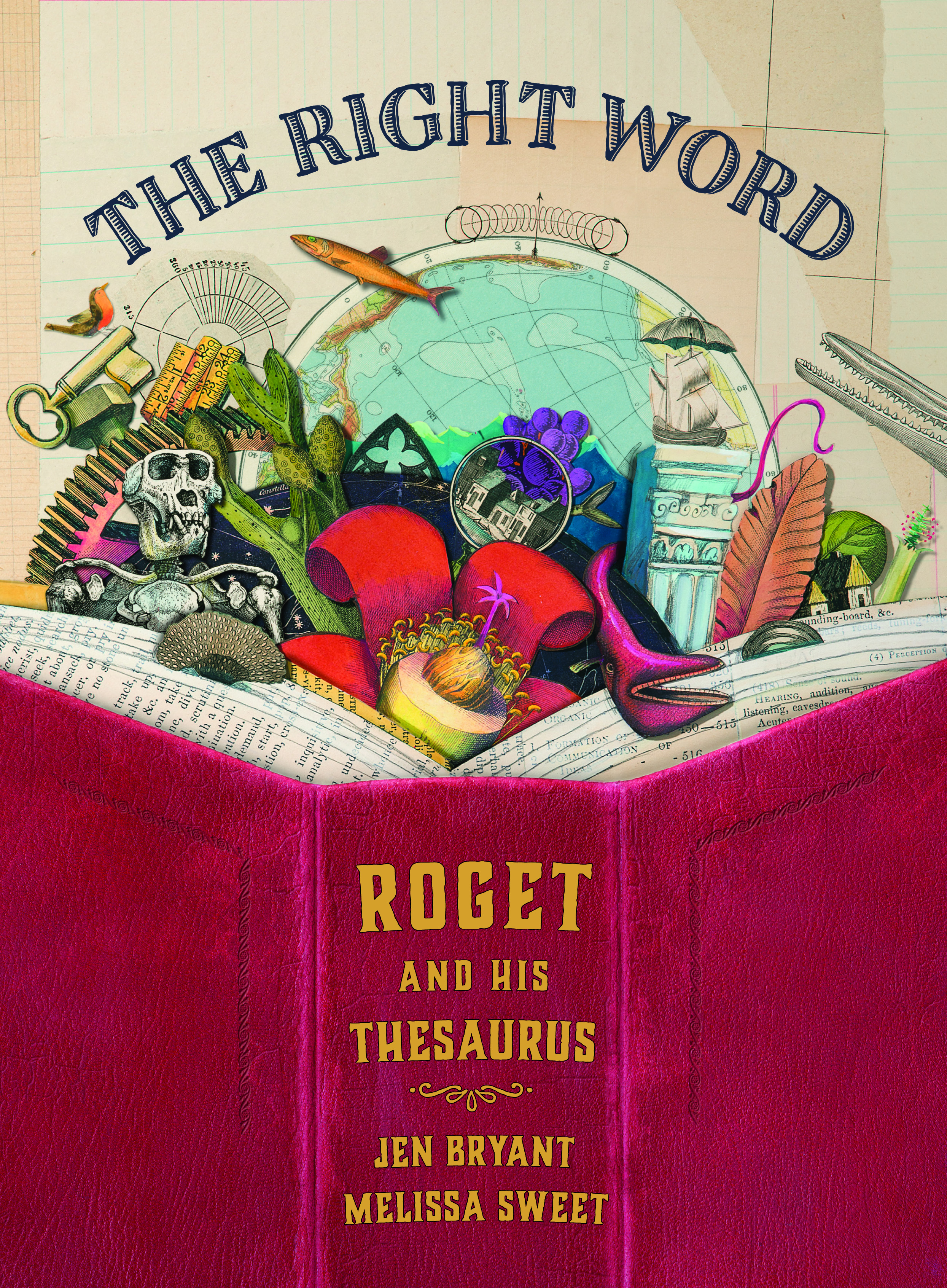
Oh wait. I shared this book with a group of fifth graders toady. The Right Word: Roget and His Thesaurus, by Jen Bryant and illustrated by Melissa Sweet.

Right-Word-by-Jen-Bryant-on-BooKDragon   59-reasons-to-write

Later, at home…

On the treadmill.
Reading a chapter from Kate Messner’s 59 Reasons to Write: “Point of View, Voice, and Mood”
“What would this object say?”
I look around.
What a weird conglomeration of stuff there is in this basement!

My eyes settle on my son’s collection of antique hand held planers.
Think of all the wood they’ve caressed,
boards they’ve smoothed and
readied to become a table or a bookcase.

Later still…

At my desk
What to write about?

I have no idea!

Thank you to StaceyTaraDanaBetsyAnna, and Beth for this space for teachers and others to share their stories each day during the month of March and on Tuesdays throughout the year. Be sure to visit Two Writing Teachers to read more Slice of Life posts.