Slice of Life: Not Failing

11454297503_e27946e4ff_h

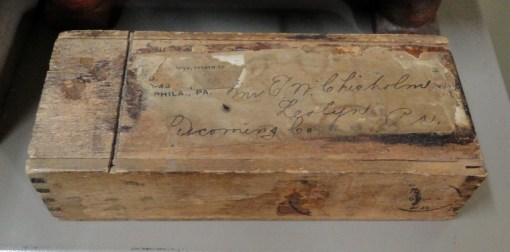
Yesterday, I summoned up all my courage and submitted a collection of poems to a writing contest. Then I came home and worked on a poem for Laura Shovan’s annual daily writing prompt project. This year’s theme is Found Objects. Here is the object for February 1st:

Photo by Robyn Hood Black

Laura posted this photo on Friday. On Sunday I’d written a draft—which is the object of this month-long writing adventure—then went about the many other tasks on my list for the day.

After a busy day at school, errands, and grocery shopping, I sat down to take a quick look at my draft before I posted it on Laura’s website. As I read, I had a sinking feeling. I convinced myself that my poem was terrible and not worth sharing.

Fast forward 24 hours. I spent the day watching my students take risks reading words they didn’t know, explaining their thinking about the theme of the book they were reading, and drafting nonfiction books. I marveled at their persistence and courage. They inspired me to come home and share this poem:

Nested within
the musty confines of
this worn pine box,
rubbed smooth
from years of use,
a cache of pencils
wait in silence.

Inside their graphite
filaments,
a cacophony of words,
some sweet, some sour,
are poised,
eager to escape.

© Catherine Flynn, 2016

After all, in the words of Ray Bradbury, “You only fail if you stop writing.”

Thank you to StaceyTaraDanaBetsyAnnaBeth, Kathleen, and Deb for this space for teachers and others to share their stories each Tuesday. Be sure to visit Two Writing Teachers to read more Slice of Life posts.

Slice of Life: On My Desk

11454297503_e27946e4ff_h

Despite having the past three days off, and despite the fact that I actually spent a fair amount of time reading and writing, I am at a loss for a slice. Wait. That’s not entirely true. I have at least three slice ideas. But each requires more time and energy than I have at the moment.

So I’m stealing an idea from Grace Lin, author of The Year of the Dog, the Newbery Honor book Where the Mountain Meets the Moon, and many other wonderful books for kids. On her blog, Grace occasionally posts about what’s on her desk. Since I spent a good part of the morning sorting through the piles that had accumulated on my desk over the holidays, this seemed like a good idea.

FullSizeRender-1

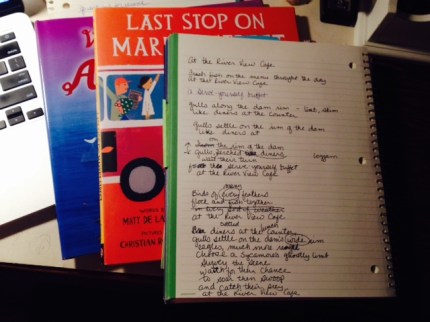
At the top of the pile is my notebook. After I got my desk into shape, I worked on a poem inspired by a trip to watch bald eagles at a local hydroelectric dam. I was hoping this would be my slice for today, but it’s just not ready.

Like many of you, I’ve been thinking about Matt de la Peña’s picture book, Last Stop on Market Street since it won the Newbery Medal last week. I have drafted the beginnings of a post about this lovely book.

Finally, Irene Latham’s new poetry picture book, When the Sun Shines on Antarctica, is coming out on February 2nd. Check back here next Friday for more information about that!

What’s on your desk?

Thank you to StaceyTaraDanaBetsyAnnaBeth, Kathleen, and Deb for this space for teachers and others to share their stories each Tuesday. Be sure to visit Two Writing Teachers to read more Slice of Life posts.

Slice of Life: Writing as Exploration

11454297503_e27946e4ff_h

“Writing is an exploration. You start from nothing and learn as you go.”
E.L. Doctorow

This quote is perfect and true.

Over a year ago, I began writing a story about a girl who falls out of a tree and breaks her arm. When I started writing, I didn’t know much more than that. I didn’t even know why she was in the tree in the first place. But that didn’t stop me. I kept writing and have learned much about this girl.

Then, last spring, I got sidetracked by another idea. All my writing energy went into this new project. However, as it often does, life intervened and both projects have been on the back burner for a few months.

Now, though, I feel ready to move on. I’m curious about what’s going on with this girl. More than a year later, she still has her arm in a cast. Surely that bone must be healed by now!

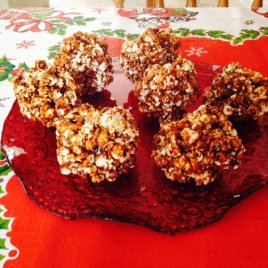
So yesterday I just started writing. I had no plan, no idea what what was going on with this character. But, true to Doctorow’s words, I figured it out (or at least got a better idea). It turned out that she wanted to make popcorn balls. So we made popcorn balls. This endeavor wasn’t completely successful, as the sugar and molasses tasted slightly burned. But the process of making this old family recipe revealed priceless details that I’d long forgotten.

CXVDAHLWAAEAKY8

Who knows what lies ahead for this character, or if this scene will end up as part of her story. I have an idea of how events will go, but I don’t know for sure. And that’s why I love Doctorow’s quote. I don’t have to know. I’ll figure it out. All I have to do is keep writing.

Thank you to StaceyTaraDanaBetsyAnnaBeth, Kathleen, and Deb for this space for teachers and others to share their stories each Tuesday. Be sure to visit Two Writing Teachers to read more Slice of Life posts.

Slice of Life: A Year of Discovery

11454297503_e27946e4ff_h

My One Little Word for 2015 was “discover.” I feel now like the housekeeper in the Bing Crosby movie White Christmas when she says, “sometimes you find out things you wish you hadn’t.” How could I have known that I’d discover what it was like to watch my 32 year old daughter-in-law lose her battle with metastatic melanoma? Or that I’d learn that hearts really do ache when they’re broken?

Everything else I discovered this year has the shadow of Julia’s death hanging over it. We’ve gone back to a semblance of daily life; I’ve even done most of the Christmas baking I usually do. But thoughts of Julia and Michael are never far from the surface. My grief for their lost life together is sometimes paralyzing, as is my worry about Michael’s life to come.

I know that our family is not the only family missing a loved one this holiday season. Sadly, the headlines have been too full of violent and untimely loss. That doesn’t make it any easier.

I’m not sure I’ll choose a word for 2016. Maybe I’m being superstitious, but it feels like tempting fate. Or maybe I will choose a word. That word is love. Because love is truly what has helped us all survive the past four months. And maybe that’s the most important discovery of all.

Thank you to StaceyTaraDanaBetsyAnnaBeth, Kathleen, and Deb for this space for teachers and others to share their stories each Tuesday. Be sure to visit Two Writing Teachers to read more Slice of Life posts.

A Slice of Wonder

11454297503_e27946e4ff_h

Not long ago, I saw this picture on Facebook:

12278753_999548306773456_100783203088609880_n

As a kid, I spent hours poring over our encyclopedias, soaking up all sorts of information. When I became a teacher, I wanted to foster that same sense of curiosity in my students. My first classroom had a wall of windows that looked out over the lawn and playing fields. I taped a construction paper frame to one of the windows and labeled it our “Observation Station.” I made little notebooks for the kids to write down what they saw and what they were curious about.

Screen Shot 2015-12-07 at 11.48.33 PM

On today’s Internet, the entire world is just one or two clicks away. Wonderopolis, in case you’re not familiar with this amazing resource, focuses on answering a single question each day. Recent questions include “Do snakes have ears?” and “What do bees do in winter?” If this website had been around when I was a classroom teacher, it would have had front and center billing in my classroom. As it is, I’ve promoted it and encouraged the teachers I work with to incorporate it into their day as often as possible. At NCTE, a stellar panel shared their thoughts about wonder and curiosity at the Wonderopolis Breakfast. Georgia Heard, Barbara Philips, Paul Hankins, Joellen McCarthy, and Kristin Ziemke wowed us with the depth of their thinking and insights about encouraging wonder in our students.

Georgia Heard began by telling us that “school should be a scavenger hunt” and that we should be “in awe of the universe.”

Paul Hankins left everyone speechless with his thinking about wonder. He thought of W as a compass, pointing to “our true north.” Rotating the letter 90 degrees to the left reveals a B, which stands for our beliefs. Flip the B, and, with some creative visualizing, you have a C, which reminds us of the need to create opportunities in our learning environments where kids can wonder, ask questions, collaborate. Finally, one last rotation reveals an M, which stands for the “mountains of meaning” our students will build in the our rich classrooms. Paul also urged us to have “uncommon courage” to build the habits of mind in our students that foster wonder and to become “classroom concierges.” Find out where your kids want to go and facilitate their journey.

The brilliance was flying and I honestly couldn’t keep up with all the smart thinking that was being shared. Here are a few examples:

Wonderopolis is as mobile as the human mind.

“We need to encourage our kids to go beyond the quick answer to find the connections and patterns that lead to the deeper answer.” Kristin Ziemke

Wonder journals are a place for questions, observations, sketches. They should travel back and forth between home and school.

“Wonder leads to finding the information, not finding the answer. New discoveries lead to new questions…” Kristin Ziemke

If you’re curious and want to know more, you can follow Wonderopolis and all the panelists on Twitter. JoEllen McCarthy regularly posts a text/Wonder pairing. Look for her #WOTDP hashtag. 

Georgia Heard & Jennifer McDonough’s book A Place for Wonder (Stenhouse, 2009) is another fabulous resource. It’s full of suggestions on how to invite children’s questions and observations into our classrooms by encouraging their curiosity and wonder.

Kristine Ziemke’s new book, co-authored with Katie MuhtarisAmplify: Digital Teaching and Learning in the K-6 Classroom (Heinemann, 2015) was just published in October. I haven’t had a chance to read it yet, but it’s at the top of my TBR stack!

The world has changed in immeasurable ways since I first cracked opened those encyclopedias more than fifty years ago. But the capacity for children to ask questions and be curious has not. Thank you, Wonderopolis, Georgia, Barbara, Paul, JoEllen, and Kristin, for sharing your ideas about nurturing our students and their ever-present sense of wonder.

Thank you to StaceyTaraDanaBetsyAnnaBeth, Kathleen, and Deb for this space for teachers and others to share their stories each Tuesday. Be sure to visit Two Writing Teachers to read more Slice of Life posts.

Slice of Life: Every Picture Tells a Story

11454297503_e27946e4ff_h

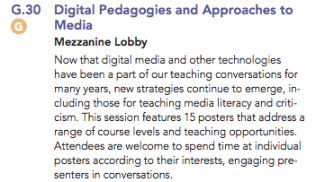
On Thursday, I’ll be heading to Minneapolis for my third NCTE Annual Convention. The previous two conventions have energized and inspired me. It’s such a thrill to meet nationally known educators and authors. I’ve also had a great time meeting fellow Slicers, bloggers, and Twitter friends. This year, my anticipation is even greater because I’ll be presenting “Every Picture Tells A Story” during a poster session on Saturday morning.

Screen Shot 2015-11-17 at 1.20.42 PM  Screen Shot 2015-11-17 at 12.31.45 PM

                                                                                  Screen Shot 2015-11-17 at 12.27.34 PM

Many years ago, when I first read Keane & Zimmerman’s Mosaic of Thought (Heinemann, 1997) and Strategies that Work, by Harvey & Goudvis, I was inspired to find ways to provide my students with additional practice using comprehension strategies to develop their understanding of texts. I also realized that  many kids who struggle with decoding weren’t getting enough opportunities to utilize the strategies. They were exerting so much energy decoding, they had nothing left for the higher level thinking needed for a deep understanding of their reading.

So I began incorporating art into my reading instruction as a way to give kids with decoding difficulties chances to practice and feel successful with comprehension strategies. It was quickly apparent that all students would benefit from learning to “read” the art. I’ve used paintings and illustrations to help first graders develop their retelling skills and third graders practice inferring and drawing conclusions. WPA photographs were a huge help when sixth graders were building background knowledge before reading Bud, Not Buddy. The possibilities for using art and photographs in the classroom are endless.

Paintings, illustrations, and photographs are also perfect for close reading. Strategies spelled out in recent books such as What Readers Really Do: Teaching the Process of Meaning Making (2012), by Dorothy Barnhouse and Vicki Vinton, Falling in Love with Close Reading, by Christopher Lehman and Kate Roberts, and Notice & Note: Strategies for Close Reading, by Kylene Beers and Robert L. Probst can all be introduced and practiced using art. After gathering details and developing ideas, students can also work on incorporating details that support their thinking into their writing, something our students always find challenging.

Constructing meaning from visual images has grown in popularity over the past ten years or so. There are many books and articles that offer additional ideas and suggestions for incorporating  them into the curriculum. Later this week, I’ll be sharing some of these resources, as well as a lesson I recently taught in fifth grade.

Hope to see you in Minneapolis! Thank you to StaceyTaraDanaBetsyAnnaBeth, Kathleen, and Deb for this space for teachers and others to share their stories each Tuesday. Be sure to visit Two Writing Teachers to read more Slice of Life posts.
 

Slice of Life: Cultivating a Passion for Writing

11454297503_e27946e4ff_h

A few weeks ago, on her superb blog, Vicki Vinton asked “What are you doing to cultivate passion in readers and writers in your rooms?”

One way I try to cultivate passion is to wear my love for reading and writing on my sleeve. Another is to hold Family Writing Nights. Last winter, inspired by Dana Murphy’s presentation at NCTE, I organized our first writing night, which you can read about here. It was a big success, and many people asked if we could have another FWN. I’d hoped to squeeze it in last spring, but the schedule filled up quickly and there were too many conflicts. So this year I decided to hold our first writing night in the fall, followed by another in February.

File_004

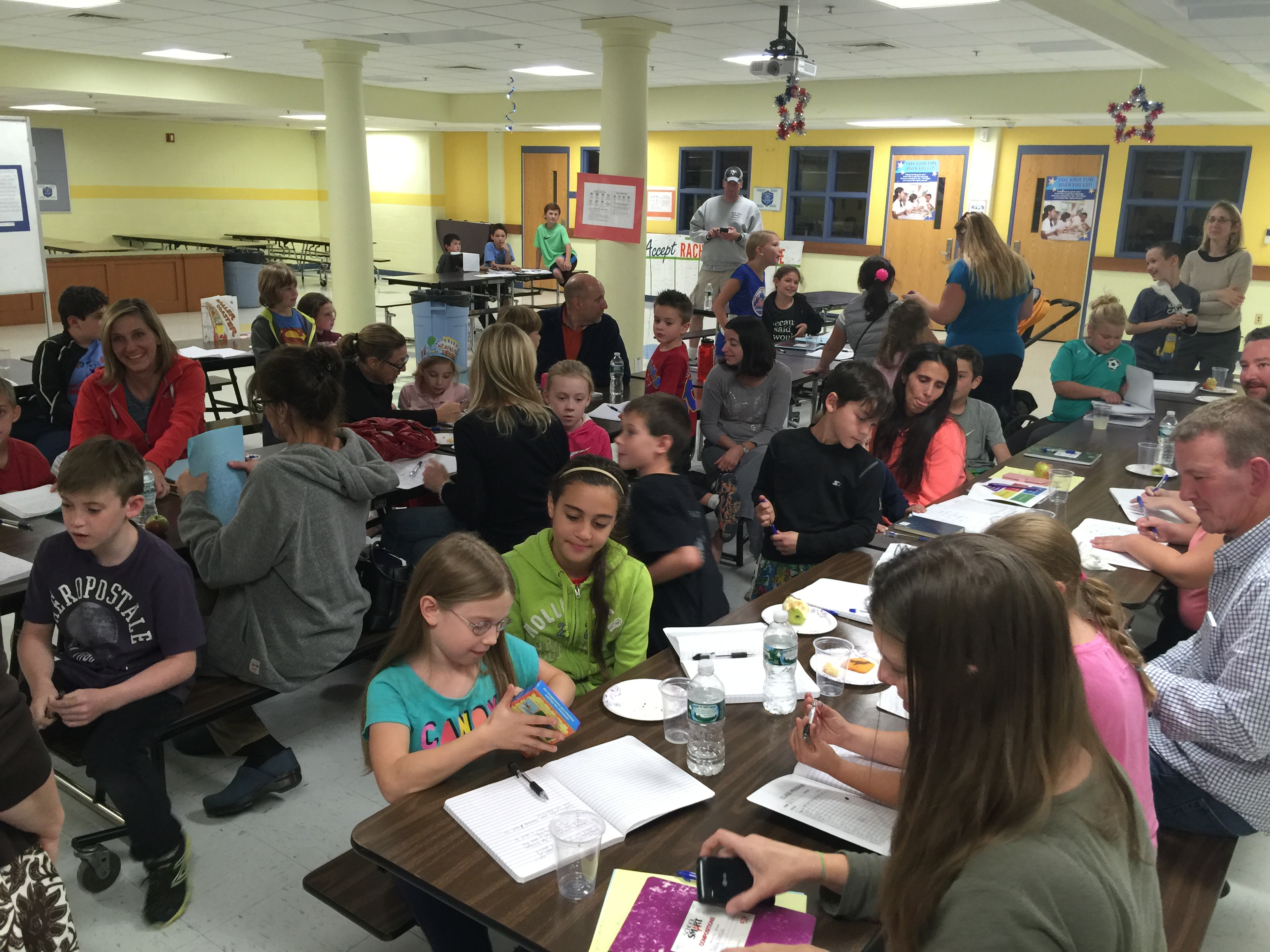
The turnout wasn’t quite as high as last year’s event, but we still had an enthusiastic crowd.

Ralph Fletcher says that “memories are like a fountain no writer can live without.” Hoping to spark some summer memories, I began the evening by reading Marla Frazee’s exciting Roller Coaster (HMH Books for Young Readers, 2006). This gem of a small moment story recalls a child’s first time on that amusement park ride that everyone loves or loves to hate. Either perspective makes a good story!

I also shared a tip I learned recently from Shanna Schwartz shared at a TCRWP Writing Units of Study workshop. She suggested encouraging writers to use their body as a kind of memory map. Shanna said to have kids (or adults) start at the top of their head and ask if they have a story about their hair. I know I have my share of  disastrous hairstyles! Maybe they have a story about a time they cut their hair, or a time they cut someone else’s hair. Moving down, is there a story about a loose tooth? What about that broken arm? Are they wearing a t-shirt they got on vacation or with the name of their favorite sport team? Once you start asking these questions, the list of possible stories is endless!

At the end of the evening, one dad came up to me to say how much he had enjoyed the evening. He told me he’d had a pretty stressful day, and that sitting down to write had relaxed him and relieved some of his stress. The next day, several students brought their notebooks to school to share what they’d written after they got home.

That’s the kind of enthusiasm we hope for in all of our students. It’s incredibly gratifying to help others find their voice as a writer. That’s why I’ll continue to organize Family Writing Nights, doing everything I can to encourage writers of all ages.

Thank you to StaceyTaraDanaBetsyAnnaBeth, Kathleen, and Deb for this space for teachers and others to share their stories each Tuesday. Be sure to visit Two Writing Teachers to read more Slice of Life posts.
SOL: Choose Kind

11454297503_e27946e4ff_h

“When given the choice between being right or being kind, choose kind.”
Dr Wayne W. Dyer

I was reminded of this famous precept last Friday evening at the airport. My son and I were flying to Phoenix for my daughter-in-law’s memorial service. I arrived at Michael’s apartment in plenty of time for our 8:10 flight, and by 5:00 we were standing on the curb waiting for the car he had ordered.

We waited. Michael called the car company and they assured him that the car was “minutes away.” We waited. No car. He called again.

“What! They’re not there yet? I’m sending another one,” the dispatcher said.

Another 15 minutes. Now we were worried. We waited five more minutes and knew we couldn’t wait any longer. We got in my car and headed for the Belt Parkway. At 6:00. On a Friday evening. Before a long weekend. Traffic was moving at a snail’s pace.

While Michael was driving, I was on my phone looking for other flights in case we missed ours. Nothing. There were no other flights leaving from anywhere in the New York area that would get us to Phoenix in time for the service. Finally we decided that I would drop Michael off at the terminal so at least he would make the flight.

After I dropped him off, I parked in JetBlue’s short-term parking garage. The trek from this garage to the terminal is a long one, and I ran as fast as I could. By 7:40, sweating and out of breath, I got to the check in counter. I explained to the man that I had given my credit card to my son so he could get his boarding pass and could he please help me. He gave a cursory glance to his computer and said, “You’re late. Check in is closed.”

I tried to be calm and said, “I know I’m late, but I have to get on that plane.”

“You’re too late.” With that he turned from me to another customer.

Frantic, I ran to the other end of the terminal, hoping to get a different answer from a different person. With the clock ticking, I explained the situation once again. This time, the woman very calmly picked up the phone, then started typing. I held my breath as she continued to talk to the person at the gate. Within minutes, I had a boarding pass in my hand and she was walking me to the part of security where late arrivals are moved to the head of the line.

I think I thanked her at least 20 times during our short walk. People in line ahead of me with later flights let me go ahead of them, and I got through security in record time.

Running once again, I arrived at the empty gate at 8:00. The attendants there assured me the plane wasn’t leaving without me and I didn’t have to run. The flight attendant on the plane took my suitcase, stowed it for me, then showed me to my seat.

The look on my son’s face when he saw me walking down the aisle was full of amazement and relief. Because I was so late, my seat had been changed, so I couldn’t sit next to him. But that was okay. We were both on the plane.

After all that, we ended up being delayed. They were still refueling and stowing the checked baggage after I was in my seat. We made it to Phoenix and the memorial service was lovely. But I would have been devastated if I hadn’t been there to support my son through yet another very difficult day.

I’m not sure why the first person I talked to was so unwilling to help me. In the end, it doesn’t really matter. I’m just grateful that someone was willing to help me. And I hope the next time someone asks him for help, he’ll do the right thing, and choose kind. 

Thank you to StaceyTaraDanaBetsyAnnaBeth, Kathleen, and Deb for this space for teachers and others to share their stories each Tuesday. Be sure to visit Two Writing Teachers to read more Slice of Life posts.
Slice of Life: A Day at Teachers College

11454297503_e27946e4ff_h

Four days of conferences in three different locations in one week sounds like too much, doesn’t it? But I did it, and survived! From a day at Teachers College with six colleagues for a day-long immersion into the Writing Units of Study to the Connecticut Reading Conference with Peter Johnston, Lester Laminack, Christine Hertz, Mary Howard, and Linda Hoyt, my brain felt like it was ready to explode as I drove home Friday afternoon. But in a good way!

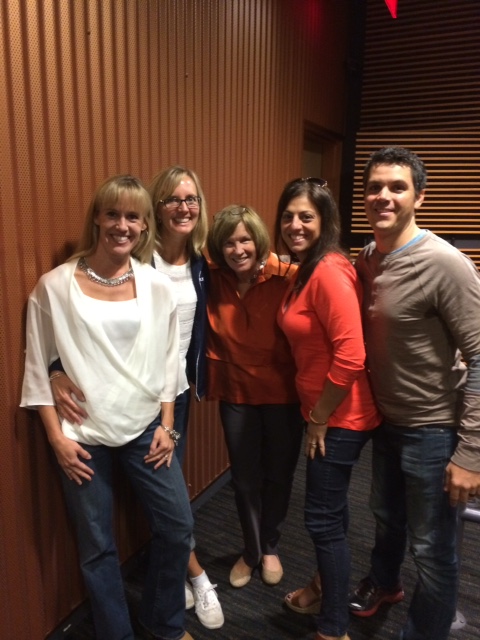
Our day at Teachers College was a huge success. I spent the day with my two first grade colleagues learning more about writing workshop in K-2 from the amazing Shanna Schwartz, while four teachers from our school spent the day learning about 3-5 writing workshop with Lucy Calkins. Needless to say, we had plenty to talk about on the drive home.

3-5 teachers loved meeting Lucy Calkins.

I took nine (!) pages of notes, so I’m not going to attempt to distill them all into one post. Rather, here are a few of my key takeaways.

“Writing Workshop Bill of Writers”
“We apprentice children in the life of a writer”

All children have the right to…

Time to write
Units based in authentic genres
Knowledge of conventions
Skills and strategies for writing
Understanding of the writing process
Collaboration

In other words, our students deserve nothing less than to do “what real writers do in a writing life.”

Shanna stressed the importance of collaboration and feedback, and I love this idea: “Our best writing is the writing we work on on our own and with feedback from others. Feedback is a gift.”

On revision, Shanna had this to say: “Revision is a complement we give our best work.” Isn’t that a wonderful idea?

The importance of read alouds and mentor texts was also emphasized: “A writer can’t write what they haven’t heard or read.” and “Read alouds help readers/writers think about what writing can sound like.”

Shanna also talked about the importance of beginning the year with narrative writing. She explained that narrative is the “first way we exist in the world” and that “when we meet people, we tell them our story.” Shanna reminded us that “story is the first kind of reading we do.” Finally, she pointed out that “story is the building block of every other kind of writing…small stories are often included in informational and opinion writing.”

When conferring with children, Shanna suggested we begin by saying, “Tell me about what your working on in this story.” After listening to the writer’s response, “think about what will make this writer stronger and more independent.” She also urged us to “give compliments that are productive by noticing a behavior and tell them the effect that behavior” has on their writing. This type of praise will “encourage them to do it again,” and thus help them become more independent. Independence is the goal, after all.

If there was any common thread to all I learned last week, the idea of independent learners is it. As Lucy Calkins wrote in A Guide to the Reading Workshop: Primary Grades (Heinemann, 2015), “the goal…is not only to teach kids to read [and write], but to help them grow up to be people who value reading [and writing].

By the way, look who got a shout-out:

FullSizeRender-2

Pretty good company, don’t you think?

Thank you to StaceyTaraDanaBetsyAnnaBeth, Kathleen, and Deb for this space for teachers and others to share their stories each Tuesday. Be sure to visit Two Writing Teachers to read more Slice of Life posts.
Slice of Life: Stitching a Life Back Together

11454297503_e27946e4ff_h

Separation
by W. S. Merwin

“Your absence has gone through me
Like a thread through a needle.
Everything I do is stitched with its color.”

The last official weekend of summer was bittersweet. My son was home, and we had company all weekend. Our days were filled with hiking, swimming, and napping. Our evenings began with suppers outside by candlelight and ended long past midnight around our fire pit. There were moments of laughter, but more moments of tears, as the loss of his dear, beautiful Julia is still a fresh wound. His heartbreak is palpable and visible in his face. But as we sat by the fire Friday night, I could feel his relief to be in our backyard, surrounded by his family and friends. I, too, felt a sense of peace start to return. This line, from “The Lake Isle of Innisfree,” by William Butler Yeats, came to me:

“And I shall have some peace there, for peace comes dropping
      slow.”

“Dropping slow” seemed to me exactly the way to describe the process of trying to stitch your heart and life back together without all the pieces. He’ll be putting his heart back together for years to come; maybe for the rest of his life. I’ll be there to help him with each stitch.

This slice was difficult to write. It feels much too personal for a blog that is supposed to be about teaching reading and writing. And yet, a slice is “a simple way to practice what we ask of students—to write…a small sliver of your ordinary life.”  I am grateful to be part of this community and to have a place to share this writing, which seems so far removed from my original mission, but which was so necessary for me to write.

Thank you to StaceyTaraDanaBetsyAnna, and Beth for this space for teachers and others to share their stories each Tuesday. Be sure to visit Two Writing Teachers to read more Slice of Life posts.