
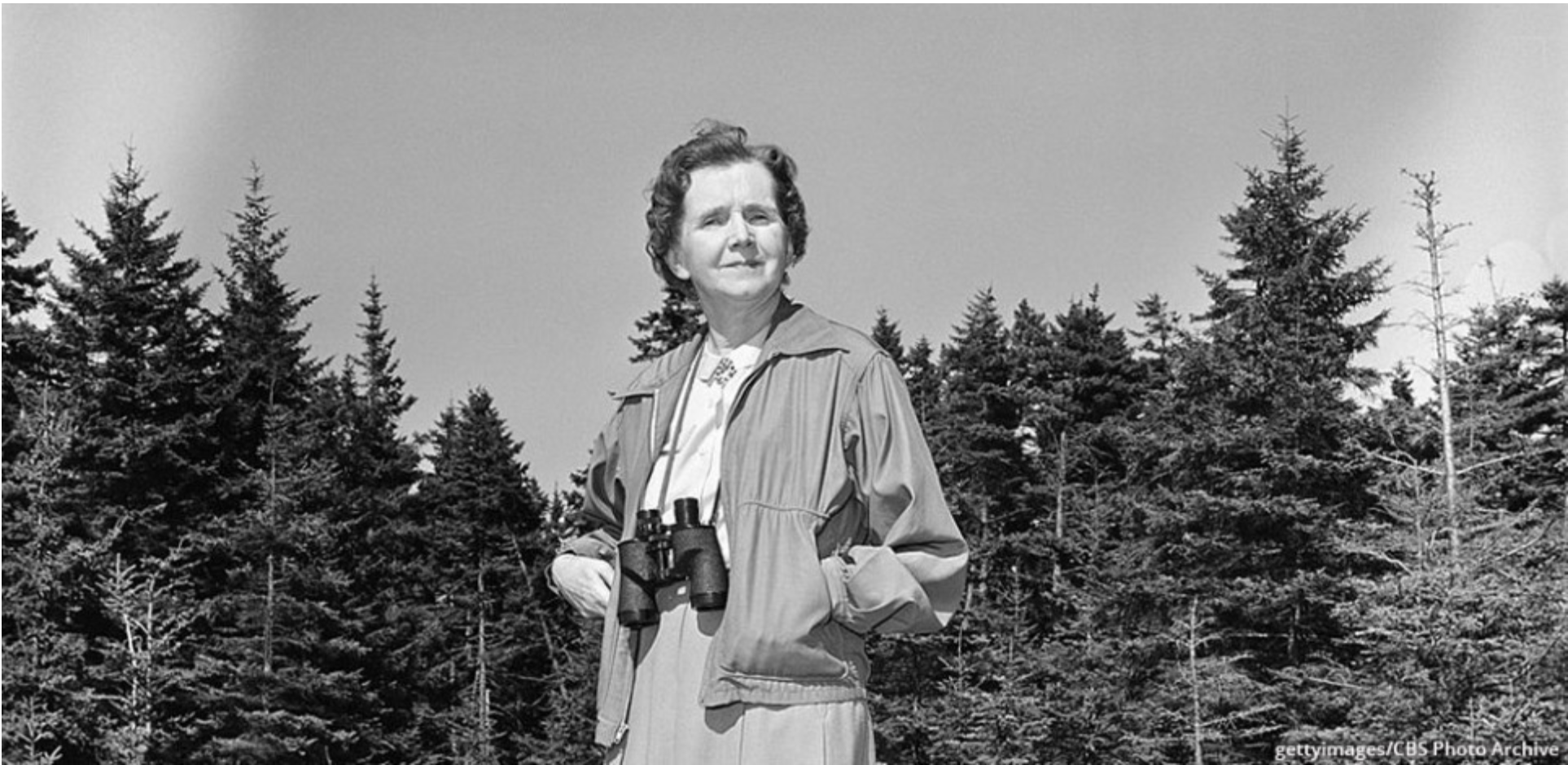
Rachel Carson, today’s profiled author, hardly needs an introduction. She is “a monumental figure in the 20th century and founder of the modern environmental movement.” Of Carson’s Silent Spring, historian Jill Lepore noted that “the number of books that have done as much good in the world can be counted on the arms of a starfish.”
I worry that we’re forgetting the lessons of Silent Spring, that we’ve substituted other pernicious insecticides for DDT. Fighting back against large chemical companies feels impossible. Maybe this project is really just one way for me to try.
Today’s poem if a fib. Fibs are based on the Fibonacci sequence, which predicts patterns in nature. This form seemed appropriate for a poem based on the work of a woman who wrote extensively about how “earth’s vegetation and its animal life have been molded by the environment.” (Silent Spring, p. 16) To create this fib, I chose words at random from page 16 and 17 of Silent Spring. Then, following a syllable count to match, then mirror, the Fibonacci sequence, arranged them into a (hopefully) meaningful sequence.
Earth,
air,
river
alchemy
supports the balance,
powers earth’s enduring nature.
Man’s assault alter’s life’s habits,
modifies the chain,
alarming
forests,
soil,
rain.
Draft, © 2021, Catherine Flynn
Previous Writing Wild posts:
Day 1: Dorothy Wordsworth
Day 2: Susan Fenimore Cooper
Day 3: Gene Stratton-Porter
Day 4: Mary Austin
Day 5: Vita Sackville-West
Day 6: Nan Shepherd
 Reading to the Core