Slice 31 of 31: Thresholds

Image

When I was in college, I had an English professor who always talked about thresholds. Literally, “the plank, stone, or piece of timber that lies under a door,” threshold is also described as the END; BOUNDARY, “the place or point of entering or beginning.” (Merriam-Webster Online Dictionary) I’m pretty sure it was that contrast that appealed to her: how can it be the end and the point of entering at the same time? It’s really all about the perspective we choose to take.
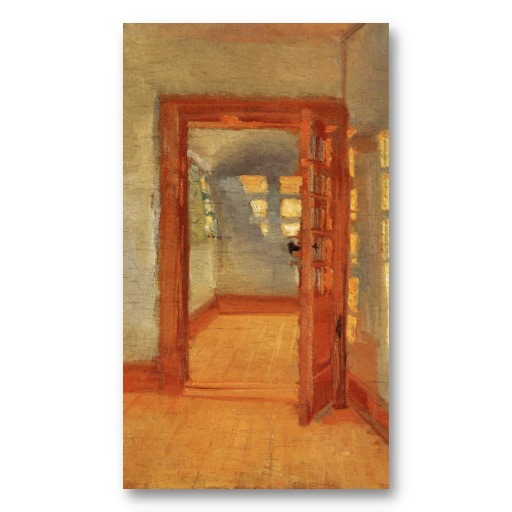
Brondum's Annex by Anna Ancher
Brondum’s Annex by Anna Ancher

So I’m thinking of today as a threshold, not as the end. This month has lived up to the term “challenge.” I had to let go of my paralyzing fear of posting something that was less than perfect. Because I did, I was free write some things I might not have ever written.

The welcoming community of writers also made it possible for me to learn and grow. So much amazing writing has been done this month! And the comments of praise and encouragement were more helpful than you can ever know. I appreciate each and every one of them.

But, as I said, this is not the end. Rather, it is the beginning of a new writing life for me. One in which I’m more attuned to keeping my eyes open for new ideas and insights. One in which I make time every day to write.

Because we’re on the threshold of National Poetry Month, I’d like to leave you with this poem by Rita Dove. I think it applies to writing as well:

The First Book

Open it.

Go ahead, it won’t bite.

Well…maybe a little.

More a nip, like. A tingle.

It’s pleasurable, really.

You see, it keeps on opening.

You may fall in.

Sure, it’s hard to get started:

remember learning to use

knife and fork? Dig in:

You’ll never reach bottom.

It’s not like it’s the end of the world–

just the world as you think

you know it.

Thank you so much to Stacey and Ruth at Two Writing Teachers for hosting this Slice of Life Challenge!
Slice 29 of 31: The Tree that Time Built for Poetry Friday

Image

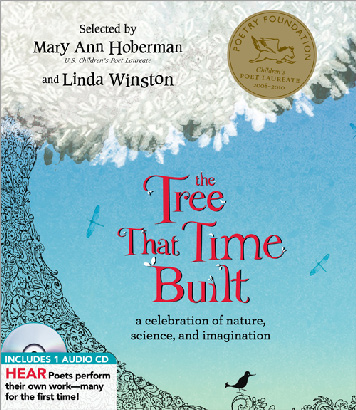
Mary Ann Hoberman is one of my favorite poets. I read A House is a House for Me to my children countless times, and my students love the You Read to Me, I’ ll Read to You series. But somehow I missed The Tree that Time Built (Sourcebooks Jabberwocky, 2009). This anthology, selected by Hoberman and cultural anthropologist Linda Winston, is a “celebration of nature, science, and imagination.” It is a beautiful book: poems are centered on cream-colored pages and line drawings by Barbara Fortin add just the right amount of accent. The poems are organized thematically and notes throughout the book add information about the poets, their craft, and poetic forms. A glossary is included, as well as a list of suggested reading. There is even a CD of selected poems being read by Hoberman, Winston, and others!

Image

I was particularly struck by this poem:

You And I

Only one I in the whole wide world

And millions and millions of you,

But every you is an I to itself

And I am a you to you, too!

But if I am a you and you are an I

And the opposite also is true,

It makes us both the same somehow

Yet splits us each in two.

It’s more and more mysterious,

The more I think it through:

Every you everywhere in the world is an I;

Every I in the world is a you!

by Mary Ann Hoberman

The fifth graders I’ve been working with (more about that here) are fascinated by alliteration. This poem is a perfect example of alliteration’s close cousin, assonance, which they are not familiar with. It also gets to the heart of poetry. When I asked the students the other day why we were reading and studying poetry, I was met by a lot of blank stares. But one brave soul timidly raised her had and said something to the effect of “It let’s us know what people feel.” I told her I agreed with her one hundred percent. “You and I” helps us see that we have more in common than we think, feelings and all.

I wish you all a wonderful Poetry Friday!

Mary Lee (who wrote a much more extensive review of this book here) has the round up at A Year of Reading. Be sure to stop by to read more poetry posts. Thank you also to Stacey and Ruth at Two Writing Teachers for hosting this Slice of Life Challenge!
Slice 28 of 31: Unpacking Poetry

Image

Earlier this month, I attended the TCRWP’s Saturday Reunion in New York City. One of the sessions I went to was “To Lift the Level of Writing, We Need to Lift the Level of Rehearsal and Revision: Mentor Texts Can Teach Not Just Qualities of Good Writing, But Process,” presented by Brooke Geller. The session began with Geller stating that kids need to see the big picture before they begin writing. Knowing what the finished product will look like is the first step in engagement. Geller described the following process to immerse students in the genre being studied, in this case, a research-based argument essay.

Unpacking a Text

  • could be a published text, student work, or your own writing.
  • students should spend time with the text, reading and rereading
  • ask “What are you noticing?”
  • put kids in groups of 3-4, give them a piece of writing in the middle of a big sheet of paper
  • have them mark up the text with their observations and the evidence
  • students should use their prior knowledge about genre– “What do you know about essays?”
  • read first, then read with the eyes of a writer
  • teacher should go from group to group and add her own thoughts
  • come back together–create list of what they think are characteristics of the genre
  • charts can be used as teaching tools

At my school, the fifth grade teachers were getting reading to begin a unit on poetry. We’ve been talking about ways to increase student engagement and the quality of their writing, and I suggested that unpacking poems would be a great way to begin.

The teachers and I selected five poems and mounted them on sheets of butcher paper. At the start of class the next day, the classroom teacher and I modeled the process for the students. We discussed the importance of reading the poem aloud and rereading it several times. Then gave each group their poem and a marker. As they began working, the room was filled with the hum of their reading. The classroom teacher and I moved from group to group, talking and rereading along with the kids. Certain poetic elements were easier to spot; the poem either rhymed or it didn’t. Some students could describe what they noticed, but didn’t know what it was called.  It occurred to me that this activity was also an excellent form of pre-assessment. The teachers and I had a concrete list of what the students knew about poetry.

mentor text  photo-1

photo-3
We left empty space so we can add more elements as they’re introduced.

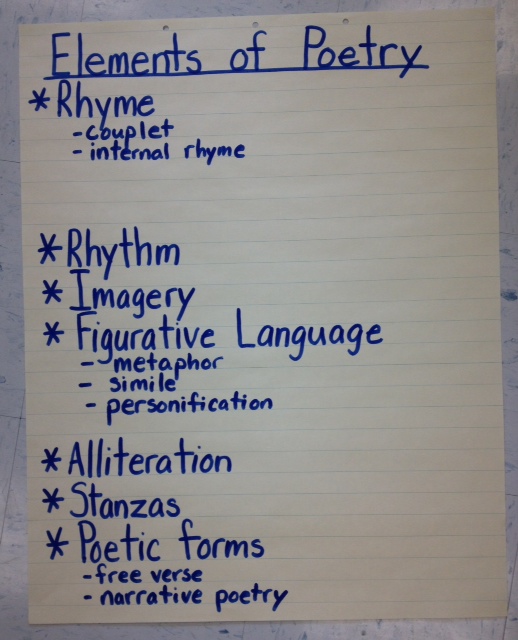
After school, the classroom teacher and I created this chart to use throughout the unit.

photo-2

As students find examples of these poetic elements, they will be added to the appropriate column. These examples will support them when they begin writing their own poems. We will also add columns to the chart as we teach more poetic elements and devices.

A variation on this process suggested by Geller would be to put the same piece of writing on sheets of paper, but have a different focus question on each sheet.

Possible questions include:

  • What makes this text (poetry, essay, etc)?
  • How is this text set up? Why is this important?
  • What is the purpose? How do you know this?
  • How does the author show the heart of the story?

Students could rotate around room, rereading the text in light of each question.

As we reflected on the work of our students, we noticed that engagement had been high and all students participated in the discussions. We also noted that no one had mentioned anything about repetition of words, or the word choices the poets made. And while most students could spot a simile, metaphors were more difficult. Over the next few weeks, we will be crafting mini-lessons to teach these elements.  We will continue to use the wonderful ideas Brooke Geller shared at TCRWP throughout the unit. I’ll let you know how it goes.

Thank you to Stacey and Ruth at Two Writing Teachers for hosting this Slice of Life Challenge!
Slice 23 of 31: What to Bring to a Desert Isle

Image

For her 45th birthday, my cousin asked us not to buy her any presents. Rather, she’d like book and music recommendations. What would we want with us if we were stranded on a desert isle? I could not choose just one of either, and certainly didn’t want to just give her a list. So I wrote her a poem. I don’t think she’ll mind if I share it here.

Image

To a desert isle I’d bring,

Music that would make my soul sing.

Mozart’s Figaro,

Les Miserable,

Broadway musicals,

Nothing macabre.

So many books, its harder to choose,

Too many titles I’d be loathe to lose.

The Book Thief,

Bel Canto,

Cloud Atlas and more,

would help transcend any lonely shore.

What books and music would you want to have with you?

Thank you to Stacey and Ruth at Two Writing Teachers for hosting this Slice of Life Challenge!

Slice 21 of 31: A Book Spine Poem

Image

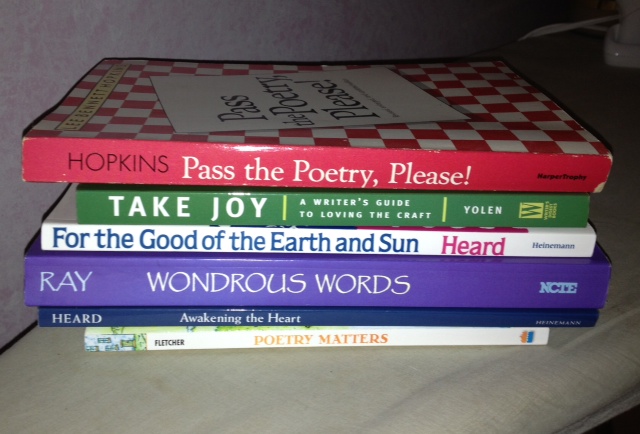
National Poetry Month is just around the corner, and although I teach and use poetry all year, I do make a fuss about all things poetical in April. This book spine poem really wrote itself as I revisited some of my favorite resources:

Image

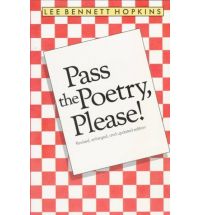
Pass the Poetry, Please!

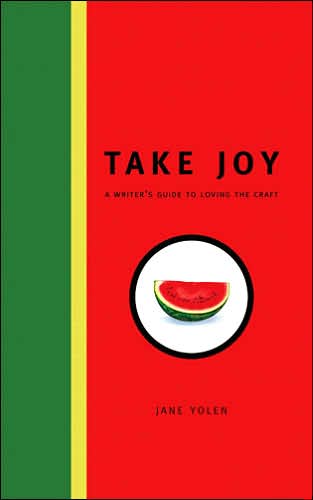
Take Joy

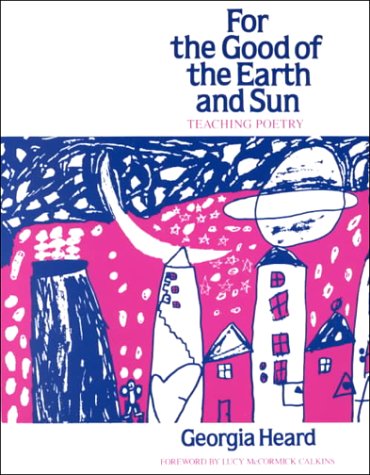
For the Good of the Earth and the Sun

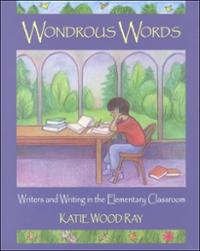
Wondrous Words

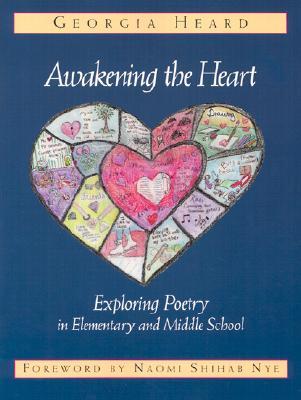
Awakening the Heart

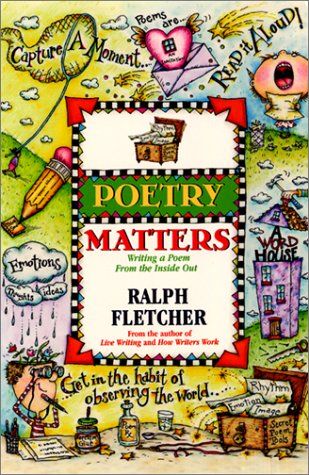
Poetry Matters

I’ve written before about using poetry with students (here, here  and here) and I know I’ll be writing about it again. For now, here’s a snippit of the wisdom contained within each of these excellent resources.

9780064460620Originally published in 1972, Lee Bennett Hopkins’ book is a classic resource for sharing and teaching poetry. Here is a comment he shares from poet David McCord:

“Poetry is so many things besides the shiver down the spine.” (p. 7)

Take-Joy

Jane Yolen is one of my all-time favorite authors. In Take Joy: A Writers Guide to Loving the Craft (Writers Digest Books, 2006), her wisdom and passion for writing permeate every page.

“…poetry, at it’s most basic, is a short, lyrical response to the world. It is emotion under extreme pressure or recollection in a small space. It is the coal of experience so compressed it becomes a diamond.” (p. 87)

043508495X

For the Good of the Earth and the Sun: Teaching Poetry (Heinemann, 1989), by Georgia Heard, is filled with practical advice and inspiration. In chapter 5, “Language:  The Poet’s Paint,”  she offers this:

“Sometimes I pretend a word is like a geode: rough and ordinary on the outside, hiding a whole world of sparkling beauty inside. My job as a poet is to crack the words open to find that inner treasure.” (p. 74)

wondrous-words-writers-writing-in-elementary-classroom-katie-wood-ray-paperback-cover-art

Wondrous Words: Writers and Writing in the Elementary Classroom (NCTE, 1999), by Katie Wood Ray, was a revelation to me. Here were the answers I’d been looking for about how to teach writing. Ray’s thoughts about read aloud confirm what we know in our hearts:

“Our students need to be…fortunate enough to be read to every single day by someone who values wondrous words and knows how to bring the sounds of those words to life in the listening writer’s ears and mind and heart.” (p. 69)

27041

Georgia Heard offers more thoughts about teaching poetry in Awakening the Heart: Exploring Poetry in Elementary and Middle School (Heinemann, 1999).

“One of the most important life lessons that writing and reading poetry can teach our students is to help them reach into their well of feelings–their emotional lives–like no other form of writing can.” (p. xvii)

poetry%20matters

Ralph Fletcher wrote Poetry Matters: Writing a Poem From the Inside Out (HarperTrophy, 2002) for kids, but it’s one of my favorite books about the craft of poetry. Speaking directly to children, he advises them

“There is poetry everywhere. [Write] What you wonder about. In my book A Writer’s Notebook, I wrote a chapter on ‘fierce wonderings’ and ‘bottomless questions.’ These are the kinds of haunting questions you can live and ponder but never really answer. Not surprisingly, these ‘wonderfull’ questions provide great grist for poems.” (p. 51)

Thank you to Stacey and Ruth at Two Writing Teachers for hosting this Slice of Life Challenge!

SOLC 2013 14 of 31: Distant Dreams

Image

Can I say again how incredible this Challenge is and how grateful I am to be participating? People are writing amazing, beautiful stories. My only regret is that I really only have time to read a fraction of them. One of the blogs that I’ve discovered through SOLC is Kelly Mogk’s Project Chameleon. On Tuesday, Kelly shared Brigit Zinn’s heartbreaking story. She also talked about having unclaimed writing dreams that, for whatever reason, we are not fulfilling; goals that we’re not even working toward fulfilling.

This inspired me to back through my notebooks to see what was languishing there. Something for a story? The first lines of a poem?

I found this, written on Jan. 16, 2011

Writing exercise via The Huffington Post: Pick the 7th book from your bookshelf, open to the 7th page, find the 7th line, then write a 7 line poem that begins with that line.

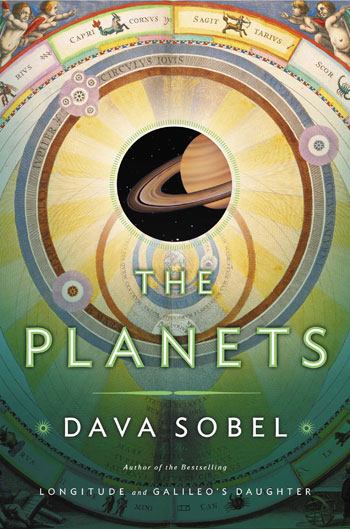
The 7th book: The Planets, by Dava Sobel (Viking, 2005).

sobel_dava_planetscover2

The 7th sentence on the 7th page:  “Even though Pluto remained unexplored, deemed too distant and too difficult to visit, it’s own unexpected moon was discovered accidentally in 1978, through careful analysis of photographs taken by ground-based telescopes.”

Rather unwieldy for a poem. However, I think “too distant and too difficult” has possibilities.

Too distant are you from me now;

Our hearts diverged long ago

Too difficult the journey back

Your dreams led down a different path

Back to today. This feels unfinished, but I don’t think I would change what’s already here. Will I make the time today to work on this poem? It’s unlikely. Over the next week? Maybe. But now it’s back in my head, and I can think about it. I can try to follow it to the end of its path.

Thank you to Stacey and Ruth at Two Writing Teachers for hosting this Slice of Life Challenge!