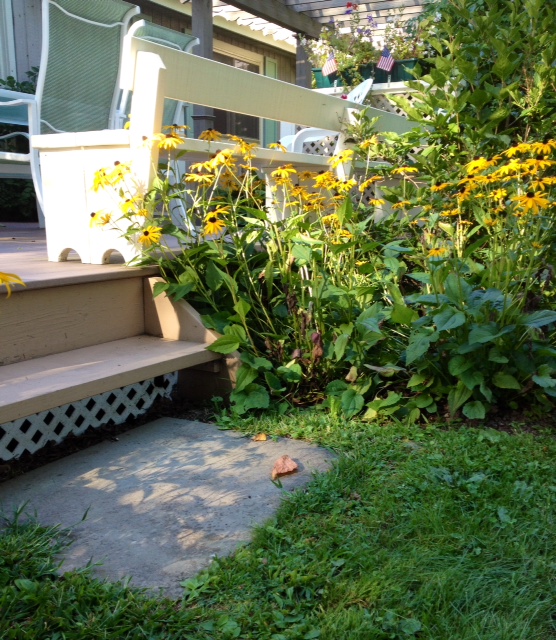
The weather has been beautiful in Connecticut this summer, but several recent cool nights signal a change is on the way. Poets love to celebrate the seasons, and many wonderful poems sing the praises of autumn. Today I’m sharing a poem from Firefly July, (Candlewick Press, 2014), Paul B. Janeczko and Melissa Sweet’s gorgeous new anthology.
“Headline”
A leaf on
the doorstep—
dont even
have to pick
it up to
know the news.
by Cid Corman
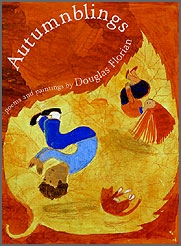
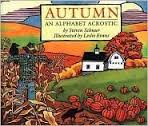
There are several wonderful poetry collections for children specifically about fall. My favorites include Autumnblings, (HaperCollins, 2003) by Douglas Florian, and Autumn: An Alphabet Acrostic (Houghton Mifflin Harcourt) by Steven Schnur. Both books are perfect to use as mentor texts for young poets.
Be sure to visit Jone at Check It Out! for the Poetry Friday Round Up.
When I was a kid, my family always spent a week camping in Rhode Island. We spent many days at the beach, but we also spent time at Beavertail State Park in Jamestown. My parents loved to sit and watch the waves crashing over the rocks and the ships in the bay. My favorite part of being at Beavertail was examining the many tide pools that dotted the rocks when the tide was out. I imagined that I was a marine biologist, studying the seaweed and mollusks that braved the harsh conditions of these rocky oases.
I was reminded of these tide pools last week when a friend and I visited the Yale Center for British Art to see “‘Of Green Leaf, Bird, and Flower’: Artists’ Books and the Natural World,” an exhibit which celebrates the work of “self-taught naturalists and artists [who] recorded and observed the natural world around them from the sixteenth century to the present.” The variety of artistic responses and creativity on display was stunning. In addition to traditional sketches and watercolors, there were collages, works of cut paper, dioramas, and mixed media.
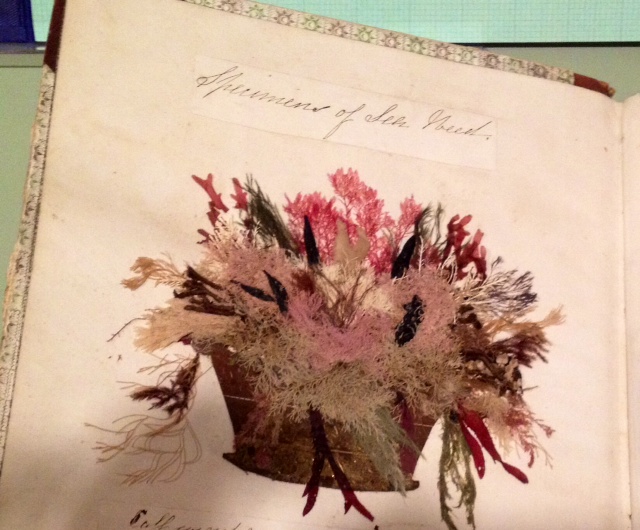
Specimens of Sea Weed, ca. 1840 Yale Center for British Art
I found this collage of sea weed specimens especially charming. Apparently creating this kind of sea weed collage was a popular activity in the 19th century, and E.L. Aveline’s poem, “Flowers of the Ocean, often accompanies such pieces. The poem appeared in The Mother’s Fables, in Verse, Designed, Through the Medium of Amusement, to Convey to the Minds of Children Some Useful Precepts of Virtute and Benevolence in 1812. The title page of this volume urges readers to “Find tongues in trees, books in running brooks/Sermons in stones, and good in every thing.” Not bad advice, and the artwork in this exhibit demonstrates that many people followed it faithfully.
Flowers of the Ocean
Call us not weeds—we are flowers of the sea;
For lovely, and bright, and gay-tinted are we,
Our blush is as deep as the rose of thy bowers;
Then call us not weeds—we are Ocean’s gay flowers.
Not nursed like the plants of a summer parterre,
When gales are but sighs of an evening air;
Our exquisite, fragile, and delicate forms
Are nursed by the ocean, and rocked by its storms.
by E.L. Aveline
“Of Green Leaf, Bird, and Flower” is on display until August 10. If you’re near New Haven, it’s worth the trip. Please be sure to visit Janet and Sylvia at Poetry for Children for the Poetry Friday Roundup.
Thank you, Ruth, for providing this space and giving us the opportunity to pause and celebrate the joys from our week.
June can be a bittersweet time for teachers as we let go of children we have grown to love. This week, I want to celebrate one of these students.
I began working with this second grade girl at the end of November. She had struggled with reading in first grade, but by last September it was clear that she wasn’t making progress. Her parents consented to testing to see if she was eligible for special education, but these revealed that she had average skills and abilities, and therefore not eligible. But she was eligible for the Tier 3 reading support I provide.
When we began working together, she was reading at a level about a year behind where most second graders are in November. She came to our lessons eager to to her best, and began to make slow but steady progress.
As I wrote earlier in the week, I usually have a short read-aloud time during my intervention lessons. About a month ago, I began reading Firefly July (Candlewick Press, 2014), Paul B. Janeczko’s wonderful collection of short poems,to this little girl. She was entranced by Melissa Sweet’s whimsical illustrations and several of the poems quickly became favorites. This line from Robert Wallace’s “In the Field Forever” even inspired her to write her own poem:
Sometimes the moon’s a scythe, sometimes a silver flower.
Here is her poem:
The Colors of the Moon
Sometimes the moon looks like a golden banana.
Sometimes it looks like a white hammock.
Sometimes it looks like a ripe orange.
Sometimes the moon looks like a cookie with a splash of milk.
Sometimes it looks like a red apple.
Isn’t that lovely?
All her hard work has paid off. She is leaving second grade only one level below our end-of-year expectation, and she is no longer mixing up lowercase “b” and “d”. But best of all, she is leaving second grade a poet and a much more confident and enthusiastic reader. Hooray for her!
“Imagination is the beginning of the cognitive process through which we create meaning.”
Betty K. Garner
One morning last week, I found myself following a builder’s pickup truck on my way to work. A long length of yellow tape was trailing out of the bed of the truck. At first, I was slightly annoyed that this tape was slowing me down, but I became so fascinated watching its gyrations that I was sorry when the driver realized what was happening and pulled over to capture the escaped tape.
Coincidentally, I had just finished reading an article by Betty K. Garner called “The Power of Noticing” in Educational Leadership‘s February 2013 issue on creativity. Garner explains that taking the time to really notice something “supplies the raw material for creative thinking” and that “this kind of cognitive engagement stimulates curiosity and creativity.” So when I arrived at school, I rushed to my desk and wrote everything I remembered about what the wayward tape had conjured in my mind. Several days and several drafts later, here is a poem I created out of those images.
Since this is the last Tuesday of National Poetry Month, I hope Mary Lee won’t find this poem’s link to imagination too tenuous and mind if I share it with the readers of her “Our Wonderful World” poetry project.
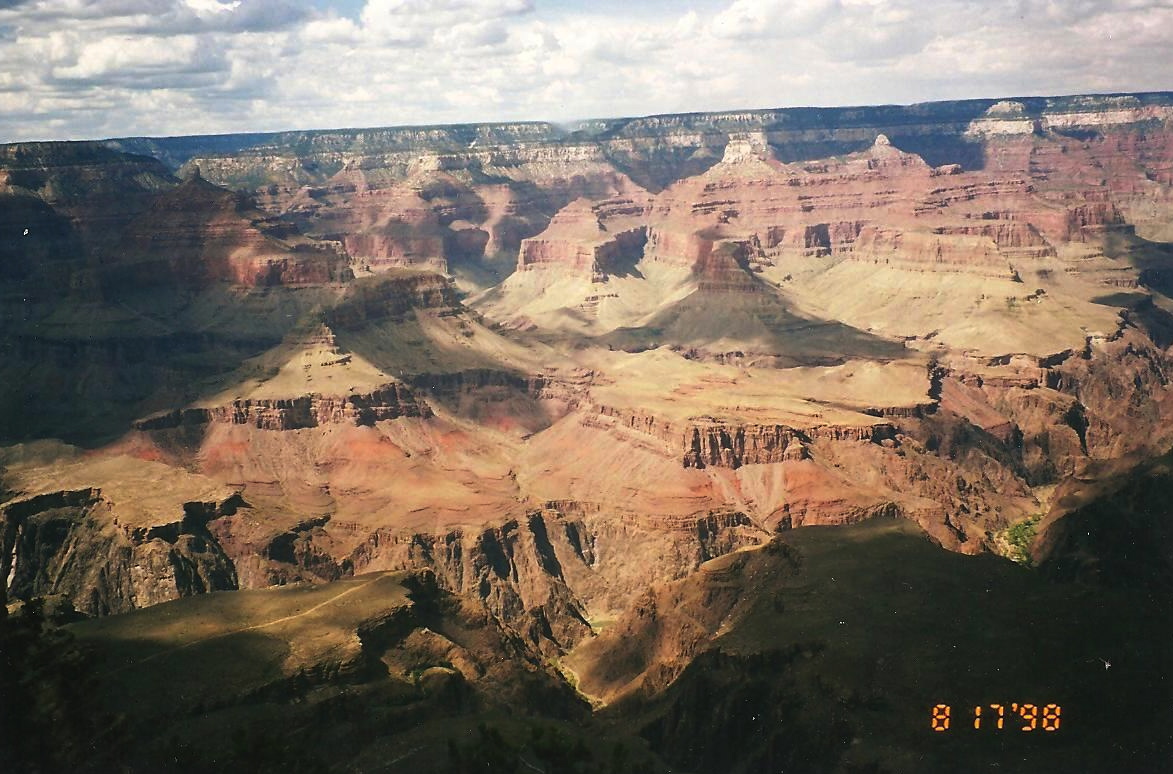
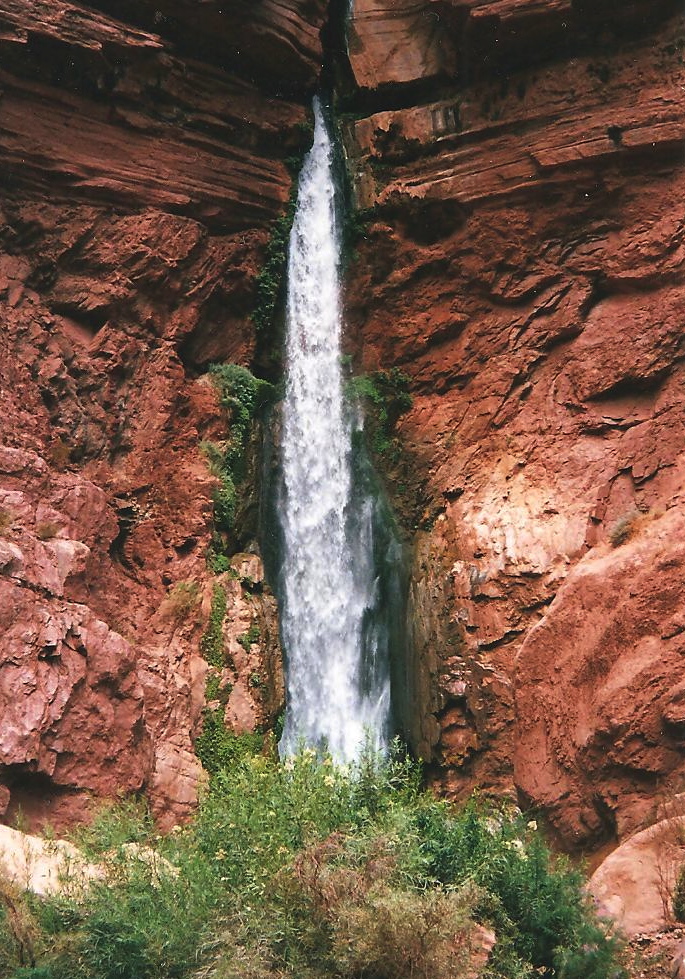
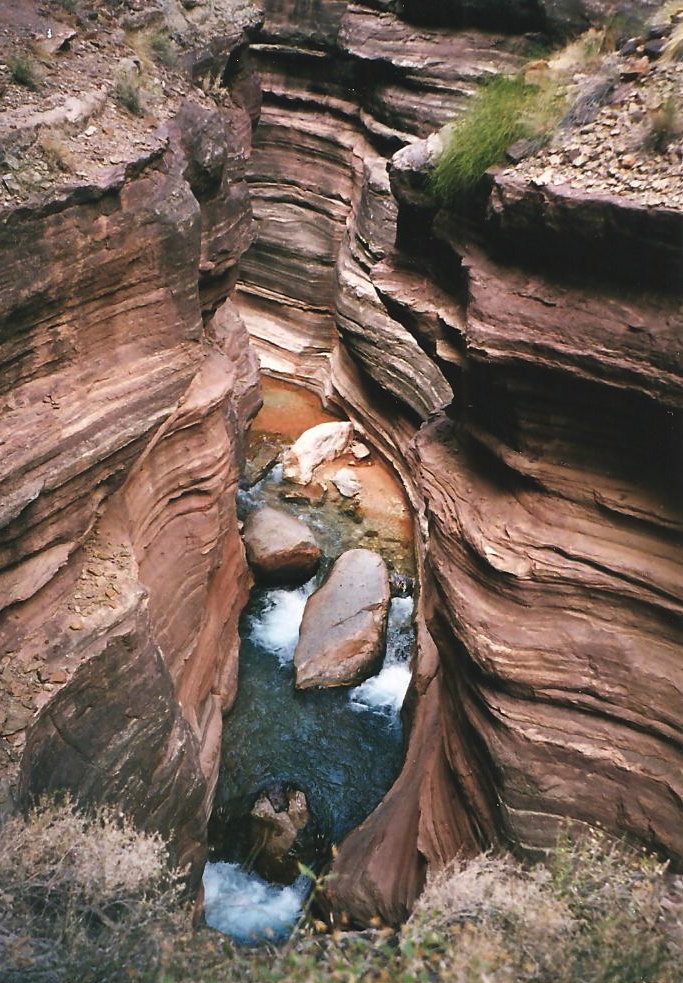
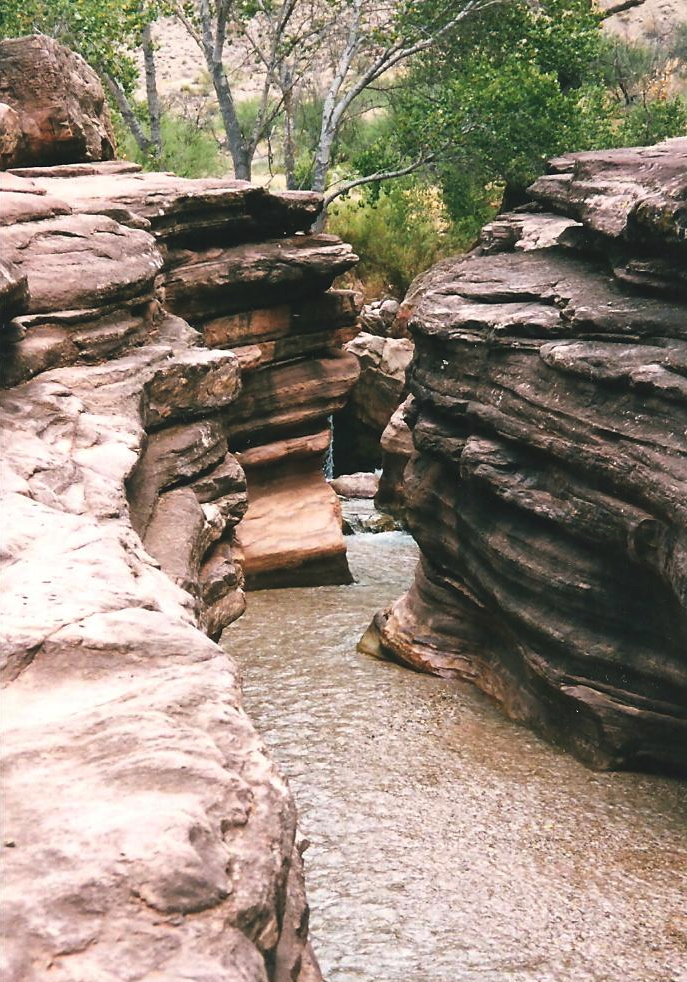
Mary Lee Hahn is celebrating National Poetry Month by celebrating “Our Wonderful World.” Each day, Mary Lee is writing an original poem in honor of either a man-made or natural wonder. Today’s wonder is the Grand Canyon. I have rafted down the Colorado River through the Grand Canyon twice, so I couldn’t pass up this opportunity to write a poem about my experience.
We have hundreds of photos from both of these trips, and I kept a journal during each trip. I have shared memories of our adventures in the past, Lava Fallsand The Legend of the Sanpodohavatulli Expedition. Before attempting to write this poem, I reread my journals, skimmed through many of the pictures, and jotted many notes. But this poem did not come easily. I didn’t know where to start. Then, after listening to Christopher Leheman’s Teacher Poets online workshop this morning, it became clear that I needed to focus on a small sliver of the entire trip. Our hike to Deer Creek was one of the most memorable, so I focused on this beautiful side canyon.
Chris Lehman recently invited teachers to join him in an online poetry workshop, TeacherPoets. He also invited people to respond to the question “Why poetry?” Many smart, insightful responses have been shared here. How to answer this question without restating what so many have already contributed? I decided to read through a few of my favorite poetry resources and create a found poem (some lines are slightly altered to work in the sequence).
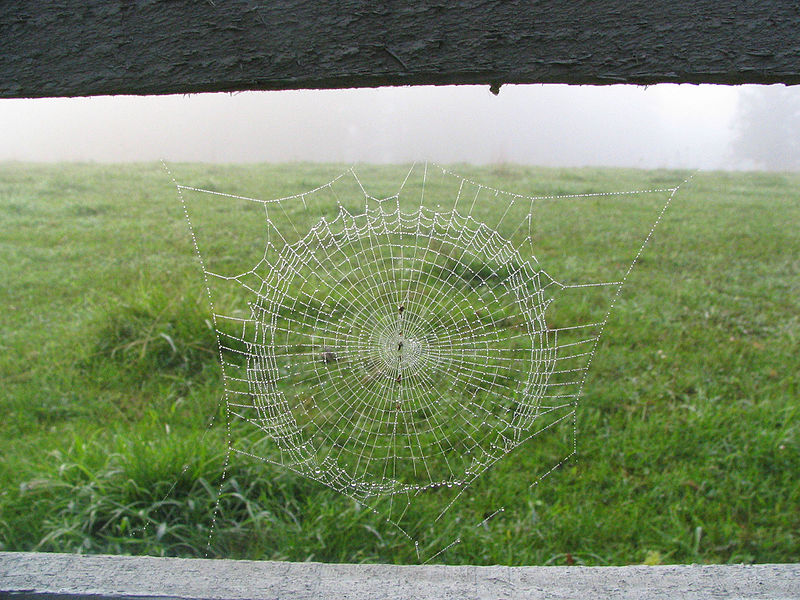
By Phyzome is Tim McCormack (Own work) , via Wikimedia Commons
Why Poetry?
Feel in touch with that universal rhythm.
Lift the veil from the hidden beauty of the world;
Find the mystery in everyday things and objects.
Rekindle a latent sense of wonder.
Have a good eye and a sharp ear.
Find your own voice.
Discover the perfect word for your purpose.
Use fresh imagery that rattles the senses and
Some wordplay that makes it sparkle.
Group them together in a shape or rhythmical structure.
Poems hum,
The breathings of your heart.
And words are nets to capture
The secrets you didn’t know you were keeping.
Here are the authors and sources of these lines, in order:
Lillian Morrison, Seeing the Blue Between: Advice and Inspiration for Young Poets, compiled by Paul B. Janeczko; Candlewick Press, 2003
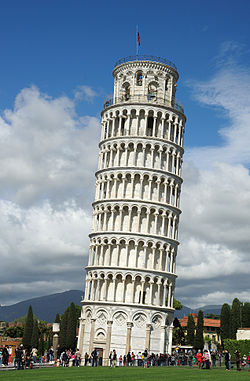
In honor of National Poetry Month, I’m sharing a slice of poetry today. I was inspired by Mary Lee Hahn‘s “Our Wonderful Word” poetry project. Each day during the month of April, Mary Lee is writing an original poem in honor of either a man-made or natural wonder. Today’s wonder is the Leaning Tower of Pisa.
I briefly considered becoming an architect when I was in high school, and although I chose a different path, my fascination with architecture remains. Not long after reading Brunelleschi’s Dome by Ross King, I found Tilt: A Skewed History of The Tower of Pisa, by Nicholas Shrady. When I pulled the book off my shelf last weekend, I was struck by how much the tower looked like a wedding cake. And although I’m sure I’m not the first person to make that comparison, it was the spark I needed for this poem.
How to write this final post of the 2014 Slice of Life Challenge? Yesterday’s post was reflective and full of thanks to everyone who made this challenge possible and who encouraged me through their generous comments. I had planned to do a standard “It’s Monday! What Are You Reading?” post, but as often happens, life intervened and I knew that plan wasn’t going to work.
I spent much of the day revising our fifth grade poetry unit and thought I could write about that, but that didn’t seem appropriate for my final slice. “In the end,” I decided to use a list poem (another list!) I read today, “Things To Do If You Are The Sun,” by Bobbi Katz, as a model for a poem that sums up how participating in this challenge has changed me as a writer.
Things To Do If You’re a Writer
Let words envelop you and swirl inside your head.
Look at a flower bud and see a diver poised on the brink of the board.
Hear an owl hooting and wonder what coded message he’s sending out
into the night.
Bite into a pear and taste summer in its sweetness.
Touch a puppy’s ear and feel the satiny edge of a well-loved blanket.
Breathe in the late winter air and sniff a hint of spring.
Gather these bits and pieces, like a magpie, and weave them
into something wonderful.
Share your creation with friends, who, through reading your words,
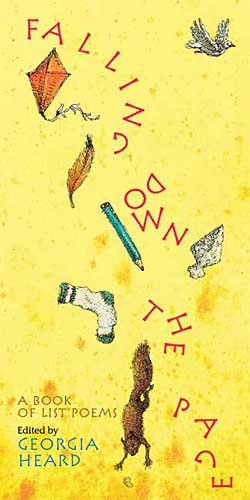
If you’d like to read “Things to do if You Are the Sun,” it can be found in Falling Down the Page: A Book of List Poems (Roaring Brook Press, 2009), edited by Georgia Heard. If you’d like to read other list poems and gather more ideas for using them as mentor texts with children, read Elaine Magliaro’s post at Wild Rose Reader.
“Poetry is a language in which man explores his own amazement.”
~ Christopher Fry ~
Every month, I lead our school’s Language Arts Committee meeting. The purpose of this committee is to promote the language arts and ensure that our teaching is based on the latest research. I usually begin the meetings sharing news from our state Department of Education, upcoming conferences and workshops, and information gathered at conferences I’ve attended. Teachers share lessons they’ve had success with and examples of student work. We always have snacks and these meetings are a nice way for teachers to learn about what’s happening at other grade levels.
I spent much of my afternoon planning tomorrow’s meeting. Since National Poetry Month is just a few days away, I will be sharing poetry resources and have a poetry activity planned. Here’s a preview of what’s on the agenda.
Poem in Your Pocket Day is on Thursday, April 24th this year. We’ll actually be in school on this day. For several years, this day has been during our April break.
Poet-to-Poet Project is “a multimedia educational project that invites young people in grades 3-12 to write poems in response to those shared by some of the award-winning poets who serve on the Academy of American Poets Board of Chancellors.” The resources for this project are incredible: videos of the poets reading their poems, lesson plans, and more. Students can submit their original poems to poets.org for possible publication on the website in May.
Book spine poems are a form of found poetry and are a fun way to ease into poetry. You can read about the basic steps at Kenn Nesbitt’s, our current Children’s Poet Laureate, website, Poetry4kids.com.
Poetry Tag Time is an e-book of 30 original poems for children compiled in 2011 by Sylvia Vardell and Janet Wong. A veritable who’s who in children’s poets contributed a poem after being “tagged” by the previous poet. Each poem is connected in some way. I participated in an activity very similar to this several years ago during an online Children’s Literature class, but it was called a poetry “merry-go-round.” The professor posted the first poem, then a student had to post a poem that linked to the original, and so on. I really enjoyed reading the different ways people connected to the poems, and read many wonderful poems I might never have seen. I asked everyone to bring a poem tomorrow so we can play Poetry Tag.
Thinking about Poetry Tag reminded me of a incredible project Linda Rief shared at NCTE last November. At the beginning of the year, Rief’s students created Heart Maps, an idea from Georgia Heard’s amazing book, Awakening the Heart: Exploring Poetry in Elementary and Middle School. Rief’s students then read volumes of poetry, gathering poems that spoke to them and exemplified an area of their heart map. Students copied these poems out by hand, and gathered them into a “Heart Book.” Vicki Vinton shared a description of this project on her blog, To Make a Prairie.
This seems like a lot to cover in the 40 minutes or so we have for our meeting! My hope is that everyone leaves the meeting with a collection of poems and at least one new idea to try during National Poetry Month. What are your plans for National Poetry Month?
I grew up next door to my grandmother and have many happy memories of hours spent at her house. Many of those hours were spent in her kitchen watching and helping her cook. So in January, when Mary Lee Hahn shared her poem “Recipe,” I was inspired to write a poem about my grandmother and her kitchen. A list of words and phrases grew, but I couldn’t seem to find a way to organize them.
A few days later, Tricia Stohr-Hunt challenged readers to write a pantoum in her Monday Poetry Stretch. As I read about the structure of pantoums, I began to see possibilities for a poem about my grandmother. Then Fran McVeigh shared memories of her grandmother for her Slice of Life Challenge post earlier this week, and her slice prompted me to go back and revise this poem.
UPDATED: My apologies to Margaret at Reflections on the Teche for not thanking her for hosting the Poetry Friday Round Up yesterday. It’s not too late to visit her and read all the wonderful poems shared there.


 Reading to the Core