Slice of Life: “Breakfast of the Birds”

11454297503_e27946e4ff_h    poetry-friday-1-1

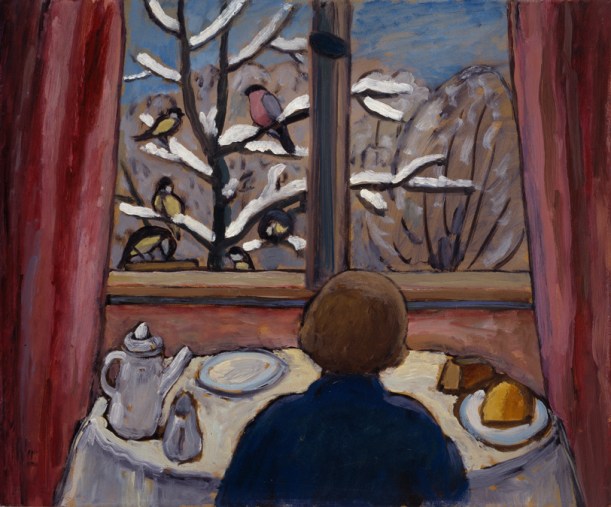
Earlier this week, Tricia Stohr-Hunt posted this painting, by Gabriele Münter, on her blog, The Miss Rumphius Effect:

Gabriele Münter, Breakfast of the Birds, 1934; © 2012 Artists Rights Society (ARS), New York / VG Bild-Kunst, Bonn - See more at: http://nmwa.org/works/breakfast-birds#sthash.eKbv2uZn.dpuf
Gabriele Münter, Breakfast of the Birds, 1934; © 2012 Artists Rights Society (ARS), New York / VG Bild-Kunst, Bonn – See more at: http://nmwa.org/works/breakfast-birds#sthash.eKbv2uZn.dpuf

Tricia invited her readers to write an ekphrastic poem to go along with this painting. I was intrigued by the contrast between the birds socializing outside and the woman sitting down by herself inside. Here is my response:

This morning our old
chestnut tree,
the one you planted
all those years ago,
is wrapped in a cloak
of fine white snow.

Goldfinches and robins,
like confetti scattered in
celebration of the coming spring,
brighten its branches
as they serenade me:
“cheer-up, cheer-up, cheer-up.”

How do they know
that some days are worse than others,
and that this morning,
I miss you more than ever?

© Catherine Flynn, 2016

Thank you to StaceyTaraDanaBetsyAnnaBeth, Kathleen, and Deb for this space for teachers and others to share their stories each Tuesday throughout the year and every day during the month of March. Be sure to visit Two Writing Teachers to read more Slice of Life posts. Also, be sure to visit Robyn Hood Black at Life on the Deckle Edge for the Poetry Friday Roundup.

A Poetry Friday Slice of Life

11454297503_e27946e4ff_h         poetry-friday-1-1

There are collections of one sort or another in every room in my house. The tops of the kitchen cabinets are filled with antique and vintage crocks and kitchen wares. Baskets filled with seashells are everywhere. Bottles, books, McCoy pottery line bookcases and shelves. Is there a word for serial collectors?

Some of these items are quite small, and as I dusted a shelf in my kitchen yesterday, I started thinking about Amy Ludwig VanDerwater’s challenge to readers of Michelle Heidenrich Barnes’s blog, Today’s Little Ditty, to “write a poem about something small, an animal or object you see every day and do not usually give much thought.”

I’ve been working on a poem for this challenge for most of the week and had hoped to share it today but it’s not ready. However, the objects on this shelf made me wonder if I’d chosen the right subject for my poem. Then I realized that it didn’t matter. I could write more than one poem if I wanted to. I certainly have enough small objects to write about!

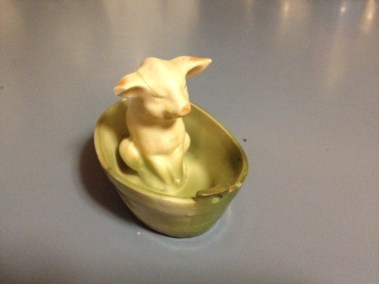
Here’s a draft inspired by a ceramic figurine that sits on a shelf in my kitchen.

“Pig”

A ceramic pig
sits in a shiny
green wash tub,
his ears and nose
the pale pink
of a winter sunrise.

Like Wilbur
as he licked
the buttermilk
trickling
into his mouth,
a blissful smile
spreads across his face.

© Catherine Flynn, 2016

IMG_3756

Thank you to StaceyTaraDanaBetsyAnnaBeth, Kathleen, and Deb for this space for teachers and others to share their stories each Tuesday throughout the year and every day during the month of March. Be sure to visit Two Writing Teachers to read more Slice of Life posts. And don’t forget to stop by Irene Latham’s lovely blog, Live Your Poem, for the Poetry Friday Roundup.

Poetry Friday: Penelope’s Ditty

poetry-friday-1-1

Each month, Michelle Heidenrich Barnes of Today’s Little Ditty shines the spotlight on a noted children’s poet. February’s featured poet, David L. Harrison, left readers with a challenge to compose a poem inspired by the word “ditty.” David explained that “I’m always entertained by how many poems come spinning out of the same word, and they arrive in all sorts of packaging.”

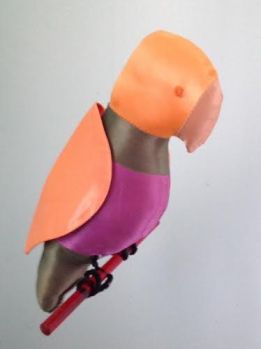
My brain started spinning and something made me remember this stuffed parrot, a baby gift from a friend for my oldest son:

618128b2-02c9-45ce-828d-4e89e44af964

I named her Penelope and hung her over Brian’s changing table. I made up stories about her and used to sing “Penelope the parrot is such a pretty girl…” to him as I dressed and changed him. He used to laugh and eventually sang along with me. After almost thirty years in the attic, she’s a little worse for the wear. She used to have black button eyes, and her colors aren’t quite as vibrant as they once were, but here she is, ready for her updated ditty.

“Penelope’s Ditty”

A parrot named Penelope
grew restless, bored, and fluttery.

She longed to soar over the ocean blue,
not sit in a cage like a stuffed statue.

Spreading her silky feathers wide,
she caught the breeze and began to glide.

Above an island, volcanic and steamy,
she met her mate, oh so dreamy!

Now nestled on her balcony
in the lush rainforest canopy,

she primps, she preens and looks so pretty,
visits with friends, is charming and witty.

Happy to be footloose and free,
Always singing her sweet little ditty!

© Catherine Flynn, 2016

Please be sure to visit Elizabeth Steinglass for the Poetry Friday Roundup.

Poetry Friday: Blue Jays in the Snow

poetry-friday-1-1

I’ve been participating in Laura Shovan‘s Found Object Poetry Project this month, and in addition to drafting a poem every day, I’ve been reading Ted Kooser‘s The Poetry Home Repair Manual: Practical Advice for Beginning Poets (University of Nebraska Press: 2005). Kooser, who served as the U.S. Poet Laureate from 2004-2006, offers exactly that in his plain-spoken, straightforward style. In addition to lots of good advice, he includes plenty of poetry as examples of how “poems freshen the world,” including this beauty from A.R. Ammons.

“Winter Scene”
by A.R. Ammons

There is now not a single
leaf on the cherry tree.

except when the jay
plummets in, lights, and,

in pure clarity, squalls,
then every branch

quivers and
breaks out in blue leaves.

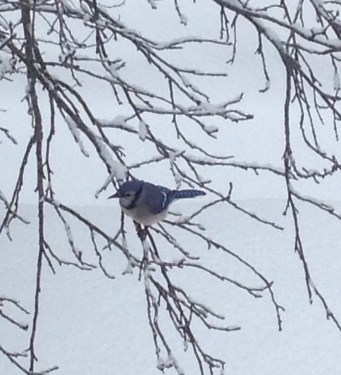
FullSizeRender
A blue jay in our apple tree last winter.

I don’t remember where I first read Siv Cedering’s lovely “When it is Snowing,” but it immediately came to mind after reading “Winter Scene.”

“When it is Snowing”
by Siv Cedering

When it is snowing
the blue jay
is the only piece of
sky
in my
backyard.

Please be sure to visit Donna Smith at Mainely Write for the Poetry Friday Roundup.

Poetry Friday: Found Object Poetry

poetry-friday-1-1

I’ve been participating in Laura Shovan’s Found Object Poem Project this month, and although I’ve missed two or three days, my brain is certainly getting a workout! It’s fascinating to see the wide variety of poems people have written in response to the same object. Even poems with similar word choice have very different tones.

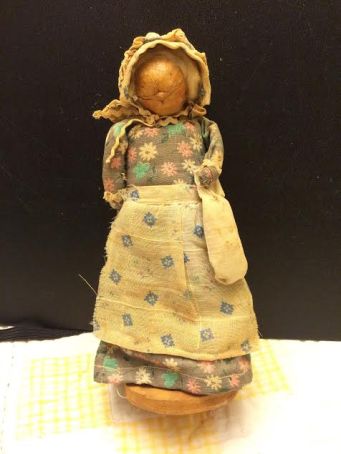
My poem for today was written in response to this Found Object, shared by Linda Baie:

baie-doll

Although this is clearly not a corncob doll, it reminded me instantly of Little House in the Big Woods, and Laura’s corncob doll, Susan.

Bouncing along this rutted trail
toward a great unknown,
I clutch my dolly, Susan,
keeping her corncob body close.
Ma saved one cob
from last summer’s harvest
to make this dolly, just for me
after I helped her husk
the bushels of corn
Pa hauled from the field.
Corn for us to eat,
corn to grind into meal,
corn to feed our brown swiss, Bess,
so she’d share her sweet, creamy milk.

Ma sewed a little dress from scraps of calico
soft as a cloud,
blue as the summer sky,
sprigged with pink and white daisies
like those in our yard.
Fashioned a tiny muslin bonnet,
just like mine,
it’s wide pleated brim shielding our faces
from the blazing sun
as it leads us westward,
toward our new home.

© Catherine Flynn, 2016

You can read more Found Object poems at Laura’s blog. Also, please be sure to visit Kimberely Moran at Written Reflections for the Poetry Friday Roundup.

Poetry Friday: In the Presence of Birds

poetry-friday-1-1

My One Little Word for 2016 is present. I chose this word mainly to help me stop procrastinating, and so far it is helping. But a month after the fact, I’ve realized that another meaning of the word, being mindful and observant of the here-and-now, is also fitting. After all, observation is the work of poets (and teachers, but that’s another story!). This week I came across two poems that are full of presence, and also happen to be about birds. 

“Grace”
by Judith Moffet

It comes when you’re not looking. Has been there
Before you noticed. Blazes forth between
The hickory’s new leaves, their tender green
Massy above you flopped into a chair,
Hot from the garden with an aching back.
Two phoebes flit from tree to eave to tree
Feeding the tyrant nestlings you can’t see;
You watch them labor, mind and body slack

Read the rest of the poem here.

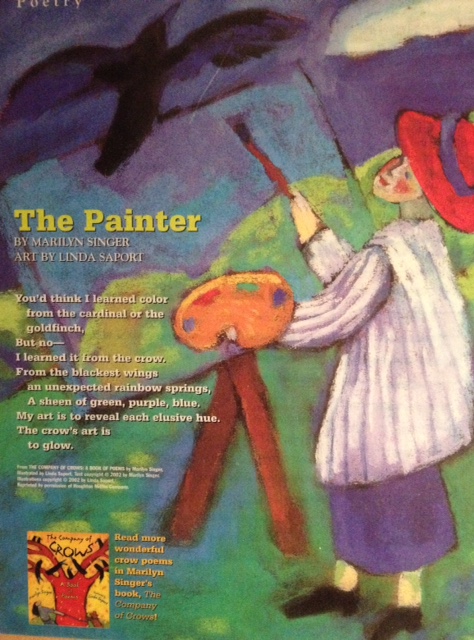
I also found this gem by Marilyn Singer, torn from the pages of Storyworks, in a folder of poems at school:

FullSizeRender-1

Please be sure to visit Tricia Stohr-Hunt at The Miss Rumphius Effect for the Poetry Friday Roundup.

The Poetry Friday Roundup & Irene Latham

poetry-friday-1-1

“The real voyage of discovery consists not in seeking new landscapes, but in having new eyes.”
Marcel Proust

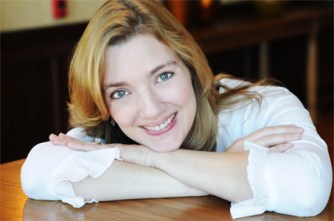
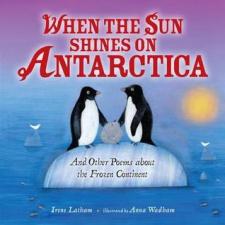
Welcome to the Poetry Friday Roundup! I’m happy to welcome you all today, and I have a special treat for you. To celebrate the publication on Monday of her new book, When the Sun Shines on Antarctica (Millbrook Press), Poetry Friday regular Irene Latham has stopped by to answer a few questions and to share two of my favorite poems from this delightful collection.
           irene1    26543123

In these poems, Irene looks at at the flora and fauna of Antarctica with new eyes and discovers just the right images and metaphors to bring the creatures of this forbidding land to life. At the same time, she skillfully weaves together science and wonder. Fifteen action-packed poems evoke the delicate interaction between a wide variety of species, including penguins, seals, and whales, and the harsh environment of the Antarctic summer, where temperatures remain “well below zero.”

Anne Wadham’s illustrations perfectly complement the playful tone of Irene’s poetry. A glossary and list of books and websites for further reading round out the book, and make it the perfect addition to any classroom library. In conjunction with When the Sun Shines on Antarctica, Irene has launched the Antarctica Explorers Club for young scientists eager to learn more about this remote and fascinating continent and its inhabitants.

Here’s a perfect example of how Irene sees a familiar creature with new eyes:

“Krill in Space”

The sea
is their universe

as they swim,
sway,

drift—

a trillion
tiny astronauts

without
a ship.

They weave
through galaxies

of gobbling
nets,

dodge
black holes

that look like safe
caves to explore—

but aren’t.

And this poem makes me want to go sledding with these penguins!

“Emperor Penguins at Play”

At the top of the hill
they belly flop,

drop,

slide, and glide on built-in sleds.

Out in the ocean,
eager to fly,
they swim,        breathe,         swim
as they leapfrog waves.

In need of rest,
they board an ice ship
where they ride and revive,
play endless rounds
of Red Light, Green Light,

Penguin Says,

and I Spy.

© Irene Latham, 2016. Shared with permission of the author.

Welcome, Irene!

Thank you, Catherine!

The jacket flap copy says that your “exploration of Antarctica began when [you] read The White Darkness by Geraldine McCaughrean. Can you elaborate on how you came to write this book?

Many (all?) of my books arise out of my obsessions. But first, a confession: until I read THE WHITE DARKNESS, I never really gave Antarctica much thought. Like many folks, I lumped the poles together –Antarctica and the Arctic, as if they were one and the same, just on opposite ends of the globe. It never occurred to me that the cartoons showing polar bears and penguins together couldn’t possibly be true! I had a lot to learn, obviously. So, THE WHITE DARKNESS. In addition to being a riveting story, this book oh so poetically places the reader in Antarctica. One line from the book really started it all: McCaughrean describes Antarctica as “a mosaic of white puzzle pieces saying, ‘solve me! Solve me!’ How’s that for an invitation? I started reading everything I could about Antarctica, and eventually poems began to emerge. It helped that I had just done DEAR WANDERING WILDEBEEST, which also focuses on the animals in a unique ecosystem. ANTARCTICA was a logical follow-up, and I’m thrilled to share both books with illustrator Anna Wadham.

Can you briefly describe your research process?

Since I’ve never visited Antarctica, my research involved reading lots of books about Antarctica, reading Antarctica scientist blogs, visiting websites, and talking to experts like fellow Birminghamian James McClintock, who has made nearly 20 research trips to Antarctica! Jim recorded many of his adventures in a book titled LOST ANTARCTICA: Adventures in a Disappearing Land, and I’m thrilled that he and I will be presenting a program together to celebrate my book’s release.

How do you decide on the form for each poem?

I love writing free verse poems, so it’s not wonder these are all free verse — with a little rhyme and alliteration and rhythm thrown in! It wasn’t a decision so much as just the way it happened. The fun part was coming up with imaginative ways to present each animal: Mrs. Weddell shopping for a new coat; an Adelie penguin placing a personal ad; elephant seals wrestling WWE style; and so forth.

Your website is full of wise advice for writers and poets. This is my favorite: “Keep on writing until your words shimmer and shine and actually produce electricity.” Do you have any specific advice for teachers and students who are inspired to use When the Sun Shines on Antarctica as a mentor text for writing nonfiction poetry?

Thank you! Shimmer and shine and electricity are certainly worthy goals, aren’t they? Two things come immediately to mind when I think about advice for writing nonfiction poetry: specificity and surprise. I think the impulse when writing nonfiction poetry is to include all the facts in the poem, kind of a big-picture look at the animal, when what poetry demands is going small, looking closely, choosing one moment or detail that you really want to showcase. Our goal as poets is to explode the moment. So, for Mrs. Weddell, the poem is only about the transition from wooly winter coat to sleek summer style, nothing else. It’s SO HARD to be specific, because that means making tough choices. But tough choices are exactly what being a poet requires. The second thing is to focus on surprise. Sometimes the subject itself is the surprise, such as the brinicle poem in this collection. Who (except Laura Purdie Salas) has ever heard of a brinicle? (View a great video here!) Or the surprise can be making a surprising comparison, like the krill poem, which presents krill as astronauts lost in space. This is where the joy and magic happens — when we as poets allow ourselves to be imaginative and whimsical and creative in the connections we are making between one thing and another. Sometimes it takes many drafts to find that magic, so patience is also required!

Who are your poetic influences? Favorite poets?

My most favorite poets are Poetry Friday poets! I am never more inspired/educated/delighted than when I read Poetry Friday posts. The first poets I loved as a child were Shel Silverstein and Dr. Seuss. As a teen I loved Khalil Gibran. Other well-known poets I turn to again and again are Mary Oliver, Langston Hughes, Pablo Neruda, Naomi Shihab Nye, Sharon Olds. I’ve often said that if I was stuck on a deserted island, I would want with me GOOD POEMS, edited by Garrison Keillor. In the world of children’s poetry, I don’t think it gets any better than Valerie Worth. I keep ALL THE SMALL POEMS AND FOURTEEN MORE on my nightstand year-round.

Your next book, Fresh, Delicious (WordSong/Boyd’s Mill Press) will be out in March. What’s on the horizon for you after that?

Thank you for mentioning FRESH DELICIOUS! I had so much fun writing poems about farmers’ market fruits and vegetables, and I am in love with Mique Moriuchi’s illustrations. Next up is a book I co-wrote with Charles Waters called IT’S NOT BLACK & WHITE. It’s about a white girl (me) and a black boy (Charles) who are forced to work together on a 5th grade poetry project, and they have a conversation about shoes and hair and church and recess and more — all through the lens of race. It’s largely autobiographical, and it was one of the toughest, most rewarding projects I’ve ever worked on. The book will release from Lerner in 2017 with illustrations by Sean Qualls and Selina Alko.

Thank you again, Irene, for stopping by and sharing your poetry and wisdom with us today!

And now for the roundup! Please click to add your link and read more poetic offerings.

Poetry Friday: A Poem Full of Nothing

poetry-friday-1-1

Each month, Michelle Heidenrich Barnes interviews a children’s poet and asks them to leave readers a poetry challenge. This month, Douglas Florian challenged readers “to write a poem about nothing.” 

When Michelle posted this challenge, I was just finishing physicist Lisa Randall‘s new book, Dark Matter and the Dinosaurs (Ecco/HarperCollins, 2015). Some of the science was over my head, but Randall’s theory, that the demise of dinosaurs was caused by “a comet that was dislodged from its orbit as the Solar System passed through a disk of dark matter,” is fascinating. To set the stage for the big event, Randall gives a brief history of the universe and the truly cosmic question of how, or if, our universe arose from nothing. Her statement that “A cause implies there must be something” was swirling in my head as I thought about and drafted this poem.

“Full of Nothing”

An empty pot is full of nothing
but space for chicken soup,
bubbling and warm.

An empty box is full of nothing
but the opportunity for a gift,
adored and cherished.

An empty page is full of nothing
but possibilities for your poem,
honest and true.

An empty hand is full of nothing
but room to hold yours,
calm and reassuring.

An empty heart is full of nothing
but potential for love,
a treasure beyond measure.

© Catherine Flynn, 2016

Please be sure to visit Tara Smith at A Teaching Life for the Poetry Friday Round Up.


Poetry Friday: Poetry in Motion

poetry-friday-1-1

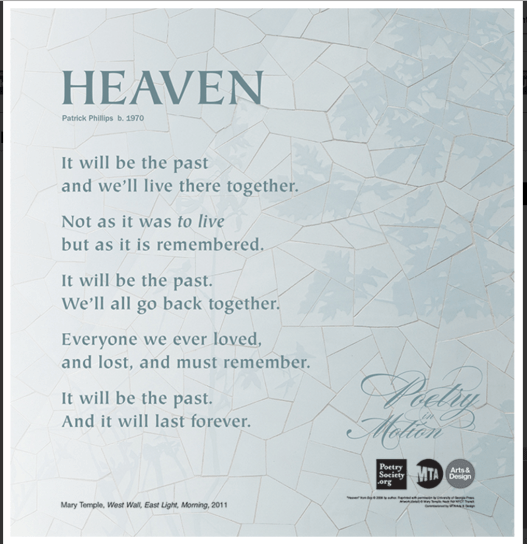
Whenever I’m on the subway, I’m always on the lookout for one of the MTA’s “Poetry in Motion” posters. “Poetry in Motion” is a joint project between the Poetry Society of America and the Metropolitan Transportation Authority. Poetry is placed in “transit systems of cities throughout the country, helping to create a national readership for both emerging and established poets.”

Earlier this week, on my way to hear Colum McCann interview Elizabeth Strout about her new book, My Name is Lucy Barton (Random House, 2016), I was on a packed rush hour train and couldn’t tell if there was a poem in the car or not. However, later in the evening, the train was almost empty and I easily spotted this beauty by Patrick Phillips:

Screen Shot 2016-01-14 at 8.27.51 PM
http://web.mta.info/mta/aft/poetry/poetry.html?year=2014&poem=11

This was a perfect end to a perfect evening. McCann, author of Let the Great World Spin, which won the National Book Award, and the critically acclaimed Thirteen Ways of Looking, and Strout were smart, funny, and insightful. Their conversation revolved around My Name is Lucy Barton in particular and writing in general. And although both Strout and McCann are primarily novelists, their finely observed prose is infused with poetry.

I couldn’t keep up trying to write down all of McCann and Strout’s wise words about writing, but I do remember Strout saying that her eyes and ears are always open, that she loves to listen. I also found this on McCann’s website: “Put your faith in language.” And this “So this, then, is a word, not without love, to a young writer: write.”

Please be sure to visit Keri Collins at Keri Recommends for the Poetry Friday Round Up.

Poetry Friday: “Good Intentions”

poetry-friday-1-1

“Good Intentions”

A Fitbit in my stocking!
A not-so subtle hint
that I should take up jogging,
avoid candy, chocolate, mint.

All went well for a few short days,
but then, oh, cardinal sin!
Out shopping while I was hungry,
my resolve was wearing thin.

“One quick bite is all I need,
a little lunch won’t hurt.”
Justifying my decision,
I vowed not to have dessert.

I savored a juicy burger
and devoured salty fries.
But I can’t track those extra calories,
‘cause I lost my Fitbit down at Five Guys!

© Catherine Flynn, 2016

This is based on a true story, although it didn’t happen to me. When a friend told me she lost her Fitbit at Five Guys, I knew I had to write a poem using that line. I’ve taken a lot of poetic license in this draft, so please don’t judge my friend!

Be sure to visit Mary Lee Hahn at A Year of Reading for the Poetry Friday Roundup. I wish you all a New Year filled with family and friends, happiness and good health, and success with your resolutions!

© Nevit Dilmen [CC BY-SA 3.0 (http://creativecommons.org/licenses/by-sa/3.0) or GFDL (http://www.gnu.org/copyleft/fdl.html)], via Wikimedia Commons
© Nevit Dilmen [CC BY-SA 3.0 (http://creativecommons.org/licenses/by-sa/3.0) via Wikimedia Commons