National Poetry Month: Writing Wild, Day 8

If you have been following these Writing Wild posts, you may have noticed the profiled authors are in roughly chronological order. As we approach the present, there are more writers I am familiar with, even a fan of. That is true today. Award-winning poet Mary Oliver, who died in 2019, is well known and widely loved. Ruth Franklin, writing in The New Yorker, states that Oliver “tends to use nature as a springboard to the sacred.” Kathryn Aalto explains that “a fusion of mystery,prayer, and presence is at the heart of all Oliver’s poetry and prose.” (Writing Wild, p. 92)

Attempting to write a poem after Mary Oliver seems like a fool’s errand. And yet I am compelled to follow her “Instructions for living a life: Pay attention. Be astonished. Tell about it.” I have been following these directions for over sixty years, long before I’d heard of Mary Oliver. But the poetry of those steps has always been in my bones.

I decided the best approach to today’s challenge would be to use one of Oliver’s poems as a mentor text, copy it “word for word, then replace [that poet’s] language with your own.” (I posed this challenge for my critique group back in February.

Deciding on a subject wasn’t difficult. Also on my blog today is a celebration of Leslie Bulion & Robert Meganck’s wonderful new book, Spi-Ku: A Clutter of Short Verse on Eight Legs. I have always loved the beauty and grace of spiders. A spider I observed in my garden one morning became the topic of this poem. I couldn’t find and poems by Mary Oliver about spiders (I looked quickly; there must be one or two). The mentor poem I chose is “The Instant” (found on p. 51 of Devotions: The Selected Poems of Mary Oliver). Oliver’s words from the original poem are italicized.

The Instant
after Mary Oliver

Today,
a small spider,
pearly and round
scrambled through
the high grass, it

seemed desperate to
get away from
my invading hands
but couldn’t move 

fast enough. Was she
swollen with eggs,
impelled by instinct
to protect them?

My heart ached for her,
remembered a feverish boy,
clutched by a silent enemy
one long ago night, and with no sound at all
I was gone.

Draft, ©2021, Catherine Flynn

Previous Writing Wild posts:

Day 1: Dorothy Wordsworth
Day 2: Susan Fenimore Cooper
Day 3: Gene Stratton-Porter
Day 4: Mary Austin
Day 5: Vita Sackville-West
Day 6: Nan Shepherd
Day 7: Rachel Carson
National Poetry Month: Writing Wild, Day 7

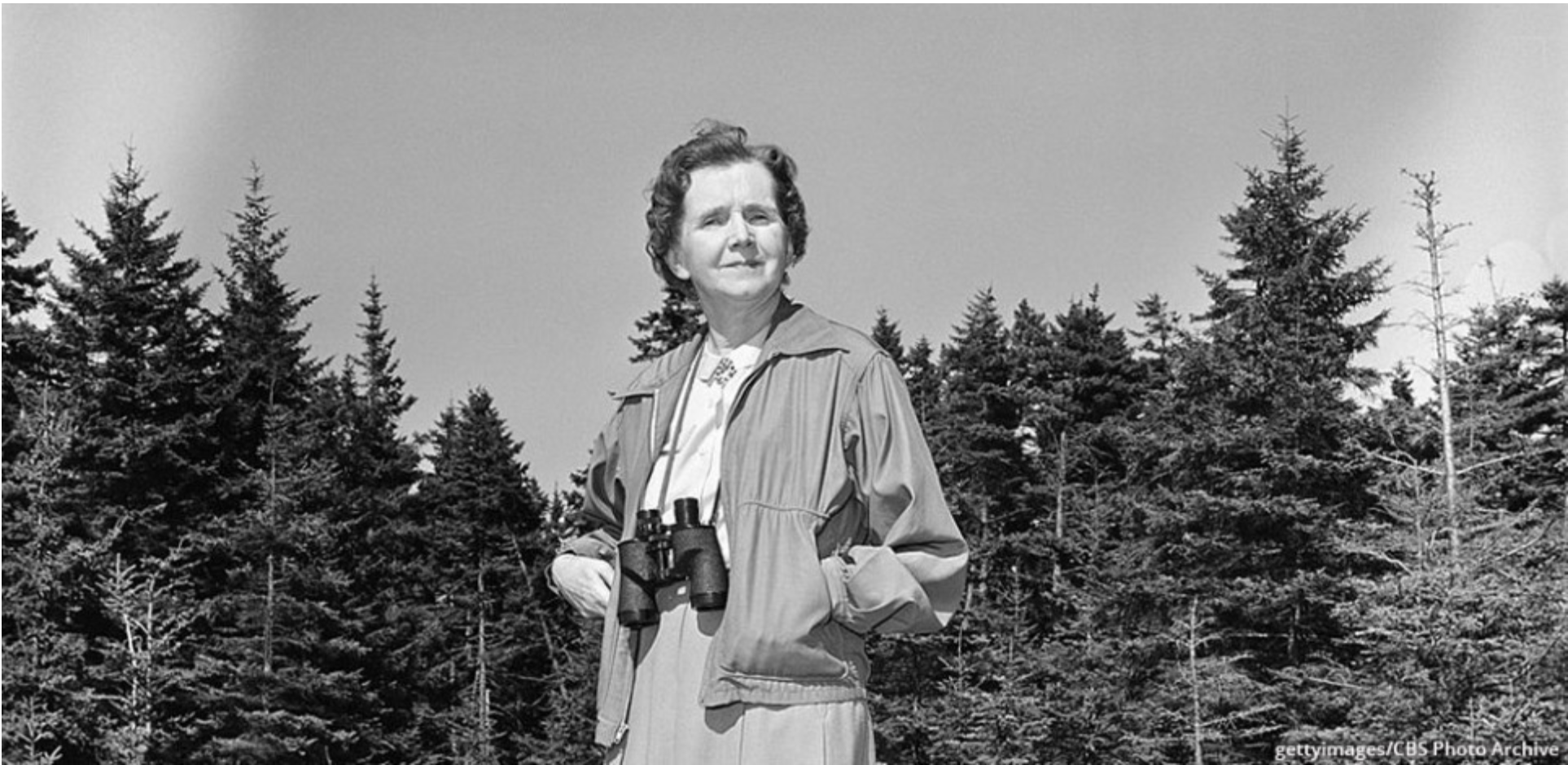
Rachel Carson, today’s profiled author, hardly needs an introduction. She is “a monumental figure in the 20th century and founder of the modern environmental movement.” Of Carson’s Silent Spring, historian Jill Lepore noted that “the number of books that have done as much good in the world can be counted on the arms of a starfish.”

I worry that we’re forgetting the lessons of Silent Spring, that we’ve substituted other pernicious insecticides for DDT. Fighting back against large chemical companies feels impossible. Maybe this project is really just one way for me to try.

Today’s poem if a fib. Fibs are based on the Fibonacci sequence, which predicts patterns in nature. This form seemed appropriate for a poem based on the work of a woman who wrote extensively about how “earth’s vegetation and its animal life have been molded by the environment.” (Silent Spring, p. 16) To create this fib, I chose words at random from page 16 and 17 of Silent Spring. Then, following a syllable count to match, then mirror, the Fibonacci sequence, arranged them into a (hopefully) meaningful sequence.

Earth,
air,
river
alchemy
supports the balance,
powers earth’s enduring nature.

Man’s assault alter’s life’s habits,
modifies the chain,
alarming
forests,
soil,
rain.

Draft, © 2021, Catherine Flynn

Previous Writing Wild posts:

Day 1: Dorothy Wordsworth
Day 2: Susan Fenimore Cooper
Day 3: Gene Stratton-Porter
Day 4: Mary Austin
Day 5: Vita Sackville-West
Day 6: Nan Shepherd

National Poetry Month: Writing Wild, Day 6

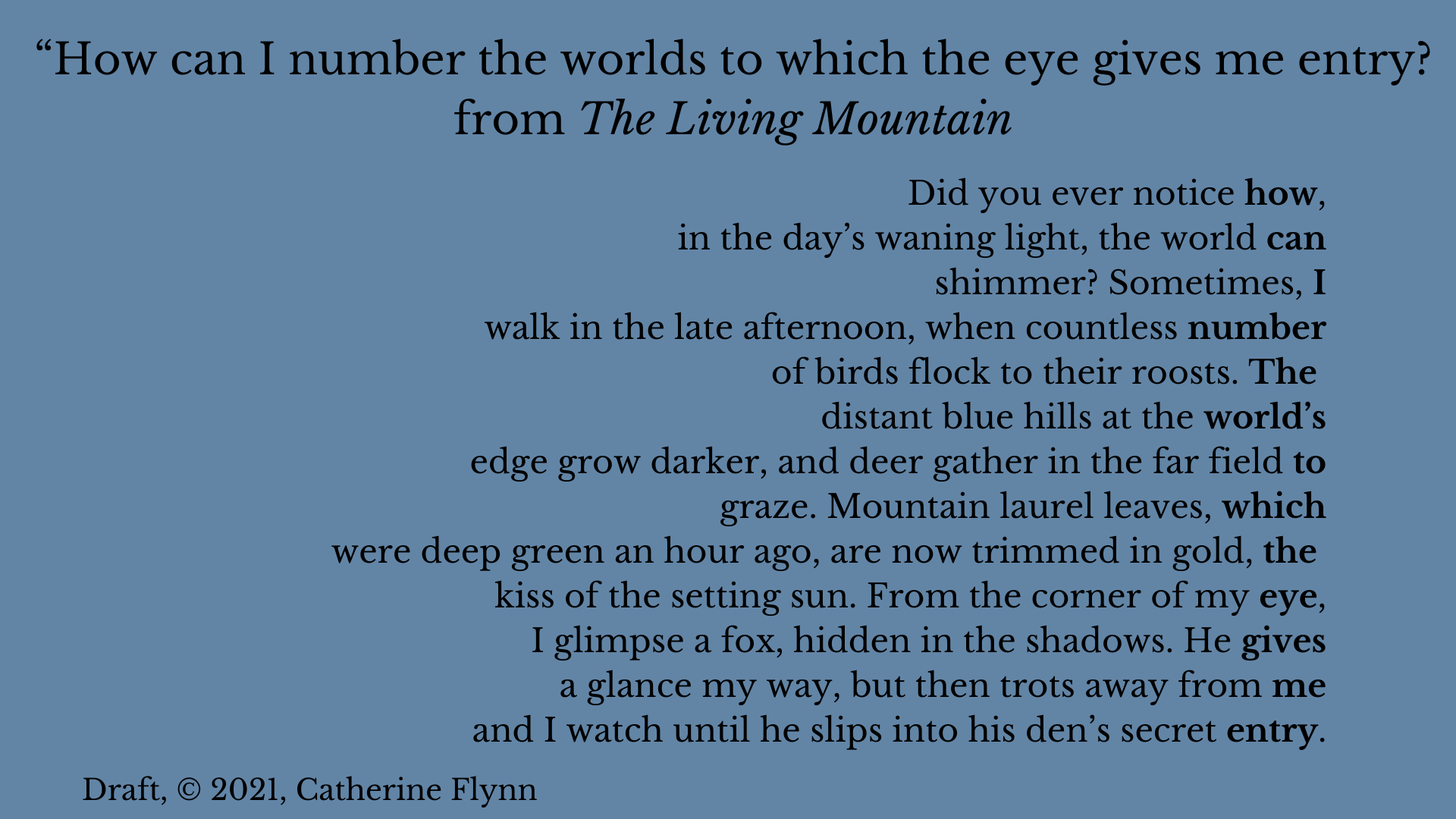
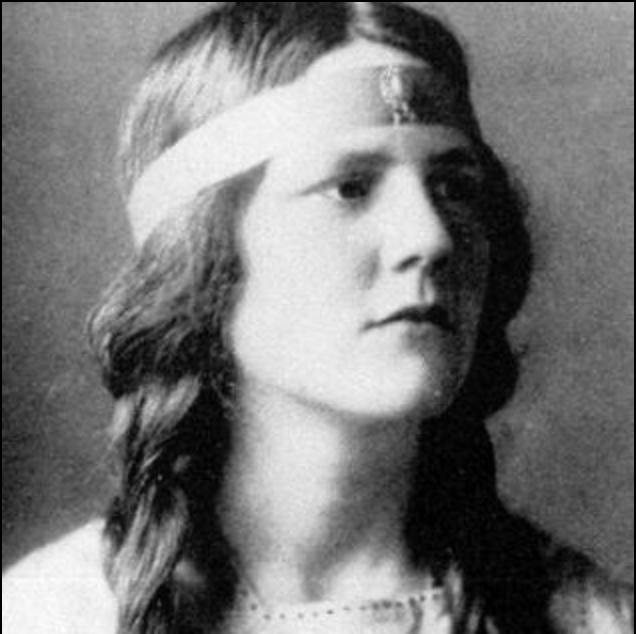
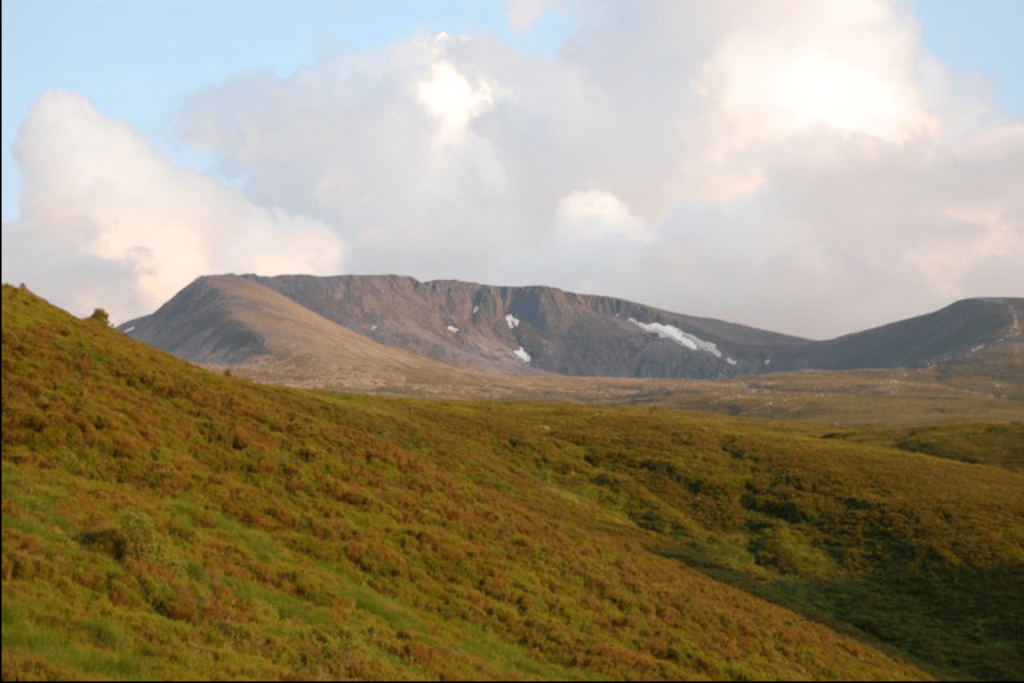
In 1870, Nan Shepherd’s ancestors were farming sheep in the highlands of northeast Scotland. One hundred or so miles away, on the other side of the Cairngorm Mountains, my great-great-grandparents were preparing to leave Inverness for the United States. Their son, John Stuart, eventually settled in the hills of western Connecticut, where he farmed until his death in 1955. I have lived on land that was once part of that farm, where cattle grazed and apple, quince and pear trees blossomed every spring, for the past 35 years. And although the connection is tenuous, I feel a deep affinity for Nan Shepherd and her love of the Cairngorms.

Shepherd wrote three novels and a volume of poetry before publishingThe Living Mountain. It is this book for which Shepherd is best remembered today. Maria Papova describes The Living Mountain as “a most unusual braiding of memoir, field notebook, and philosophical inquiry irradiated with the poetic.”

Choosing a form for today’s poem was a challenge, but in the end I opted for another Golden Shovel.

Previous Writing Wild posts:

Day 1: Dorothy Wordsworth
Day 2: Susan Fenimore Cooper
Day 3: Gene Stratton-Porter
Day 4: Mary Austin
Day 5: Vita Sackville-West

National Poetry Month: Writing Wild

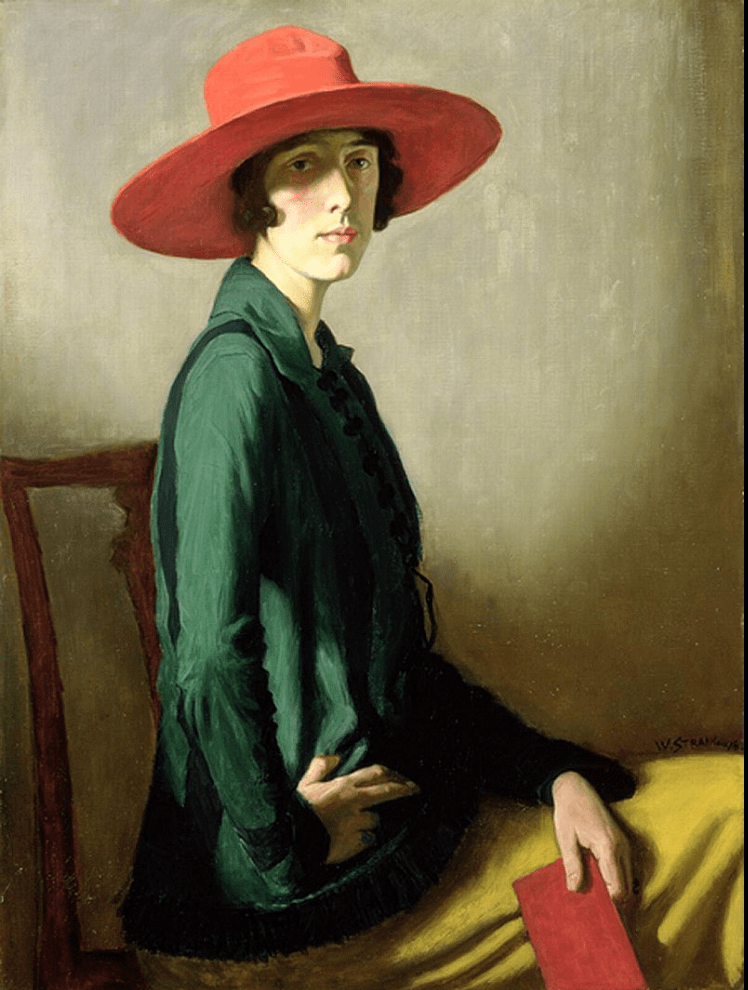
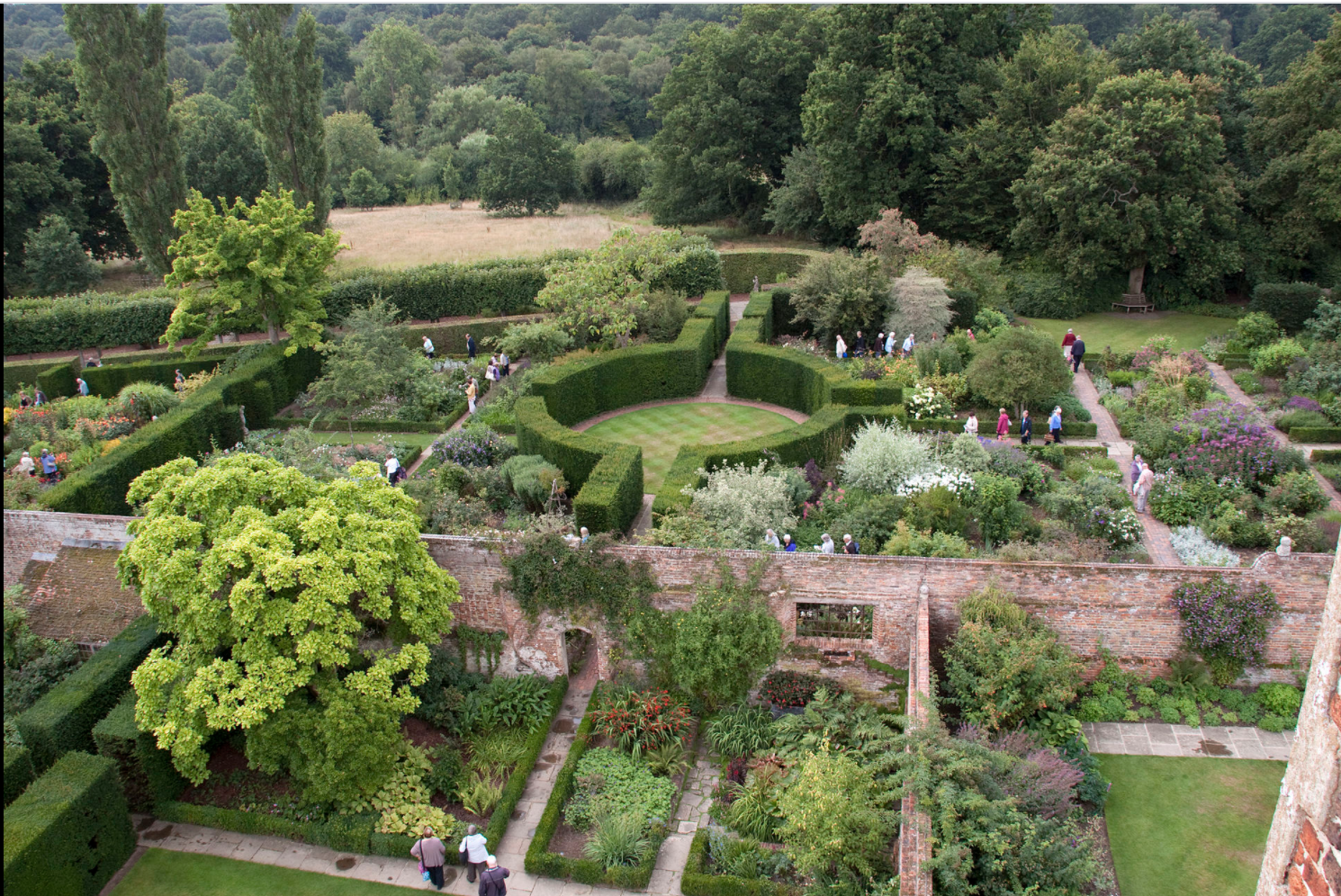
Vita Sackville-West, today’s featured author, is remembered by many as the lover of Virginia Woolf. Many more people remember her today because of the world-famous gardens at Sissinghurst Castle, in Kent, England, which she and her husband, Harold Nicolson, created after they bought the run-down property in 1930. Sackville-West was also a prolific poet, essayist, novelist. For many years she wrote “In Your Garden,” a weekly column about gardening that appeared in the Observer.

Because Sackville-West was such a prolific author (she even has her own Twitter feed!), I decided to gather a bouquet of lines and write a cento. I may have broken the rules a bit by changing tenses to help lines fit together. These words are italicized. Most of these lines come from her poem “The Garden” or her gardening columns.

The Art of Gardening

Beneath the snowy mountains of the sky,
we are watching daffodils come up in the orchards:
Evidence of life.
In April, the angel of the months, the young love of the year,
the possibilities are really unlimited.

Soon, the morning glory climbs toward the sun,
a pale blue drift,
some magic in this humbler sphere.
Overblown with roses,
I like generosity wherever I find it.

Like recurrent patterns on a scroll, 
a vast mauve-and-green cobweb, 
quivers with its own lightness and buoyancy.
Wafts of vanilla come to me,
and everywhere bees go racing with the hours,
eternally renewed evidence 
of a determination to live.
As daily life accepts the night’s arrest,
Autumn in felted slippers shuffles on, muted yet fiery
In one defiant flame before they go.

But you, oh gardener, poet that you be though unaware,
now use your seeds like words
and make them lilt with color nicely flung,
always looking forward to doing something better than before.

Previous Writing Wild posts:

Day 1: Dorothy Wordsworth
Day 2: Susan Fenimore Cooper
Day 3: Gene Stratton-Porter
Day 4: Mary Austin

National Poetry Month: Writing Wild

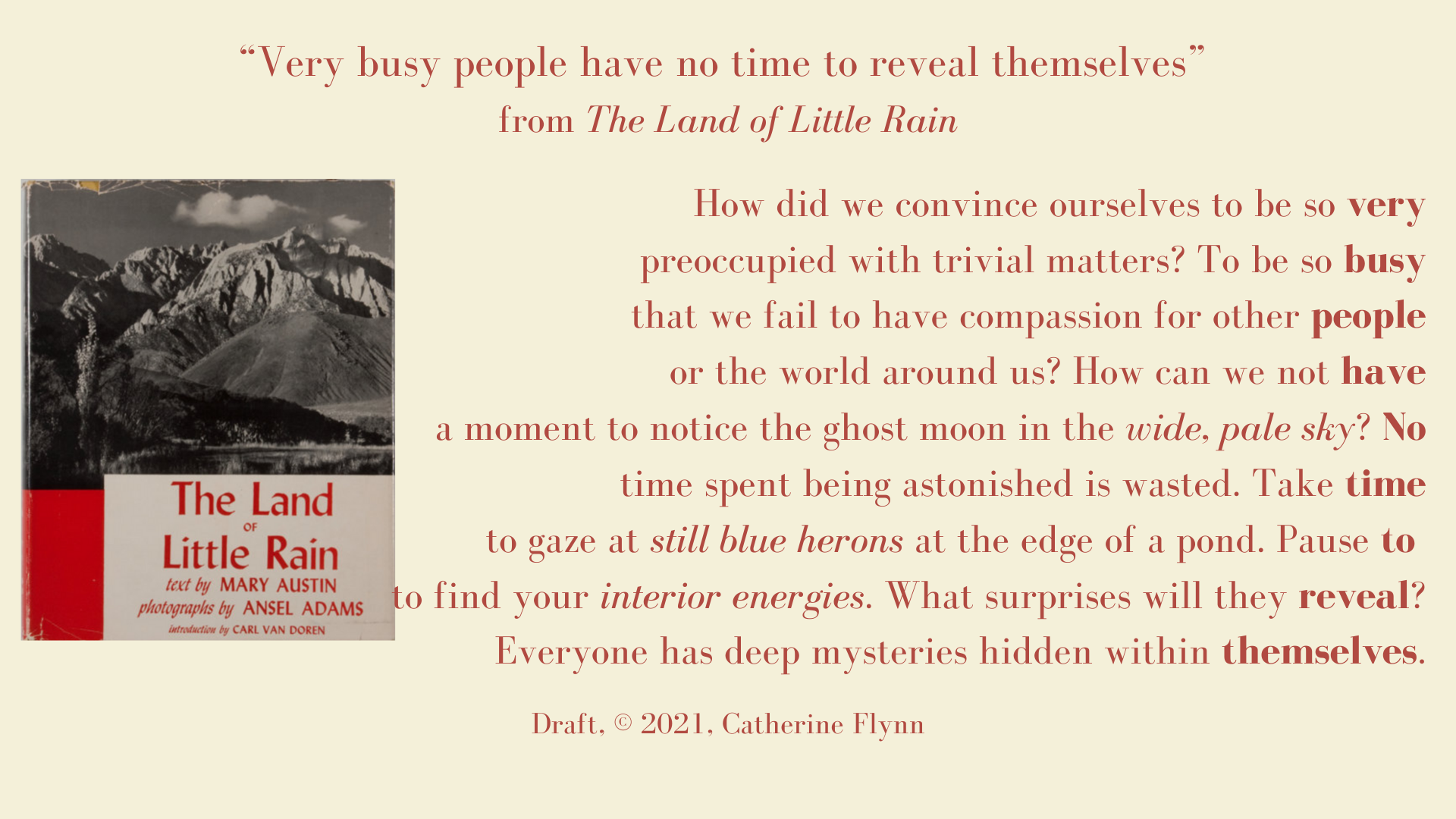
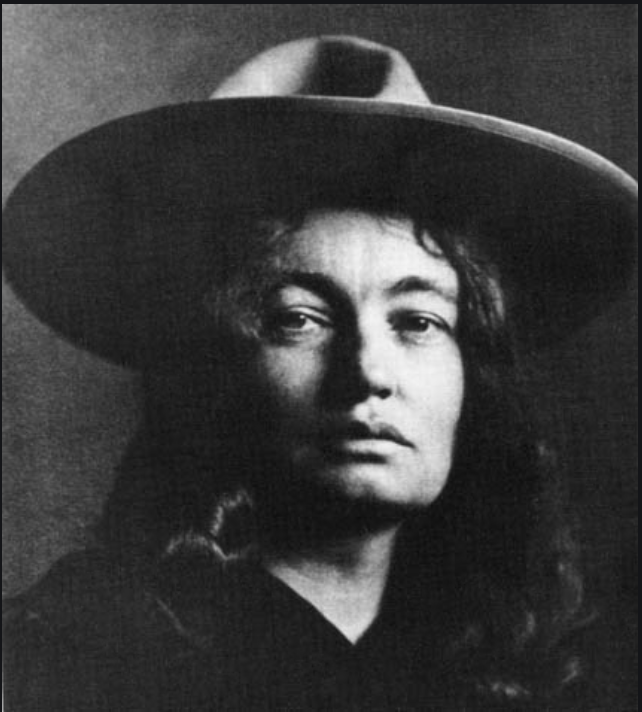
Mary Austin is today’s featured author. Like most of the women profiled in Writing Wild, Austin charted her own course in life. Aalto describes her as “an ethnographer and feminist, activist and mystic, speaker and writer.” (p. 49) In her first book, The Land of Little Rain, Austin paints a vivid picture of the plants, animals, and people of the area between the High Sierra and the Mojave Desert of California. Unlike the region she’s describing, Austin’s writing is lush and evocative: this is a place she knows and loves.

Today’s poem is another Golden Shovel. With so many rich lines to choose from, it was a challenge to pick just one, so I have woven some of Austin’s other phrases into this poem. These words are italicized.

Mary Austin in 1900
photo by Charles Lummis, via Wikipedia

Previous Writing Wild posts:

Day 1: Dorothy Wordsworth
Day 2: Susan Fenimore Cooper
Day 3: Gene Stratton-Porter

National Poetry Month: Writing Wild

Welcome to day 3 of Writing Wild, my National Poetry Month project for 2021. Today’s featured author is Gene Stratton-Porter, an Indiana native and author of novels and nature studies, poetry and essays. Kathryn Aalto describes Stratton-Porter as a “a fascinating figure at the nexus of early twentieth century changes in conservation and gender roles…[a] maverick.” (p. 40) Her best-known book, A Girl of the Limberlost, published in 1909, sounds vaguely familiar to me, but I know I never read it.

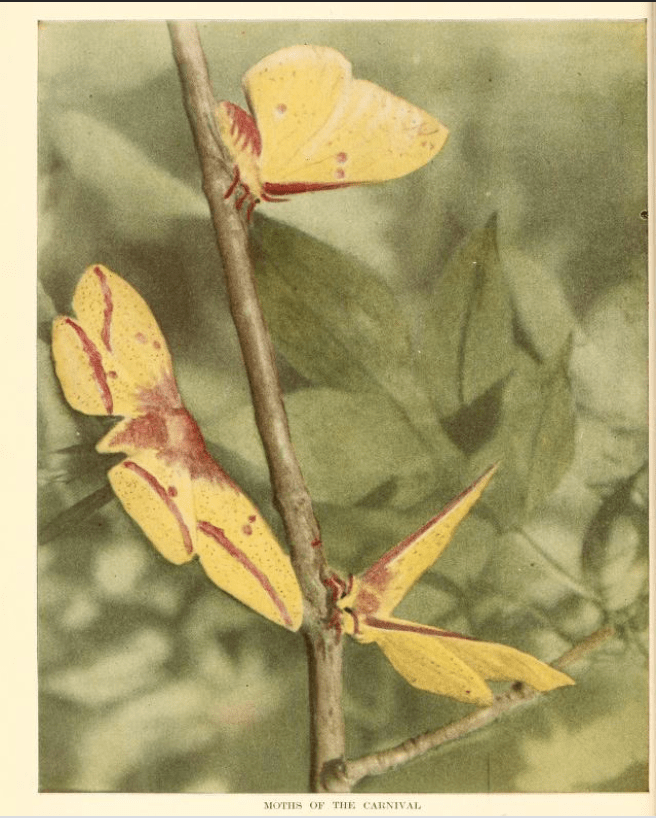
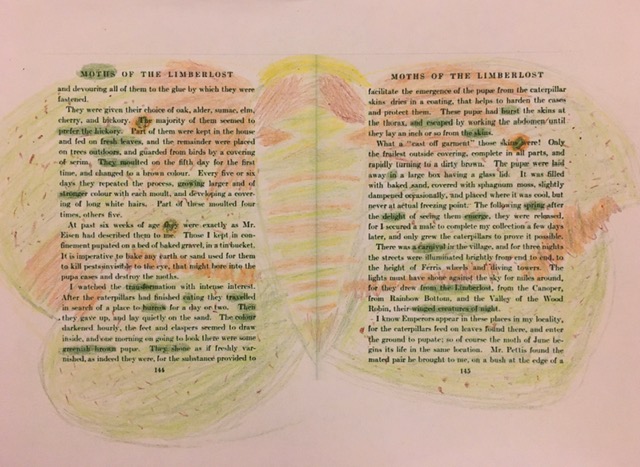
I was more intrigued by Stratton-Porter’s nature studies, many of which are available online. Maybe because I don’t know a lot about them, I was drawn to Moths of the Limberlost (1912). Because I could print pages from this book, I decided to create a blackout poem today. I’ve never tried this form, and finding the right page to work with was like searching for the moths themselves! I finally just picked two pages at random. And although my drawing skills are woefully inadequate, I had fun creating today’s poem.

The Yellow Emperor

moths
prefer the hickory.
Fresh leaves,
outdoors.

They moult,
growing stronger.

Transform.
Eat.
Travel.
Burrow.

Then colour greenish brown.

They shone,
burst,
and escaped
those skins.

In spring delight
emerge,

A carnival
from the Limberlost:

Winged creatures of the night.

Draft, © 2021, Catherine Flynn

Photo of Eacles Imperiales, by Gene Straton-Porter in Moths of the Limberlost

Previous Writing Wild posts:

Day 1: Dorothy Wordsworth
Day 2: Susan Fenimore Cooper

Poetry Friday & NPM: Writing Wild

Welcome to the first Poetry Friday of National Poetry Month! Today’s post is my response to my critique group’s monthly prompt. This month, Linda Mitchell challenged the Sunday Night Swaggers to

See something in many ways, then write a poem patterned after Pat Schneider’s ‘The Moon Ten Times.’

The object and the number of different views was our choice.

Today’s poem is also the second poem in my NPM project, Writing Wild. Susan Fenimore Cooper is the second author featured in Writing Wild: Women Poets, Ramblers, and Mavericks Who Shape How We See the Natural World. Like Dorothy Wordsworth, Susan Fenimore Cooper is remembered mainly in relation to her famous father, James Fenimore Cooper. Also like Dorothy Wordsworth, she was a fine writer and is considered to be “America’s first nature writer.”

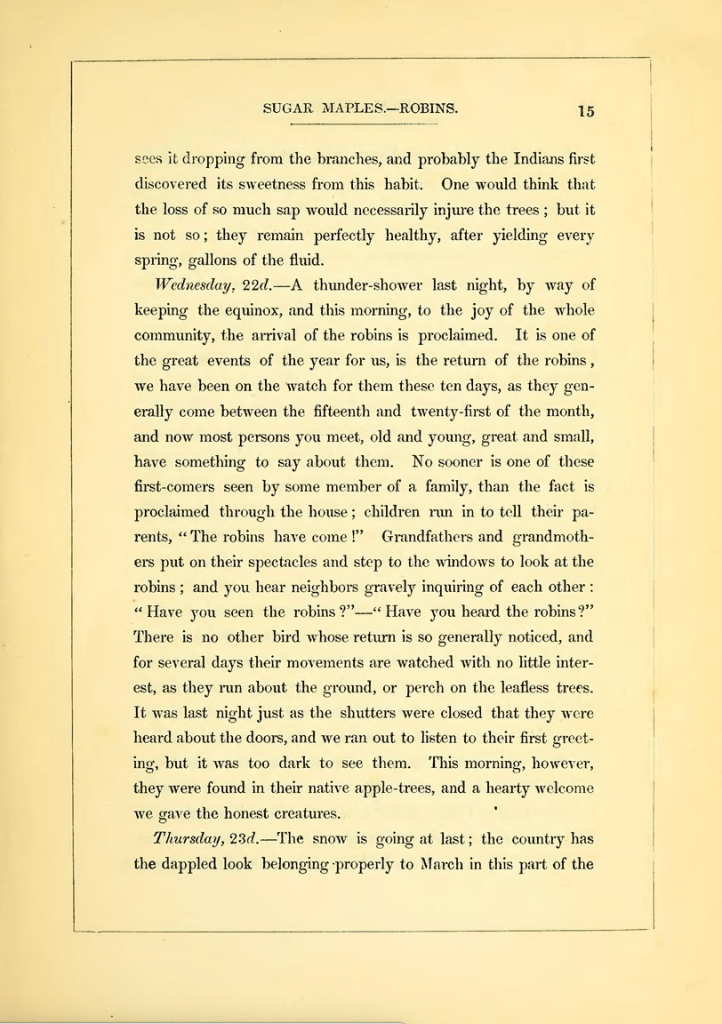
Rural Hours, Susan Fenimore Cooper’s best know work, captures the daily rhythms of the natural world in early-nineteenth century Cooperstown, NY. Her entry for March 22nd describes “the return of the robins.” Since returning robins are still a sure sign of spring, I took this line for the title of a week’s worth of observations of this beloved bird.

“The Return of the Robins” 

Flash of red
against blue sky:
the robins have returned!

A riot of robins patrol 
dormant hay fields:
the borderland between 
winter and spring.

Yellow-billed
tug-of-worm champ:
nightcrawlers beware!

Adorned in feathers fine as silk,
round red breasts
reflect the morning sun.

Feathered flutists 
fill the dawn
with their winsome refrain:
Cheer-up, cheer-up, cheer-up

Scavenger of sticks
and straw:
nestchitect

Mud-daubed nests
filled with a trove of turquoise eggs:
promises for tomorrow.

Draft, © 2021 by Catherine Flynn

Please visit my fellow Swaggers to read their responses to Linda’s challenge:

Molly Hogan @ Nix the Comfort Zone
Linda Mitchell @ A Word Edgewise
Heidi Mordhorst @ My Juicy Little Universe
Margaret Simon @ Reflections on the Teche

Then head over to Mary Lee’s blog, A Reading Year, for the Poetry Friday Roundup and more NPM celebrations!

National Poetry Month: Writing Wild

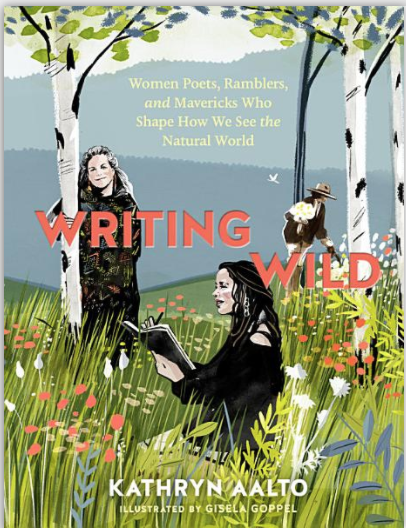
Welcome to “Writing Wild,” my National Poetry Month project for 2021. A few months ago, I came across Writing Wild: Women Poets, Ramblers, and Mavericks Who Shape How We See the Natural World, by Kathryn Aalto. The title immediately drew me in, and I have been savoring this book, which “celebrates 25 women whose influential writing helps deepen our connection to and understanding of the natural world,” ever since. Many of these women were very familiar and some I had heard of, but others were completely new to me. Aalto highlights an additional 47 women whose work is also grounded in the natural world. I soon realized that I could spend the rest of my life reading all of the books written by these trailblazing women. I also realized that these women were a deep well of inspiration. And so this project was born.

My goal this year is to use the writing of each of the 25 featured writers to inspire a poem. (I have chosen 5 of the highlighted authors to round out the list to 30.) Originally, I thought I would do a Golden Shovel every day, but because words and ideas often suggest the appropriate form, I think I’d like to leave my options open.

All of the writers included in Writing Wild pushed back against the expectations and/or restrictions society placed on them. The first featured writer, Dorothy Wordsworth may have been eclipsed by her famous brother, William, but, Dorothy also wrote poetry, letters and kept journals, recording her keen observations of England’s Lake District. Aalto states that Dorothy “wrote so well that both her brother and Coleridge are known to have lifted phrases from her journals.”

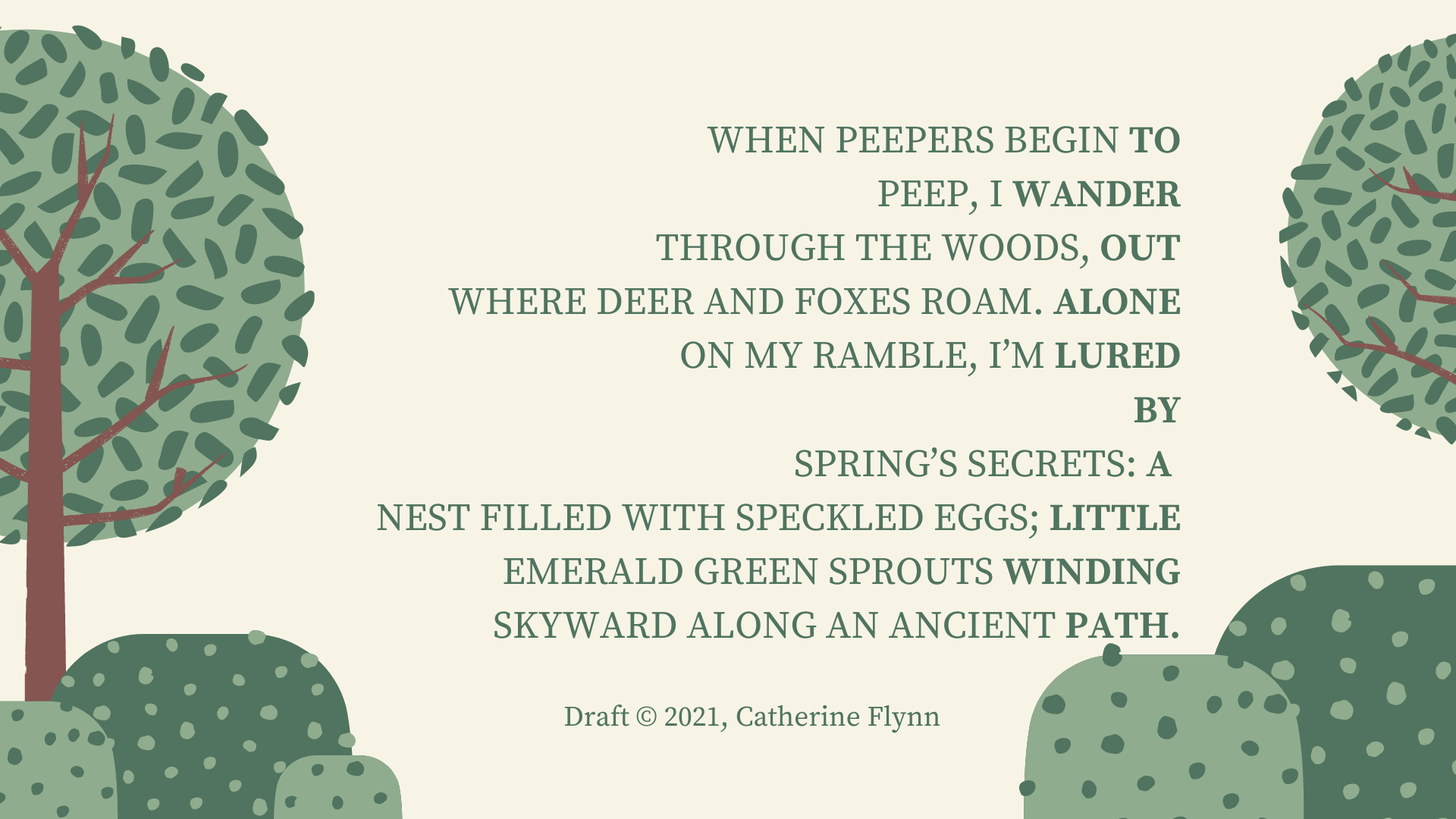
And so I begin National Poetry Month with a Golden Shovel, using the following lines of Dorothy’s from “Grasmere–A Fragment:”

“…to wander out alone.
Lured by a little winding path…”

You can discover more National Poetry Month projects by visiting Susan Bruck at Soul Blossom Living.

Praise Song for the Natural World

As National Poetry Month draws to a close, it’s time to put the month in perspective (my OWL for 2020). Twenty-four poems in thirty days is short of my goal of posting a poem every day. BUT, it is more than I have ever managed in April. I’m not going to bore you with reasons or rationales for why I didn’t post everyday; you know them all. What I will say is that even on days I didn’t post, I was writing, reading, thinking, observing. In other words, I was being a writer. I have learned much during this month of writing that I will strive to carry forward. Thank you to everyone who followed along on my meanderings. And congratulations to everyone who completed 30 poems in 30 days. I admire your perseverance!

This poem was inspired by and is modeled after Elizabeth Alexander’s stunning “Praise Song for the Day,” which she read at President Barack Obama’s first inauguration.

Praise Song for the Natural World

Each day, wild creatures go about the work of survival.
A vibrant bluebird flits through the undergrowth
in pursuit of an alluring female.

High in a pine, a nesting hawk surveys
the countryside, screeching in protest
at a mob of pesky crows.

All around, color is brightening the drab world.
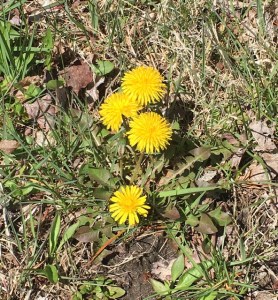
Brilliant yellow dandelions are open for business
and hungry bees buzz joyously among them.

Violets sprinkle the hillside like confetti
And every shrub and tree is wrapped
In a fine haze of green or pink or red.

In the pond, clumps of frogspawn
are silently, mysteriously on their
journey of transformation.

Praise song for their confidence, their
optimism in the face of a fickle world,
for their honest pursuit of life.

Praise song for every blossom, every nest, every egg.

Draft, © Catherine Flynn, 2020


Previous “News From the Natural World” poems:

April 29: A Flamboyance of Flamingos
April 27: A Northwoods Lullaby
April 26: A Paddling of Mallards
April 25: World Penguin Day
April 24: Save the Birds
April 23: An Earth Day ABC
April 21: Nature’s Harmony
April 20: Crowns of Moss
April 19: Propagation
April 18: At the Pond
April 17: The Red Chair
April 16: Dear Venus
April 15: Listen
April 14: Ode to a Tide Pool
April 11: What Does A Bird’s Egg Know?
April 10: Clusters of Clover
April 9: Song of the Pink Moon
April 8: Jewel of the Jungle
April 5: Phantom of the Forest
April 4: To Build a Nest
April 3: Apple Cake
April 2: Specimen
April 1: Forest Snail

News From the Natural World: A Flamboyance of Flamingos

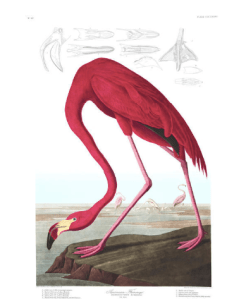
One of the challenges posed by Audubon Alaska for its month-long Bird Poetry Corner was to write an ekphrastic poem. They provided a photograph to use as inspiration, but I recently saw this video of flamingos let loose in the Denver Zoo and knew a flamingo poem was about to take flight. Watching this video was also inspiring. Audubon did paint this stunning, if somewhat stern looking, flamingo:


John James Audubon, 1838

A flamboyance of flamingos
march in formation
like an army of wind-up tin soldiers.
As they parade, heads are bobbing
up and down
on sinuous necks,
pivoting from side to side
seeking their one true love.

Suddenly, their wings rise,
And a multitude of roses
burst into bloom.

Draft, © Catherine Flynn, 2020

Previous “News From the Natural World” poems:

April 27: A Northwoods Lullaby
April 26: A Paddling of Mallards
April 25: World Penguin Day
April 24: Save the Birds
April 23: An Earth Day ABC
April 21: Nature’s Harmony
April 20: Crowns of Moss
April 19: Propagation
April 18: At the Pond
April 17: The Red Chair
April 16: Dear Venus
April 15: Listen
April 14: Ode to a Tide Pool
April 11: What Does A Bird’s Egg Know?
April 10: Clusters of Clover
April 9: Song of the Pink Moon
April 8: Jewel of the Jungle
April 5: Phantom of the Forest
April 4: To Build a Nest
April 3: Apple Cake
April 2: Specimen
April 1: Forest Snail