Poetry Friday: Finding Beauty

It’s the first Friday of the month, so it’s time for another Sunday Night Swaggers challenge. This month, Molly Hogan challenged us to “find beauty in the ugly” by reinventing “the world around you (or one aspect of it) by shifting your lens to see the beauty in what at first seems to be ugly or unnoteworthy.”

I had a few ideas, but hadn’t gotten far with any of them before I went to NCTE in Baltimore a few weeks ago. There, I attended Georgia Heard, Rebecca Kai Dotlich, Ralph Fletcher, and Lester Laminack‘s session, “Seeing the World Like a Poet.” During her part of the presentation, Georgia explained that the job of the poet is to take “the film of ordinary off of everyday objects.”

These words were in my mind the next morning while I was waiting in line to check my coat. My eyes were drawn to a building across the street that was glowing in the bright morning sun. Then, as I turned to give my coat to the attendant, I noticed this:
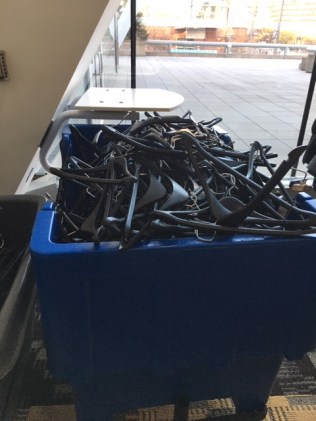
At first glance, this jumble of hangars is decidedly everyday and unnoteworthy. But take a closer look…

A Wedge of Hangers

Like pinioned swans,
captives on a pond,
a wedge of hangers
wait, silent and still.

Soon each will rise,
basking in the embrace
of coats, grateful
for the support
of their plastic wings.

© Catherine Flynn, 2019

During the same session, Ralph Fletcher shared that “photography uncovers surprises” and that we should “follow where they lead.” As I was writing this poem, I was surprised to learn that a wedge is in fact a collective noun for swans. So even though these hangers aren’t exactly wedge-shaped, I think wedge is the perfect word to describe a group of hangers.

Please be sure to visit my fellow swaggers to see where they found beauty this month:

Molly Hogan @ Nix the Comfort Zone 
Linda Mitchell @ A Word Edgewise
Heidi Mordhorst @ My Juicy Little Universe
Margaret Simon @ Reflections on the Teche

Then be sure to visit Tanita at fiction, instead of lies for the Poetry Friday Roundup.
It’s Monday! What Are You Reading? Picture Book Pairs

Image

Last week my school held its spring book fair. I have loved book fairs for as long as I can remember. All those new books, beckoning, begging to be picked up and read. This year I found some real treasures.

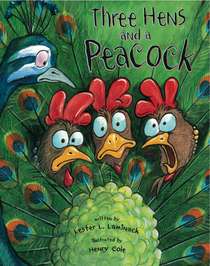
Three Hens and a Peacock (Peachtree, 2011) by Lester Laminack and illustrated by Henry Cole, was the first to catch my eye. This is the story of an interloper in the hen house and how he upsets the routines of life on Tuckers’ farm. By the end, life is back to normal, and the everyone has learned a lesson about not trying to change who they are.

Image       Image

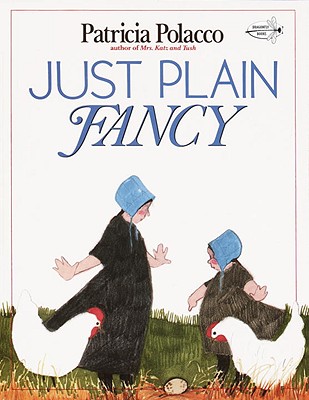
This book reminded me of Just Plain Fancy (Bantam Books, 1990), by Patricia Polacco. Polacco’s story is set on an Amish farm, where the unexpected guest arrives in the form of an egg. Two little girls have the responsibility for caring for the hens, and when they find the unusual egg, they add it to one of the nests in the hen house. Imagine their surprise when they realize that this bird is no hen!

Pairing these books would be a good way to address CCSS Anchor Standard 9: “Analyze how two or more texts address similar themes or topics in order to build knowledge or to compare the approaches the authors take.”  This work begins in Kindergarten by having children “compare and contrast the adventures and experiences of characters in familiar stories” with prompting and support.

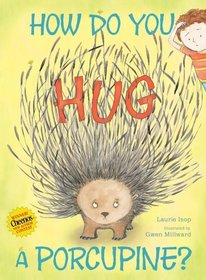
Actually, all of the books I found at the book fair could be used to meet this standard. How Do You Hug a Porcupine? (Simon & Schuster, 2011) by Laurie Isop and illustrated by Gwen Millward, answers this very prickly question. The boy who wants to attempt this, shown scratching his head on the cover, tries several very creative ways to protect himself from the porcupine’s quills. This book is a perfect mentor text for young writers. They could come up with their own solutions to this problem, or they could pose a similar question to answer.

Image      Image

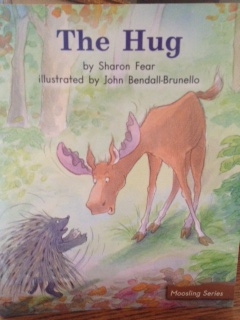
This book initially got my attention because several of my students had just finished reading The Hug, by Sharon Fear. This book is part of the Fountas & Pinnell Leveled Literacy Intervention series and is published by Heinemann. There are several stories about the main character, Moosling, in this series. Moosling is a loveable moose who gets himself into one predicament after another. In The Hug, Little Pins needs a hug so his good friend Moosling figures out how to give him one.

bookszisformoose

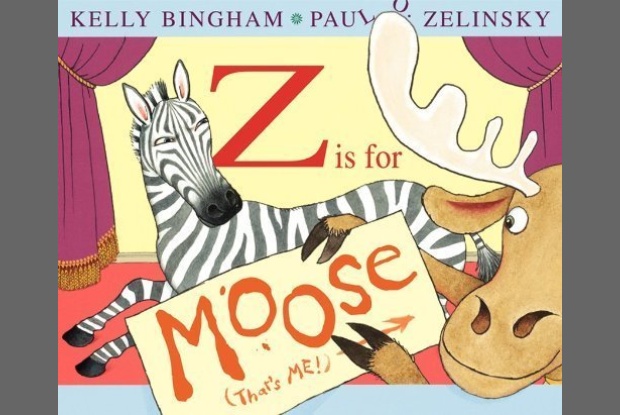
Speaking of moose, Kelly Bingham’s Z is for Moose (Greenwillow, 2012) has gotten all kinds of good press, but somehow I hadn’t read it yet. Hilariously illustrated by Paul O. Zelinsky, this book is a must-read. The book trailer is just as funny as the book.

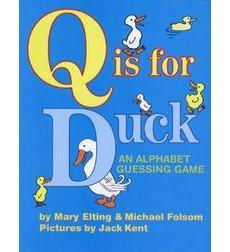
I would pair this book with Q is for Duck: An Alphabet Guessing Game (Clarion Books, 2005) by Mary Elting & Michael Folsom with pictures by Jack Kent, for more mixed up alphabet fun.

9780618574124_xlg

What treasures did you find at the book fair this year?

Be sure to visit Jen and Kellee at Teach Mentor Texts to find out what others are reading today.