
“There are no good books which are only for children.” W.H. Auden
It’s no secret to anyone who knows me or reads this blog that I love children’s literature. I have always loved to read, but it wasn’t until my first son was born that I truly understood the importance of sharing books and reading with children. I’ve written about this before, but I’ve been thinking about it again after visiting the outstanding exhibit at the New York Public Library, The ABC of It: Why Children’s Books Matter, curated by Leonard S. Marcus, one of the most respected scholars of children’s literature today.
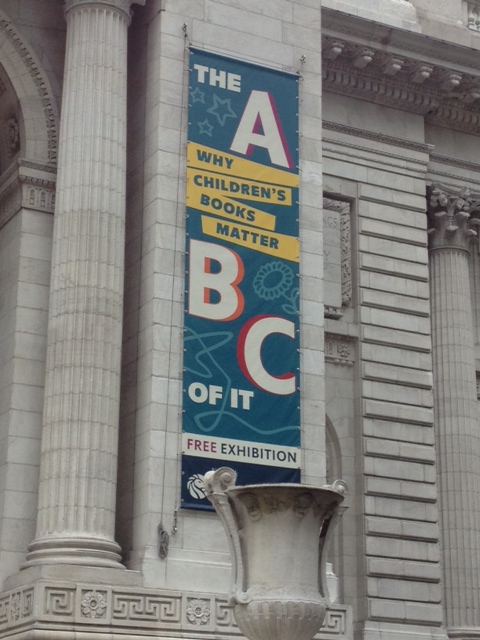
When I was little, people cared about me enough to read to me and to see that I had books to read to myself. How sad it was for me to realize that this is not true for every child. My love of books and my passion to share them with children is what led me to teaching and is what drives me still.
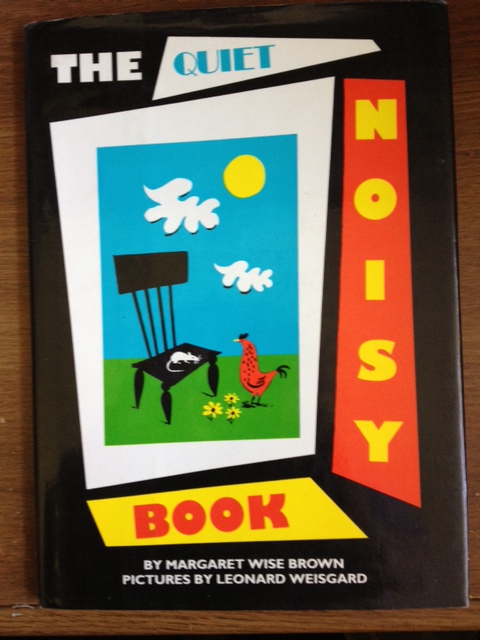
And yet, there are always new discoveries to be made. Earlier this summer I was at a local library’s book sale. I love going to these sales; they’re like treasure hunts to me. What unappreciated book has someone casually discarded? What long lost favorite of childhood is waiting for me to discover it among the many copies of yesterday’s fad? Among other treasures, I found The Quiet Noisy Book, by Margaret Wise Brown and illustrated by Leonard Weisgard. The bright, bold illustrations are distinctly mid-century, but I was captivated by Brown’s text.
 It was a very quiet noise.
Such a quiet noise.
As quiet as quietness.
It was a very quiet noise.
As quiet as someone eating currant jelly.
As quiet as a little kitten lapping milk.
The teacher in me was very excited at all the possibilities for using this as a mentor text for writing. In an instant, this book was in my bag and I felt a rush of excitement that I had rescued it from oblivion. I also had a new Margaret Wise Brown book to add to my collection.
So last Saturday at the New York Public Library, I was surprised to see this in the section of the exhibit devoted to Lucy Sprague Mitchell, the Bank Street Writers Laboratory and it’s impact on children’s literature.
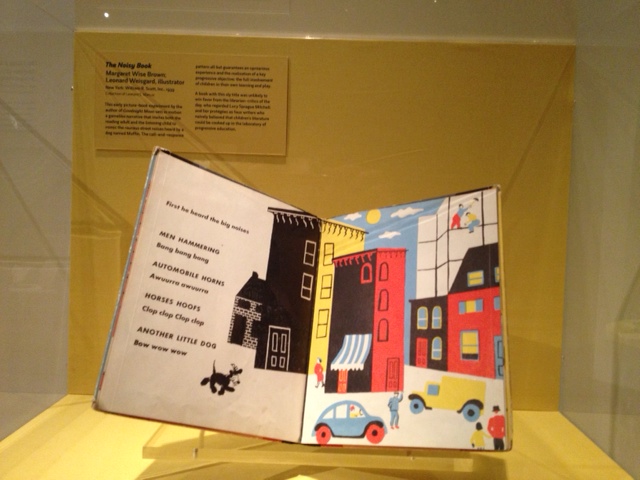
I recognized the style of the illustration right away, but didn’t think it was the same book. When I got home, I checked on-line and discovered that Brown and Weisgard had created a series of Noisy books. How had I never heard of them?
Another section of the exhibit highlighted Alice in Wonderland. Among the items on display here are a photo of Alice Liddell, her own copy of Carroll’s book, and a charming carving of Tweedledee and Tweedledum that was used as a parasol handle. The highlight for me, though, was this Alice, whose neck would lengthen and then shrink back to it’s normal size.
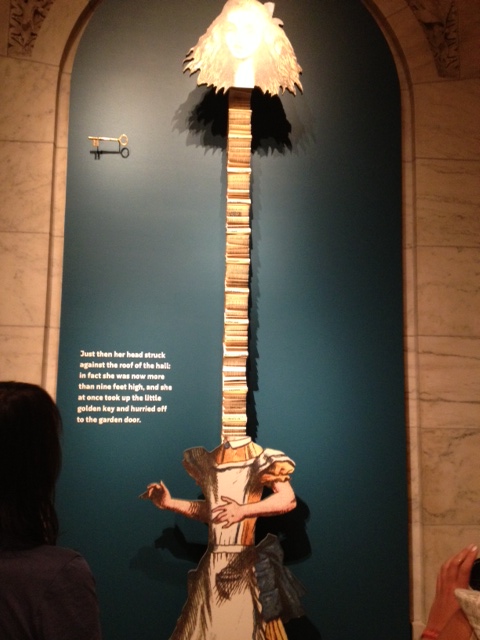
How fitting that her neck was made of books! To me, Alice’s extended neck represents the endless possibilities to be found in books. One book leads to another, which leads to the next, and on and on forever. It also represents how books connect us, one to another, each one leaving a piece of itself within us. Why do children’s books matter? Because, in the lovely words of Julius Lester, they “link our souls like pearls on a string, bringing us together in a shared and luminous humanity.”
Thank you, as always, to Stacey and Ruth at Two Writing Teachers for hosting the Slice of Life Challenge.
 Reading to the Core