
Children’s first reading experiences are usually through picture books, and for this reason, people have fond memories of them and are passionate about their favorites. Because of the role picture books play in introducing the magic of reading to children, they are worth celebrating.
Picture Book 10 for 10 is the brainchild of Cathy Mere of Reflect & Refine: Building a Learning Community and Mandy Robeck of Enjoy and Embrace Learning. During this annual event, now in its sixth year, teachers, librarians, and book lovers create lists of 10 essential picture books. Cathy and Mandy collect and share these lists, and everyone is richer because of their efforts. Be sure to visit their blogs to see their lists, and check out dozens of Picture Book 10 for 10 lists here. Thank you, Cathy and Mandy, for organizing this celebration of picture book love.
Many children are introduced to picture books through collections of nursery rhymes. The rhythm of poetry is soothing and the rhymes give kids the foundation they need to become independent readers. But most importantly, reading nursery rhymes and poetry to children is fun.
Creating this list was quite a challenge, as there are many, many beautiful poetry picture books available these days. For any one of the poets listed below, there are one or two or ten other books that are just as worthy of inclusion on this list.
1. Bookspeak: Poems about Books, by Laura Purdie Salas, illustrated by Josée Bisaillon (Clarion Books, 2011)

What could be better than a collection of poems celebrating books? Laura Purdie Salas gives voice to all parts of books, including the cover, index, and the end. You can watch the trailer for Bookspeak, listen to Laura read two poems, and read the teacher’s guide here.
2. Red Sings From the Treetops: A Year in Colors by Joyce Sidman, illustrated by Pamela Zagarenski (Houghton Mifflin Books for Children, 2009)
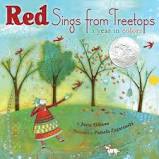
Joyce Sidman is one of my favorite poets, and I love Pamela Zagarenski’s whimsical style, so this book was a shoe-in for this list. I have written about it before here.
3. Firefly July: A Year of Very Short Poems, selected by Paul B. Janeczko, illustrated by Melissa Sweet (Candlewick Press, 2014)
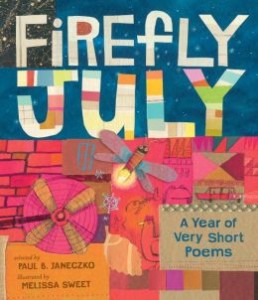
This award-winning anthology, illustrated with whimsical perfection by Melissa Sweet, includes poems celebrating each season and is not to be missed. Julie Roach, writing in School Library Journal described Sweet’s illustrations this way: “Colors and shapes with willowy details expertly blur or bring bits of the images into focus to create a magical sense of place, time, and beauty.”
4. A World of Wonders: Geographic Travels in Verse and Rhyme, by J. Patrick Lewis, pictures by Alison Jay (Dial Books for Young Readers, 2002)
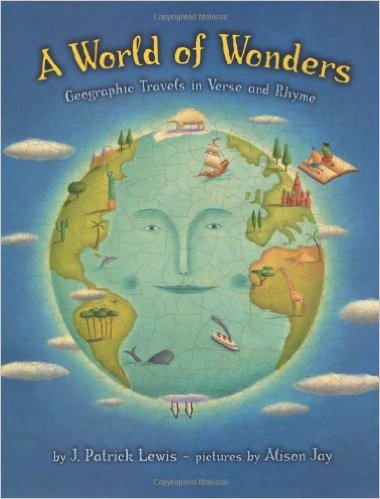
Lewis brings his signature blend of humor and interesting facts to the world of geography in this collection. Allison Jay’s muted colors and craquelure,“a cracking or network of fine cracks in the paint, enamel, or varnish of a painting,” illustrations evoke maps from the age of exploration.
5. Forest Has a Song, by Amy Ludwig VanDerwater, illustrated by Robbin Gourley (Clarion Books, 2013)
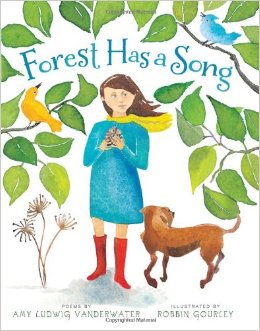
Amy Ludwig VanDerwater turns her keen poet’s eye to the forest landscape throughout the year. Gourley’s delicate watercolors are the perfect complement to VanDerwater’s evocative poems.
6. On the Wing: Bird Poems and Paintings by Douglas Florian (Harcourt, 1996)

Douglas Florian’s sophisticated humor and word play make his poetry perfect choices for any elementary classroom. Find out more about Florian and his other poetry collections here.
7. What’s for Dinner? Quirky, Squirmy Poems from the Animal World, by Katherine B. Hauth, illustrated by David Clark (Charlesbridge, 2011)
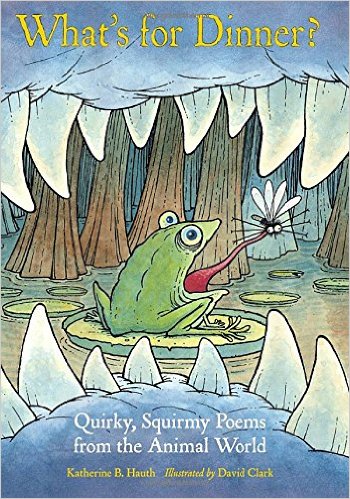
This NSTA/CBC Outstanding Science Trade Book is chock-full of hilarious poems about the very serious subject of how animals capture their prey. Hauth includes factual information about each animal, as well as a list of suggested reading. David Clark’s cartoon-like illustrations add to the humor.
8. Bug Off! Creepy, Crawly Poems, by Jane Yolen, photographs by Jason Stemple (WordSong, 2012)
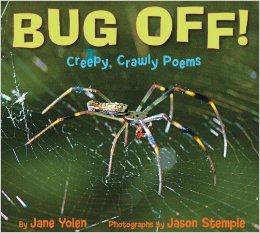
Jane Yolen is one of my favorite authors of all time. In fact, my 2013 Picture Book 10 for 10 post was devoted to her work. Yolen has published many volumes of poetry, but her collaborations with her photographer son, Jason Stemple, are my favorites. Stemple’s photographs are full of incredible details, and Yolen’s poetry captures the “beauty and mystery” of “these tiny living beings.” (From Yolen’s author’s note.)
9. Turtle in July, by Marilyn Singer, illustrated by Jerry Pinkney (Macmillan, 1989)
Marilyn Singer is the 2015 winner of the NCTE Award for Excellence in Poetry for Children and has long been one of my favorite poets. You can read a previous post about Marilyn’s poetry here. This collection, filled with Jerry Pinkney’s stunning illustrations, is a must-have for any elementary classroom.
10. Creatures of the Earth, Sea, and Sky, by Georgia Heard, drawings by Jennifer Owings Dewey (WordSong, 1992)
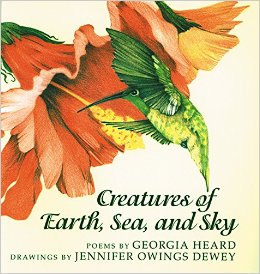
Georgia Heard has written that “poets find poems in hundreds of different places” (Awakening the Heart: Exploring Poetry in Elementary and Middle School, Heinemann: 1999), and in this wonderful collection, which has long been a staple in my classroom, she has found poems throughout the animal kingdom. Dewey’s detailed, realistic drawings add to the beauty of this book.
My previous Picture Book 10 for 10 lists:
2014: Friendship Favorites
2013: Jane Yolen Picture Books
2012: Wordless Picture Books

 Reading to the Core