Slice of Life: Trusting Myself

11454297503_e27946e4ff_h

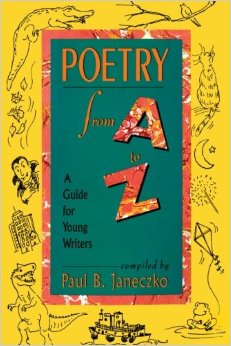
My school is undergoing some renovations this summer and several teachers are moving to new classrooms. Because of this, people were cleaning and weeding like mad during the last few weeks of school. I am not moving, but should have been doing my own weeding. Instead, I couldn’t resist going through other people’s discard piles. Unbelievably, I found a copy of Paul B. Janeczko’s Poetry from A to Z: A Guide for Young Writers (Simon and Schuster, 1994).

51MHmbefxrL._SY344_BO1,204,203,200_

I’ve been savoring this anthology, which includes poems by Valerie Worth, Myra Cohn Livingston, Ralph Fletcher, Eve Merriam, and more. Many poems are accompanied by notes of advice and guidance from the poets themselves. My favorite so far is this piece of wisdom from Georgia Heard:

“I write first drafts with only the good angel on my shoulder, the voice that approves of everything I write. This voice doesn’t ask questions like, ‘Is this good? Is this a poem? Are you a poet?’ I keep that voice at a distance, letting only the good angel whisper to me: ‘Trust yourself.’ You can’t worry a poem into existence.”

This is exactly the encouragement I need as I write the first draft of a poetry project I’ve been working on. School demands have been draining and distracting me for the past few months, so I haven’t gotten too far beyond pages of notes. But now that summer is here, I’ll be at my desk every day with that good angel on my shoulder, trying not to worry, trusting myself.

Thank you to StaceyTaraDanaBetsyAnna, and Beth for this space for teachers and others to share their stories each Tuesday. Be sure to visit Two Writing Teachers to read more Slice of Life posts.

Poetry Friday: NCTE Poetry Rock Stars

poetry-friday-1-1

“Poetry is about loving the world and showing that love through words.”

Irene Latham

I’m still basking in the glow of NCTE. Many of the sessions I attended were about integrating poetry into the curriculum. I feel fortunate that I’ve gotten to know many of the poets and teachers who presented during these sessions through blogging on Poetry Friday. Meeting them face-to-face was a highlight of my weekend at the Gaylord. Their wisdom, humor and generosity have made me a better writer and a better teacher. I use their books with students every day.

During her portion of the CLA Master Class, Poetry Across the Curriculum, Heidi Mordhorst described her vision of integrating the curriculum as synergy. The definition she provided, “the interaction or cooperation of two or more organizations, substances, or other agents to produce a combined effect greater than the sum of their separate effects” not only characterizes what happens when we share poetry with our students. It embodies the spirit of the Poetry Friday community, a community I am so thankful for.

So many wonderful poems were shared during these sessions (thank you, Janet & Sylvia, for all the postcards!), I couldn’t choose just one to share today. I also wanted to express how grateful I am to these women. So I’ve stitched together a thank you of sorts using their own words.

What is beauty?

Whatever you believe it to be. (1)

To listen, to look,

to think, and to learn. (2)

Opening your heart and sharing your feelings, (3)

with plenty of space to dream. (4)

I’m glad you are my secret friend. (5)

We’re just a link away. (6)

You fold the memory

into your hearts, (7)

turn outside to inside

stranger to friend, (8)

and look inside yourself to find

the good I see in you. (9)

I’m a piece of the sky

in a circle of sun, (10)

But none of it would matter much

without the likes of you. (11)

Thank you to all the poets whose work inspired this poem!

1: Tricia Stohr-Hunt, whose blog, The Miss Rumphius Effect, was one of the first I ever read, continues to be an incredible resource for poetry. These lines are from Tricia’s poem, “Beauty”.

2: Janet Wong, co-creator with Sylvia Vardell, of The Poetry Friday Anthologies. These books are amazing resources. Janet’s poem, “Liberty” provided these lines.

3: Irene Latham‘s newest book, Dear Wandering Wildebeest and Other Poems from the Watering Hole (Millbrook Press, 2014) has quickly become a favorite with my students. These lines are from an acrostic Irene shared during the session “Poem As Storyteller: Collaborating With Authors to Write Narrative Poetry.”

4. Sara Holbrook and Michael Salinger‘s session, “Writing to Increase Literacy and Learning Across the Curriculum” was full of practical suggestions for incorporating poetry into the school day. This line is from her poem, “On Becoming Proficient,” which can be found in Zombies Evacuate the School (WordSong, 2010).

5. Heidi Mordhorst is a teacher, poet, and blogger whose work I have only recently become familiar with, but I’m looking forward to reading and sharing more of Heidi’s poetry. This line can be found in Heidi’s poem, “Funday, Imaginary 1st”.

6. The poetry of Laura Purdie Salas is a staple of my classroom. I’ve been sharing her poetry with students for years and was thrilled to meet her at NCTE! This line is from Laura’s poem, “Just Like That”.

7. Georgia Heard is another rock star of poetry I was excited to meet. Georgia’s books about Awakening the Heart and For the Good of the Sun and the Earth have had a profound influence on my teaching. This line is from her poem “Ars Poetica”, which can be found in The Poetry Friday Anthology for Middle School.

8. Amy Ludwig VanDerwater’s blog, The Poem Farm, is a treasure-trove of resources for teachers and poets. This line is from “First Practice”, one of Amy’s contributions to the The Poetry Friday Anthology for Middle School.

9. I have long been a fan of Eileen Spinelli‘s picture book, Sophie’s MasterpieceBut I was less familiar with her poetry. These lines are from Eileen’s powerful “Poem for a Bully” which can be found in The Poetry Friday AnthologyK-5 edition.

10. I met Rebecca Kai Dotlich at NCTE almost by accident. We were each waiting for a friend, and, without having any idea who she was, I introduced myself. She was very friendly and introduced herself as Rebecca. We chatted, and through the course of the conversation I realized that I was casually talking with the author of some of my favorite poems for children. These lines are from an all-time favorite, “A Circle of Sun”.

11. Mary Lee Hahn‘s blog, A Year of Reading, is another inspirational resource. She and Franki Sibberson have set the standard for excellence in blogs by teachers. Mary Lee’s passion for teaching and poetic skills continue to amaze me. Mary Lee’s poem “Our Wonderful World” is the source of these lines.

Thank you again to every one of you! Thank you also to Anastasia Suen for hosting the Poetry Friday Round Up!

SOLC 2014: Plans for National Poetry Month

11454297503_e27946e4ff_h

“Poetry is a language in which man explores his own amazement.”

~ Christopher Fry ~

Every month, I lead our school’s Language Arts Committee meeting. The purpose of this committee is to promote the language arts and ensure that our teaching is based on the latest research. I usually begin the meetings sharing news from our state Department of Education, upcoming conferences and workshops, and information gathered at conferences I’ve attended. Teachers share lessons they’ve had success with and examples of student work. We always have snacks and these meetings are a nice way for teachers to learn about what’s happening at other grade levels. 

I spent much of my afternoon planning tomorrow’s meeting. Since National Poetry Month is just a few days away, I will be sharing poetry resources and have a poetry activity planned. Here’s a preview of what’s on the agenda.

  • Poem in Your Pocket Day is on Thursday, April 24th this year. We’ll actually be in school on this day. For several years, this day has been during our April break.
  • Poet-to-Poet Project is “a multimedia educational project that invites young people in grades 3-12 to write poems in response to those shared by some of the award-winning poets who serve on the Academy of American Poets Board of Chancellors.” The resources for this project are incredible: videos of the poets reading their poems, lesson plans, and more. Students can submit their original poems to poets.org for possible publication on the website in May.
  • Book spine poems are a form of found poetry and are a fun way to ease into poetry. You can read about the basic steps at Kenn Nesbitt’s, our current Children’s Poet Laureate, website, Poetry4kids.com.
  • Poetry Tag Time is an e-book of 30 original poems for children compiled in 2011 by Sylvia Vardell and Janet Wong. A veritable who’s who in children’s poets contributed a poem after being “tagged” by the previous poet. Each poem is connected in some way. I participated in an activity very similar to this several years ago during an online Children’s Literature class, but it was called a poetry “merry-go-round.” The professor posted the first poem, then a student had to post a poem that linked to the original, and so on. I really enjoyed reading the different ways people connected to the poems, and read many wonderful poems I might never have seen. I asked everyone to bring a poem tomorrow so we can play Poetry Tag.
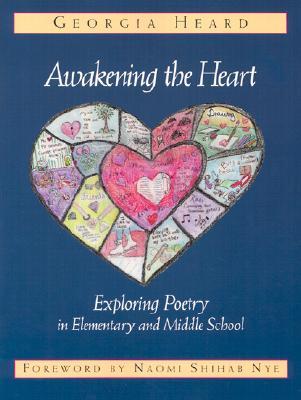
  • Thinking about Poetry Tag reminded me of a incredible project Linda Rief shared at NCTE last November. At the beginning of the year, Rief’s students created Heart Maps, an idea from Georgia Heard’s amazing book, Awakening the Heart: Exploring Poetry in Elementary and Middle School. Rief’s students then read volumes of poetry, gathering poems that spoke to them and exemplified an area of their heart map. Students copied these poems out by hand, and gathered them into a “Heart Book.” Vicki Vinton shared a description of this project on her blog, To Make a Prairie.

This seems like a lot to cover in the 40 minutes or so we have for our meeting! My hope is that everyone leaves the meeting with a collection of poems and at least one new idea to try during National Poetry Month. What are your plans for National Poetry Month?

Thank you, as always, to StaceyTaraDanaBetsyAnna, and Beth for hosting the Slice of Life Challenge. Be sure to visit Two Writing Teachers to read more Slice of Life posts.

Poetry Friday: Georgia Heard, Roque Dalton, and Unlocking the Door to Poetry

Poetry_Friday_Button-210

Poetry filled the air last weekend at the NCTE Convention in Boston. One of the highlights for me was hearing Georgia Heard, Tom Romano, and Linda Rief speak about the importance of “Keeping Poetry at Our Core.”

georgiaheard

Georgia Heard began the session by pointing out that “poetry is in every single strand of the CCSS.” She urged us to grow poetry slowly, not to wait until April, but to make a place for poetry in our classrooms every day. “Poetry changes us,” she said, “it changes our writing and our living.”

With these thoughts about the importance of poetry in mind, Heard went on to give us steps to guide our work. The first step is to “choose poems that are accessible, non-threatening, and relevant” to our students. Once we’ve done this, the next crucial step is to help students connect with a poem by guiding them “toward finding themselves and their lives inside the poem.”

Heard also shared that we have to give our students the tools they need to analyze and interpret poetry. Through close reading and asking questions such as “How does this poem relate to your life?” and “What is the impact of this poem on your life?” students can “unlock the door of a poem.” Then they will be able to analyze the meaning and craft of a poem for other layers of meaning.

Heard inspired me to be even more mindful about helping my colleagues share poetry with students when she closed her part of the session with the wisdom of Matthew Fox:

“The Celtic peoples…insisted that only the poets could be teachers. Why? I think it is because knowledge that is not passed through the heart is dangerous.”

This quote can also be found in Georgia’s book, Awakening the Heart (Heinemann, 1999, pg. 118). As I revisited my copy of this classic, I rediscovered this poem by Roque Dalton, another reminder that poetry is for everyone.

“Like You ”

Like you I

love love, life, the sweet smell

of things, the sky-blue

landscape of January days.

And my blood boils up

and I laugh through eyes

that have known the buds of tears.

I believe the world is beautiful

and that poetry, like bread, is for everyone.

And that my veins don’t end in me

but in the unanimous blood

of those who struggle for life,

love,

little things,

landscape and bread,

the poetry of everyone.

(translated by Jack Hirschman)

Tom Romano and Linda Rief were just as eloquent and inspiring, so, in the weeks to come, they will each have their own well-deserved post. For more inspiring poetry posts, NCTE-related and otherwise, be sure to visit Carol’s Corner, for the Poetry Friday Round Up.

Slice 21 of 31: A Book Spine Poem

Image

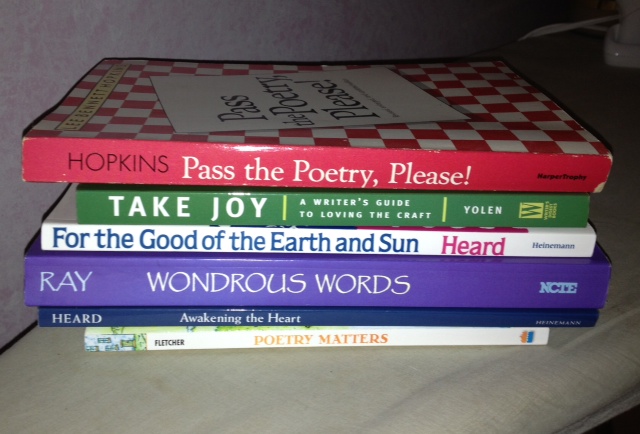
National Poetry Month is just around the corner, and although I teach and use poetry all year, I do make a fuss about all things poetical in April. This book spine poem really wrote itself as I revisited some of my favorite resources:

Image

Pass the Poetry, Please!

Take Joy

For the Good of the Earth and the Sun

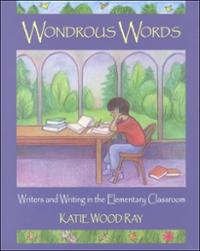
Wondrous Words

Awakening the Heart

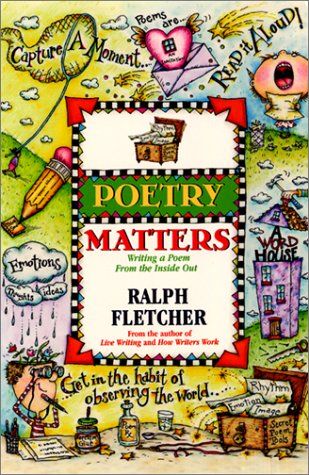
Poetry Matters

I’ve written before about using poetry with students (here, here  and here) and I know I’ll be writing about it again. For now, here’s a snippit of the wisdom contained within each of these excellent resources.

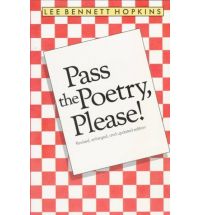
9780064460620Originally published in 1972, Lee Bennett Hopkins’ book is a classic resource for sharing and teaching poetry. Here is a comment he shares from poet David McCord:

“Poetry is so many things besides the shiver down the spine.” (p. 7)

Take-Joy

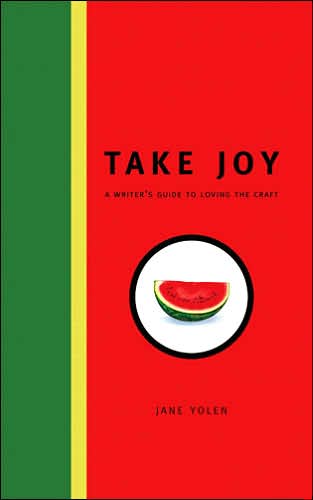
Jane Yolen is one of my all-time favorite authors. In Take Joy: A Writers Guide to Loving the Craft (Writers Digest Books, 2006), her wisdom and passion for writing permeate every page.

“…poetry, at it’s most basic, is a short, lyrical response to the world. It is emotion under extreme pressure or recollection in a small space. It is the coal of experience so compressed it becomes a diamond.” (p. 87)

043508495X

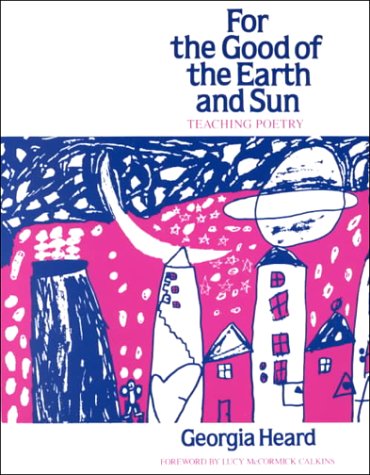
For the Good of the Earth and the Sun: Teaching Poetry (Heinemann, 1989), by Georgia Heard, is filled with practical advice and inspiration. In chapter 5, “Language:  The Poet’s Paint,”  she offers this:

“Sometimes I pretend a word is like a geode: rough and ordinary on the outside, hiding a whole world of sparkling beauty inside. My job as a poet is to crack the words open to find that inner treasure.” (p. 74)

wondrous-words-writers-writing-in-elementary-classroom-katie-wood-ray-paperback-cover-art

Wondrous Words: Writers and Writing in the Elementary Classroom (NCTE, 1999), by Katie Wood Ray, was a revelation to me. Here were the answers I’d been looking for about how to teach writing. Ray’s thoughts about read aloud confirm what we know in our hearts:

“Our students need to be…fortunate enough to be read to every single day by someone who values wondrous words and knows how to bring the sounds of those words to life in the listening writer’s ears and mind and heart.” (p. 69)

27041

Georgia Heard offers more thoughts about teaching poetry in Awakening the Heart: Exploring Poetry in Elementary and Middle School (Heinemann, 1999).

“One of the most important life lessons that writing and reading poetry can teach our students is to help them reach into their well of feelings–their emotional lives–like no other form of writing can.” (p. xvii)

poetry%20matters

Ralph Fletcher wrote Poetry Matters: Writing a Poem From the Inside Out (HarperTrophy, 2002) for kids, but it’s one of my favorite books about the craft of poetry. Speaking directly to children, he advises them

“There is poetry everywhere. [Write] What you wonder about. In my book A Writer’s Notebook, I wrote a chapter on ‘fierce wonderings’ and ‘bottomless questions.’ These are the kinds of haunting questions you can live and ponder but never really answer. Not surprisingly, these ‘wonderfull’ questions provide great grist for poems.” (p. 51)

Thank you to Stacey and Ruth at Two Writing Teachers for hosting this Slice of Life Challenge!