
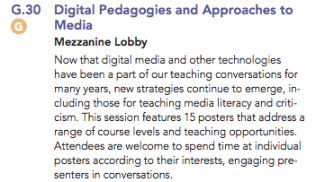
On Thursday, I’ll be heading to Minneapolis for my third NCTE Annual Convention. The previous two conventions have energized and inspired me. It’s such a thrill to meet nationally known educators and authors. I’ve also had a great time meeting fellow Slicers, bloggers, and Twitter friends. This year, my anticipation is even greater because I’ll be presenting “Every Picture Tells A Story” during a poster session on Saturday morning.

Many years ago, when I first read Keane & Zimmerman’s Mosaic of Thought (Heinemann, 1997) and Strategies that Work, by Harvey & Goudvis, I was inspired to find ways to provide my students with additional practice using comprehension strategies to develop their understanding of texts. I also realized that many kids who struggle with decoding weren’t getting enough opportunities to utilize the strategies. They were exerting so much energy decoding, they had nothing left for the higher level thinking needed for a deep understanding of their reading.
So I began incorporating art into my reading instruction as a way to give kids with decoding difficulties chances to practice and feel successful with comprehension strategies. It was quickly apparent that all students would benefit from learning to “read” the art. I’ve used paintings and illustrations to help first graders develop their retelling skills and third graders practice inferring and drawing conclusions. WPA photographs were a huge help when sixth graders were building background knowledge before reading Bud, Not Buddy. The possibilities for using art and photographs in the classroom are endless.
Paintings, illustrations, and photographs are also perfect for close reading. Strategies spelled out in recent books such as What Readers Really Do: Teaching the Process of Meaning Making (2012), by Dorothy Barnhouse and Vicki Vinton, Falling in Love with Close Reading, by Christopher Lehman and Kate Roberts, and Notice & Note: Strategies for Close Reading, by Kylene Beers and Robert L. Probst can all be introduced and practiced using art. After gathering details and developing ideas, students can also work on incorporating details that support their thinking into their writing, something our students always find challenging.
Constructing meaning from visual images has grown in popularity over the past ten years or so. There are many books and articles that offer additional ideas and suggestions for incorporating them into the curriculum. Later this week, I’ll be sharing some of these resources, as well as a lesson I recently taught in fifth grade.
Hope to see you in Minneapolis! Thank you to Stacey, Tara, Dana, Betsy, Anna, Beth, Kathleen, and Deb for this space for teachers and others to share their stories each Tuesday. Be sure to visit Two Writing Teachers to read more Slice of Life posts.



 Reading to the Core