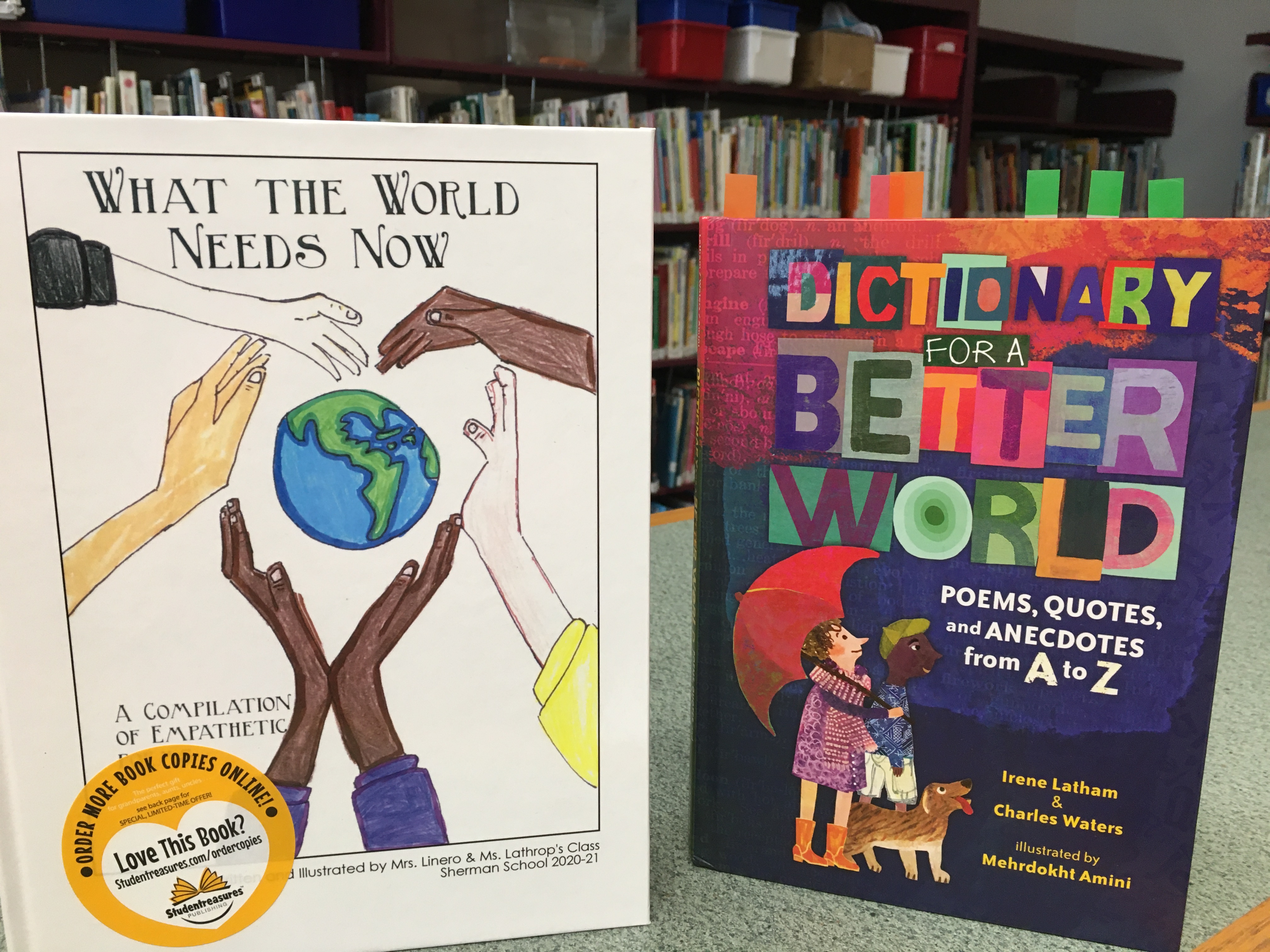
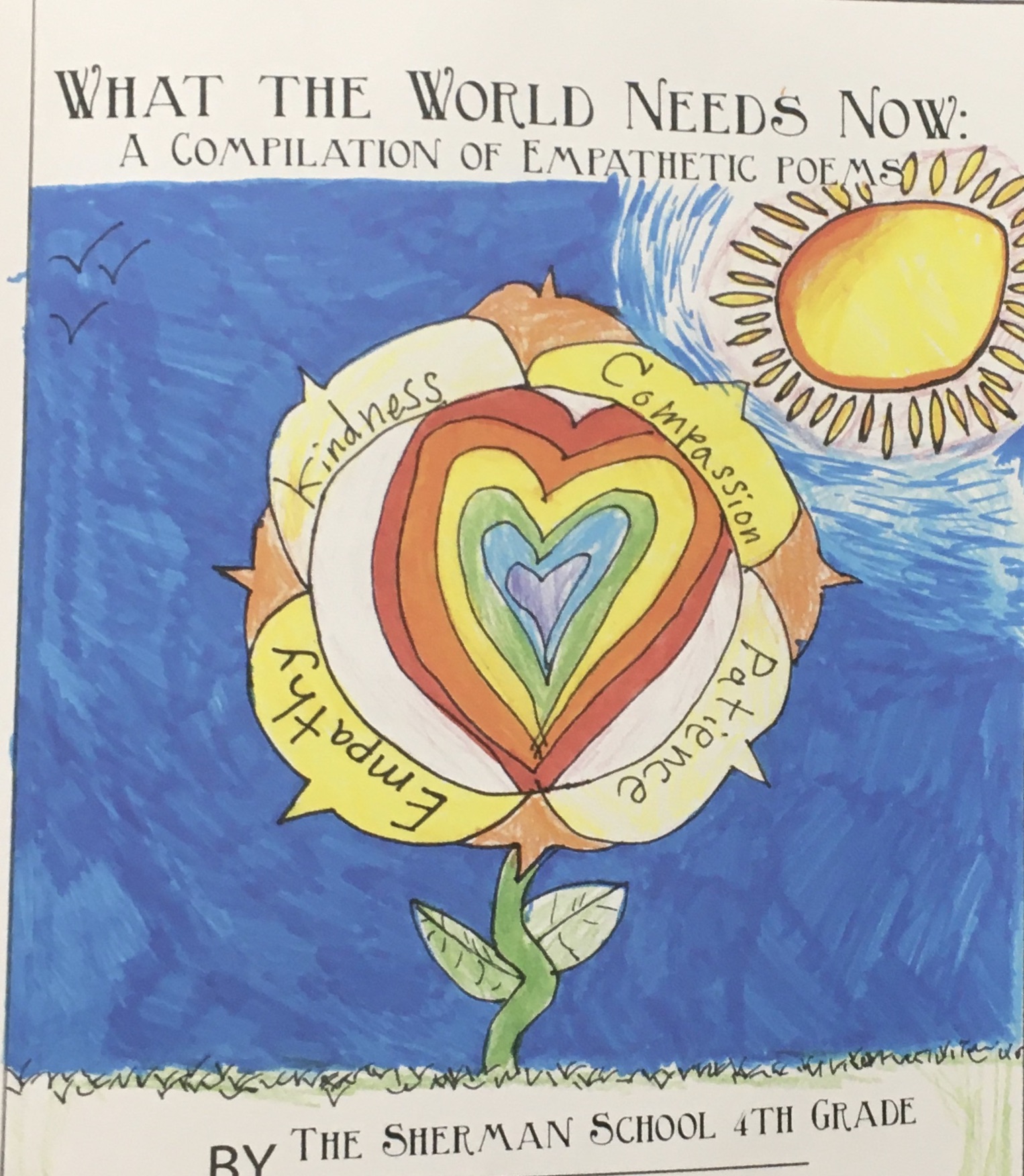
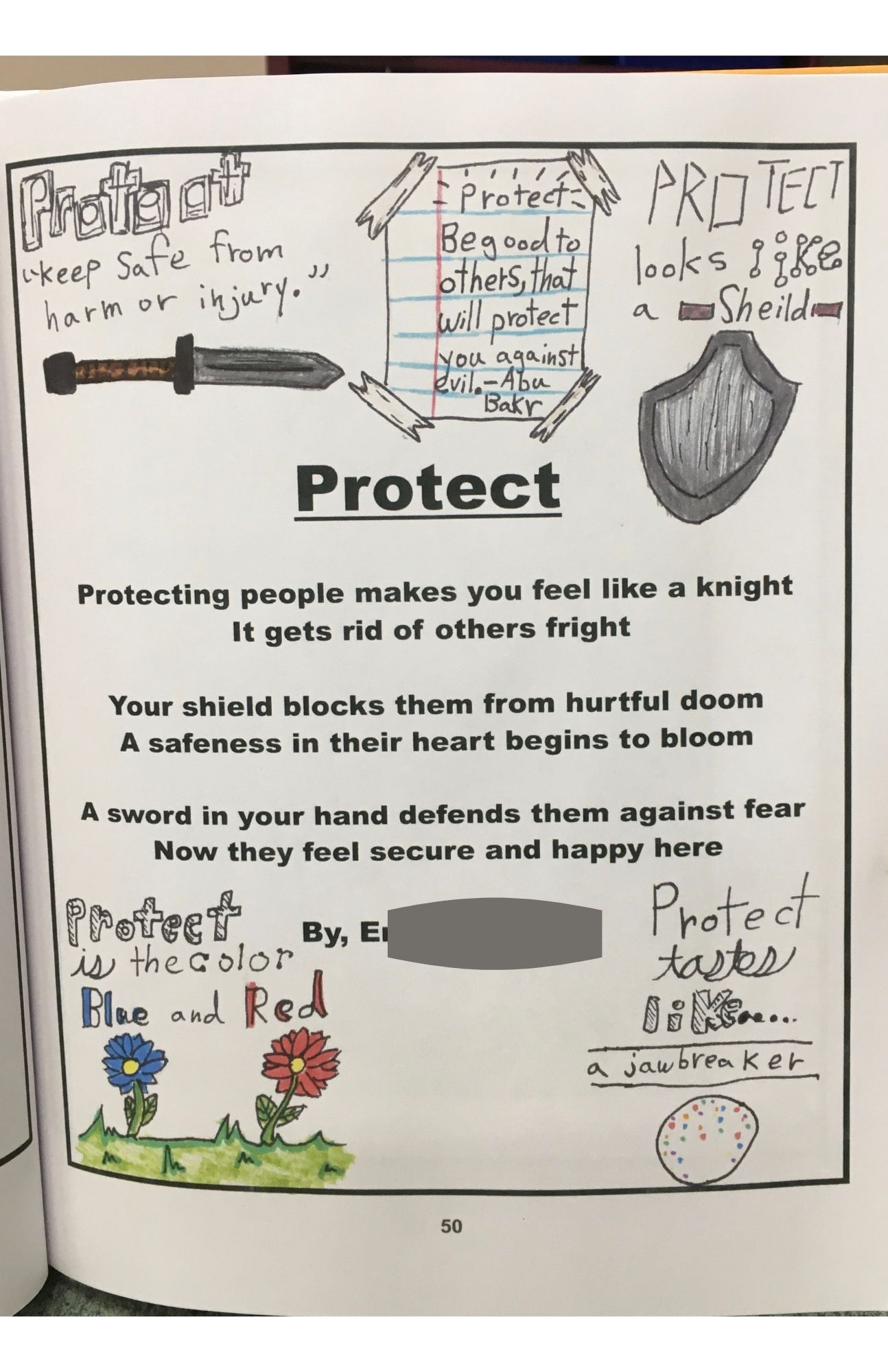
Back in March, Irene Latham and Charles Waters visited our school virtually to share their passion for poetry and to create “wordzines” with our students. Before their visit, teachers shared Dictionary for a Better World, Irene and Charles’s amazing collection of “poems, quotes, and anecdotes from A to Z.” We were all inspired by the wisdom and love that fills this book. Our fourth graders were so excited about their wordzines and the poems in Dictionary for a Better World that they decided to create their own book of “poems, quotes, and anecdotes.” And so What the World Needs Now was born. My friend and colleague Bernadette Linero, teacher extraordinaire, found a way to publish the book and all students have a copy to keep and treasure always. Here’s a peek into the creative work of our fourth graders:
Thank you to Irene and Charles for helping our students to think deeply about empathy, kindness, compassion and more. Thank you for inspiring them to create their own art and poetry that will, in the words of Nelson Mandela, “create a better world for all who live in it.”
Please be sure to visit Buffy Silverman for the Poetry Friday Roundup!
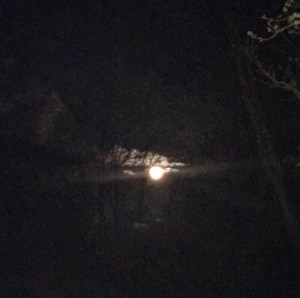
I knew I wanted to write about this week’s spectacular pink moon today, but wasn’t sure what format my poem should take. This morning, I was rereading Dictionary For A Better World, by Irene Latham and Charles Waters. I am absolutely in love with this book. Charles and Irene’s poems are just the beginning of the many layers to this rich and rewarding book. If you haven’t read it, read it now. You’ll feel much better.
Hope seems to be in short supply lately, so I had this page bookmarked. As it happens, Irene’s poem about hope is a nonet, “a nine-line poem that begins with a one-syllable line and builds to a nine-syllable line, or the reverse.” As today is April 9th, this seemed like the perfect time to try this form.
Song of the Pink Moon
Round pink moon rises, shines her bright spotlight on a woodland pond. Soaring from the shadows, the humming and thrumming of a thousand exuberant spring peepers, singing the world a love song.
Happy New Year! Welcome to the first Poetry Friday Roundup of 2018! If you’re new to Poetry Friday, you can learn more from Renée LaTulippe at No Water River.
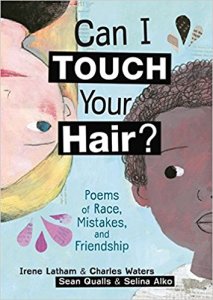
Today I’m proud to feature a brave and beautiful new book by two dear poetry friends, Irene Latham and Charles Waters, Can I Touch Your Hair? Poems of Race, Mistakes, and Friendship, published by Carolrhoda Books on January 1, 2018. With starred reviews from Kirkus and Publisher’s Weekly, this book deserves a place in every classroom. (A Teacher’s Guide is available here.)
Assigned to work together on a poetry project, Irene and Charles are ambivalent. Irene articulates this with the frank honesty of childhood: “Charles is black/and I am white.”
Overcoming their misgivings, they find common ground in the everyday worries of all kids, and begin by writing about shoes and hair. These subjects soon give way to more serious topics such as saying the wrong thing, racial tensions, police brutality, and fear of others because they look different.
They walk the tightrope of adolescent friendships when Irene’s request to join “the black girls/ play[ing] freeze dance” and Charles’s friends “play me dirty.” The poems reveal an unfolding friendship, which Sean Qualls and Selina Alko capture in their sensitive illustrations as heart-shaped flourishes erupting from their pens, mouths, and minds.
Throughout the collection, Irene and Charles make their alter egos come alive by honestly revealing pieces of vulnerability, as when Charles realizes he’s “a few shades too dark/to be allowed to call [a new classmate] by his nickname.” This is balanced by their courage to face fear and shame, as Irene does in “Apology.” When an African-American classmate’s family tree is “draped in chains,” she realizes that the words “I’m sorry…are so small/ for something/so big.”
Both poets use figurative language to bring a depth of feeling and wisdom that amplifies the emotional impact of their writing. We feel the “fury rising inside” Charles, as if he’s “a tidal wave about to crash on land,” as well as the joy they each feel as they “stand in line, cradling our books like newborn kittens,” as they wait to meet author Nikki Grimes.
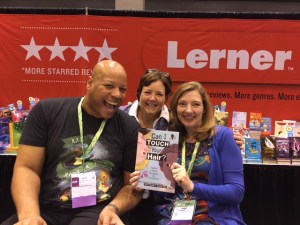
With Charles and Irene at NCTE in St. Louis last November.
Irene and Charles generously allowed me to share two of their poems with you today. Thank you so much!
“The Poem Project”
When our teacher says, Pick your partner, my body freezes
like a ship in ice.
I want Patty Jean,
but Madison
has already looped
arms with her.
Within seconds,
you-never-know-what-
he’s-going-to-say-Charles
is the only one left.
How many poems?
someone asks. About what? Do they have to be true?
Mrs. Vandenberg
holds up her hand. Write about anything! It’s not black and white.
Mrs. Vandenberg wants us to write poems?
Finally, an easy project. Words fly off my pen
onto the paper, like writing is my superpower.
The rest of the time, my words are a curse. I open my mouth,
and people run away. Now I’m stuck with Irene?
She hardly says anything. Plus she’s white.
Her stringy, dishwater blond hair waves
back and forth as she stutter-steps toward me.
My stomach bottoms out. “Hello,” I say. “Hi,” she says.
I surprise myself by smiling at her–she smells like
a mix of perfume and soap. We stare at our sneakers
before I ask, “So, what do you want to
write about?” She shrugs. I say, “How about our shoes, hair?
Then we can write about school and church?”
She takes a deep breath. “Okay.”
I match it. “Let’s start there.”
In an interview with Megan Labrise on the podcast Fully Booked by Kirkus Reviews (starting at 32:40), Charles and Irene share the origin of Can I Touch Your Hair, as well as their hopes for their book. Irene states their wish is that “it will make it easier to have these really difficult conversations about race” and as we “talk about it, listen to each other, [we’ll] realize that we’re all human people, we have more in common than we have separate, different, and that the different parts are beautiful.” Because, as Irene and Charles so wisely point out in the book’s final poem, “Dear Mrs. Vandenberg”: “We are so much more than black and white!”
And now for the Roundup! Please join today’s celebration of poetry by sharing your link.


 Reading to the Core