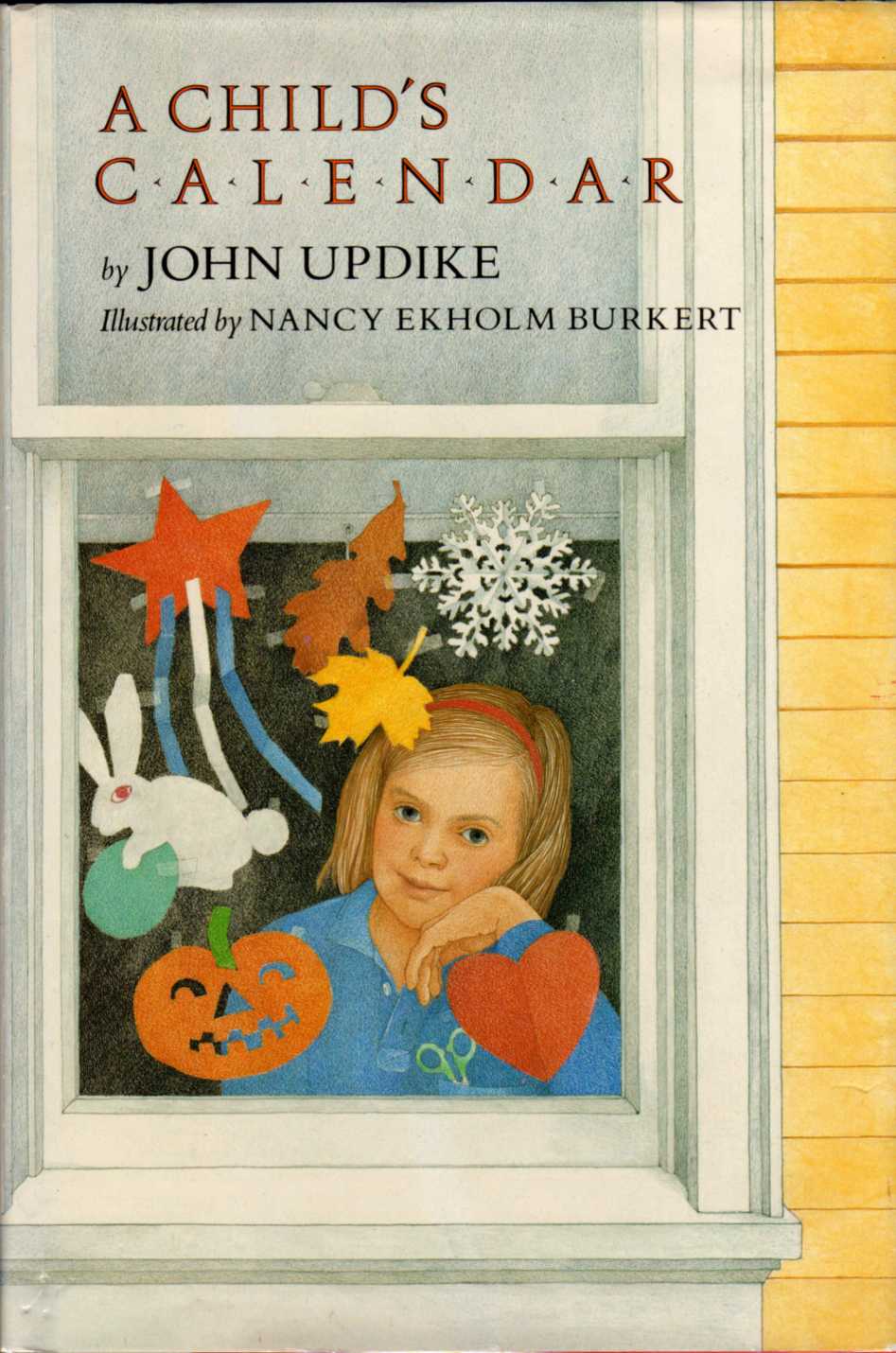
I found my copy of this book at a library book sale years ago, and it was immediately a favorite. Updike’s verses capture the essence of each month in terms children can still relate to, fifty years later. Maria Papova has written about this book and Trina Schart Hyman’s 1999 illustrations on Brain Pickings. There are also poems for several different months included in Papova’s post.
Please be sure to visit Heidi Mordhorst at My Juicy Little Universe for the Poetry Friday Round Up.
Poets often talk about finding the right form as being the key to unlocking a poem. This is true for this draft. I jotted notes and images for this poem two weeks ago. Since then, I’ve been carrying them around with me, talking myself through different combinations of words and order of lines, but nothing satisfied me. Then, as I was looking for another poem in Mary Ann Hoberman’s outstanding collection, The Tree That Time Built, I came across Eve Merriam’s “Reply to the Question: ‘How Can You Become a Poet?’” I immediately recognized Merriam’s free verse examination of a leaf as a potential model for my campfire images. The original, which you can read on many websites and blogs, is focused on a single object, whereas I’m trying to capture an experience. Here is a link to Heidi Mordhorst’s post about how Merriam’s poem nicely illustrates the connection between poetry and science.
In August I was lucky to attend a Reading Institute at Teachers College Reading and Writing Project. This week-long institute is reinvigorating and energizing, and my brain is always bursting with ideas when I leave.
The staff developers at TCRWP do a terrific job of incorporating songs, videos, and other digital texts into their lessons to both engage students and broaden their horizons. I don’t watch much TV or listen to popular music on a regular basis, so I’m often out of the loop on what kids are watching and listening to. But after leaving New York, I was inspired to change the station on my way to work and listen to a country music radio station. Keith Urban’s new song, “John Cougar, John Deere, John 3:16” (written by Shane McAnally, Ross Copperman, and Josh Osborne) was playing. I was drawn in by the melody right away, and the lyrics really intrigued me.
I’m a 45 spinning on an old Victrola I’m a two strike swinger, I’m a Pepsi cola I’m a blue jean quarterback saying “I love you” to the prom queen in a Chevy…
Then my teacher brain kicked in and all sorts of possibilities for sharing this song with older students started swirling in my brain. The song evokes a bygone era and offers endless opportunities for building knowledge about the culture of mid-twentieth century America.
I was also reminded of George Ella Lyon’s poem, “Where I’m From.” Popular in writing workshops as a mentor poem, many teachers begin the school year with this poem as a way to learn about their students and build community. Pairing Urban’s rendition of “John Cougar, John Deere, John 3:16” with Lyon’s poem is a sure way to inspire young poets to pen their own poetic memoir.
“Where I’m From”
by George Ella Lyon
I am from clothespins, from Clorox and carbon-tetrachloride. I am from the dirt under the back porch. (Black, glistening, it tasted like beets.) I am from the forsythia bush the Dutch elm whose long-gone limbs I remember as if they were my own.
“Your absence has gone through me Like a thread through a needle. Everything I do is stitched with its color.”
The last official weekend of summer was bittersweet. My son was home, and we had company all weekend. Our days were filled with hiking, swimming, and napping. Our evenings began with suppers outside by candlelight and ended long past midnight around our fire pit. There were moments of laughter, but more moments of tears, as the loss of his dear, beautiful Julia is still a fresh wound. His heartbreak is palpable and visible in his face. But as we sat by the fire Friday night, I could feel his relief to be in our backyard, surrounded by his family and friends. I, too, felt a sense of peace start to return. This line, from “The Lake Isle of Innisfree,” by William Butler Yeats, came to me:
“And I shall have some peace there, for peace comes dropping slow.”
“Dropping slow” seemed to me exactly the way to describe the process of trying to stitch your heart and life back together without all the pieces. He’ll be putting his heart back together for years to come; maybe for the rest of his life. I’ll be there to help him with each stitch.
This slice was difficult to write. It feels much too personal for a blog that is supposed to be about teaching reading and writing. And yet, a slice is “a simple way to practice what we ask of students—to write…a small sliver of your ordinary life.”I am grateful to be part of this community and to have a place to share this writing, which seems so far removed from my original mission, but which was so necessary for me to write.
Thank you to Stacey, Tara, Dana, Betsy, Anna, and Beth for this space for teachers and others to share their stories each Tuesday. Be sure to visit Two Writing Teachers to read more Slice of Life posts.
About suffering they were never wrong,
The Old Masters: how well they understood
Its human position; how it takes place
While someone else is eating or opening a window or just walking
dully along;
How, when the aged are reverently, passionately waiting
For the miraculous birth, there always must be
Children who did not specially want it to happen, skating
On a pond at the edge of the wood:
They never forgot
That even the dreadful martyrdom must run its course
Anyhow in a corner, some untidy spot
Where the dogs go on with their doggy life and the torturer’s horse
Scratches its innocent behind on a tree.
In Breughel’s Icarus, for instance: how everything turns away
Quite leisurely from the disaster; the ploughman may
Have heard the splash, the forsaken cry,
But for him it was not an important failure; the sun shone
As it had to on the white legs disappearing into the green
Water; and the expensive delicate ship that must have seen
Something amazing, a boy falling out of the sky,
Had somewhere to get to and sailed calmly on.
Pieter Brueghel the Elder (1526/1530–1569) [Public domain], via Wikimedia Commons Please visit Linda at Teacher Dance for the Poetry Friday Roundup.
Missing you, the star at the center of their universe, the cats wander the apartment, their orbit thrown off kilter by your sudden departure.
They sniff the rug, the sofa cushions wondering, “Where is she?” “Did she sit here a minute ago?”
They wrap around my legs, seeking, searching. They nibble at their food, lap up water with their rough, pink tongues that long to kiss your beautiful face, then meander back to the bedroom, hoping to find you waiting there,
where you belong.
Thank you, everyone, for your all your kind words and understanding last week. My daughter-in-law Julia was a beautiful woman who will be dearly missed by everyone who knew her.
The Poetry Friday Round Up is here today, but I hope you’ll all forgive me and let the comments serve as the round-up. We had a sudden death in our family yesterday, and I am distraught. I promise next time I host I will be in a more festive spirit.
Lead by Mary Oliver
Here is a story
to break your heart.
Are you willing?
This winter
the loons came to our harbor
and died, one by one,
of nothing we could see.
A friend told me
of one on the shore
that lifted its head and opened
the elegant beak and cried out
in the long, sweet savoring of its life
which, if you have heard it,
you know is a sacred thing.,
and for which, if you have not heard it,
you had better hurry to where
they still sing.
Do you remember having a magic slate when you were a kid? You know, those cardboard tablets with a gray film over a waxy black background that you could draw and/or write on with a stylus. Then you lifted the film and everything was erased and you could start over.
I feel like my summer has had that gray film over it. The illness of a dear family member has colored my every waking moment. I wish I could lift the film and erase the events of the past six weeks. But life isn’t a magic slate. This is our new reality, and we are dealing with it one day at a time.
It has been a challenge for me to write during this time. I’ve had a hard time concentrating, and haven’t written anything I felt was worth sharing. But I’ve missed this community. So although this is a short slice, I just wanted to say hello to you all, and let you know I haven’t forgotten you. I hope you all have a good start to the school year.
Thank you to Stacey, Tara, Dana, Betsy, Anna, and Beth for this space for teachers and others to share their stories each Tuesday. Be sure to visit Two Writing Teachers to read more Slice of Life posts.
Children’s first reading experiences are usually through picture books, and for this reason, people have fond memories of them and are passionate about their favorites. Because of the role picture books play in introducing the magic of reading to children, they are worth celebrating.
Picture Book 10 for 10 is the brainchild of Cathy Mere of Reflect & Refine: Building a Learning Community and Mandy Robeck of Enjoy and Embrace Learning. During this annual event, now in its sixth year, teachers, librarians, and book lovers create lists of 10 essential picture books. Cathy and Mandy collect and share these lists, and everyone is richer because of their efforts. Be sure to visit their blogs to see their lists, and check out dozens of Picture Book 10 for 10 lists here. Thank you, Cathy and Mandy, for organizing this celebration of picture book love.
Many children are introduced to picture books through collections of nursery rhymes. The rhythm of poetry is soothing and the rhymes give kids the foundation they need to become independent readers. But most importantly, reading nursery rhymes and poetry to children is fun.
Creating this list was quite a challenge, as there are many, many beautiful poetry picture books available these days. For any one of the poets listed below, there are one or two or ten other books that are just as worthy of inclusion on this list.
1.Bookspeak: Poems about Books, by Laura Purdie Salas, illustrated by Josée Bisaillon(Clarion Books, 2011)
What could be better than a collection of poems celebrating books? Laura Purdie Salas gives voice to all parts of books, including the cover, index, and the end. You can watch the trailer for Bookspeak, listen to Laura read two poems, and read the teacher’s guide here.
2. Red Sings From the Treetops: A Year in Colors by Joyce Sidman, illustrated by Pamela Zagarenski (Houghton Mifflin Books for Children, 2009)
Joyce Sidman is one of my favorite poets, and I love Pamela Zagarenski’s whimsical style, so this book was a shoe-in for this list. I have written about it before here.
3. Firefly July: A Year of Very Short Poems, selected by Paul B. Janeczko, illustrated by MelissaSweet (Candlewick Press, 2014)
This award-winning anthology, illustrated with whimsical perfection by Melissa Sweet, includes poems celebrating each season and is not to be missed. Julie Roach, writing in School Library Journal described Sweet’s illustrations this way: “Colors and shapes with willowy details expertly blur or bring bits of the images into focus to create a magical sense of place, time, and beauty.”
4. A World of Wonders: Geographic Travels in Verse and Rhyme, by J. Patrick Lewis, pictures by Alison Jay (Dial Books for Young Readers, 2002)
5. Forest Has a Song, by Amy Ludwig VanDerwater, illustrated by Robbin Gourley (Clarion Books, 2013)
Amy Ludwig VanDerwater turns her keen poet’s eye to the forest landscape throughout the year. Gourley’s delicate watercolors are the perfect complement to VanDerwater’s evocative poems.
6. On the Wing: Bird Poems and Paintings by Douglas Florian (Harcourt, 1996)
Douglas Florian’s sophisticated humor and word play make his poetry perfect choices for any elementary classroom. Find out more about Florian and his other poetry collections here.
7. What’s for Dinner? Quirky, Squirmy Poems from the Animal World, by Katherine B. Hauth, illustrated by David Clark (Charlesbridge, 2011)
This NSTA/CBC Outstanding Science Trade Book is chock-full of hilarious poems about the very serious subject of how animals capture their prey. Hauth includes factual information about each animal, as well as a list of suggested reading. David Clark’s cartoon-like illustrations add to the humor.
8. Bug Off! Creepy, Crawly Poems, by Jane Yolen, photographs by Jason Stemple (WordSong, 2012)
Jane Yolen is one of my favorite authors of all time. In fact, my 2013 Picture Book 10 for 10 post was devoted to her work. Yolen has published many volumes of poetry, but her collaborations with her photographer son, Jason Stemple, are my favorites. Stemple’s photographs are full of incredible details, and Yolen’s poetry captures the “beauty and mystery” of “these tiny living beings.” (From Yolen’s author’s note.)
9. Turtle in July, by Marilyn Singer, illustrated by Jerry Pinkney (Macmillan, 1989)
Marilyn Singer is the 2015 winner of the NCTE Award for Excellence in Poetry for Childrenand has long been one of my favorite poets. You can read a previous post about Marilyn’s poetry here. This collection, filled with Jerry Pinkney’s stunning illustrations, is a must-have for any elementary classroom.
10. Creatures of the Earth, Sea, and Sky, by Georgia Heard, drawings by Jennifer Owings Dewey (WordSong, 1992)
Georgia Heard has written that “poets find poems in hundreds of different places” (Awakening the Heart: Exploring Poetry in Elementary and Middle School, Heinemann: 1999), and in this wonderful collection, which has long been a staple in my classroom, she has found poems throughout the animal kingdom. Dewey’s detailed, realistic drawings add to the beauty of this book.
This poem was recently featured in The New York Times Magazine. It was exactly the poem I needed to read at that moment, and I’ve been carrying it with me ever since.
“The Word That Is A Prayer”
by Ellery Akers
One thing you know when you say it:
all over the earth people are saying it with you;
a child blurting it out as the seizures take her,
a woman reciting it on a cot in a hospital.
What if you take a cab through the Tenderloin:
at a street light, a man in a wool cap,
yarn unraveling across his face, knocks at the window;
he says, Please.
By the time you hear what he’s saying,
the light changes, the cab pulls away,
and you don’t go back, though you know
someone just prayed to you the way you pray. Please: a word so short
it could get lost in the air
as it floats up to God like the feather it is,