Sunday mornings at my house have a very different pace from the rest of the week. Here is a peek into my morning. (I tried to put some of these pictures side-by-side, but was having too many formatting issues!)
On my way to walk with my friend Colette, of Used Books in Class fame. We walk together every weekend as long as it’s not below 20 degrees, raining, or snowing.
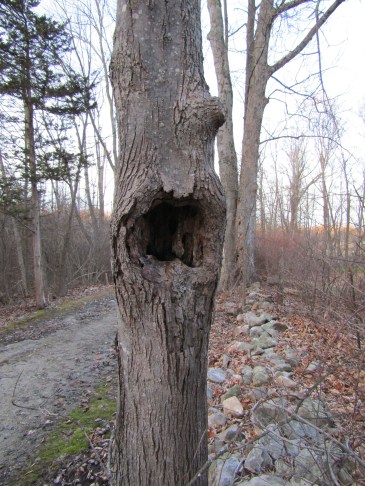
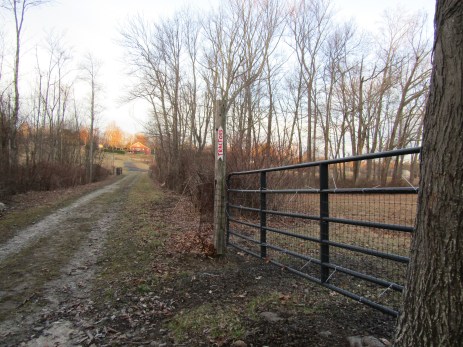
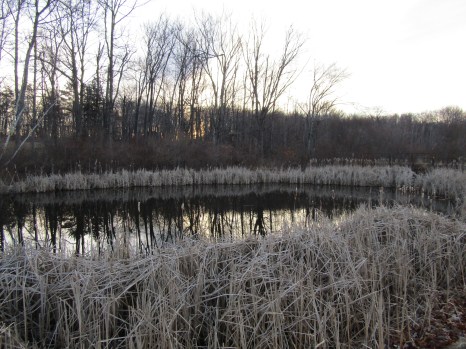
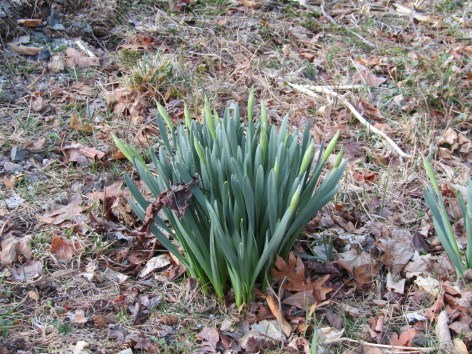
Colette’s dog, Chaucer, always joins us. He’s ready to go!This knot hole intrigued me. I get all sorts of ideas when I walk.Our walk takes us through the fairgrounds of the annual Fireman’s fair.Spring is here!Soon this pond will be full of tadpoles.This tree was full of singing chickadees who didn’t want their picture taken.Another sign of spring.Back home, ready to work on the crossword puzzle.Off to breakfast.Breakfast’s was delicious! Now it’s time to write my slice, work on my WIP, and read. Happy Sunday, everyone!
Thank you to Stacey, Tara, Dana, Betsy, Anna, Beth, Kathleen, and Deb for this space for teachers and others to share their stories each Tuesday throughout the year and every day during the month of March. Be sure to visit Two Writing Teachers to read more Slice of Life posts.
What would you do if a fourth grader brought in War & Peace for their independent reading book?
This happened yesterday, and A.’s teacher came to me for advice.
“Well, we can’t tell her she can’t read it, so let’s help her see that it’s not a good fit for her,” I suggested.
I sat down with A. and asked her about her book choice. “All the other books in the town library are boring,” she said.
“Did you look at the Nutmeg (Connecticut’s state book award) nominees? I know there are some good books on the list.”
“They didn’t have any of those books, so the librarian told me I could look in the Young Adult section and my mom said it was okay.”
Since when is War & Peace kept in the Young Adult section, I thought to myself.
“We’ve talked about ways to choose a ‘just right’ book for a couple of years,” I reminded her. “Why don’t you read the first page to me so we can make sure you can read most of the words.” The five-finger rule is introduced in first grade.
She skipped past the introduction and two pages listing “Principle Characters” before she arrived at Chapter One. Where the first paragraph was written in French. She gave a little laugh and said, “I’ll skip that part.” She then went on to valiantly attempt the maze of Russian surnames.
At the bottom of the page she smiled at me and said, “I could read most of the words that weren’t in French.” She had missed six words, but at this point, it really wasn’t about counting miscues.
“What was happening on this page?” I asked her.
“Well, in the first paragraph, the lady has a cough, but I’m not really sure what was going on in the second paragraph,” she explained.
“A.,” I explained gently, “I’m so proud of you that you want to challenge yourself as a reader, and War & Peace is a challenging book.” Thinking of Teri Lesesne’s Reading Ladders, I continued, “But maybe it should be a book you work toward reading. Why be frustrated reading it now when we can find books that you like that will get you ready to read War & Peace someday.”
She agreed this might be a better idea. I wanted this to feel like her decision, though, so I suggested that she read more of the book over the weekend and that we could talk again on Monday.
I really don’t want to tell her she can’t read this book. But I also don’t want her to miss all the wonderful books that she should be reading in fourth grade. I want her to, in the words of Frank Serafini, assume “an identity as a reader” by reading books like Echo, by Pam Muñoz Ryan, or The War that Saved My Life, by Kimberly Brubaker Bradley. Both of these books are much better choices for her, and they both have plenty of war and peace.
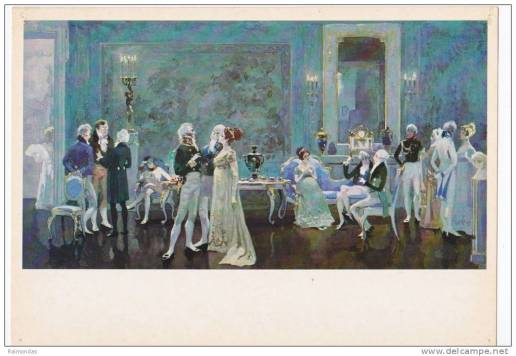
A.Nikolaev
Thank you to Stacey, Tara, Dana, Betsy, Anna, Beth, Kathleen, and Deb for this space for teachers and others to share their stories each Tuesday throughout the year and every day during the month of March. Be sure to visit Two Writing Teachers to read more Slice of Life posts.
There are collections of one sort or another in every room in my house. The tops of the kitchen cabinets are filled with antique and vintage crocks and kitchen wares. Baskets filled with seashells are everywhere. Bottles, books, McCoy pottery line bookcases and shelves. Is there a word for serial collectors?
Some of these items are quite small, and as I dusted a shelf in my kitchen yesterday, I started thinking about Amy Ludwig VanDerwater’s challenge to readers of Michelle Heidenrich Barnes’s blog, Today’s Little Ditty, to “write a poem about something small, an animal or object you see every day and do not usually give much thought.”
I’ve been working on a poem for this challenge for most of the week and had hoped to share it today but it’s not ready. However, the objects on this shelf made me wonder if I’d chosen the right subject for my poem. Then I realized that it didn’t matter. I could write more than one poem if I wanted to. I certainly have enough small objects to write about!
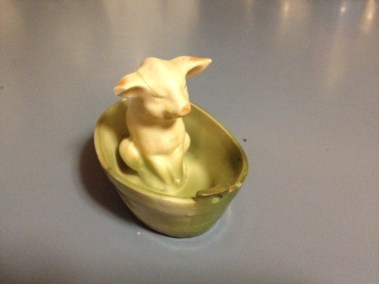
Here’s a draft inspired by a ceramic figurine that sits on a shelf in my kitchen.
“Pig”
A ceramic pig sits in a shiny green wash tub, his ears and nose the pale pink of a winter sunrise.
Like Wilbur as he licked the buttermilk trickling into his mouth, a blissful smile spreads across his face.
Thank you to Stacey, Tara, Dana, Betsy, Anna, Beth, Kathleen, and Deb for this space for teachers and others to share their stories each Tuesday throughout the year and every day during the month of March. Be sure to visit Two Writing Teachers to read more Slice of Life posts. And don’t forget to stop by Irene Latham’s lovely blog, Live Your Poem, for the Poetry Friday Roundup.
A familiar petulant look, downcast eyes and protruding lower lip, came over her face. She began pulling her hair over her forehead, trying to hide.
I sighed, trying to retain my patience. I’ve been working with this student since the fall when she was diagnosed with dyslexia. In an effort to expedite her progress, she has two intervention sessions on most days. She sees the special education teacher every day and I see her at least three times a week to practice and reinforce what she is learning in special ed. She reads poems and books on topics that interest her. She’s written poems and short paragraphs aboutballet, her passion. She’s been making nice progress.
Yesterday she was working on an acrostic poem for the word “ballet.” She didn’t have any trouble coming up with single words for each letter. But then I reminded her that poets use descriptive words to express their feelings and create images. “Let’s think of ways to describe the barre,” I suggested.
“I like it the way it is.”
I counted to ten. I knew I wouldn’t accomplish anything by engaging in a power struggle with this student, but one of our objectives is to help her learn to be more open-minded and persistent.
I tried one more time. “Let’s look at a poem in your folder and see how Irene Latham describes the “Farm Fresh Eggs.”
Tears began to well up in her eyes. That was my cue that we were finished. As I walked her back to her classroom, I was calm and said we’d take another look at the poem tomorrow. She shrugged, but said goodbye as she went back to her class.
She isn’t this uncooperative too often, but it has happened often enough to know that we might not achieve the goals we set for her at her PPT in October. Her parents and their advocate were insistent that we say what reading level she would achieve by her annual review next fall. We tried to explain that our goal was to have her catch up to grade level expectations as quickly as possible, but there were too many variables to make any kind of prediction about how long it would take to get her there. They were skeptical, but gave us the benefit of the doubt.
As a parent, I understand their worry and desire to have her performing at grade level sooner rather than later. But I also understand that pushing her too hard won’t help her reach this goal. It could undermine our efforts. Everyone is doing everything they can to support this student, providing her with appropriate instruction, modifications, and accommodations. We should be celebrating her every accomplishment, no matter how insignificant it may seem. She will get there in the end. It may just take a little longer for her. Things take the time they take.
Thank you to Stacey, Tara, Dana, Betsy, Anna, Beth, Kathleen, and Deb for this space for teachers and others to share their stories each Tuesday throughout the year and every day during the month of March. Be sure to visit Two Writing Teachers to read more Slice of Life posts.
I have started this slice three times throughout the day. After my first two failed attempts, I asked myself what exactly I was hoping to accomplish by participating in this challenge. It’s more than writing every day because I already do that, but I know I have lots of room to grow as a writer. So is there something specific I want to work on?
As I reread my last few posts, I noticed that I begin my slices in very predictable ways. I either dive right in with “I…” or by telling when something happened: “Yesterday…” or “Last week…” You get the idea.
I thought about one of the most famous opening lines in children’s literature: “‘Where’s Papa going with that ax?’ said Fern to her mother as they were setting the table for breakfast.” We are immediately pulled into the story and are just as curious as Fern about that ax. E.B White deftly weaves in other important details of time and setting into this sentence, and we do notice them. But it’s that ax that has our attention.
Glancing through a random issue of the New Yorker, I noticed many articles began by establishing the time or the setting. This opening line, though, from “Forced Out” by Matthew Desmond, got my attention: “Arleen Beale’s latest eviction began with a snowball fight.” Aren’t you curious? You can read about it here.
In The Revision Toolbox: Teaching Techniques that Work (2nd edition, Heinemann, 2014), Georgia Heard writes that “The lead or introduction to a piece of writing is the ‘front door.’ You want your guests or readers to feel compelled to stay and linger.” Ted Kooser tells readers of The Poetry Home Repair Manual (University of Nebraska Press, 2005) that “the titles and the first few lines of your poem represent the hand you extend in friendship toward your reader.” I love this idea. Both Heard and Kooser go on to share specific techniques for compelling, friendly openings.
Over the next few days I’ll be playing with different types of openings, hoping to invite you into a piece of writing that you’ll want to linger over. But it’s unlikely that they will have anything to do with an ax.
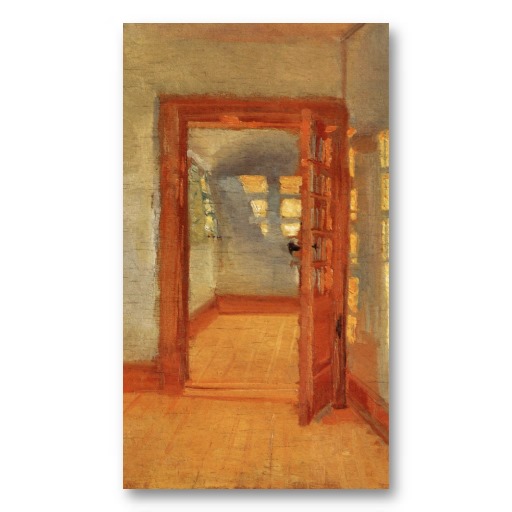
Brondum’s Annex by Anna Ancher
Thank you to Stacey, Tara, Dana, Betsy, Anna, Beth, Kathleen, and Deb for this space for teachers and others to share their stories each Tuesday throughout the year and every day during the month of March. Be sure to visit Two Writing Teachers to read more Slice of Life posts.
LISTENING to keyboard sonatas by Domenico Scarlatti, performed by Mikhail Pletnev. I can’t write or do school work while listening to music with lyrics because I’ll start singing along!
WONDERING if I have everything I need for a PD session with K-2 teachers this afternoon.
THINKING about a couple of ideas I have for poems.
FEELING relieved that my son Michael is getting settled in his new apartment.
TEXTING with my son Brian and his wife about their new puppy, Louie.
READING Silver People: Voices from the Panama Canal, by Margarita Engle. The Firefly Letters is the only book I’ve read by Engle. I think I’ll have to do something about that this year. What an amazing writer!
REFLECTING on how to best help two of our neediest students, both of whom are making very slow progress.
DRINKING a cup of tea, Bigelow Lemon Lift.
WATCHING nothing. We never turn the TV on in the morning.
WISHING I had gotten more housework done over the weekend. We’re having company this weekend, and I’m not sure how I’m going to get everything done before they arrive on Friday.
WORKING ON getting our taxes together.
KNITTING a hat for a baby shower I’m going to in a few weeks.
Louie is only 11 weeks old. Look at the size of those paws!
Thank you to Elisabeth Ellington of The Dirigible Plum for the “Currently” format of this slice, and thank you to Stacey, Tara, Dana, Betsy, Anna, Beth, Kathleen, and Deb for this space for teachers and others to share their stories each Tuesday throughout the year and every day during the month of March. Be sure to visit Two Writing Teachers to read more Slice of Life posts.
It seems early in the game to be stuck for an idea of what to write about, and I’m not really stuck. I have a couple of topics I want to write about. Just not tonight. I remembered reading a “Currently” post earlier today and thought that would be an easy option. There was just one problem. I couldn’t find the post. Okay, I’ll just google “currently blog post.” Of course I didn’t find what I was looking for. I found something better.
WordPress has a .pdf document called 365 Days of Writing Prompts. I scrolled to the prompt for March 7th, but didn’t love it. So I went back into February and found this:
Buffalo nickel
Dig through your couch cushions, your purse, or the floor of your car and look at the year printed on the first coin you find. What were you doing that year?
This appealed to me. I grabbed by wallet and pulled out a penny. 1997. What was I doing in 1997?
I was teaching third grade. If I remember correctly, I had a pretty challenging class that year, and I was taking classes for my master’s degree. Brian turned 16 in November and was chomping at the bit to get his driver’s license. Michael was 13 and our days were filled with soccer practice, swim meets and kayaking on the weekend. Life was a blur.
But what truly stands out for me about 1997 is that my dear Aunt Polly lost her battle with cervical cancer that October. Aunt Polly was only 9 years older than me and I idolized her like an older sister. When I spent the night at my grandparents house, I slept in the twin bed across from hers in her room under the eaves. I loved being there with her.
She loved the Beatles and had turned a room above the garage into her Beatle shrine. Posters and clippings from magazines covered the walls, and she taught me to do the twist in that room.
All too soon, Aunt Polly was a busy teenager with no time for her little niece. Then she went off to college and I didn’t see her for months at a time. But as we both got older, we grew closer again. She was an accomplished photographer and took all the pictures at my wedding as her gift to me and my husband. Sadly, because she was so busy behind the camera, I don’t have any photos of us together that day.
It’s unbelievable to me that almost nineteen years have passed since I said goodbye to Aunt Polly. I think of her often and wish she could have grown old with her husband and their dogs, been at my sister’s wedding, and seen my boys grow up into men. She was one of the most loving, caring people I have ever known, and I’m lucky she was part of my life. Thank you, Aunt Polly, for everything.
Thank you to Stacey, Tara, Dana, Betsy, Anna, Beth, Kathleen, and Deb for this space for teachers and others to share their stories each Tuesday throughout the year and every day during the month of March. Be sure to visit Two Writing Teachers to read more Slice of Life posts.
When you walk into a yarn shop, you are faced with a dizzying array of colors and textures. There are yarns almost as fine as thread to yarns as thick as a pencil and everything in between. When I decide to knit something, a lot of decisions have to be made. Which weight yarn is right for my project? What color and texture should I use? All of these choices affect the “mood” of the finished hat or scarf or sweater.
On Friday, I brought an assortment of different yarns into the sixth grade ELA classes. As I shared the yarn with the kids, we talked about how different each skein was from the other. I asked the students which yarn they thought would be the best choice for a hat for Dad or a blanket for a new baby. They intuitively understood that the function of the finished product influenced the yarn choice.
I pointed out that, just like knitters make choices about yarn, authors choose particular words to achieve an intended effect, and these choices influence how a reader reacts to a piece of writing. To illustrate this, I shared the first stanza of William Blake’s “The Echoing Green.”
The sun does arise, And make happy the skies. The merry bells ring To welcome the spring. The skylark and thrush, The birds of the bush, Sing louder around, To the bells’ cheerful sound, While our sports shall be seen On the echoing green.
As soon as we finished reading I asked them to write down a word describing their mood. Then I sent them back into the poem to find which specific words Blake used that evoked that mood. They shared their ideas with their partners, then with the whole group. I was impressed with the variety of words they chose to describe their mood, but even more impressed with how they were able to cite specific words and phrases to support their ideas. We repeated this process with the other two stanzas to see if the mood was consistent throughout the poem.
Analyzing “the impact of a specific word choice on meaning and tone,” as the CCSS calls for sixth grade students to do, can be tricky. These students have just started reading Tuck Everlasting, Natalie Babbitt’s profound and thought-provoking novel. Babbitt is a master of evoking mood, but her word choice can be subtle, so my sixth grade colleague and I have been working on ways to develop this challenging skill.
The kids did a great job with the work we began on Friday. I’ll be visiting them several times over the next few weeks to continue this work, including looking at several poems that have many words in common but evoke very different moods.
Thank you to Stacey, Tara, Dana, Betsy, Anna, Beth, Kathleen, and Deb for this space for teachers and others to share their stories each Tuesday throughout the year and every day during the month of March. Be sure to visit Two Writing Teachers to read more Slice of Life posts.
When my grandmother went to live in a nursing home, we were faced with the daunting task of emptying the house she’d lived in for over sixty years. Our work was rewarded, though, with countless forgotten treasures, including this:
The back of this box is stamped with the logo to the Kibbe Bros. Co., Springfield, Mass. and is inscribed to my grandmother, from Pat J. Lillis, Christmas, 1919. I wasn’t surprised to find an old candy box among my grandmother’s things. She saved everything. But I wasn’t prepared for the treasure that lay inside the box. Inside were hundreds of paper dolls and women modeling dress patterns cut from magazines. Because they’d been hidden away from both my mother and her sister and my cousins and me, they were in perfect condition.
My grandmother wrote “Loretta Lane, age 14” on the back of this doll.
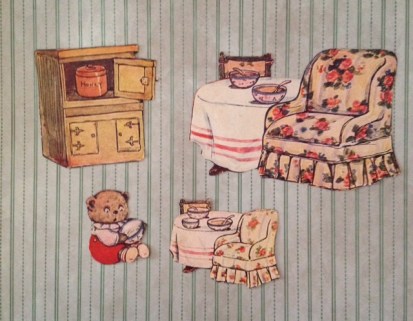
Everything was cut precisely, including characters from nursery rhymes and Alice in Wonderland. There was even small brown envelope filled with just hats. Most of the dolls, which included girls, women, and boys, were given names and ages and are all part of a large family.
All that remains of “The Three Bears.” Don’t you love the look on the bear’s face?
When we asked my grandmother about them, she said she and her younger sister had cut them out and played with them for hours. This is how I imagine them:
Dust motes dance in light streaming through windows so old the glass ripples and flows.
Bathed in this golden sunshine, a nook beneath the stairs becomes a refuge from collecting eggs, fetching cows from the far pasture.
Two heads lean together, brown hair woven into tight braids, bowed in concentration, imaginations running wild.
Four hands snip and cut, a family of paper dolls grows. Names bestowed, adventures dreamed, lives created out of thin air.
Thank you to Stacey, Tara, Dana, Betsy, Anna, Beth, Kathleen, and Deb for this space for teachers and others to share their stories each Tuesday throughout the year and every day during the month of March. Be sure to visit Two Writing Teachers to read more Slice of Life posts.
I had good intentions when I decided to participate in Laura Shovan’s Found Object Poetry Project last month. Sadly, about halfway through the month, life intervened and writing a poem every day just wasn’t possible. I kept hoping to catch up though, so I downloaded Laura’s photos and jotted notes.
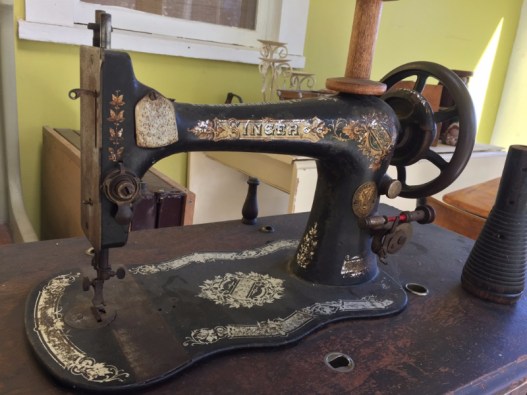
All of the photos were intriguing, but some spoke to me more than others. And although her sewing machine was much more utilitarian, this reminded me of my grandmother.
Photo by Matt Forrest Esenwine
My grandmother raised three children during the Depression, so most of her sewing was out of necessity. But she also made gorgeous quilts out of feed bag fabric for my mother and my aunt that are still treasured family possessions.
I thought this poem might be a villanelle, but oh my, what a mess that was! So I took the lines I liked the best, rearranged them a little, kept some of the rhyme, and came up with this draft.
“Quilting a Garden”
After she finishes chores and demands, a young woman cuts precise patches, arrays them in patterns, harmonious and grand.
Coarse cotton brightens hard times gloom A young woman sews with a patient hand, quilts a garden into bloom.
Stitch after stitch, thread becomes plume, weaving her story strand by strand, quilting a garden into bloom.
Please be sure to visit Linda Baie at TeacherDance for the Poetry Friday Roundup.
Thank you to Stacey, Tara, Dana, Betsy, Anna, Beth, Kathleen, and Deb for this space for teachers and others to share their stories each Tuesday throughout the year and every day during the month of March. Be sure to visit Two Writing Teachers to read more Slice of Life posts.



















 Reading to the Core