DigiLit Sunday: Finding Our Focus

slide11

This post is part of “DigiLit Sunday,” hosted by Margaret Simon at Reflections on the Teche. This week’s topic is focus. Please be sure to visit Margaret’s blog to read more Digilit Sunday contributions.

At the ophthalmologist’s office, my chin is perched on a cold metal plate. My eyes are pressed into a mask of metal and glass that must make me look like a steampunk insect. The doctor casually flips lenses back and forth. “Better?” he asks, or “This? Or this?” How do I know with any certainty? My eyes are dilated and stung, blurry and burning with this effort. Then the doctor flips the lens again and, as if by magic, everything is clear.

comprehensive_ophthalmology

Sometimes I feel like this when I’m writing. I have some nebulous idea in mind that I circle around for days or even longer before I have a clearer vision of what direction or shape a project will take. Other times, an idea appears as suddenly as if a switch was flipped. Who knows why.

The trick is to be ready to catch the idea. I’m fascinated to hear authors and other artists describe how ideas come to them. Francine Prose recently talked about the origin of her new novel, Mister Monkey, on NPR. As I listened, I thought only a true artist could find inspiration in such an awkward and unlikely moment and turn it into a work that moves and enlightens others.

How does this relate to teaching? There are at least two sides to this question. Our primary focus, of course, is our students. But clarifying that focus onto individual students is a much more complicated job.

I wonder, though, if it’s really that different from being at the ophthalmologist’s? We look at students and their work through different lenses. Our first lens is straightforward: we look to see if their work is accurate. Whether it is or isn’t, a second lens will be needed. If the work is correct, we’ll look through a lens of where to go next. If it isn’t, we need our “why not” lens.

As a reading interventionist, this is a lens I look through often. During a phonics dictation last week, a student spelled chase, (as in “The cat will chase the mouse.”) as chaise. Focusing on the why of this spelling and not just the right or wrong of it tells me two things. First of all, this student needs more work with long a spelling patterns. Secondly, and more importantly, he knows what they are, but hasn’t learned that they aren’t  usually used at the same time. With this information in hand, I can focus my attention on how to help him master these spelling patterns.

Not only do we have to view the students and their work through the right lens, we need the knowledge to know what we’re looking at, the skill to catch the idea, if you will. Without this knowledge to give our teaching a focus, we may wander around from idea to idea, but never connect them in any meaningful way. We have to articulate a goal, then keep it in focus. We may fall short, or we may have to alter our path along the way. But as long as our focus is clear, and we remain flexible, we are much more likely to succeed. 

Poetry Friday: “Fifth Grade Autobiography”

poetry-friday-1-1

Over the past few weeks I’ve been working with 8th graders on poems inspired by memories. After brainstorming possible topics, they began drafting. I was in awe of the depth and range of emotions and tones in their writing, from witty to heartbreakingly serious.

As we began revising, it was clear that they needed some mentor poems to help them think about line breaks. After spending some time on The Poetry Foundation’s archive of poems for children, I found this beauty by Rita Dove.

“Fifth Grade Autobiography”
by Rita Dove

I was four in this photograph fishing
with my grandparents at a lake in Michigan.
My brother squats in poison ivy.
His Davy Crockett cap
sits squared on his head so the raccoon tail
flounces down the back of his sailor suit.

My grandfather sits to the far right
in a folding chair,
and I know his left hand is on
the tobacco in his pants pocket
because I used to wrap it for him
every Christmas.

Read the rest of the poem here.

Please be sure to visit the lovely Laura Purdie Salas at Writing the World For Kids for the Poetry Friday Roundup.

The Landscape of Everyday Life

poetry-friday-1-1

It’s only half a mile from where I live now. Follow the road as it snakes its way down a rock-strewn hill, then flattens out and runs like a ribbon in front of lawns where holsteins once grazed on sweet clover. Round another corner and the house comes into view: a cape, white with black shutters, just like so many others scattered across New England. Except this one is special, at least to me. This is the house I grew up in.

More than thirty years have passed since my family sold this house, yet hundreds of memories flooded through me as I stood in front hallway on Sunday. Ordinary days of running out the door when I was late for the bus; extraordinary days when I left for college, when I got married.

Who was that person, rushing out, so anxious to find out what life had in store? Is there some trace of her within me? When I look in the mirror, I see her still, even though the face, like the house, is transformed with age. Are her dreams so different now?

How long do we keep our previous homes in our hearts? All these years later, I could walk through that house blindfolded. I wept as I stood in my old bedroom, utterly changed, yet still mine. In The Most Beautiful House in the World (Penguin Books, 1990), Witold Ribczynski describes his home as “the landscape of my everyday” life. This landscape of my childhood is seared into my soul because it was there that my soul was forged.

Memory is a tricky thing. The rooms felt smaller, but the sunlight pouring through the window was as bright and warm as it had ever been. Not every memory from that house is happy. How could it be? But I was loved there, and felt safe there. Birds build nests that suit their habitat, their biology and anatomy. They nestle into contours that fit their bodies precisely. That house was a perfect fit.

Thank you to StaceyDanaBetsyBeth, KathleenDeb, Melanie, and Lisa for creating this community and providing this space for teachers and others to share their stories each Tuesday. Be sure to visit Two Writing Teachers to read more Slice of Life posts.

Poetry Friday: Mary Oliver’s “Song for Autumn”

poetry-friday-1-1

“Attention is the beginning of devotion”
Mary Oliver

For the past week, I have been reading and savoring Upstream, Mary Oliver’s luminous new collection of essays. I am in awe of Oliver’s power of observation, her keen ear, her deft turn of phrase. In an essay on Emerson, she describes his writing as “a pleasure to the ear, and thus a tonic to the heart, at the same time that it strikes the mind.” For me, this is a description of Oliver’s own writing as well.

We had our first snow yesterday, and the everlastings and late roses were “crowned with the first tuffets of snow,” so I thought this was a particularly appropriate poem to share today.

“Song for Autumn”
Mary Oliver

Don’t you imagine the leaves dream now
how comfortable it will be to touch
the earth instead of the
nothingness of the air and the endless
freshets of wind? And don’t you think
the trees, especially those with
mossy hollows, are beginning to look for

the birds that will come–six, a dozen–to sleep
inside their bodies? And don’t you hear
the goldenrod whispering goodbye,
the everlasting being crowned with the first
tuffets of snow?

Read the rest of the poem here.

Please be sure to visit Linda at Teacher Dance for the Poetry Friday Roundup.

Finding My Writing Rhythm

11454297503_e27946e4ff_h

Have you ever had one of those weeks when you have something going on every single evening? This is one of those weeks for me. I’ve been distracted by all I have to accomplish in the next few days. I’m still am not sure how I’ll manage it all. But I haven’t written a Slice in almost a month, and I didn’t want to let another week slip by without writing.

Then all of a sudden it was after eight o’clock. I’d been tossing around a couple of ideas throughout the day. I’d even started drafting one. But nothing was coming together. As I was cleaning the kitchen, considering my options, I heard snatches of the baseball game from the living room. It sounded like the starting pitcher had walked the first two batters. Not an auspicious way to begin a game.

Hall of Fame Pitcher Sandy Koufax By Bell Brand ([1]) [Public domain], via Wikimedia Commons
By Bell Brand ([1]) [Public domain], via Wikimedia Commons

As a lifelong baseball fan, I know that pitchers sometimes take time to settle into a rhythm and hit their stride. Sometimes their first few pitches are erratic: high, low, outside. Sometimes they don’t recover from these rough starts. They give up too many runs too early, and they are done for the day. But sometimes they settle down a pitch a brilliant game.

I realized that I was having trouble writing my slice because, like that pitcher, I couldn’t settle down. I couldn’t find my writing rhythm.

How often do our students find themselves in this situation? Probably more often than we know. They may have an idea, but aren’t really sure how to find their way into it. Or maybe they can’t choose between a few ideas. Whatever the case, we can establish routines and provide supportive writing environments, but we can never completely prevent a bad writing day. The key is not to give up, and to let our students know we’re not giving up on them. When the manager goes out to the mound to take the ball away, he doesn’t yell and scream. (Although he might later.) He’s calm and nurturing, just as we are when our students are stuck.

And just like that struggling pitcher, we will either settle down and write something, or we’ll put down our pen after only a sentence or two. But we’ll also be back tomorrow, pen in hand, ready to face the page with our best effort.

Thank you to StaceyDanaBetsyBeth, KathleenDeb, Melanie, and Lisa for creating this community and providing this space for teachers and others to share their stories each Tuesday. Be sure to visit Two Writing Teachers to read more Slice of Life posts.

DigiLit Sunday: Why I Write

slide11

This post is part of “DigiLit Sunday,” hosted by Margaret Simon at Reflections on the Teche. This week’s topic, in preparation for the National Day On Writing on October 20, is “Why I Write.” Please be sure to visit Margaret’s blog to read more Digilit Sunday contributions.

“You were made and set here to give voice to your own astonishment.”
~ Annie Dillard ~

When I was growing up, I loved to explore. Inside or out, it didn’t matter. I was curious about what was under every rock and what I could see from the top of each tree. I wanted to know what was in every drawer and old trunk I could find. At one point, I even wanted to be an archeologist so I could say it was my job to find treasure.

I didn’t become an archeologist, but my curiosity has never left me. Daily walks are explorations. I always return home with something: a leaf or fragment of a wasp’s nest, an image in my head or on my camera. Opening a book and entering into unknown worlds is another way to delve into the unknown. Poking around an antique shop or a flea market also recaptures that thrill of discovery.

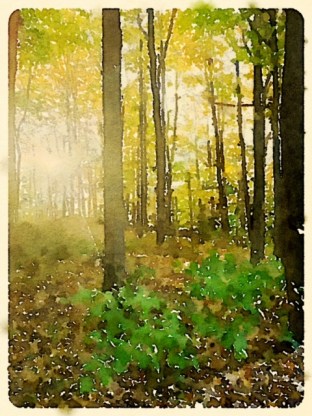
Preset Style = Travelogue Format = 6" (Medium) Format Margin = Small Format Border = Sm. Rounded Drawing = #2 Pencil Drawing Weight = Heavy Drawing Detail = Medium Paint = Natural Paint Lightness = Auto Paint Intensity = More Water = Orange Juice Water Edges = Medium Water Bleed = Average Brush = Fine Detail Brush Focus = Everything Brush Spacing = Medium Paper = Buff Paper Texture = Medium Paper Shading = Medium Options Faces = Enhance Faces
A view from a late afternoon walk last week, enhanced by Waterlogue.

But the most important way I keep my sense of wonder and curiosity alive is by writing. When I write, I can wander through the woods where I played as a kid. Or pore over old photos from the desk in my grandmother’s living room. I can rummage around in forgotten boxes for hours and still be excited when some long-forgotten memento turns up.

Writing lets me puzzle through questions. The page, after all, is a good listener. Writing lets me have a conversation about subjects no one else is interested in. In both cases, writing clarifies my thoughts about my work and life. Sometimes writing captures my frustrations. Letting the paper absorb my irritation or discouragement helps to dissipate negative feelings.

Writing also allows me, as Ted Kooser so wonderfully described it in The Poetry Home Repair Manual, to have moments “full of joyous, solitary discovery.” I have experienced these moments, although they are they exception, not the rule. What I have learned during my life as a writer, is that the more you write, the more likely you are to make one of those joyous discoveries; a flash of insight, when the right words flow out in the right order. It is a deeply satisfying moment.

The writing I do for myself, because I want to, also puts me in a better position to help my students. I know that extended periods of time to write about things they’re passionate about is necessary if they are to become skilled writers and thinkers. I want my students to have the opportunity to see where their writing takes them. Who knows what they might discover about themselves?

Writing may be satisfying, but it can also be deeply frustrating. My writing always falls short of my expectations. So why do I continue? I keep writing because I always learn something new. And I’m always searching for the undiscovered treasure waiting for me at the bottom of the trunk.

IMWAYR: “Before Morning”

IMWAYR 2015

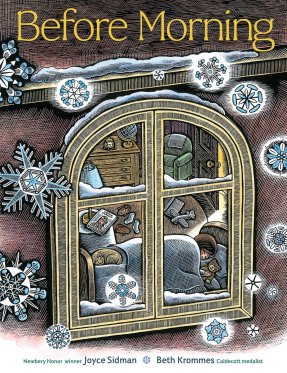
Samuel Taylor Coleridge once reminded “clever young poets” that poetry is “the best words in the best order.” Joyce Sidman’s poetry embodies this advice. In her latest book, Before Morning (Houghton Mifflin Harcourt, 2016), Sidman has chosen just sixty-six words and crafted them into a lyrical incantation full of love and longing.

bdfd272b-5c2a-4265-9e88-1a3449d63d31-jpg-_cb271101758_

A hallmark of Sidman’s poetry is her unexpected metaphors and images, and Before Morning is true to form. We’re instantly lured into “the deep woolen dark” where “the earth turns to sugar/and all that is heavy/turns light.”  A deceptively simple rhyme scheme is almost “hidden from sight,” but adds to this book’s rhythm and beauty.

Beth Krommes‘s scratchboard and watercolor illustrations give a marvelous depth to Sidman’s poem and resonate in unexpected ways. Sidman herself has said that the illustrations were “a complete surprise.” Krommes, who has illustrated two of Joyce’s earlier books, Butterfly Eyes and Other Secrets of the Meadow (Houghton Mifflin Harcourt, 2006) and Swirl by Swirl: Spirals in Nature (Houghton Mifflin Harcourt, 2011), provides a setting that is instantly recognizable to readers: the hustle and bustle of daily life. Children will want to pore over the details of this family’s life and will find surprises on every page.

In her author’s note, Joyce explains that Before Morning is “an invocation—a poem that invites something to happen.” She goes on to encourage readers to think about their own wishes and find the best words for them.

I tried to find the best words I could to express how much I love this book. My wish is for Joyce Sidman and Beth Krommes to continue collaborating and creating stunning picture books like Before Morning.

Please be sure to visit Jen Vincent at Teach Mentor Texts and Kellee Moye of Unleashing Readers for more book recommendations.

Poetry Friday: “Mabon”

poetry-friday-1-1

“Mabon”
by Annie Finch

For Mabon (fall equinox), Sept. 21

Our voices press
from us
and twine
around the year’s
fermenting wine

Yellow fall roars
Over the ground.
Loud, in the leafy sun that pours
Liquid through doors,
Yellow, the leaves twist down

as the winding
of the vine
pulls our curling

voices–

Glowing in wind and change,
The orange leaf tells

How one more season will alter and range,
Working the strange
Colors of clamor and bells

In the winding
of the vine
our voices press out
from us
to twine

When autumn gathers, the tree
That the leaves sang
Reddens dark slowly, then, suddenly free,
Turns like a key,
Opening air where they hang

Read the rest of the poem here.

img_3459

Thursday was a glorious autumn day in Connecticut. The sky was clear blue, and the trees glowed in the afternoon sun. And even though the equinox was a few weeks ago, this poem describes the day exactly.

Please be sure to visit Violet Nesdoly for the Poetry Friday Roundup.

IMWAYR: “Some Writer: The Story of E.B. White” by Melissa Sweet

IMWAYR 2015

The miracle of a book is a mystery to children. They wonder where books come from. They think authors are, as E.B. White put it, “mythical being[s].” To children, books seem to be conjured out of thin air. Which, in a sense, like a spider’s web itself, they are.

In Some Writer: The Story of E.B. White (Houghton Mifflin Harcourt, 2016), Melissa Sweet has woven a miraculous, magical book that peels back a layer of this mystery to reveal the very human side of one of our most mythical authors, E.B. White.

28114411

Sweet’s inviting prose and inventive artwork immediately draw readers into White’s world. The illustrations are a hybrid of photos, collage, and watercolors. Sepia-toned photographs of White with his father and brother in Maine are followed by one of Sweet’s appealing watercolors. White’s own description of the scene, from his 1940 essay, “A Boy I Knew,” is typed out on vintage paper using a manual typewriter, serves as a caption. The effect is beguiling. I wanted to be sitting there “at the water’s edge [on] a granite rock upholstered in lichen.”

img_1237

Drawing extensively on White’s letters and essays, Sweet takes readers from White’s childhood in Mount Vernon, New York to his death in Maine eighty-six years later. As a boy, he was surrounded by words and discovered at an early age that writing helped him “to assuage my uneasiness and collect my thoughts.” Keeping her text focused on how early events in White’s life impacted his development as a writer and his future work, Sweet helps readers see the roots of Stuart Little, Charlotte’s Web, and The Trumpet of the Swan in his life and his early writings.

White’s early poems and stories were published in St. Nicholas Illustrated Magazine for Boys and Girls. Sweet includes copies of these, giving the book the intimate feel of a scrapbook of a beloved relative. Readers will want to savor every page. Glimpses of White’s masterpieces for children are found throughout his life. Sweet writes about White’s time as a camp counselor at Camp Otter in Canada, and we learn about his road trip across the country in a Model T after graduating from Cornell.

Each major work, as well as The Elements of Style, is given its own chapter. We learn of the difficulties White had finishing Stuart Little, the criticism it received from librarians, and the love lavished on it by children. Sweet describes in detail how White’s farm in Maine, his doomed pig, and a spider’s egg sac coalesced into Charlotte’s Web. Sweet’s description, drawing on White’s own words, of how the opening scene of this book evolved is a master class in revision. As every writer knows, “revising is part of writing.” These scenes show how the fantastical elements of White’s fiction are grounded in the real world. As White replied to one of his critics, “children can sail easily over the fence that separates reality from make-believe.”

No detail in the design of Some Writer is ignored: chapter numbers are old typewriter keys, old-fashioned labels are used for page numbers and to identify the essay or letter of White’s that is being quoted. Sweet’s collages are perfect mentor texts for creative ways to convey information.

img_1238

The publisher lists the age range as 7-10, but middle school readers will also find plenty to be inspired by in this book. All readers and writers have much to learn from E.B. White’s quiet wisdom about writing and life. Interested readers will want to explore the extensive endnotes and bibliography of White’s own work, as well as works written about him. There is a touching afterword by White’s granddaughter, Martha, and notes from Melissa Sweet about her writing process and her art.

Sweet writes with the economy White advocates in The Elements of Style. “Every word tell[s]” a key part of White’s story. She blends her words and her art with White’s words and demystifies the process of becoming a writer… “through hard work and being open to the world around you.”

After White’s death, Roger Angell, William Shawn, and John Updike wrote in his obituary, “White felt it was a writer’s obligation to transmit as best he can his love of life, his appreciation for the natural world.” Sweet’s love of and appreciation of E.B.White, his work, and the natural world shine out from every page of Some Writer. In her author’s note, Sweet quotes White, saying “It has been ambitious and plucky of me to attempt to describe what is indescribable…[But] a writer, like an acrobat, must occasionally try a stunt that is too much for him.” Like Charlotte’s Web itself, Sweet’s “stunt” is nothing short of a miracle.

img_1239

Review copy received from Houghton Mifflin Harcourt. An Educator’s Guide for Some Writer is available here.

Please be sure to visit Jen Vincent at Teach Mentor Texts and Kellee Moye of Unleashing Readers for more book recommendations.

Poetry Friday: Sail Away to Fairyland

poetry-friday-1-1

Once again, I’m down to the wire meeting Michelle Heidenrich Barnes’s ditty challenge. This month, Jane Yolen challenged Michelle’s readers to “Write a poem in which reading and or writing is featured in the form of a septercet.”  How hard could that be?

As it turns out, I had a very hard time figuring out my way into this poem. How to narrow down a lifetime of reading and writing? Then, this line, from “Do-Re-Mi” and The Sound of Music came into my head: “Let’s start at the very beginning…” Suddenly, I was on my grandmother’s lap and she was reading Jack the Giant Killer, by Harold Lentz, to me. This book belonged to my uncle when he was little, and it was a favorite of mine and my cousins because of its fabulous pop-up scenes.

16055

Here is a draft of the septercet inspired by this book.

“Sail Away to Fairyland”

Nestled on my grandma’s lap,
she opens a book and I’m
sailing off to fairyland.

A magic castle rises,
princess slumbering within,
the prince arrives to wake her.

Turn the page. Red Riding Hood
knocks on Grandma’s door. Beware!
A devious wolf awaits.

One story ends, another
begins. “Fee, fi, fo, fum,” hums
a hungry, fearsome giant.

Just in time, Jack saves the day,
rescues friends from a sad fate.
But Giant, enraged, gives chase,

lumbering down the beanstalk.
Will Jack get away? He grabs
an axe, chops with all his might.

Tales now told, the book is closed.
You know how this story ends.

Happily ever after.

© Catherine Flynn, 2016

1310744-3
My favorite pop-up, Sleeping Beauty’s castle.

Thank you, Michelle and Jane, for sparking this trip down memory lane. Please be sure to visit Karen Edmisten at The Blog With the Shockingly Clever Title for the Poetry Friday Roundup.