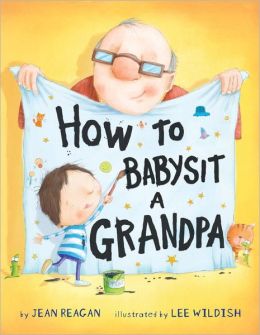
How to Babysit a Grandpa (Alfred Knopf, 2012), by Jean Reagan, with illustrations by Lee Wildish, is a charming story. The book opens with these words of wisdom from a little boy who is about to spend the day with his grandpa.
“Babysitting a grandpa is fun–if you know how.”
Our nameless hero goes on to explain all the highlights of a five-year old’s day: snacks, going outside, playing games, and more. He even suggests “bouncy music” to make clean up easier. Every other page or so provides additional tips for would-be grandpa-sitters, such as snack suggestions and ideas for lots of creative play. (I love that there is a T.V in one illustration, but it is never mentioned, let alone turned on.)
Adding to the appeal of Reagan’s text are Lee Wildish’s digital illustrations. His characters remind me of Melissa Sweet’s non-collage work–imbued with love and a sense of humor about the realities of life as a child. There are crumbs all over the table, and the boy’s tongue is set firmly in the corner of his mouth as he draws a picture for grandpa.
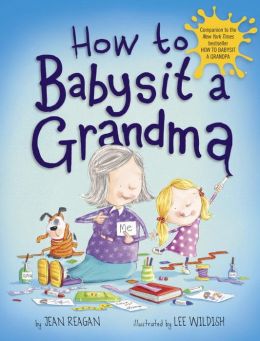
Reagan and Wildish have teamed up again for How to Babysit a Grandma (Alfred Knopf, 2014), and it is every bit as engaging as How to Babysit a Grandpa. The style and tone are the same (the boy and his grandpa even make a cameo appearance at the park), but our heroine has her own ideas for activities to “keep a grandma busy.”
Both of these books are perfect mentor texts for Kindergarteners and first graders learning to write how-to books. Children could also come up with their own versions of the lists Reagan has included, or add their ideas to hers. These books could just as easily be enjoyed as read-alouds, or shared in September in honor of Grandparents Day. The possibilities are endless. One thing is certain, though. If you have a 4-6 year old, know one, or teach them, these books should be on your list of How to Entertain a Child.
Don’t forget to visit Jen at Teach Mentor Texts and Kellee at Unleashing Readers to find out what other people have been reading lately. Thanks, Jen and Kellee, for hosting!
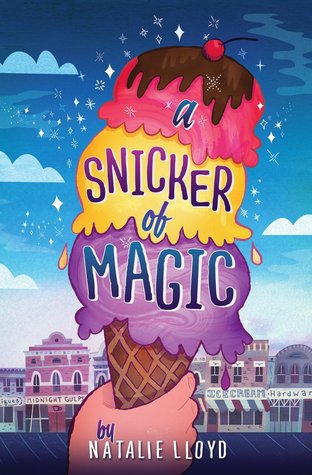
I feel like I’m late to the party for A Snicker of Magic (Scholastic, 2014), Natalie Lloyd’s debut middle-grade novel. Even though it’s only been out for a little over a month, A Snicker of Magic has gotten oodles of love on Twitter and kid lit blogs. This love is well deserved.
A Snicker of Magic is one of those “good stories” that “take your heart someplace else.” Felicity Pickle, a 12 year old who “sees words everywhere,” is the heart of Lloyd’s story. After years of being “sweet gypsies,” Felicity, her mother, and sister arrive in the tiny town of Midnight Gulch, Tennessee. Tired from years of wandering, Felicity is ready to stay, but fears her mother will become restless and want to leave again at any moment. Midnight Gulch “used to be a secret place… because the people who lived there had magic in their veins.” But the magic is gone. Felicity is curious about why it left and where it went. With the help of her new friend, Jonah, and a colorful cast of characters, she does her best to find the magic and return it to the town.
Felicity is a poet who knows that she holds “the finest magic, words worth spinning, stories worth telling.” Hope has perched in her soul, and she uses her gift with words to heal the pain caused by a century of anger and misunderstanding. Lloyd has spun a story filled with magic, a story well worth telling. A Snicker of Magic is a good choice for a read aloud in fourth or fifth grade and will likely inspire many students to become word collectors and poets themselves.
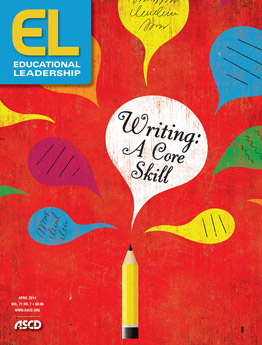
Educational Leadership, the monthly journal published by ASCD, always has timely articles by leading researchers, and the April issue is no exception. Devoted to “Writing: A Core Skill,” contributors include Carol Jago, Mary Ehrenworth, Kelly Gallagher, Penny Kittle, and more. I’m still reading, but can see already that this issue is a valuable resource. The articles I’ve read offer a succinct introduction to many elements of good writing instruction, including using mentor texts, teaching craft rather than formulas, types of writing, and more. I plan on sharing Jeff Anderson’s contribution, “What Writing Is & Isn’t,” with my colleagues. This article is the perfect springboard for a discussion about our understanding of writing instruction.
Don’t forget to visit Jen at Teach Mentor Texts and Kellee at Unleashing Readers to find out what other people have been reading lately. Thanks, Jen and Kellee, for hosting!
How to write this final post of the 2014 Slice of Life Challenge? Yesterday’s post was reflective and full of thanks to everyone who made this challenge possible and who encouraged me through their generous comments. I had planned to do a standard “It’s Monday! What Are You Reading?” post, but as often happens, life intervened and I knew that plan wasn’t going to work.
I spent much of the day revising our fifth grade poetry unit and thought I could write about that, but that didn’t seem appropriate for my final slice. “In the end,” I decided to use a list poem (another list!) I read today, “Things To Do If You Are The Sun,” by Bobbi Katz, as a model for a poem that sums up how participating in this challenge has changed me as a writer.
Things To Do If You’re a Writer
Let words envelop you and swirl inside your head.
Look at a flower bud and see a diver poised on the brink of the board.
Hear an owl hooting and wonder what coded message he’s sending out
into the night.
Bite into a pear and taste summer in its sweetness.
Touch a puppy’s ear and feel the satiny edge of a well-loved blanket.
Breathe in the late winter air and sniff a hint of spring.
Gather these bits and pieces, like a magpie, and weave them
into something wonderful.
Share your creation with friends, who, through reading your words,
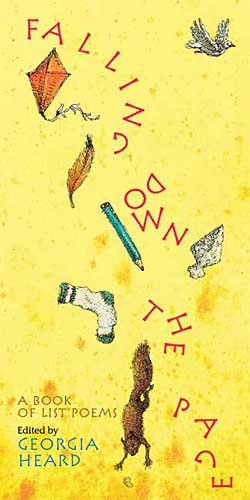
If you’d like to read “Things to do if You Are the Sun,” it can be found in Falling Down the Page: A Book of List Poems (Roaring Brook Press, 2009), edited by Georgia Heard. If you’d like to read other list poems and gather more ideas for using them as mentor texts with children, read Elaine Magliaro’s post at Wild Rose Reader.
As this month draws to a close, it seems natural to reflect on what I’ve learned. Lists have been popular this year. I love lists and have tried a few different formats myself, and thought a compare/contrast style list would work to organize my jumbled thoughts about writing each day for the past 30 days.
The Perils of Writing Every Day
Chocolate on the computer–I guess as long as it doesn’t work its way into the keyboard or USB port, it really can’t hurt.
Almost driving into a snowbank as I watched a bobcat cross the road. (Thankfully, the snow is gone!)
Being so tired from reading and writing (not to mention life) that I could hardly see straight, yet when I finally got into bed and closed my eyes, words floated into my brain and I had to get up to write them down.
Washing my hair with body soap because I was still tired and distracted by my thoughts.
There was something else, but I can’t remember what it was because I didn’t write it down!
The Pleasures of Writing Every Day
Finding exactly the right words to express my thoughts.
Reflecting on daily events through writing. This has helped me learn and deepen my understanding about a many topics.
Learning about myself as a writer–being conscious of my bad habits and trying to improve my writing.
Having the satisfaction of letting go of some self-doubt and accomplishing a goal — sharing an original poem each Friday was scary.
Being part of this supportive, nurturing community. Your comments and feedback have encouraged me and made me brave.
I am so grateful to Stacey, Tara, Dana, Anna, Betsy, and Beth for providing this space for us to share our writing, and to everyone on the support team who helped with all the details. I can only imagine the time and effort that have gone into making this month-long challenge a success. Thank you all for your generosity!
Finally, I am in awe of all of you. The writing that you have shared in response to the SOL challenge has been amazing. Your words have moved me to laughter and tears, and have given me new insights and understanding into life. Thank you so much for sharing.
“Poetry is a language in which man explores his own amazement.”
~ Christopher Fry ~
Every month, I lead our school’s Language Arts Committee meeting. The purpose of this committee is to promote the language arts and ensure that our teaching is based on the latest research. I usually begin the meetings sharing news from our state Department of Education, upcoming conferences and workshops, and information gathered at conferences I’ve attended. Teachers share lessons they’ve had success with and examples of student work. We always have snacks and these meetings are a nice way for teachers to learn about what’s happening at other grade levels.
I spent much of my afternoon planning tomorrow’s meeting. Since National Poetry Month is just a few days away, I will be sharing poetry resources and have a poetry activity planned. Here’s a preview of what’s on the agenda.
Poem in Your Pocket Day is on Thursday, April 24th this year. We’ll actually be in school on this day. For several years, this day has been during our April break.
Poet-to-Poet Project is “a multimedia educational project that invites young people in grades 3-12 to write poems in response to those shared by some of the award-winning poets who serve on the Academy of American Poets Board of Chancellors.” The resources for this project are incredible: videos of the poets reading their poems, lesson plans, and more. Students can submit their original poems to poets.org for possible publication on the website in May.
Book spine poems are a form of found poetry and are a fun way to ease into poetry. You can read about the basic steps at Kenn Nesbitt’s, our current Children’s Poet Laureate, website, Poetry4kids.com.
Poetry Tag Time is an e-book of 30 original poems for children compiled in 2011 by Sylvia Vardell and Janet Wong. A veritable who’s who in children’s poets contributed a poem after being “tagged” by the previous poet. Each poem is connected in some way. I participated in an activity very similar to this several years ago during an online Children’s Literature class, but it was called a poetry “merry-go-round.” The professor posted the first poem, then a student had to post a poem that linked to the original, and so on. I really enjoyed reading the different ways people connected to the poems, and read many wonderful poems I might never have seen. I asked everyone to bring a poem tomorrow so we can play Poetry Tag.
Thinking about Poetry Tag reminded me of a incredible project Linda Rief shared at NCTE last November. At the beginning of the year, Rief’s students created Heart Maps, an idea from Georgia Heard’s amazing book, Awakening the Heart: Exploring Poetry in Elementary and Middle School. Rief’s students then read volumes of poetry, gathering poems that spoke to them and exemplified an area of their heart map. Students copied these poems out by hand, and gathered them into a “Heart Book.” Vicki Vinton shared a description of this project on her blog, To Make a Prairie.
This seems like a lot to cover in the 40 minutes or so we have for our meeting! My hope is that everyone leaves the meeting with a collection of poems and at least one new idea to try during National Poetry Month. What are your plans for National Poetry Month?
Bowling alleys have a culture all their own. The sound of balls hurtling down the polished alleys, the crashing of the pins. The funny shoes, the smell of fries. For some people, bowling is serious business. Those in leagues have handicaps and custom-made balls. For many, though, bowling is a fun night out with friends, maybe once or twice a year, with nothing really at stake. I am this kind of bowler.
By David Castillo Dominici, freedigitalphotos.net
Friday afternoon was our annual staff “Bowling Tournament of Champions.” Teachers and other staff members sign up and teams are assembled at random. Each team comes up with a silly name and matching silly attire. I love these afternoons because it gives us a chance to chat with colleagues we don’t often see. We’re outside of school, and for the most part, school stays out of the conversations. Everyone cheers each other on, no matter which team they’re on, although sometimes a hidden competitive streak reveals itself. There are prizes for the team with the most spirit, the best costumes, and, of course, the champions. It’s all good fun.
Until it isn’t
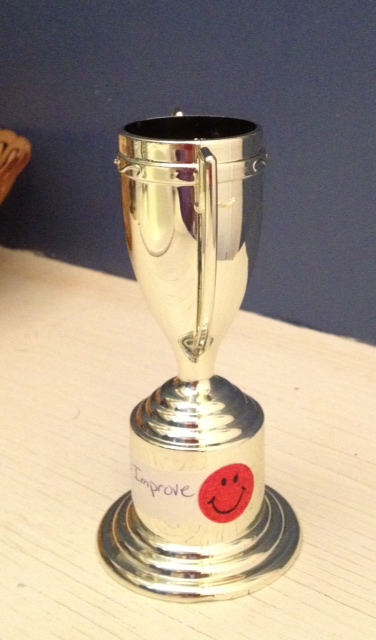
I know I’m not great a great bowler, but I usually can hold my own at these tournaments. But Friday wasn’t my day. I’d been up much too late the night before, and I didn’t sit down for lunch until after two o’clock. Add this to the fact that I bowl once a year and you get this: a trophy for “Most Likely to Improve.” (Code for: lowest score) The smiley face sticker on the trophy didn’t help.
Now I’m not really that upset about all this. I had a good time. But it made me think about the chances of doing well in any kind of activity that you do only once a year.
Maybe you can see where I’m going with this, but don’t misunderstand. I am not, in any way, saying that with more test preparation kids would do better on standardized tests. In fact, I think exactly the opposite is true.
Diane Ravitch pointed out, in her keynote address at the Teachers College Reading and Writing Project Saturday Reunion yesterday, that the tests our children are taking as part of the PARCC and SBAC pilots “have no diagnostic value” and serve only to give “numbers to students.” What does this have to do with ensuring that a child is “college and career ready,” the stated goal of the current education reform movement? How does that help a teacher know her students and understand how to help them learn and grow?
If the Department of Education and the reformers working so hard to destroy public education truly cared about children and were interested in ensuring that every child reached his or her full potential, they would do everything in their power to help teachers enrich instruction. They would do everything in their power to ensure that teachers have time to, in Stephanie Harvey’s words, “teach kids to think so they can acquire and use knowledge” and “solve problems on their own.” They would do everything in their power to lower the rate of childhood poverty, the highest in the developed world.
If the reformers in power took only these steps, then would be on our way to giving all our children the education they deserve. Then we really would be the “Most Likely to Improve.”
This morning, I left my house at 6:30 and drove to Teachers College at Columbia University for their spring Reading and Writing Project Saturday Reunion. I spent the day with thousands of dedicated teachers soaking up the wisdom of the amazing presenters. Because I am now quite tired, here is my day in pictures.
Diane Ravitch delivering the opening keynote.
Diane Ravitch’s keynote was a call to arms. Lucy Calkins, in her introduction, described Ravitch as “the single most important defender of public education” and “our hero, inspiring all of us to speak out and tell the truth.
Fellow Slicer Anna Gratz Cockerille sharing strategies to help children improve their informational writing.Cynthia Satterlee had great advice for helping kids craft personal opinion essays.Stephanie Harvey reminding teachers that “there’s a difference between thinking and knowledge. We have to teach kids to think so they can acquire and use knowledge.”Kathleen Tolan describing how to “take an ordinary idea about a character and make it extraordinary.”The wisdom of Kathy Collins: “Children should believe that when they give something to texts, they will get something back from the text.”Having coffee with friends and talking about our wonderful day.On my way to Brooklyn, my first view of the Freedom Tower.The view from Brooklyn.Dinner with my son and his girlfriend.
What an amazing day, filled with learning, laughter, family, and friends. Thank to everyone at Teachers College for hosting this amazing event!
Yesterday I contemplated the life story of a man I know only because I often pass him on my way to work. Today, I’m still thinking about life stories, and this made me think of Jennifer Allen, a literacy specialist in Waterville, Maine, and the author of Becoming a Literacy Leader: Supporting Learning and Change (Stenhouse, 2006)and A Sense of Belonging: Sustaining and Retaining New Teachers (Stenhouse, 2009). I read Becoming a Literacy Leader when I began working as a literacy specialist and found Allen’s advice both thoughtful and practical.
Early in Allen’s career as a literacy leader, she was frustrated by the lack of buy-in from her colleagues. In an effort to break the cycle of PD sessions where she did most of the talking, Allen posed this question: “If you had only seven stories to tell of your life, what would they be?” Allen states that “the attention and interest of the staff was captured immediately” and that “teachers were eager to share their stories.” (No surprise here, right, Slicers?)
I intended to share what my seven stories would be, even though I’ve shared some of them with you already. But when I looked up Allen’s current biographical information, I found a “What Do You Know?” interview. Thisseems much more manageable at this late hour.
Books Next to My Bed: The Round House, by Louise Erdrich; Words in the Dust, by Trent Reedy; The Arden Shakespeare: Book of Quotations from Songs and Sonnets; What the Heart Knows: Chants, Charms & Blessings, by Joyce Sidman, illustrated by Pamela Zagarenski; A Tree Grows in Brooklyn, by Betty Smith
Favorite Destressing Activity: Going for a walk
Pets: Lucy, a beagle, and Noodles, a fluffy orange kitty
Hobbies: Knitting and gardening
Inspiration: Nature, art, and interesting people
Favorite Place to Visit: Northern Virginia, where my son and his wife live, and New York City, where my younger son lives (Also home to the Metropolitan Museum of Art, my favorite museum.)
Guilty Pleasure: Peanut M&Ms
Item on My Bucket List: Traveling to Florence, Italy
Music on My iPod: (Very eclectic and not too up-to-date) the Beatles, Broadway shows, Mozart
Proud Accomplishment: Raising two sons
What Makes Me Laugh: My husband, The Big Bang Theory
A Few Favorite Movies: Some Like it Hot, The Shawshank Redemption,White Christmas
Another double-duty Slice for It’s Monday! What Are You Reading?
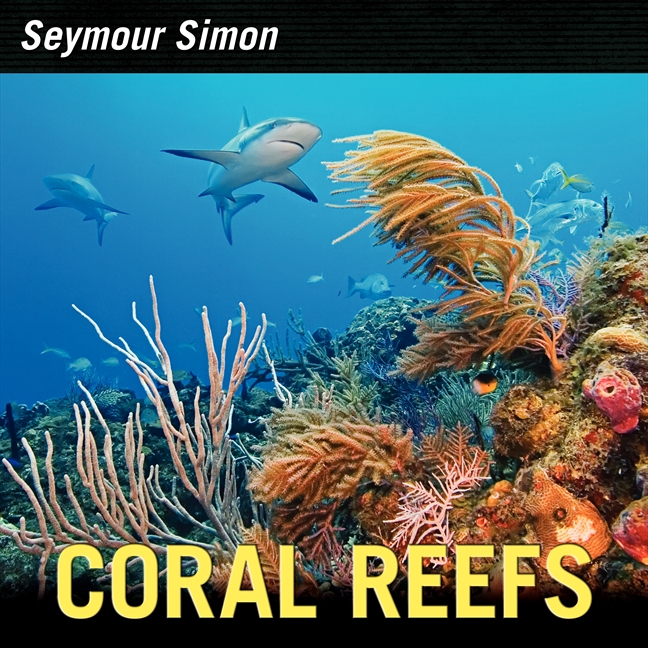
Coral Reefs, by Seymour Simon (Harper, 2013)
This is a gorgeous book, filled with stunning photographs of one of the earth’s most fragile ecosystems. Coral Reefs gives young readers a thorough overview of the “gigantic communities of living things.” (pg. 6) Simon describes the different types of coral, what they eat, and where they’re found in the world. The “many different kinds of citizens” of a coral reef are also described.
The close-up photographs are captivating and kids will want to pore over them for hours. An index is included, as are a glossary and links to websites with additional information. This book would make a nice companion to the more fanciful but just as informative Coral Reefs by Jason Chin.
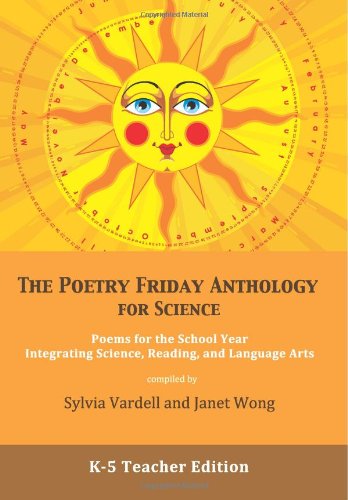
I’ve also been enjoying the poems collected by Sylvia Vardell and Janet Wong in The Poetry Friday Anthology for Science (Pomelo Books, 2014). Dozens of the best poets writing for children today have contributed to this volume. The poems cover a broad range of scientific topics, from scientific practices and lab safety to famous scientists and future challenges, and everything in between. (Although there wasn’t one specifically about a coral reef.)
Wong and Vardell begin their informative introduction with the question “Why poetry with science?” To make their case, they quote legendary author and educator Bernice Cullinan:
“Scientists observe with a clear eye, record their observations in precise, descriptive language, and craft their expressions. Poets do the same thing.”
Also included are tips for sharing the poems and connections to the Next Generation Science Standards. In addition, the following resources are included:
a bibliography of poetry books for science
links to websites and blogs, for both poetry and science
a list of professional resources
a “mini-glossary of science terms”
title, poet, and subject indexes
This book is a must-have resource elementary teachers working to integrate literacy into their science instruction. Student editions are available by grade level and include bonus poems.
Several poems from the anthology have been shared on blogs over the past week. Jone at Check It Out has “Sound Waves” by Amy Ludwig VanDerwater:
You can also read poems from each grade level at Irene Latham’s blog, Live Your Poem…
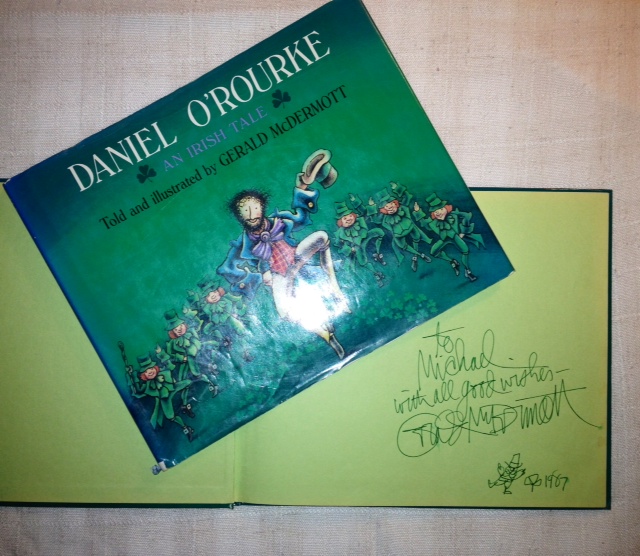
Finally, because it’s St. Patrick’s Day, I have to give a shout-out to my favorite book to share on this day, Daniel O’Rourke (Viking Kestrel, 1986), by Gerald McDermott. Sadly, it seems that this tale of Daniel O’Rourke’s misadventures at the hands of three mischievous leprechauns is out of print. My own children loved this story when they were small, and dozens of my classes over the years have laughed along as Daniel is taken on a wild ride by the legendary pooka.
Our copy, signed by the author to my youngest son.
Don’t forget to visit Jen at Teach Mentor Texts and Kellee at Unleashing Readers to find out what other people have been reading lately. Thanks, Jen and Kellee, for hosting!
Last week, I mentioned sharingKing Midas and the Golden Touch with the fourth grade students at my school. They all enjoyed the story, and because of our rich discussion, had a good understanding of the theme. They were also able to write about this understanding, but incorporating evidence from the story into their writing was more of a challenge.
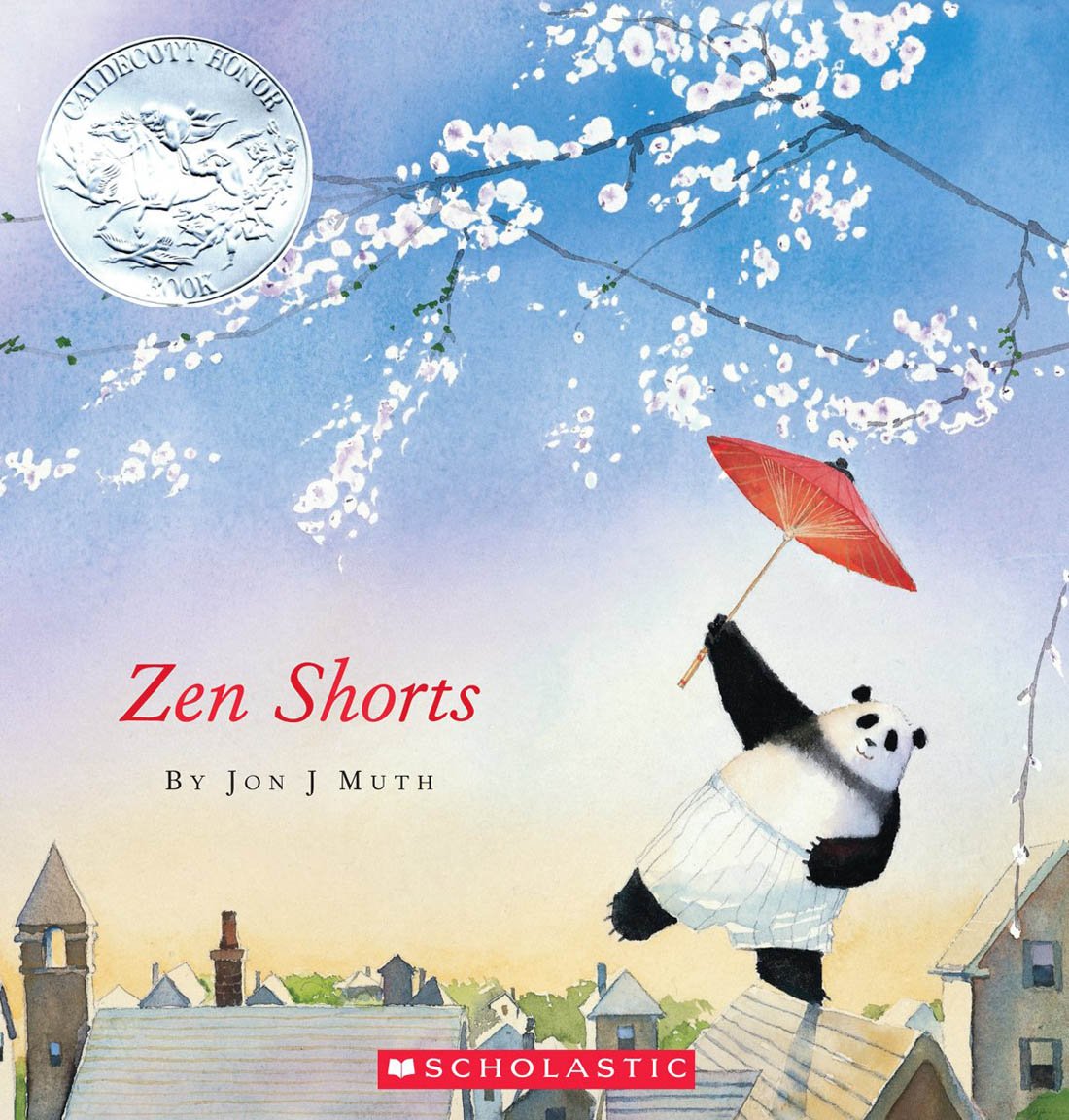
Their teachers and I knew from the start that this wasn’t going to be a “one-shot deal.” We knew there would be many more lessons, including guided and independent practice, as well as feedback, to get our students to be able to do this kind of work well. So on Friday, I was back in their classrooms with a very short excerpt from Jon J. Muth’s Zen Shorts, “Uncle Ry and the Moon.” I love sharing this deceptively simple story with students, and have done so many times. Muth’s book is quiet and unassuming, but it contains a powerful message.
Following the same routine we had used with King Midas, I read the story through once. The kids followed along on a typed version of the text. When I finished reading, I was met with a roomful of puzzled faces. I asked the kids to write what they had noticed and what they were wondering (We used a modified version on Vicki Vinton’s “Know/Wonder” chart for this.) Once they had their thoughts written down, they shared. All of the students were confused by Uncle Ry’s attitude toward the intruder. This clearly conflicted with the action they would take, or expect anyone to take, under similar circumstances. I complimented them for noticing this important contradiction, and explained to them the importance of this kind of observation. When an author includes those contradictions, he’s doing it for a reason. (Notice & Note, pg. 71)
Our next step was to reread the story, more carefully this time, and we stopped along the way to discuss what we were noticing now, and trying to sort out our confusion and begin to answer some of our questions. As we read, some students made thoughtful observations or raised interesting questions. Others asked questions to clarify a simpler element of the story, but these were important, too. I let them discuss these with their partners before sharing with the whole class.
It was during this conversation that one boy tentatively raised his hand. I have known and worked with this student since he was in first grade. His thinking is often perceptive, but can sometimes be muddled. I paused before calling on him to give him time to organize his thinking. Then I nodded to him and he said, “It’s like he’s the opposite of King Midas. Uncle Ry gives things away because he doesn’t mind being poor, and Midas wanted to have as much gold as he could get.”
I was speechless. I hadn’t thought of that myself. His teacher and I exchanged a look of joy. Of course, we let him know how impressed we were with his thinking and the he had made such a meaningful connection to King Midas. Then, another student started to raise her hand, and again, I could see the wheels still turning. She proceeded to tell us that another reason Uncle Ry was different from Midas is that Midas was blinded by greed, but Uncle Ry was blinded by his kind nature, and that was why he saw the intruder as a visitor.
I have shared this story with students many times before, but they have never come to these deep and thoughtful conclusions or level of understanding. So what was different? I hadn’t read the story right after King Midas before, but I wasn’t consciously thinking of a thematic connection between the two. Just as before, I had a plan when I began the lesson, but it was more open-ended. In the past, we were usually focusing specifically on character traits or summarizing. I firmly believe that the kids were able to achieve this level of understanding because I followed their lead. I let them develop the questions they had about the story. I let them go back and locate significant passages in the text. We do our students a huge disservice when we teach from a script and ask only preplanned, canned questions.
Are we finished with this work? Absolutely not. But we are laying a solid foundation for the kind of close reading and thinking skills our students will need to be thoughtful, caring human beings. And that, my friends, is worth all the gold in the world.









 Reading to the Core