It’s Monday! What Are You Reading?

IMWAYR

My colleagues and I have been busy teaching and revising informational writing units of study. We’ve been concerned, though, about having enough good mentor texts for our Kindergarten through second grade students to emulate. A traditional five-paragraph essay is NOT our goal, yet an organizational structure is needed so they don’t write pages and pages of random facts. This week I found two informational texts with unique structures that will be inspiring mentor texts for young writers.

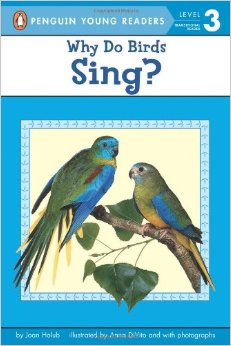
Why Do Birds Sing? (Penguin Young Readers, 2004) by Joan Holub and illustrated by Anna DiVito is a question-and-answer book. Holub anticipates any question kids might have about birds, then responds with brief, informative answers. DiVito’s cartoon-like illustrations are paired with color photos that provide close up views of many familiar species.
51ghouWrrrL._SY344_BO1,204,203,200_

This book is a terrific mentor text. Children have many questions about subjects they’re interested in, and this question-and-answer structure is a perfect way for them to organize their research findings. Text features in Why Do Birds Sing? are limited to photographs and labels, but the photos have been thoughtfully chosen to illustrate and/or support the information being presented.

Holub and DiVito have also teamed up to create Why Do Dogs Bark?, Why Do Cats Meow?, and others that answer these urgent questions that all kids ask.
51zj0DcTTBL._SX258_BO1,204,203,200_

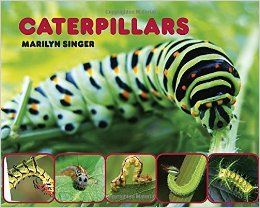
Caterpillars, by Marilyn Singer (EarlyLight Books, 2011) is a fact-filled book lavishly illustrated with close-up color photographs of both familiar and unfamiliar caterpillars. What I really love about this book, though, is its unique structure. Poet Singer (who was recently awarded the National Council of Teachers of English Award for Excellence in Poetry for Children) begins the book with a poem introducing caterpillars. Here is the first stanza:

Caterpillars smooth,

Caterpillars hairy.

Munching in a giant bunch,

Lunching solitary.

The poem is followed by a page devoted to elaborating each line, providing young readers with all sorts of interesting facts. Each page is also filled with gorgeous color photographs showing examples of the species or behavior described in the text. There is also a quiz, a matching game (caterpillar-to-moth/butterfly), glossary, resource list, index, and more.

Caterpillars, which was named a National Science Teachers Association Outstanding Trade Book for Science in 2012, is listed by the publisher as being appropriate for K-2 students. But I think older students would also enjoy Singer’s informative, accessible writing style and have fun creating their own poem to organize their informational writing.

Both of these books are excellent mentors for a whole class book on a single topic, or for individuals writing about a topic of their choice. Best of all, they are engaging nonfiction texts that can be enjoyed as read-alouds or as independent reading by all elementary age students.

Don’t forget to visit Jen at Teach Mentor Texts and Kellee at Unleashing Readers to find out what other people have been reading lately. Thanks, Jen and Kellee, for hosting!

Slice of Life: Family Writing Night

11454297503_e27946e4ff_h

 “You have a story to tell.”

~ Donald Graves ~

FullSizeRender

I returned from NCTE last November energized by all the informative and inspiring sessions I attended. The Two Writing Teacher’s presentation, “Tools to Build a Culture of Writing Through Story,” was chock full of achievable ideas to promote writing. In her portion of the session, Dana Murphy shared her experience hosting a Family Writing Night. I knew this was an event I wanted to hold at my school. (You can access Dana’s presentation slides here.)

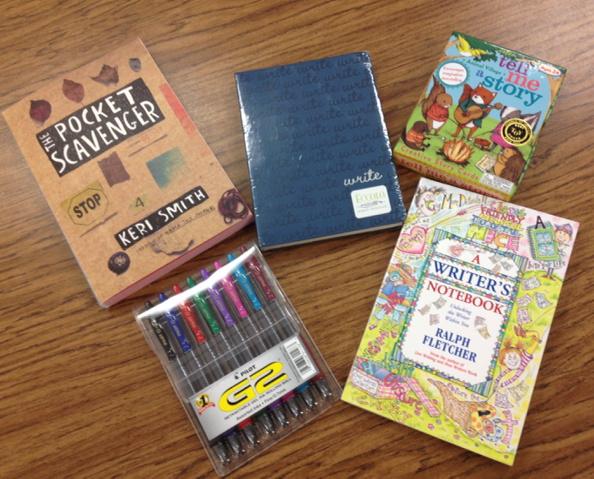
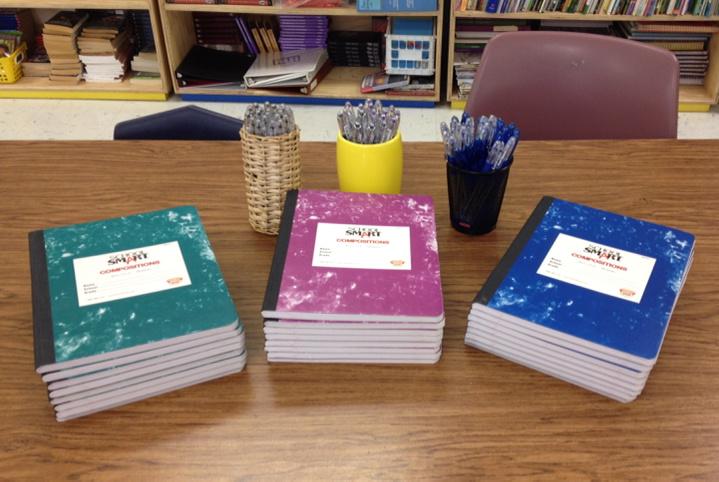
My building administrators thought having a Family Writing Night was a great idea and gave me their support. The PTO provided funds for journals, pens, door prizes and refreshments.

B9F1ZfmIQAA9GAN

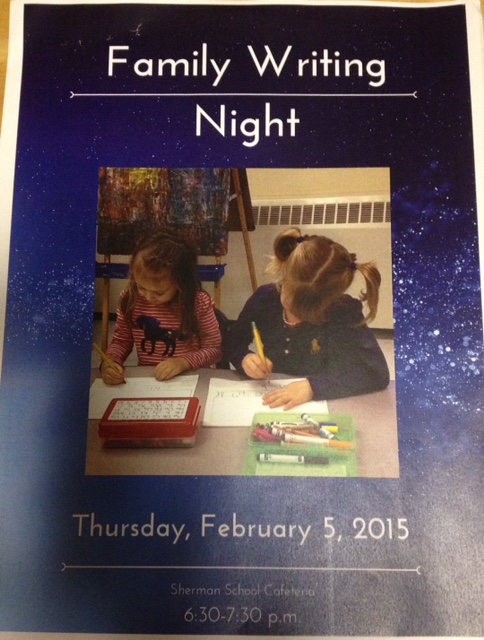
Dana emphasized that in order for Family Writing Night to be a success, you had to spread the word. In addition to having announcements on Twitter and in the school and PTO e-newsletters, old-fashioned hard copies went home in backpacks. Canva was a great tool to create posters, flyers, even door prize tickets! Classroom teachers were extremely supportive and reminded students daily about the event.

FullSizeRender-1

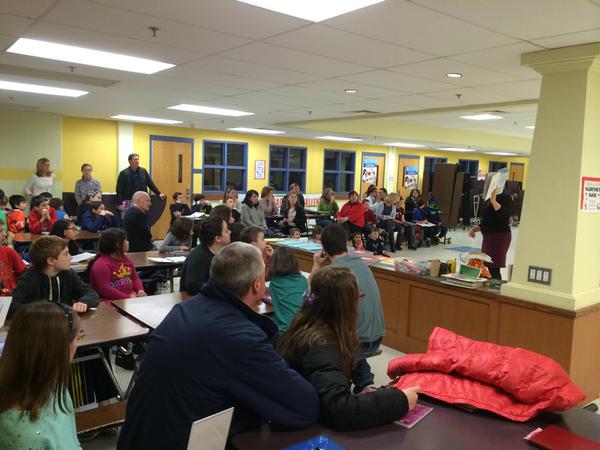
To get an idea of how many people to expect, I created a Google Form and asked people to let me know if they were coming. But I made it clear that whether they responded or not, everyone was welcome. I heard from about twenty people. So you can imagine my surprise when over sixty people turned out in near-zero temperatures!

B9HmOn7IcAE4Xgb

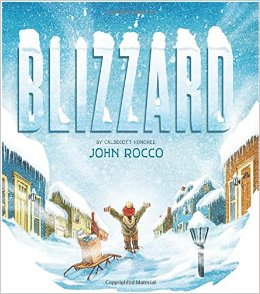
Everyone chose a notebook and pen, then filled out a door prize ticket. When people were settled, I took Dana’s advice to “fill the room with beautiful words” and began the evening with a read aloud. John Rocco’s Blizzard (Disney-Hyperion, 2014) is my favorite new book, so I started the evening by reading Rocco’s boyhood memory of the Blizzard of 1978. (I also thought this might spark some weather-related stories; we’ve had a little snow lately!)

Bulletin board adapted from Dana's presentation.
Writing Process bulletin board adapted from Dana’s presentation.

Then I talked very briefly about the the benefits of writing daily and the recursive nature of the writing process. I stressed that the goal of Family Writing Night, indeed any family writing time, was to have fun sharing memories and ideas. I reminded parents how important it is that they encourage kids to write without inhibitions, and not censor themselves because they may not know the exact spelling of a word or the best way to phrase a sentence. Editing is the final step. The most important thing is to get their thoughts down and keep writing daily. Just like athletes, writers develop fluency and build their writing muscles by writing.

I also encouraged parents to let kids to write about events and topics that are important and meaningful to them. To demonstrate that this could be anything, I shared Ralph Fletcher’s “Squished Squirrel Poem.” I had suggested that people bring photos of family vacations or other memorable events to get their writing started. As Ralph Fletcher says, “Memories are like a fountain no writer can live without.” 

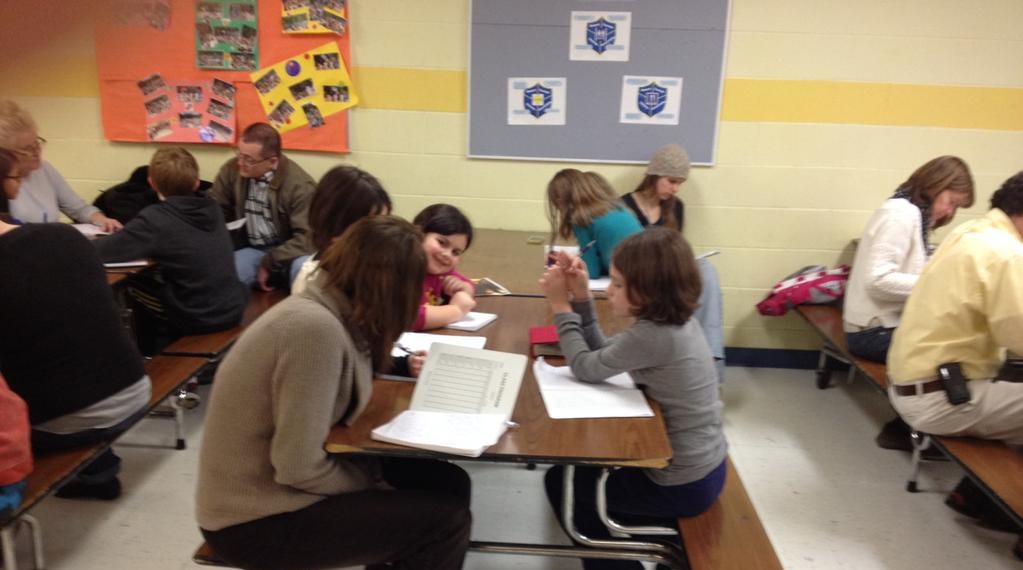
Then, everyone wrote. It was so gratifying to see more than sixty moms, dads, brothers, and sisters all writing! They wrote about tropical vacations, afternoons at the ball park, their pets, and more.

B9MAeB8IAAAJdiS

After about fifteen minutes, I encouraged everyone to share their writing with their families. Dana had shared some commenting prompts, such as asking a question or “tell how the writing made you feel,” which I had available as a handout. These got the writers going for another ten minutes or so.

Time really does fly when you’re having fun! I was amazed at how quickly the hour went by. Soon it was time to draw the winners of the door prizes.

B8oF1EwIYAAg1rM

Parents were effusive with their thanks and appreciation for the opportunity to come out and write with their children. Many wanted to know when the next Family Writing Night would be, and one mom asked if we could do this monthly! But the best feedback came from a third grader who told me, “I can’t wait to get home to finish my story!”

Thank you, Dana, for inspiring this wonderful evening. Thank you also to StaceyTaraBetsyAnna, and Beth for sharing your terrific ideas at NCTE. As always, thank you for this space to share our stories each Tuesday. Be sure to visit Two Writing Teachers to read more Slice of Life posts.

It’s Monday! What Are You Reading?

IMWAYR

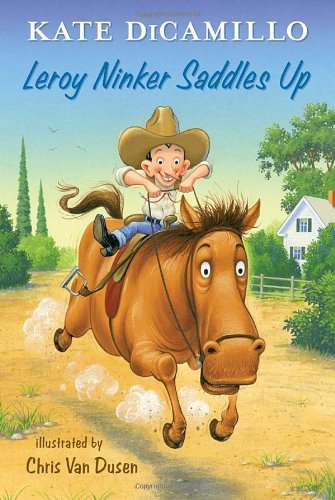
Leroy Ninker Saddles Up (Candlewick Press, 2014) by Kate DiCamillo

Mercy Watson was a staple in my first grade classroom, so I was excited to learn that Leroy Ninker was back with his own adventure. Leroy has repented his thieving ways is now a man with a dream. Inspired by the westerns he watches while working at the Bijou Drive-In Theater, he dreams of being a cowboy. The Bijou’s ticket seller, Beatrice Leapaleoni, encourages Leroy to follow that dream. She urges him to wrestle fate to the ground and get himself a horse.

Leroy does just that. He meets Maybelline, a big horse with a loud whinny, and it’s love at first sight. Silliness ensues, but as in all Kate DiCamillo stories, love overcomes all obstacles. Leroy and Maybelline even end up on Deckawoo Drive for breakfast with Mercy Watson. On the menu? Hot buttered toast, of course.

Leroy Ninker Saddles Up is a perfect read aloud for first or second grade. Mercy Watson fans will enjoy reading Leroy’s adventure with Maybelline on their own. This book is filled with sage advice (“Be a straightforward communicator,” Patty LeMarque tells Leroy.) and self-discovery (Leroy “never imagined he could string so many words together at once.”) But most of all it is a book filled with love, “word after beautiful word…”  

 0763663395.01.LZZZZZZZ  513Q6i-sQFL._SX258_BO1,204,203,200_

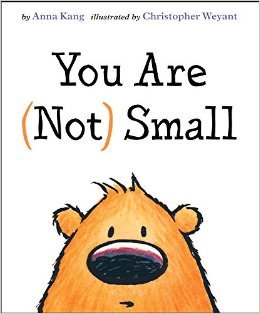
Somehow I missed the debut of You Are (Not) Small (Two Lions, 2014) by Anna Kang and illustrated by Christopher Weyant, last summer. Thankfully, it won the Geisel Award last Monday, so when I saw it at the library over the weekend, I recognized it and brought it home.

Using just a handful of words, Kang’s text and Weyant’s illustrations work together to convey important lessons on differences and perspective. These concepts work on many levels, giving this book wide appeal. Younger readers will easily understand the literal meaning of these differences, and older readers will be able to infer a deeper meaning. Everyone will love that when the characters finally do find common ground, they celebrate by sharing a meal. After all, everyone loves to eat!

In classic picture book fashion, the final page presents a new possibility, opening the door for children to create their own You Are (Not)… story.

Don’t forget to visit Jen at Teach Mentor Texts and Kellee at Unleashing Readers to find out what other people have been reading lately. Thanks, Jen and Kellee, for hosting!
Slice of Life: John Rocco’s Blizzard

11454297503_e27946e4ff_hIt’s been snowing for much of the past week, wreaking havoc with assessment schedules, mid-year goal meetings, and learning in general. On the other hand, I have had plenty of time to read, which is always a good thing.

John Rocco’s Blizzard (Disney-Hyperion, 2014) has been out since October, but I didn’t read it until last week. Rocco was ten when the Blizzard of ’78 buried most of southern New England under forty inches of snow. This picture book memoir is an adventure story that all kids will love, whether or not they’ve experienced record-setting snow storms. But as I reread this wonderful story, I realized that this book is a great mentor text, one that will inspire kids to write about their own epic weather adventures.

61TeuiKZunL._SX258_BO1,204,203,200_

The simplicity of Rocco’s language is deceiving. He has done a terrific job choosing just the right word and detail to truly bring this story to life. When John and his sister finally get outside after the snow stops, they realize that walking is “like trying to move through white quicksand.” When John makes his list of necessities before he heads to the store, “candy bar” is the only starred item. And when he returns from his adventure, he tells his family about his “perilous journey.”

Rocco’s word choice also make this book a good choice for an activity like one Lynne Dorfman and Diane Dougherty describe in their recent book, Grammar Matters: Lessons, Tips, and Conversations; Using Mentor Texts, K-6 (Stenhouse, 2014, a must-read for any K-6 teacher). They suggest gathering nouns and the active verbs they’re paired with to spur kids thinking about replacing worn-out words with more vivid choices. Also, Rocco’s uncluttered declarative sentences are perfect for introducing compound and complex sentences. There is even a great example of parallel structure, beginning when John realizes that “I was the only one who had memorized the survival guide.”

The  visual humor of Rocco’s illustrations and his ingenious use of text features give Blizzard an added depth of meaning. The passing days of the week are each spelled out in clever ways that blend into the scenes. “Tuesday,” for example, is spelled out by a squirrel scurrying across the roof. The old-fashioned cash register totals $19.78, and there are clues about John’s fascination with frozen landscapes scattered throughout the book. The fold-out map of John’s trek to the store is a wonder, and I can imagine some kids spending lots of time poring over this winter wonderland.

Blizzard  belongs in every K-3 classroom library, and I can imagine 4th and 5th graders who will love it, too. First and foremost, read this book for the wonderful story that it is. Then go back and take a closer look. You and your students will be richly rewarded. I can’t wait to share this book with my students, if it ever stops snowing!

Thank you to StaceyTaraDanaBetsyAnna, and Beth for this space for teachers and others to share their stories each Tuesday. Be sure to visit Two Writing Teachers to read more Slice of Life posts.

Slice of Life: Reading Before the Blizzard

11454297503_e27946e4ff_h

Yesterday, in an effort to get everyone home safely before the snow began, we had an early dismissal. Usually this means a four-hour day, but with a blizzard bearing down, the powers that be decided school would end at 11:30, leaving us with a three hours.

What can be accomplished in three hours? With the right book, plenty!

My schedule this week includes introducing the “Contrast & Contradiction” signpost (from Beers & Probst’s excellent Notice & Note: Strategies for Close Reading) to our fourth grade students. Our shortened day gave me just the right amount of time to read Eve Bunting’s One Green Apple, the text we’ll be using in our lessons, to both classes. Despite the excitement generated by the impending storm, the kids were mesmerized as I read this lovely story of a girl who has just arrived in America. Farah doesn’t speak English and is worried about other cultural differences between her and her new classmates. But over the course of the story, she begins to see that there might be a place for her in this strange country. I told the kids ahead of time that I was simply reading the story, that we’d ask questions and share thoughts later. It was such a peaceful way to start the day.

Then I met with a third grade student who is working hard but making s-l-o-w progress. I worry about her every day. Finding books she can read independently that aren’t too babyish is a challenge. I’ve heard much praise for Shannon and Dean Hale’s The Princess in Black lately and knew I had to get this book for this student. So when I saw it on the shelf at Target on Sunday, I snatched it up. Words can’t describe the look on her face when I handed this book to her. As I gave it to her, I said something like, “…if you love it.” Her response? “I love it already.”

There was just enough time to meet with both of my first grade students, and they each read a Rigby leveled reader that was “just right” for them. I watched with pride and respect as they worked through unfamiliar words, using multiple strategies to decode these words. Are they where they “should be” at this point in first grade? No. Will they “meet grade level expectations” in June? Probably not. But they are on their way, and I was happy to give them a chance to practice and polish their skills with an engaging book that pushed them but didn’t frustrate them.

And what did I do when I got home? Read a book, of course!

Thank you to StaceyTaraDanaBetsyAnna, and Beth for this space for teachers and others to share their stories each Tuesday. Be sure to visit Two Writing Teachers to read more Slice of Life posts.

IMWAYR: One Plastic Bag & The Red Bicycle

IMWAYR

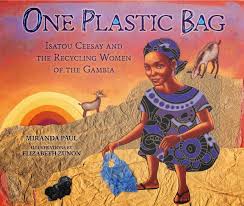
One Plastic Bag: Isatou Ceesay and the Recycling Women of the Gambia (Millbrook Press, 2015; available February 1st) Review copy provided by NetGalley

imgres

Plastic bags are ubiquitous the world over, but in Isatou Ceesay’s village in Gambia they are causing serious problems. Goats eat them, then become ill when they can’t digest them. Water collects in the piles of discarded bags, giving mosquitoes pools for breeding. Isatou comes up with a plan to recycle the bags by crocheting them into purses. Not only is the village clean again, but the purses provide income for the villagers.

Isatou Ceesay is an inspiring role model, and Miranda Paul has done an excellent job making her story accessible to young readers. One Plastic Bag clearly explains the problems caused by discarded plastic bags. Not only will children everywhere be motivated to recycle bags, they’ll be inspired to think outside the box when searching for solutions to problems. Elizabeth Zunon’s collage illustrations, which include pieces of plastic bags, complement the text perfectly.  An Author’s Note includes how Paul came to write One Plastic Bag, as well as a map, timeline, pronunciation guide, and a list of books for further reading.

One Plastic Bag has its own website where you can meet Isatou Ceesay, Miranda Paul, Elizabeth Zunon, and others. You can also learn more at Julie Danielson’s lovely blog, Seven Impossible Things Before Breakfast, which featured an extensive selection of Elizabeth Zunon’s artwork for One Plastic Bag back in November.

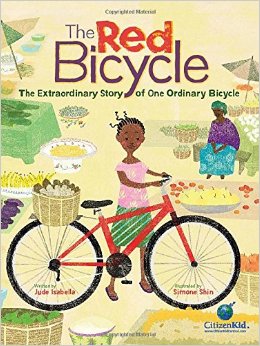
The Red Bicycle: The Extraordinary Story of One Ordinary Bicycle (CitizenKid, division of Kids Can Press, 2015; available March 1st) Review copy provided by NetGalley

6185Q9gFiOL._SY344_BO1,204,203,200_

Jude Isabella and Simone Shin’s “extraordinary story of one ordinary bicycle”  is a perfect book to pair with One Plastic Bag. Young Leo has worked hard and saved his money to buy a bicycle. He rides “Big Red” everywhere and takes such good care of it that even after a few years, it “looks almost brand new.” The problem is that Leo has outgrown his beloved bike, and wants to make sure its new owner will love it as much as he has. The owner of the local bike shop tells Leo about an organization that is collecting bicycles to ship to villages in Africa. Leo gets Big Red ready for its trip across the ocean, shown on a map by a dotted red line. When Big Red arrives in Burkina Faso, Alisetta is excited to get such a beautiful bike. The whole village cheers her on as she joyously learns to ride her new bicycle. Big Red makes life easier for Alisetta and her family by helping them get their sorghum crop to market. After Big Red is damaged in an accident, it’s recycled again. Now an ambulance, Big Red gets health workers to remote villages and sick patients to clinics where they get the care they need.

Readers will be inspired to help get bicycles to African villagers, and information about organizations that collect bicycles or money to transport them is included at the end of the book. Ideas for follow-up activities and facts about Burkina Faso are also included.

Both of these books will be great additions to any K-5 unit on recycling and can be used to inspire opinion writing about the importance of recycling. They will provide children with a look at daily life in Western Africa, increase their  awareness of the importance of recycling, and show them realistic ways they can get involved in these important efforts. 

Don’t forget to visit Jen at Teach Mentor Texts and Kellee at Unleashing Readers to find out what other people have been reading lately. Thanks, Jen and Kellee, for hosting!
Poetry Friday: Wacky, Wild, and Wonderful: 50 State Poems by Laura Purdie Salas

poetry-friday-1-1

I first discovered the work of Laura Purdie Salas in 2008 when she wrote a series of poetry books for Capstone Press. Tiny Dreams, Sprouting Tall: Poems About the United States and Lettuce Introduce You: Poems About Food were perfect for two units my colleagues and I were revising. Since that time my students and I have enjoyed Stampede: Poems to Celebrate the Wild Side of School (Clarion, 2009), Bookspeak: Poems About Books (Clarion, 2011), and most recently, A Rock Can Be… (Millbrook, 2015). (A complete list of Laura’s books can be found here.) So last spring, when Laura put out a call for teachers to collaborate with her on her latest poetry project, I jumped at the chance. I was thrilled to be chosen to create activities for Wacky, Wild, and Wonderful: 50 State Poems.

I loved every minute of working with Laura on this project. These poems, rich in imagery and figurative language, inspired many extension and enrichment activities. They celebrate the diversity of our ecosystems and geologic formations, as well as bring our history to life. I learned about landmarks I’d never heard of, and started planning trips to some of them! Laura graciously gave me permission to share some of her wonderful poems from this collection today. I hope you enjoy them as much as I do!

“Indiana: Time to Walk the Dogwood”

Black-Eyed Susan rings the Bluebells—
“Dinnertime! Come eat!”
Sweet William drinks his Milkweed
with a sweet Mayapple treat.
They eat their toast with Buttercups
and have a lovely talk.
Then dinner’s done and they must take
their Dogwood for his walk.
William wears his Dutchman’s Breeches,
white and pressed and neat.
Susan’s Yellow Ladyslippers
snuggle up her feet.
Dogwood chases Cardinals flashing
red and wild and bright.
His Fleabane’s bad, he needs a bath—
another busy night.
It’s time to watch the Shooting Stars
against the darkened sky.
William plants a kiss on Sue—
Another day’s gone by.

© Laura Purdie Salas, all rights reserved, 2015

This poem, with its bouquet of Indiana wildflowers brought to life, begs to be illustrated. My art skills weren’t up to the task, but I’m sure there are plenty of young artists whose are!

Laura used an impressive variety of poetic forms in this collection. “America the Beautiful” is one of my favorite patriotic songs, so I especially loved “Colorado: Pink Lady (A Poem for Two Voices)” I can’t wait to hear our fourth graders performing this poem!

Long hike down through misty clouds,

O beautiful for spacious skies,

A dizzying descent

For amber waves of grain,

Rocks, ravines, and evergreens—

For purple mountain majesties

That clean-scrubbed pine tree scent

Above the fruited plain!

Pikes Peak, the watchman of the west,

America! America!

You rise from plains below

God shed his grace on thee

Rosy granite etched with ice

And crown they good with brotherhood

You wear the sunset’s glow

From sea to shining sea!

America,

America

Land beautiful

and free.

© Laura Purdie Salas, all rights reserved, 2015

Pike's Peak, (Library of Congress, Public domain, via Wikimedia Commons)
Pike’s Peak, (Library of Congress, Public Domain, via Wikimedia Commons)

This is a must-have collection for any classroom learning about the United States. Laura’s engaging poems will make students’ research about the states more meaningful and memorable. Click here for information on how to get your copy of Wacky, Wild, and Wonderful: 50 State Poems.

Thank you, Laura, for letting me share your work here today, and for giving me the opportunity to be part of this terrific poetry collection!

Be sure to visit Irene Latham at Live Your Poem for the Poetry Friday Round Up, and you can read North Carolina’s poem today on Laura’s blog.

Slice of Life: Finding Words that Fit

11454297503_e27946e4ff_h

I’ve been knitting for about 15 years or so. Hats, scarves, mittens; you name it, I knit it. I love the sense of accomplishment I get from creating something soft and warm out of beautiful yarn. I don’t tackle patterns with a lot of technical stitches or color patterns, but I can adapt patterns and usually knit my way out of any messes I might get myself into.

So I was pretty frustrated over the weekend when the hat I’d spent a couple of hours knitting didn’t fit. I reread the pattern to make sure I hadn’t missed a step, but I hadn’t. The hat just didn’t fit.

What to do? I really didn’t want to tear the whole thing out, although there was no pressure to finish this hat. I decided to try making the ribbing longer, but that didn’t work.

Now I’d spent about four hours on this hat. My irritation was mounting. I knew it was time to put this project aside for a while before I made a decision about tearing everything out and starting over.

I stewed over the hat through dinner and while I cleaned the kitchen. I thought about the pattern, the yarn, adding on to the ribbing. All of these choices were guided by my knowledge and experience. I’ve spent years reading magazines, studying patterns, and talking to expert knitters. I’ve played with different weights and textures of yarn. Yet this seemingly simple hat pattern got the best of me. This fact was frustrating, but not the end of the world. I’ll tear the hat out and try again. Maybe I’ll adjust the pattern so it will fit, or maybe I’ll use a different pattern altogether. I have lots of options.

This whole experience got me thinking about what we expect of our students when we ask them to write. We expect them to make decisions about words and structures, details and sentence length. I know we think we’re supporting them and giving them the practice they need, but are we? Or has the pressure we feel to get everything done by yesterday caused us to make decisions we know aren’t in the best interest of our students?

Have we given them the time they need to pore over books, to study how authors put sentences together, and really talked with them about the power of our words? Or have we judged every word choice and sentence structure? Have we made them change their words to conform to our vision of what their writing should be like?

These questions are really a reminder to myself. I know the conditions kids need to grow and succeed. But I also need to remember what it feels like to have a vision that’s just out of reach. It may be that I need a cheerleader with an encouraging word to keep me going. Or maybe I just need time to figure it out. And that’s what kids need. They need time, lots of time, to play and experiment until they find the right combination of words that are the perfect fit for them.

Thank you to StaceyTaraDanaBetsyAnna, and Beth for this space for teachers and others to share their stories each Tuesday. Be sure to visit Two Writing Teachers to read more Slice of Life posts.

It’s Monday! What Are You Reading?

IMWAYR

I haven’t written an IMWAYR post in months, but one of my goals for the new year is to blog more often, so I’m starting early with this post.

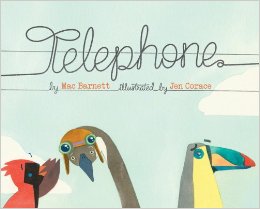
Telephone (Chronicle Books, 2014) by Mac Barnett, illustrated by Jen Corace

I was a little late to the Mac Barnett party, but I’ve been a devoted fan ever since I discovered Extra Yarn (Blazer + Bray, 2012). Having been on something of a bird kick this year, when I saw Telephone at my local bookstore, I grabbed it.

Barnett’s simple text and Corace’s illustrations work together to evoke a bygone era when kids played outside until it was time for dinner. The avian world on the telephone wire above echoes the human world below where kids are outside reading, running, and climbing. The story begins with Peter’s mother’s simple request, “Tell Peter: Fly home for dinner.” The young cardinal she asks is toting a baseball bat and hears what he wants to hear— “Tell Peter: Hit pop flies and homers.”  The birds along the wire continue to mangle this message until it is unrecognizable. Meanwhile, back in the human neighborhood, kids are waving goodbye as they get called inside. Finally, a zany, high-strung bird turns to an unflappable owl and tells him an outrageous mishmash of all the previous messages. The owl gives the other bird a sidelong glance, then calmly turns to Peter and tells him to “fly home for dinner.”

Corace’s illustrations are full of fine comic touches that add depth to the birds’ personalities: a distressed looking turkey is “too high on this wire,” and a rock-loving wren is decked out with star-shaped glasses and electric guitar.

Kids will love this book just for the pure silliness of it, but they’ll also love playing their own game of telephone. The witty word play also makes Telephone a terrific mentor text. Kids could have fun playing with rhymes, near rhymes, and synonyms to create their own version of Telephone. 

Don’t forget to visit Jen at Teach Mentor Texts and Kellee at Unleashing Readers to find out what other people have been reading lately. Thanks, Jen and Kellee, for hosting!
Slice of Life: Close “Reading” in Kindergarten

11454297503_e27946e4ff_h

Be curious always! For knowledge will not acquire you; you must acquire it.

~ Sudie Back ~

It’s hard to believe NCTE was almost a month ago! Amidst the chaos of the holidays, I’ve been reading books snagged in the Exhibition Hall (thank you, publishers!), reviewing my notes, and sharing the wealth of knowledge I gained from the terrific sessions I attended.

I was lucky to get into Chris Lehman, Kate Roberts, and Kristi Mraz’s standing-room-only session, CLOSE READING AND THE LITTLE ONES: HOW IT’S DIFFERENT (AND INCREDIBLY FUN AND EFFECTIVE) IN EARLY ELEMENTARY GRADES. With their characteristic blend of common sense and humor, these three inspiring educators shared routines K-3 teachers can use to capitalize on the natural curiosity of kids.

Chris, Kate, and Kristi pointed out that close reading in these early grades is akin to close study, or observation, “something that little ones are doing already.” Giving students opportunities to engage in close observation accomplishes many goals that support young learners, including opportunities to talk to others about their ideas. It also encourages students to “open up” their thinking through “meaningful, enjoyable experiences”

Close reading is only one part of “a balanced diet of reading instruction” that should

  • serve a specific purpose
  • focus on details in high success texts
  • allow kids to discover new meaning through carefully looking at details

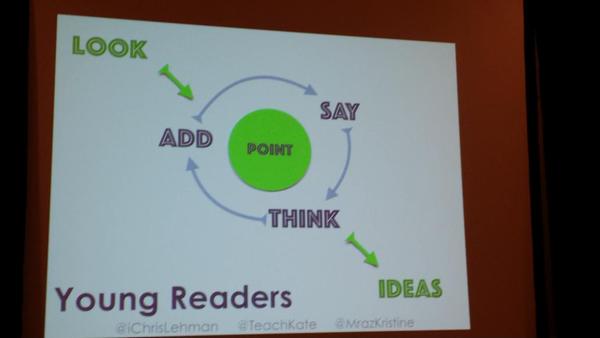
Adapting the paradigm for middle and high school readers Chris and Kate laid out in their book Falling In Love With Close Reading (Heinemann, 2013) for young readers resulted in this structure, or instructional routine, which should be repeated so often that it becomes a habit, which leads to independence.

Photo courtesy of Fran McVeigh

Kristi, Kate, and Chris emphasized that this close reading isn’t about teaching kids how to read, nor should everything be read closely. Rather, this routine is about “teaching kids a way of looking at a text or an image or an object so they can develop ideas about it.

This makes so much sense! I was excited to get back to school to share this thinking with my wonderful Kindergarten colleagues. Using Kristi, Chris, and Kate’s ideas about “close looking,” we designed an object study that coordinated with the Kindergarten’s current unit on the animal kingdom AND laid the foundation for daily close observation. As Kristi so wisely pointed out, “If you want to do strong work in reading, you have have to do strong work in other places.”

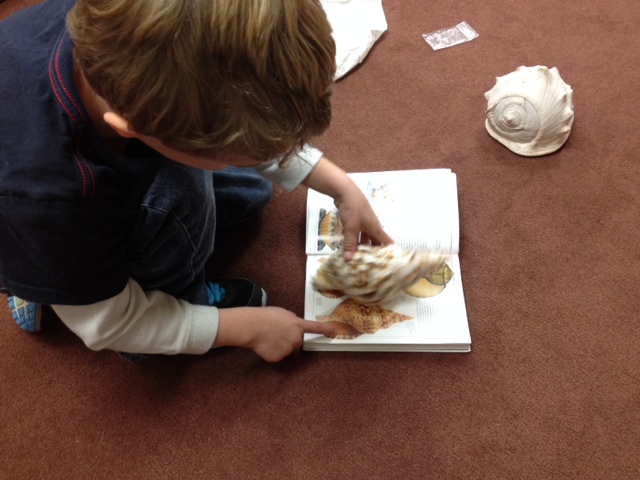
So we began by closely observing seashells. I modeled the cycle by looking closely at a shell, pointing to its surface and saying something about the color. Then I thought more about the color, and added more details about the variations of color on the shell. The kids couldn’t wait to get their hands on a shell to observe with their partners.

photo 1

Soon the room was filled with the hum of the children’s voices. They talked about the colors and the shapes and the textures. They noticed that some shells had bumps on the outside and others had spikes. They ran their hands along the smooth surface on the mouth of the shell and wondered why the texture was so different from the top of the shell. And they talked about the sounds they heard when they held the shells to their ears.

When we came back together so the kids could share their findings, it was clear they had developed some “big ideas” through their observations. Several children mentioned protection and camouflage when they talked about the colors of the shells or how hard they were. They all wanted to spend more time with the shells, comparing them and “getting to know [them] better.”

This is work we will return to daily. There are countless opportunities for close observation throughout the day, opportunities for kids to look at the world and say     “Wow!”

Thank you, Chris, Kate, and Kristi, for sharing your insights and pushing me as a teacher! Thank you to StaceyTaraDanaBetsyAnna, and Beth for this space for teachers and others to share their stories each Tuesday. Be sure to visit Two Writing Teachers to read more Slice of Life posts.