NFPB10FOR10: Our Feathered Friends

Screen Shot 2013-02-04 at 11.55.24 PM

It’s time once more for the annual celebration of nonfiction picture books! An outgrowth of Cathy Mere and Mandy Robeck‘s August Picture Book 10 for 10, this is an opportunity for bloggers to share nonfiction picture books they love. Be sure to join Mandy, Julie, and Cathy’s Picture Book 10 for 10 Google Community to read about hundreds of wonderful nonfiction picture books.

This is nfpb10for10’s fourth year, and I have participated each year. Here are links to my previous posts:

2015: Lives of the Artists

2014: Nature

2013: Passionately Curious People

This year I’m heading back to nature and focusing specifically on books about birds. I’ve been fascinated by birds my whole life, and have written about bird books before. There are so many books about birds I could have created a list of ten books just about eggs or bluebirds or poetry or any other subcategory imaginable! I did try to limit this list to newer books, although there are a few older titles that are too good to miss. There are also many field guides aimed at young readers that are worthwhile, including National Geographic Kids Bird Guide of North America: The Best Birding Book for Kids from National Geographic’s Bird Experts (National Geographic Children’s Books, 2013), which I chose not to include on this list.

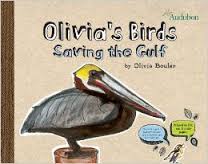
1.  Olivia’s Birds: Saving the Gulf, by Olivia Bouler, grades K-3 (Sterling Children’s Books, 2011)

When Olivia Bouler learned of the BP oil spill in the Gulf of Mexico, she was determined to help save the birds and habitat she loved. In this book she not only tells her story, but provides an introduction to different types of birds, as well as links to organizations where children can learn more about birds. Olivia is an inspiring role model for kids who want to make a difference, and to date has raised over $200,000  to clean up efforts in the Gulf of Mexico. 
imgres     Feathers

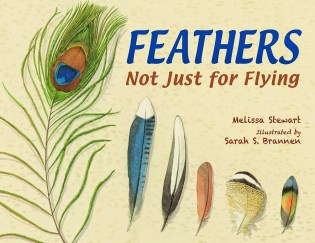
2. Feathers: Not Just for Flying by Melissa Stewart, illustrated by Sarah S. Brannen, grades K-3 (Charlesbridge, 2014)

In this book, which was named a National Science Teachers Association-Children’s Book Council Outstanding Science Trade Book, and an ALA Notable Book, in addition to many other honors, noted science writer Melissa Stewart combines scientific facts with poetry to describe the many ways birds use their feathers. Sarah S. Brannen’s illustrations capture many fine details of different feather types. Be sure to visit Melissa Stewart’s website for a wealth of information and resources about Feathers: Not Just for Flying.

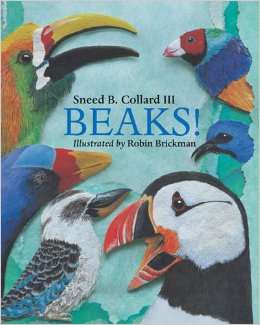
3. Beaks!, by Sneed Collard III, llustrated by Robin Brickman  (Charlesbridge, 2002)

Just as he did in Wings (Charlesbridge, 2008), Sneed Collard provides an in-depth look at the wide variety of bird beaks. He describes how each type of beak is perfectly adapted to its owner’s habitat and diet. Robin Brickman’s collage illustrations have a 3-dimensional quality to them and are so life-like you can almost hear the birds singing. Cornell University’s Lab of Ornighology has a page devoted to activities to to along with Beaks! at their BirdSlueth K-12 website.
         51zul9Pj7nL._SX258_BO1,204,203,200_    51SFANt3IFL._SX258_BO1,204,203,200_

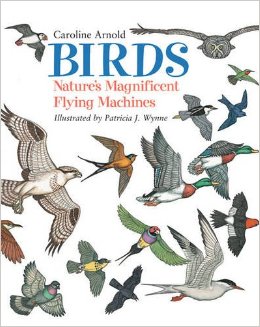
4. Birds: Nature’s Magnificent Flying Machines by Caroline Arnold (Charlesbridge, 2003)

This book, aimed at an older audience, provides in-depth descriptions of how a bird’s anatomy enables it to fly, as well as details about the many stages of flight. Colorful illustrations include a cross-section of a bird’s body, as well as close-ups of the inside of bird bones and feather structure. Birds: Nature’s Magnificent Flying Machines was selected for The Best Children’s Books of the Year list  by the Children’s Book Committee of the Bank Street College of Education, the CCBC Choices 2004, published by the Cooperative Children’s Book Center of the School of Education at the University of Wisconsin-Madison, among other honors.

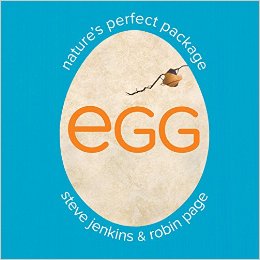
5. Egg: Nature’s Perfect Package, by Steve Jenkins and Robin Page, grades K-3 (Houghton Mifflin Harcourt, 2015)

Any list of nonfiction picture books about animals wouldn’t be complete without a book by Steve Jenkins and Robin Page. And although this book describes eggs and nesting habits of insects, reptiles, and fish as well as birds, the combination of Jenkins’s stunning collages and fascinating  facts make this book irresistible. Details about each animal’s size and habitat are included, as is a list for additional reading.
          51y-BhjG2EL._SX258_BO1,204,203,200_       615NQyOqMcL._SX258_BO1,204,203,200_

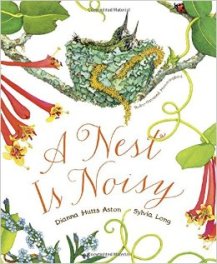
6. A Nest is Noisy, by Dianna Hutts Aston, illustrated by Sylvia Long, grades K-3 (Chronicle Books, 2015)

Following the same pattern as An Egg is Quiet, A Butterfly is Patient, A Rock is Lively, and A Seed is Sleepy, Aston and Long give readers a glimpse into the many different kinds of nests built by birds and other animals. Again, the miracle of adaptation is on full display, as readers learn how animals use the materials at hand to create safe homes for their eggs and young. A comprehensive teaching guide is available from Chronicle Books.

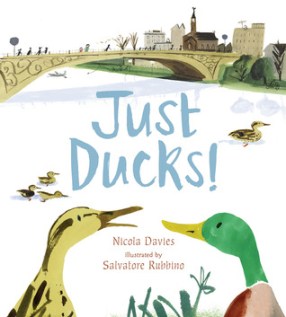
7. Just Ducks!, by Nicola Davies, illustrated by Salvatore Rubbino, grades K-3 (Candlewick Press, 2012)

In this charming picture book, Davies describes the life of ducks, as seen through the eyes of a girl who wakes up to ducks quacking outside her window every morning. Facts about ducks’ eating and nesting habits, their predators, and more are provided on each page. An index is included, as well as a short note about the many kinds of ducks found throughout the world.
       12461718   51mHxgHnm3L._SX258_BO1,204,203,200_

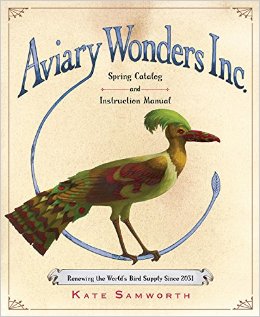
8. Aviary Wonders Inc. Spring Catalog and Instruction Manual by Kate Samworth

The winner of the 2014 Kirkus Prize for Young Readers’ Literature, Aviary Wonders Inc. Spring Catalog and Instruction Manual imagines a world twenty years in the future when birds have disappeared. Samworth has created a “catalog” where bird-lovers can go to create their own birds, choosing from a variety of body types, beaks, and feathers, all based on real birds. The contrast between the fun of creating your own bird with the grim reality of extinction make this book appropriate for older readers. Read more about the book and get a close up look at Samworth’s stunning illustrations at Seven Impossible Things Before Breakfast.

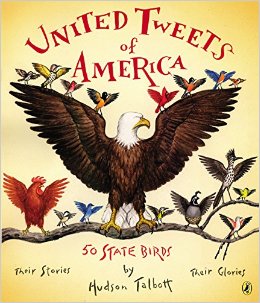
9. United Tweets of America: 50 State Birds Their Stories, Their Glories by Hudson Talbott, grades 3-5 (Philomel Books, 2008)

This book combines history and geography about each state along with information about each states’ official bird. Talbott’s cartoon-like illustrations provide a fun look at the wide variety of bird species in the U.S.
      619Pa23G8JL._SX258_BO1,204,203,200_    886449

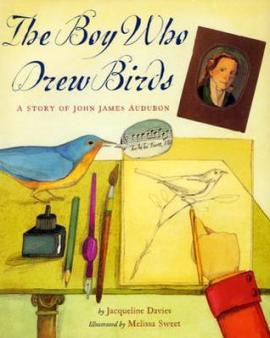
10. The Boy Who Drew Birds: A Story of John James Audubon by Jacqueline Davies, illustrated by Melissa Sweet, grades 3-5 (Houghton Mifflin, 2004)

Named an Outstanding Science Trade Book by the NSTA, among other honors, this picture book biography tells of Audubon’s earliest days in America. Audubon’s passion and curiosity led him to discover that the peewee flycatchers he observed one summer returned to the same woods of eastern Pennsylvania the following year. Melissa Sweet’s collage illustrations depict Audubon’s meticulous observations, a clear precursor to the masterpieces he would go on to paint. A Teachers Guide is available here.

Sharing any one of these beautiful books with a child is sure to spark a fascination with our feathered friends.
Slice of Life: Coloring, Anyone?

11454297503_e27946e4ff_h

When I taught 3rd grade, I had an assortment of activities available for children who finished their work early. I always had a worksheet (the shame, I know!) that had math fact practice in a hidden picture. The picture would be revealed when the facts were solved and the spaces were colored in according to a code. If, for example, the sum or difference was between 3 and 6, the space was colored green. Kids loved these sheets. They took them home if they didn’t have time to finish them during the day.

Then at some point I realized these really weren’t much of  a challenge. What kind of thinking was going on? Was the fact practice enough of a reason to continue using these sheets? I know that if I had still been in the classroom over the past five years I would have stopped using them. And that would have been my students’ loss.

The explosion in popularity of coloring books for adults seems to justify what I knew instinctively 20 years ago. After working on new math concepts, some of it beyond their still-concrete thinking brains, my students needed these coloring sheets to relax and give their brains time to get ready for the next challenging learning task. A plethora of recent articles extolling the benefits of coloring tend to focus on adults, but there are plenty of reasons to bring coloring back into the classroom, relaxation and improving focus among them. In fact, many studies have found that coloring actually increases creativity. Here’s a link to just one of the many articles I found supporting this practice.

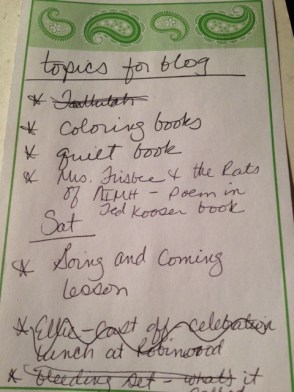
If you feel like you’ve read a post like this recently, you probably have. Elisabeth Ellington wrote recently about how her college students reacted to being assigned coloring for homework. Their responses underscore the benefits of finding time in our busy lives for a little time to play. But I’ve been thinking about this post for a while. In fact, the last save on my page of notes for this post was on January 14th, and this list has been on my desk for at least two weeks:

IMG_3694

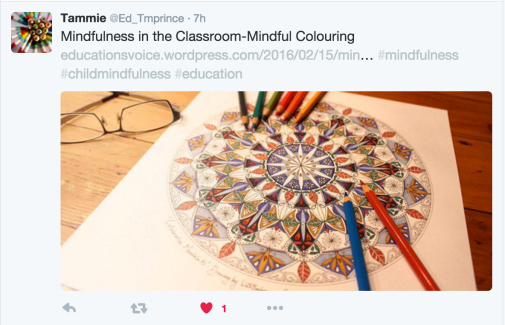
But you know how these things go. Then yesterday I came across this in my Twitter feed:

Screen Shot 2016-02-15 at 9.19.19 PM
Read this post here.

I immediately thought of this passage from Elizabeth Gilbert’s new book, Big Magic: Creative Living Beyond Fear (Riverhead Books, 2015):

“I believe that inspiration will always try its best to work with you–but if you are not ready or available, it may indeed choose to leave you and to search for a different human collaborator…This is how it comes to pass that one morning you open up the newspaper and discover that somebody else has written your book [or blog post!]…or in any way whatsoever manifested some spark of inspiration that you’d had…but had never entirely cultivated…Therefore, the idea went hunting for a new partner.”

So this idea has had more that one partner. Oh well. It’s an idea worth writing about. I hope more teachers decide to let their students color on a regular basis. Everyone will be happier if they do.

Thank you to StaceyTaraDanaBetsyAnnaBeth, Kathleen, and Deb for this space for teachers and others to share their stories each Tuesday. Be sure to visit Two Writing Teachers to read more Slice of Life posts.

Slice of Life: Being a Witness to the World

11454297503_e27946e4ff_h

There is a pond in the woods behind our house where we spent many hours exploring when my boys were growing up. They fished there in the summer and we skated in winter, but I hardly ever go back there anymore.

Sunday was a beautiful winter day here in Connecticut. There wasn’t any wind and the sky was a clear, brilliant blue, so I decided to walk down the hill to say hello to the pond. I quickly discovered that my plan wouldn’t be an easy one to carry out. The path was quite overgrown with pricker bushes that kept catching on my coat and hat. I forged ahead, but came around a bend and saw that a tree had fallen across the trail. Vines had grown up over it, making it look like a trellis or bower guarding a secret garden, a garden that I wasn’t going to be able to enter.

As I trudged back up the hill, I realized the overgrown path was like my writing brain. It’s been mostly ignored and untended for the past six months. Every time I sit down to write I feel like I have to fight my way through an overgrown thicket of brambles.

Over the past couple of weeks, though, I’ve been writing more and more and I’ve noticed that I can actually feel my brain become more flexible and limber when I sit down to write. I’m definitely more responsive to the world around me.

This got me thinking about our students, and what happens when they don’t have opportunities to write every day, or chances to sit and contemplate an idea or an image. In her book Writing Toward Home: Tales and Lessons to Find Your Way (Heinemann, 1995), Georgia Heard recommends writing “ten observational sketches” every day for a week, writing everything you notice and hear. “The more accurately you can observe your world and capture it in words,” Heard writes, “the more concrete your writing will become.” It might be a challenge to get kids to write ten sketches each day, but three or four seems reasonable. Think of the writing stamina they would build!

I’m looking forward to spring and getting that path cleared so I can go check on the pond. After all, as Georgia Heard also so wisely points out, “It is a writer’s job to act as witness to the world, to remind us all to stay awake.”

256839_1741317813642_3247017_o
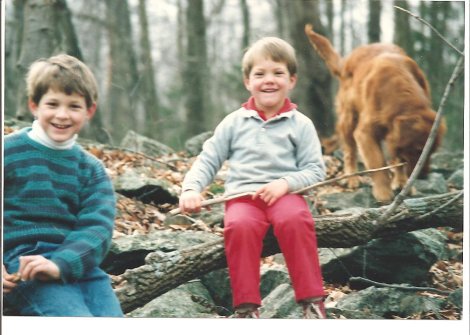
Brian and Michael at the edge of the pond.

Thank you to StaceyTaraDanaBetsyAnnaBeth, Kathleen, and Deb for this space for teachers and others to share their stories each Tuesday. Be sure to visit Two Writing Teachers to read more Slice of Life posts.

IMWAYR: Tallulah’s Tutu & More

IMWAYR 2015

When I was eight, I began ballet lessons. I had been dancing around the living room for years, and I think my mother thought it would be easier on the furniture. (The arms of our sofa made excellent alps when the Von Trapp family had to flee the Nazis in The Sound of Music.) I did love the leotards, especially the ones with satiny fronts that we wore for our recitals, but I didn’t love the disciplined practice. I was also a bit of a klutz.

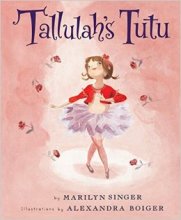
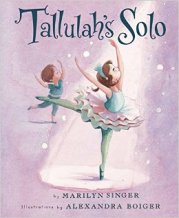
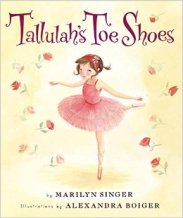
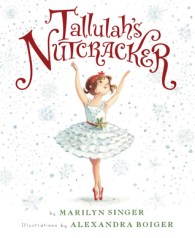
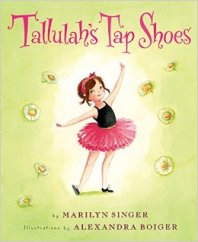
Tallulah, a budding ballerina who is the star of five picture books by Marilyn Singer, is not a klutz and she does love to practice. From the moment we meet Tallulah, in Tallulah’s Tutu (Clarion Books, 2011), we know that she is going to be “a great ballerina.”

                51l67TKQ9JL._SX258_BO1,204,203,200_     51svKus8mGL._SX258_BO1,204,203,200_    51OSltX2fgL._SX258_BO1,204,203,200_

Tallulah’s enthusiasm is irrepressible and shines through in Alexandra Boiger’s watercolors. Tallulah doesn’t understand, though, why she doesn’t get a tutu when she begins her lessons. When her teacher explains that “it takes time and a lot of practice to earn your tutu,” her disappointment causes her to have a tantrum and she gives up ballet. But she really does love ballet. She dances around the neighborhood and through the supermarket. Eventually, Tallulah returns to her lessons and earns her tutu.

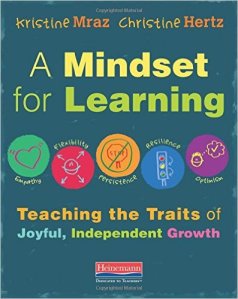
In a previous post, I’ve written about A Mindset for Learning (Heinemann, 2015) by Kristine Mraz and Christine Hertz. Throughout her five adventures, Tallulah exhibits all the characteristics of a person with “a mindset for learning.” Although Tallulah suffers disappointments in each book, her optimism and persistence always pay off in the end.  She demonstrates resilience and flexibility as she faces challenges. Also, Tallulah learns much from those around her who show her empathy when she feels most defeated.

                                    17080432          516IdpHBveL._SX258_BO1,204,203,200_

Tallulah may not be everyone’s cup of tea, but she was exactly what I needed to lure one of my students, a young ballerina who hated to read with a very fixed minset, into the world of books. We have talked about how Tallulah responds to the problems she’s faced with and how we can learn from Tallulah’s resilience and flexibility. While I still have a way to go with this student, I’ve earned her trust by sharing Tallulah’s stories with her and she’s making progress. We sometimes return to these stories if she needs a break or is having a particularly bad day. After all, it’s hard not to feel better after spending time with Tallulah.

You can learn more about Tallulah and her adventures here. Please be sure to visit Jen Vincent at Teach Mentor Texts and Kellee Moye at Unleashing Readers to find out what others are reading.


A Mindset for Learning

I first read Carol Dweck’s Mindset: The New Psychology of Success (Ballantine Books, 2006) four years ago, but had heard of her work before that. (Watch Dweck’s TED Talk here.) The book resonated with me on many levels, including how it could help my son, who had recently injured his knee and could no longer pursue his dream of being a firefighter. The implications for the classroom were obvious, especially for older students.

But I work with younger students. How to frame this idea for them? I had no idea, and really no time to think about it. Fortunately, there are superwomen like Kristi Mraz and Christine Hertz in the world who make time for these important questions. In their must-read new book, A Mindset for Learning: Teaching Traits of Joyful, Independent Growth (Heinemann, 2015), they break down the elements of a growth mindset into five essential components, or stances. These are empathy, flexibility, persistence, resilience, and optimism. Kristi and Christine explain in detail how these habits of mind can help students see themselves as “ever-evolving and powerful agents of change, both for themselves and for their world.” 

51BHLSjTaqL._SX395_BO1,204,203,200_

Kristi and Christine also provide a step-by-step routine to introduce the stances using guided inquiry of a shared text. An appendix lists two dozen picture books that celebrate a growth mindset as a starting point for this inquiry. Once the stances have been introduced, Christine and Kristi provide strategies for fostering these habits and helping children use them as problem-solving tools. These include self-talk, storytelling, goal setting, and conferring, among others.

The research base for this work is included in every chapter, and there is an extensive list of works cited and books for further reading. Charts, forms, and examples of student work help busy teachers envision how they can integrate “a mindset for learning” into their classrooms. It’s important to note that this book isn’t “one more thing” to add to an already bursting curriculum. Creating a classroom that supports “an energized and engaged learning community” is the bedrock on which our students’ learning rests.

Listen to Kristi and Chrsitine talk about A Mindset for Learning during The Educator Collaborative’s Fall 2015 Online Gathering here.

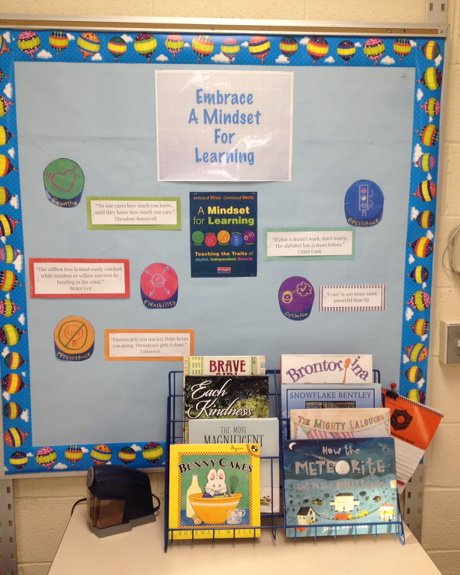
I created this bulletin board at school to promote Kristi and Christine’s wonderful book to my colleagues:

CUiv9WKWsAAYdN-

Some of the books in this photo are on Christine and Kristi’s list of books promoting a growth mindset, but others are not. I’ll be sharing my thoughts about these books and more in the next few weeks.

Thank you, Kristi and Christine, for writing this important book, and for all you do to help teachers become stronger advocates for children!

Still Blogging After Four Years

“To pay attention, this is our endless and proper work.”
Mary Oliver

Packed away somewhere in my attic is a small green glass pitcher with “Mineloa Fair” embossed in gold letters on the front. My grandmother gave this pitcher to me years ago, telling me that on the day she got it, in 1908 when she was four years old, she saw an airplane for the first time.

More than a century later, I spent a week in Northern Virginia at my son’s house, which is directly under the flight path for planes landing at Dulles Airport. It was late April and spring was in full bloom, so I went for a walk to enjoy the weeping cherry and magnolia trees. As I headed back toward my son’s house, I realized that the number of planes flying over had increased dramatically. Curious, I started counting. Soon ten planes had passed over in a very short period of time. I started timing them. There seemed to be as little as thirty seconds in between planes. By the time I was back to the house, I’d counted at least forty planes. What miracle had occurred in just over the one hundred years between the time my grandmother was awed by a biplane on the meadows of central Long Island and that spring morning when dozens of jets flew over my head in a matter of minutes?

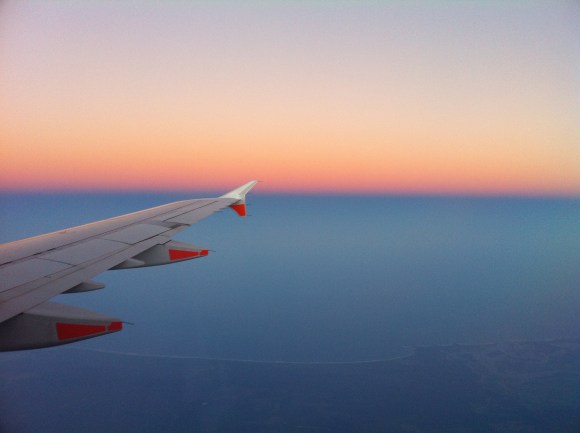
I haven’t flown a lot in my lifetime. But over the past year, it seems as if I’ve been on a plane at least once a month. Now that I’m more comfortable with the routine of flying, I hate to look like I don’t know what I’m doing, especially if I’m alone. So, not long ago, I settled into my seat and waited for takeoff, trying to seem blasé about the whole thing. Then I remembered my grandmother at that fair all those years ago. What wonder she must have felt! How could she even imagine flying in an airplane! I glanced around at my fellow passengers and saw people sending off last minute emails or reading intently. Some were already asleep. The miracle of flight had definitely become commonplace to them. I decided to find the extraordinary in what has become for many an ordinary experience.

I decided to be present for this marvelous feat of human ingenuity. Here I was, sitting in a metal tube that was about to hurl itself into the sky, defy gravity, and take me halfway across the country in about the same amount of time it took my grandmother and her family to travel from their home in Little Neck to Mineola and back. I watched as the labyrinth of runways and hangars whisked past. And I felt that indescribable moment when the wheels of the plane left the ground, that microsecond of disequilibrium as the earth fell away and the plane climbed into the astral blue sky.

Today is Reading to the Core’s fourth anniversary. Not a particularly noteworthy milestone, but one which I wanted to acknowledge and reflect upon. Much has changed in education and in our country over the past four years. The demands on teachers are greater than ever, and it’s often a challenge to keep the human face of our students in front of us as we try to meet those demands. But that is what we must do. And we must find ways to help our students find the extraordinary in the ordinary, to be present for the day-to-day wonders that surround us, just like my grandmother was all those years ago. This is my ongoing challenge.

I’m not sure what my expectations were that snowy Saturday four years ago when I finally gathered up the courage to hit the “publish” button. Whatever they were, I know my wildest dreams have been exceeded. I’ve met people and become friends with teachers and writers from around the world. I’ve discovered things about myself, both as a teacher and a person, and have grown in countless ways. Most importantly, I’m much better at paying attention to the world and the people around me.

Thank you for being part of this journey with me. I look forward to many more years of wonder and discovery with you.

Photo by Arnold Lee, via Unsplash

Slice of Life: Not Failing

11454297503_e27946e4ff_h

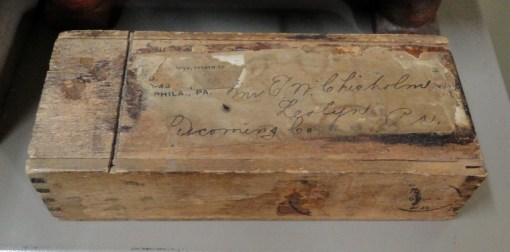
Yesterday, I summoned up all my courage and submitted a collection of poems to a writing contest. Then I came home and worked on a poem for Laura Shovan’s annual daily writing prompt project. This year’s theme is Found Objects. Here is the object for February 1st:

Photo by Robyn Hood Black

Laura posted this photo on Friday. On Sunday I’d written a draft—which is the object of this month-long writing adventure—then went about the many other tasks on my list for the day.

After a busy day at school, errands, and grocery shopping, I sat down to take a quick look at my draft before I posted it on Laura’s website. As I read, I had a sinking feeling. I convinced myself that my poem was terrible and not worth sharing.

Fast forward 24 hours. I spent the day watching my students take risks reading words they didn’t know, explaining their thinking about the theme of the book they were reading, and drafting nonfiction books. I marveled at their persistence and courage. They inspired me to come home and share this poem:

Nested within
the musty confines of
this worn pine box,
rubbed smooth
from years of use,
a cache of pencils
wait in silence.

Inside their graphite
filaments,
a cacophony of words,
some sweet, some sour,
are poised,
eager to escape.

© Catherine Flynn, 2016

After all, in the words of Ray Bradbury, “You only fail if you stop writing.”

Thank you to StaceyTaraDanaBetsyAnnaBeth, Kathleen, and Deb for this space for teachers and others to share their stories each Tuesday. Be sure to visit Two Writing Teachers to read more Slice of Life posts.

The Poetry Friday Roundup & Irene Latham

poetry-friday-1-1

“The real voyage of discovery consists not in seeking new landscapes, but in having new eyes.”
Marcel Proust

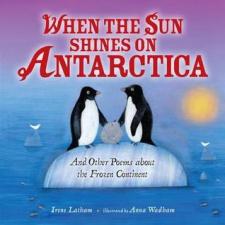
Welcome to the Poetry Friday Roundup! I’m happy to welcome you all today, and I have a special treat for you. To celebrate the publication on Monday of her new book, When the Sun Shines on Antarctica (Millbrook Press), Poetry Friday regular Irene Latham has stopped by to answer a few questions and to share two of my favorite poems from this delightful collection.

           irene1    26543123

In these poems, Irene looks at at the flora and fauna of Antarctica with new eyes and discovers just the right images and metaphors to bring the creatures of this forbidding land to life. At the same time, she skillfully weaves together science and wonder. Fifteen action-packed poems evoke the delicate interaction between a wide variety of species, including penguins, seals, and whales, and the harsh environment of the Antarctic summer, where temperatures remain “well below zero.”

Anne Wadham’s illustrations perfectly complement the playful tone of Irene’s poetry. A glossary and list of books and websites for further reading round out the book, and make it the perfect addition to any classroom library. In conjunction with When the Sun Shines on Antarctica, Irene has launched the Antarctica Explorers Club for young scientists eager to learn more about this remote and fascinating continent and its inhabitants.

Here’s a perfect example of how Irene sees a familiar creature with new eyes:

“Krill in Space”

The sea
is their universe

as they swim,
sway,

drift—

a trillion
tiny astronauts

without
a ship.

They weave
through galaxies

of gobbling
nets,

dodge
black holes

that look like safe
caves to explore—

but aren’t.

And this poem makes me want to go sledding with these penguins!

“Emperor Penguins at Play”

At the top of the hill
they belly flop,

drop,

slide, and glide on built-in sleds.

Out in the ocean,
eager to fly,
they swim,        breathe,         swim
as they leapfrog waves.

In need of rest,
they board an ice ship
where they ride and revive,
play endless rounds
of Red Light, Green Light,

Penguin Says,

and I Spy.

© Irene Latham, 2016. Shared with permission of the author.

Welcome, Irene!

Thank you, Catherine!

The jacket flap copy says that your “exploration of Antarctica began when [you] read The White Darkness by Geraldine McCaughrean. Can you elaborate on how you came to write this book?

Many (all?) of my books arise out of my obsessions. But first, a confession: until I read THE WHITE DARKNESS, I never really gave Antarctica much thought. Like many folks, I lumped the poles together –Antarctica and the Arctic, as if they were one and the same, just on opposite ends of the globe. It never occurred to me that the cartoons showing polar bears and penguins together couldn’t possibly be true! I had a lot to learn, obviously. So, THE WHITE DARKNESS. In addition to being a riveting story, this book oh so poetically places the reader in Antarctica. One line from the book really started it all: McCaughrean describes Antarctica as “a mosaic of white puzzle pieces saying, ‘solve me! Solve me!’ How’s that for an invitation? I started reading everything I could about Antarctica, and eventually poems began to emerge. It helped that I had just done DEAR WANDERING WILDEBEEST, which also focuses on the animals in a unique ecosystem. ANTARCTICA was a logical follow-up, and I’m thrilled to share both books with illustrator Anna Wadham.

Can you briefly describe your research process?

Since I’ve never visited Antarctica, my research involved reading lots of books about Antarctica, reading Antarctica scientist blogs, visiting websites, and talking to experts like fellow Birminghamian James McClintock, who has made nearly 20 research trips to Antarctica! Jim recorded many of his adventures in a book titled LOST ANTARCTICA: Adventures in a Disappearing Land, and I’m thrilled that he and I will be presenting a program together to celebrate my book’s release.

How do you decide on the form for each poem?

I love writing free verse poems, so it’s not wonder these are all free verse — with a little rhyme and alliteration and rhythm thrown in! It wasn’t a decision so much as just the way it happened. The fun part was coming up with imaginative ways to present each animal: Mrs. Weddell shopping for a new coat; an Adelie penguin placing a personal ad; elephant seals wrestling WWE style; and so forth.

Your website is full of wise advice for writers and poets. This is my favorite: “Keep on writing until your words shimmer and shine and actually produce electricity.” Do you have any specific advice for teachers and students who are inspired to use When the Sun Shines on Antarctica as a mentor text for writing nonfiction poetry?

Thank you! Shimmer and shine and electricity are certainly worthy goals, aren’t they? Two things come immediately to mind when I think about advice for writing nonfiction poetry: specificity and surprise. I think the impulse when writing nonfiction poetry is to include all the facts in the poem, kind of a big-picture look at the animal, when what poetry demands is going small, looking closely, choosing one moment or detail that you really want to showcase. Our goal as poets is to explode the moment. So, for Mrs. Weddell, the poem is only about the transition from wooly winter coat to sleek summer style, nothing else. It’s SO HARD to be specific, because that means making tough choices. But tough choices are exactly what being a poet requires. The second thing is to focus on surprise. Sometimes the subject itself is the surprise, such as the brinicle poem in this collection. Who (except Laura Purdie Salas) has ever heard of a brinicle? (View a great video here!) Or the surprise can be making a surprising comparison, like the krill poem, which presents krill as astronauts lost in space. This is where the joy and magic happens — when we as poets allow ourselves to be imaginative and whimsical and creative in the connections we are making between one thing and another. Sometimes it takes many drafts to find that magic, so patience is also required!

Who are your poetic influences? Favorite poets?

My most favorite poets are Poetry Friday poets! I am never more inspired/educated/delighted than when I read Poetry Friday posts. The first poets I loved as a child were Shel Silverstein and Dr. Seuss. As a teen I loved Khalil Gibran. Other well-known poets I turn to again and again are Mary Oliver, Langston Hughes, Pablo Neruda, Naomi Shihab Nye, Sharon Olds. I’ve often said that if I was stuck on a deserted island, I would want with me GOOD POEMS, edited by Garrison Keillor. In the world of children’s poetry, I don’t think it gets any better than Valerie Worth. I keep ALL THE SMALL POEMS AND FOURTEEN MORE on my nightstand year-round.

Your next book, Fresh, Delicious (WordSong/Boyd’s Mill Press) will be out in March. What’s on the horizon for you after that?

Thank you for mentioning FRESH DELICIOUS! I had so much fun writing poems about farmers’ market fruits and vegetables, and I am in love with Mique Moriuchi’s illustrations. Next up is a book I co-wrote with Charles Waters called IT’S NOT BLACK & WHITE. It’s about a white girl (me) and a black boy (Charles) who are forced to work together on a 5th grade poetry project, and they have a conversation about shoes and hair and church and recess and more — all through the lens of race. It’s largely autobiographical, and it was one of the toughest, most rewarding projects I’ve ever worked on. The book will release from Lerner in 2017 with illustrations by Sean Qualls and Selina Alko.

Thank you again, Irene, for stopping by and sharing your poetry and wisdom with us today!

And now for the roundup! Please click to add your link and read more poetic offerings.

Slice of Life: Reading Resolutions

11454297503_e27946e4ff_h

“The stories humans tell are a long conversation about what it means to be human.”
Gene Luen Yang

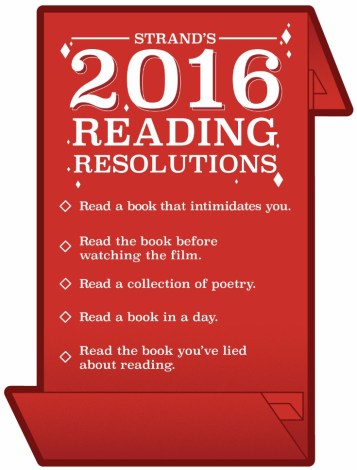
Twitter and Facebook were filled with reading challenges for 2016 over New Year’s weekend. Because I’m always reading at least 2 books, I don’t usually pay much attention to these challenges. But I was drawn to the last item on New York City’s Strand Book Store’s “Reading Resolution” list: “Read the book you’ve lied about reading.”

5bcdb112-aa71-4f8e-80b1-550443b17d98

There is one Very Famous Children’s Classic that I have never been able to get through. As an English major and a reading teacher, this has bothered me for many years. I have tried reading it as an adult to no avail. So I vowed this would be the year. (I’m not telling which book, but I am currently on page 112.)

Back at school last Monday, I was meeting with Anita, our 5th grade Language Arts teacher, about their current reading unit when I noticed their 40 book challenge display. Some kids were making great progress, but others only had one or two books listed. “Why don’t we make reading resolutions with the kids?” I suggested. She loved the idea, but we agreed that we should change lying about having read a book.

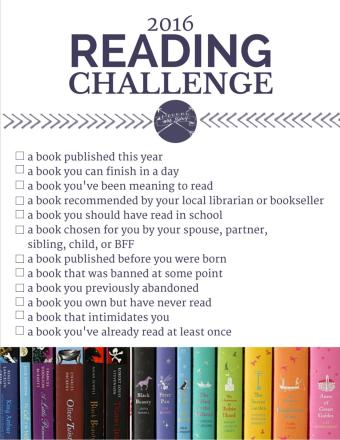
A quick Google search led me to Modern Mrs. Darcy’s challenge. She has twelve categories, one for each month. I took a few categories from her list, along with a few from the Strand’s list to create a list of resolutions for the fifth grade.

MMD-2016-Reading-Challenge
Modern Mrs. Darcy’s list

I introduced this list with a general discussion about why we read in the first place, and shared the above quote from our new Ambassador for Young People’s Literature. Then we talked about resolutions and setting goals in general, and the importance of making a resolution that was realistic. I pointed out to the kids that even though some of them were making great progress toward forty books, the categories on our list might help them if they weren’t sure what to read next.

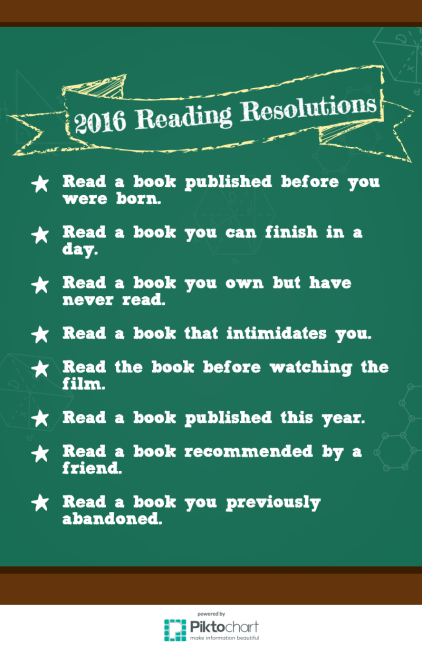
Our Reading Resolutions

I offered a few suggestions, including confessing to them about the Very Famous book I’ve never read, although I told them it intimidated me when I was a kid. I think that made a few of them quite determined to read it now! These kids were born in 2005, the year after The Tale of Despereaux was published, so I brought that along as a possible option. The movie version of Roald Dahl’s classic, The BFG, is coming out in July, so I suggested that as a book they could read before they see the movie. We also watched the movie trailer, and quite a few of them thought that would be a good place to start their reading resolutions.

Soon there was a long list of recommendations from friends on the board, and kids were encouraging their friends to try a book they’d abandoned earlier in the year. I created official “Reading Resolution” forms that we all filled out, including Anita, our principal, and myself. These are on display so we can help each other along as we work toward keeping our Reading Resolutions.

A week later, most of the kids are still buzzing about their books, although a few confessed to me yesterday that they hadn’t read over the weekend because they were too busy. I resisted my urge to scream and gently reminded them that there must have been at least ten minutes somewhere over two days when they could have read a few pages. Maybe that’s where our resolutions should have started!

I’ll keep you posted about our progress. What are your reading resolutions?

Thank you to StaceyTaraDanaBetsyAnnaBeth, Kathleen, and Deb for this space for teachers and others to share their stories each Tuesday. Be sure to visit Two Writing Teachers to read more Slice of Life posts.

A Slice of Wonder

11454297503_e27946e4ff_h

Not long ago, I saw this picture on Facebook:

12278753_999548306773456_100783203088609880_n

As a kid, I spent hours poring over our encyclopedias, soaking up all sorts of information. When I became a teacher, I wanted to foster that same sense of curiosity in my students. My first classroom had a wall of windows that looked out over the lawn and playing fields. I taped a construction paper frame to one of the windows and labeled it our “Observation Station.” I made little notebooks for the kids to write down what they saw and what they were curious about.

Screen Shot 2015-12-07 at 11.48.33 PM

On today’s Internet, the entire world is just one or two clicks away. Wonderopolis, in case you’re not familiar with this amazing resource, focuses on answering a single question each day. Recent questions include “Do snakes have ears?” and “What do bees do in winter?” If this website had been around when I was a classroom teacher, it would have had front and center billing in my classroom. As it is, I’ve promoted it and encouraged the teachers I work with to incorporate it into their day as often as possible. At NCTE, a stellar panel shared their thoughts about wonder and curiosity at the Wonderopolis Breakfast. Georgia Heard, Barbara Philips, Paul Hankins, Joellen McCarthy, and Kristin Ziemke wowed us with the depth of their thinking and insights about encouraging wonder in our students.

Georgia Heard began by telling us that “school should be a scavenger hunt” and that we should be “in awe of the universe.”

Paul Hankins left everyone speechless with his thinking about wonder. He thought of W as a compass, pointing to “our true north.” Rotating the letter 90 degrees to the left reveals a B, which stands for our beliefs. Flip the B, and, with some creative visualizing, you have a C, which reminds us of the need to create opportunities in our learning environments where kids can wonder, ask questions, collaborate. Finally, one last rotation reveals an M, which stands for the “mountains of meaning” our students will build in the our rich classrooms. Paul also urged us to have “uncommon courage” to build the habits of mind in our students that foster wonder and to become “classroom concierges.” Find out where your kids want to go and facilitate their journey.

The brilliance was flying and I honestly couldn’t keep up with all the smart thinking that was being shared. Here are a few examples:

Wonderopolis is as mobile as the human mind.

“We need to encourage our kids to go beyond the quick answer to find the connections and patterns that lead to the deeper answer.” Kristin Ziemke

Wonder journals are a place for questions, observations, sketches. They should travel back and forth between home and school.

“Wonder leads to finding the information, not finding the answer. New discoveries lead to new questions…” Kristin Ziemke

If you’re curious and want to know more, you can follow Wonderopolis and all the panelists on Twitter. JoEllen McCarthy regularly posts a text/Wonder pairing. Look for her #WOTDP hashtag. 

Georgia Heard & Jennifer McDonough’s book A Place for Wonder (Stenhouse, 2009) is another fabulous resource. It’s full of suggestions on how to invite children’s questions and observations into our classrooms by encouraging their curiosity and wonder.

Kristine Ziemke’s new book, co-authored with Katie MuhtarisAmplify: Digital Teaching and Learning in the K-6 Classroom (Heinemann, 2015) was just published in October. I haven’t had a chance to read it yet, but it’s at the top of my TBR stack!

The world has changed in immeasurable ways since I first cracked opened those encyclopedias more than fifty years ago. But the capacity for children to ask questions and be curious has not. Thank you, Wonderopolis, Georgia, Barbara, Paul, JoEllen, and Kristin, for sharing your ideas about nurturing our students and their ever-present sense of wonder.

Thank you to StaceyTaraDanaBetsyAnnaBeth, Kathleen, and Deb for this space for teachers and others to share their stories each Tuesday. Be sure to visit Two Writing Teachers to read more Slice of Life posts.