Slice of Life: PD in My PJs

11454297503_e27946e4ff_h

“I have no special talents, I am only passionately curious”
~ Albert Einstein ~

Last Saturday, I took advantage of a great day of professional development available FREE and ONLINE. The Educator’s Collaborative, founded by Chris Lehman, sponsored a day full of inspiration for educators. More than forty educators and writers were on hand to share their ideas and insights. During her presentation, Linda Hoyt talked about ways to help kids see how ideas go together, to see the relationships between seemingly diverse topics. Over the course of the day, it was hard to miss the relationship between all the sessions. The ideas delivered by so many wise presenters went together like pieces of a giant jigsaw puzzle, and the finished puzzle spelled out: STUDENT ENGAGEMENT = STUDENT LEARNING

In one way or another, each session I watched stressed the importance of inspiring our students, sparking their curiosity, and encouraging them to ask questions. These steps will lead them to make new discoveries, discoveries about the world around them, but more importantly, discoveries about themselves. These discoveries, in turn, will help them dream and discover their passions.

It would be impossible to choose the best session, or the most inspiring idea, for they were all fantastic and full of inspiring ideas. I did love that all the presenters shared the research base and philosophy behind their ideas, then provided practical strategies that we could infuse into our lessons on Monday.

You really should just stop reading and go to The Educator’s Collaborative website and start watching. But in case you’re not convinced yet, here are a few examples of all the wisdom you’ll find there.

Harvey Daniels explained that Curiosity is a better motivator than grit. Working from the positive is always so much better.”

Amy Ludwig VanDerwater reminded us that “Each of has something only we can say” and we should “say it through poetry!”

Rebekah O’Dell and Allison Marchetti gave us ideas for including “notebook time” in our classrooms and explained that this time “is an invitation and a place to play.”

Dr. Mary Howard urged us to build our classroom libraries to ensure that “students have books that will make their hearts sing!”

Linda Hoyt pointed out that we can “ignite a sense of wonder with kids through visuals in nonfiction read-alouds.”

“It’s about generating and creating pathways for thinking. It’s about giving kids new opportunities,” Kristin Ziemke explained.

Maggie Beattie Roberts told us that “tools help us do more, become more, reach dreams we have for ourselves, & make things easier.”

I could keep going, but seriously, just go watch the sessions for yourself. You’ll be so glad you did.

You’ll also find a session I wasn’t able to see because of satellite interference by four of Two Writing Teachers fearless leaders, Stacey Schubitz, Dana Murphy, Betsey Hubbard, and Deb Frazier on “Maximizing Independent Writing Time by Creating Conferring Tool Kits.” I’m looking forward to watching their session later this evening. 

Thank you to StaceyTaraDanaBetsyAnnaBeth, Kathleen, and Deb for this space for teachers and others to share their stories each Tuesday. Be sure to visit Two Writing Teachers to read more Slice of Life posts.
Slice of Life: Poetry Collections I Love

11454297503_e27946e4ff_h

“Poetry reaffirms our common humanity by revealing to us that individuals, everywhere in the world, share the same questions and feelings.”
United Nations website
World Poetry Day announcement

Last week I shared a list of my favorite read-alouds. I realized, though, that there was no poetry on that list! Because poetry is meant to be read aloud, and because National Poetry Month is right around the corner, I decided poetry deserved its own list.

Early in my teaching career, my poetry collection consisted of Shel Silverstein’s Where the Sidewalk Ends, Jack Prelutsky’s The New Kid on the Block, and The Random House Book of Poetry. Thanks to the Scholastic book order, my collection started expanding to include collections by individual poets. My choices tended toward poetry about animals and nature, and Kristine O’Connell George and Marilyn Singer quickly became favorites.

Today my poetry collection takes up two long shelves in my bookcase. Here are a few of my favorites, both old and new.

Edited anthologies with selections by many poets:

Piping Down the Valleys Wild, edited by Nancy Larrick
Read-Aloud Rhymes for the Very Young, edited by Jack Prelutsky
National Geographic Book of Animal Poetry, edited by J. Patrick Lewis
National Geographic Book of Nature Poetry, edited by J. Patrick Lewis
Another Jar of Tiny Stars: Poems by More NCTE Award Winning Poets, edited by Beatrice Cullinan & Deborah Wooten
Knock at a Star: A Child’s Introduction to Poetry, edited by X.J. Kennedy
A Kick in the Head: An Everyday Guide to Poetic Forms, edited by Paul B. Janeczko
The Tree That Time Built: A Celebration of Nature, Science, and Imagination, edited by Mary Ann Hoberman
A Pet for Me: Poems, edited by Lee Bennett Hopkins (any collection edited by Hopkins is a treasure; Don’t miss Renée LaTulippe’s wonderful spotlight on him here.)
Any of the Poetry Friday Anthologies, edited by Sylvia Vardell and Janet Wong

Collections by individual poets:

A Writing Kind of Day, by Ralph Fletcher
Joyful Noise: Poems for Two Voices, by Paul Fleischman
Hailstones and Halibut Bones, by Mary O’Neill
A Stick is an Excellent Thing: Poems Celebrating Outdoor Play, by Marilyn Singer (Marilyn’s collections of reversos are also not to be missed!)
A Maze Me: Poems for Girls, by Naomi Shihab Nye
An Egret’s Day, by Jane Yolen
In the Spin of Things: Poetry of Motion, by Rebecca Kai Dotlich
You Read to Me, I’ll Read to You, by Mary Ann Hoberman (any book in this series)
Everything is a Poem: The Best of J. Patrick Lewis, by J. Patrick Lewis
Handsprings, by Douglas Florian
When the Sun Shines of Antarctica, by Irene Latham

This list just scratches the surface of the multitudes of wonderful poetry collections available from these poets and more. My 2015 Picture Book 10 for 10 post features more of my favorites.

Books for teachers and students about poetry:

Awakening the Heart: Exploring Poetry in Elementary and Middle School, by Georgia Heard
For the Good of the Sun and the Earth: Teaching Poetry, by Georgia Heard
Poetry Matters, by Ralph Fletcher
Seeing the Blue Between: Advice and Inspiration for Young Poets, edited by Paul B. Janeczko
Pass the Poetry, Please!, by Lee Bennett Hopkins 

There are also many websites that feature poets, poetry, and ideas for teaching poetry. A Year of Reading, Mary Lee Hahn and Franki Sibberson’s must-read blog, lists links to the weekly Poetry Friday Roundup. This is a great place to begin learning more about all things poetic.

(Edited to add) Here’s another great resource from Amy Ludwig VanDerwater’s top-notch blog, The Poem Farm: NCTE’s 2016 Notable Poetry List

What are your favorite poetry collections and resources?

 Thank you to StaceyTaraDanaBetsyAnnaBeth, Kathleen, and Deb for this space for teachers and others to share their stories each Tuesday throughout the year and every day during the month of March. Be sure to visit Two Writing Teachers to read more Slice of Life posts.
Slice of Life: An Architect?

11454297503_e27946e4ff_h

When I read about people who have saved diaries and notebooks since they were twelve, I’m sad because I don’t  have these relics from my childhood. I did keep a diary when I was in 5th or 6th grade, but distinctly remember tearing it up directly into the garbage can in our garage, ashamed or embarrassed by something I’d written.

However, I did fill notebooks with drawings of floor plans for houses I dreamed of living in one day. At one point, I considered being an architect, but I abandoned this idea somewhere along the way.

Or did I? For isn’t a writer an architect of sorts? We take a blank piece of paper and design not just houses and buildings, but whole worlds. We’re not constrained by the laws of physics and don’t have to worry about the cost of our creations. We can inhabit our dream worlds to our heart’s content. (Within reason!)

And isn’t being a teacher also similar to being an architect? We design welcoming classrooms and environments that support and nurture learning. Classrooms where we help children acquire the tools they need to construct meaning from the books, articles, and websites they read. And most importantly, we help our students develop the skills they need to become the architects of their own lives. For me, that’s more fulfilling than designing houses could ever be.

 Thank you to StaceyTaraDanaBetsyAnnaBeth, Kathleen, and Deb for this space for teachers and others to share their stories each Tuesday throughout the year and every day during the month of March. Be sure to visit Two Writing Teachers to read more Slice of Life posts.
Slice of Life: Prospecting for Poetry

11454297503_e27946e4ff_h

I’m still in Virginia visiting my son, so writing time has been limited. But I did have time to go out for a walk this morning.

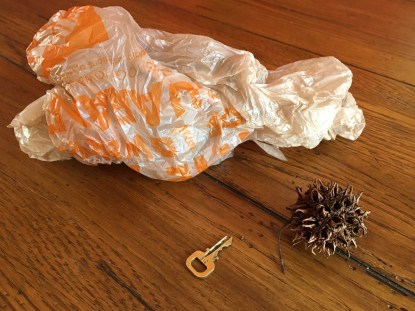
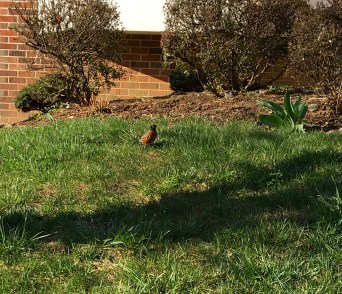
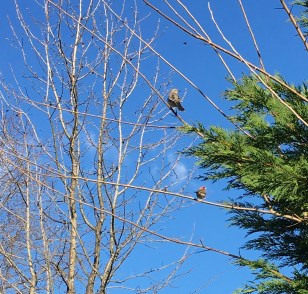
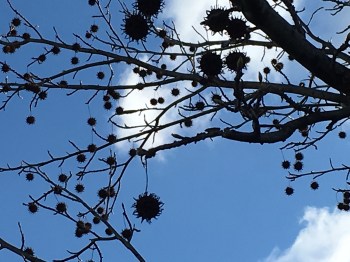
Taking walks is like going on a treasure hunt. I never know what I’ll find or what I’ll see that will spark an idea or a line of what might turn out to be a poem. I have my phone with me so I can take pictures so images will be fresh in my mind. My phone is new and I’m not completely used to it yet, so I ended up taking short videos as well as photos. This is a happy accident because now I have sounds to go along with my images.

Objects I found on my walk this morning.

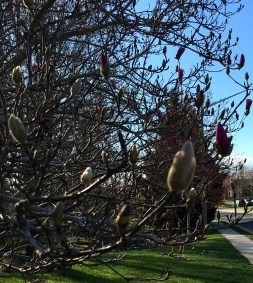
It’s quite breezy here this morning, and any left over leaves from last fall were skittering across the road as I began my walk. Forsythia is in bloom, crab apple, pear, and weeping cherry trees are blossoming, grass is turning green, and magnolias are loaded with fat buds. Birds are busy doing what birds do: singing, soaring, feathering, flocking.

IMG_0018  IMG_0039

         IMG_0050 IMG_0057

When I get home to Connecticut, I’ll sift through these ideas and images, like a miner panning for gold. I’m pretty sure there’s a nugget of something bigger in here. 

This is a perfect activity for students of all ages. Every season is unique, but what better time than spring to go out and see nature in all its glory, when, in the words of Mary Oliver, “the world offers itself to [the] imagination” of poets young and old.

Thank you to StaceyTaraDanaBetsyAnnaBeth, Kathleen, and Deb for this space for teachers and others to share their stories each Tuesday throughout the year and every day during the month of March. Be sure to visit Two Writing Teachers to read more Slice of Life posts.
Slice of Life: Read-Alouds I Love

11454297503_e27946e4ff_h

I think it’s fair to say that I am a teacher today because of a read-aloud. I have written before about the impact of my fourth grade teacher reading Charlotte’s Web to us.

When I was a classroom teacher, reading aloud was non-negotiable. We did it every day. No. Matter. What. Now that I’m not a classroom teacher, sharing wonderful books with kids is still the best part of my day.

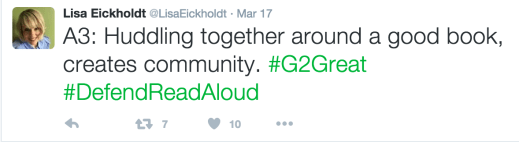
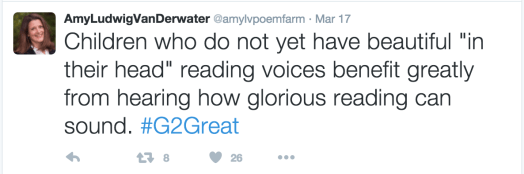
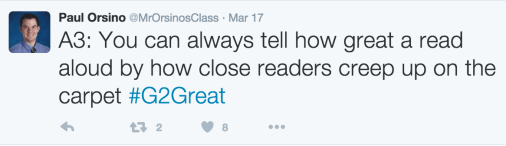
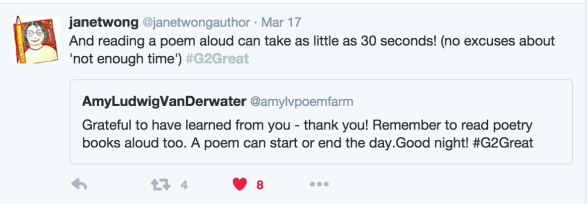
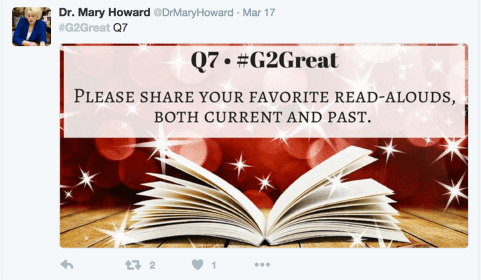
Because I love read-aloud so much, and because I love Dr. Mary Howard’s Thursday night #G2great Twitter chats, I was especially sad to miss last Thursday’s chat with Steven Layne about read-alouds. Scrolling through the archive of the chat, it’s easy to see that an incredible amount of wisdom was shared in one hour. Here are some tweets from the chat that I love:

Screen Shot 2016-03-20 at 7.21.05 AM

Screen Shot 2016-03-20 at 6.27.05 AM

Screen Shot 2016-03-20 at 6.28.11 AM

Screen Shot 2016-03-20 at 6.57.23 AM

Screen Shot 2016-03-20 at 6.36.14 AM

You can (and should!) read the Storify version of this chat here.

This was the last question of the chat:

Screen Shot 2016-03-20 at 6.38.15 AM

Linda Baie answered this question over at her blog, TeacherDance, this morning. I’m stealing Linda’s idea and answering Mary’s question from Thursday’s chat since I’m visiting my son this weekend and haven’t had time to write.

Chapter books my 3rd graders loved:

Charlotte’s Web
The BFG
The Prince of the Pond
The Birchbark House
The Tale of Despereaux
The Search for Delicious
Jeremy Thatcher, Dragon Hatcher
Stone Fox
How Whales Walked into the Sea

Recent chapter books I know kids love:

Home of the Brave
The Fourteenth Goldfish
The One and Only Ivan
Because of Mr. Terupt
Mercy Watson

Favorite picture books:

Knuffle Bunny
Boy + Bot
Brave Irene
Rugby & Rosie
The Old Woman Who Named Things
Farfallina & Marcel
Mrs. Katz & Tush
The Other Dog
The Gruffalo
Goodnight, Gorilla

I could go on all day. What are your favorite read-alouds?

Thank you to StaceyTaraDanaBetsyAnnaBeth, Kathleen, and Deb for this space for teachers and others to share their stories each Tuesday throughout the year and every day during the month of March. Be sure to visit Two Writing Teachers to read more Slice of Life posts.
Slice of Life: A Found Poem

11454297503_e27946e4ff_h

I was really stuck for an idea of what to write about today, so I visited the “Writing Prompts” page on the Poets & Writers website. There are prompts for creative nonfiction, fiction, and poetry. This poetry prompt appealed to me:

Begin at the End 
posted 2.23.16

“If you’re having trouble starting a poem, begin at the end. Take a single collection of poems and make a list of the last two words from each poem. Then write your own poem using only these words. Be vigilant at first utilizing just the vocabulary from the list. After a couple of drafts, stray from the limited words to help bring the poem to its full realization.”

Inspired by Amy Ludwig VanDerwater’s challenge to write a poem about small object, I’ve been rereading and studying Valerie Worth’s All the Small Poems and Fourteen More, so I turned to the first set of small poems for my list of words. Here they are:

among friends
she stops
like zinnias
to rest
and purr
worth something
and stay
is managed
set stone
brown grasshopper
of mice
loose skin
to us
slithering gold
poor clock
to keep
passing here
is cooked
of gold
find it
the beehive
for sleep
fences forever
whispers alone

Here is my first draft. The words and letters in bold were not on the original list.

She stops
among friends,
like zinnias
of gold,
fences set in stone,
and brown grasshoppers,
to sleep
and purr
and dream
of cooked mice…

To us, it is
worth something
not to be managed
by the clock;
to keep
passing here alone
and,
hearing whispers,
find it,
the beehive,
slithering gold,
and stay
for rest.

This was a fun exercise, despite the fact I have three unused words: poor, loose, and skin. Maybe I can work those into my next draft. The second stanza makes me happy because it reminds me of “The Lake Isle of Inisfree,” by William Butler Yeats, one of my all-time favorite poems.

I’d like to try this with students. It would be a great way to build vocabulary and would also help reinforce grammar skills like subject-verb agreement, tense, and more. Maybe I’ll save it for National Poetry Month.

 Thank you to StaceyTaraDanaBetsyAnnaBeth, Kathleen, and Deb for this space for teachers and others to share their stories each Tuesday throughout the year and every day during the month of March. Be sure to visit Two Writing Teachers to read more Slice of Life posts.
Slice of Life: War & Peace

11454297503_e27946e4ff_h

What would you do if a fourth grader brought in War & Peace for their independent reading book?

This happened yesterday, and A.’s teacher came to me for advice.

“Well, we can’t tell her she can’t read it, so let’s help her see that it’s not a good fit for her,” I suggested.

I sat down with A. and asked her about her book choice. “All the other books in the town library are boring,” she said.

“Did you look at the Nutmeg (Connecticut’s state book award) nominees? I know there are some good books on the list.”

“They didn’t have any of those books, so the librarian told me I could look in the Young Adult section and my mom said it was okay.”

Since when is War & Peace kept in the Young Adult section, I thought to myself.

“We’ve talked about ways to choose a ‘just right’ book for a couple of years,” I reminded her. “Why don’t you read the first page to me so we can make sure you can read most of the words.” The five-finger rule is introduced in first grade.

She skipped past the introduction and two pages listing “Principle Characters” before she arrived at Chapter One. Where the first paragraph was written in French. She gave a little laugh and said, “I’ll skip that part.” She then went on to valiantly attempt the maze of Russian surnames.

At the bottom of the page she smiled at me and said, “I could read most of the words that weren’t in French.” She had missed six words, but at this point, it really wasn’t about counting miscues.

“What was happening on this page?” I asked her.

“Well, in the first paragraph, the lady has a cough, but I’m not really sure what was going on in the second paragraph,” she explained.

“A.,” I explained gently, “I’m so proud of you that you want to challenge yourself as a reader, and War & Peace is a challenging book.” Thinking of Teri Lesesne’s Reading Ladders, I continued, “But maybe it should be a book you work toward reading. Why be frustrated reading it now when we can find books that you like that will get you ready to read War & Peace someday.”

She agreed this might be a better idea. I wanted this to feel like her decision, though, so I suggested that she read more of the book over the weekend and that we could talk again on Monday.

I really don’t want to tell her she can’t read this book. But I also don’t want her to miss all the wonderful books that she should be reading in fourth grade. I want her to, in the words of Frank Serafini, assume “an identity as a reader” by reading books like Echo, by Pam Muñoz Ryan, or The War that Saved My Life, by Kimberly Brubaker Bradley. Both of these books are much better choices for her, and they both have plenty of war and peace.

518_001
A.Nikolaev

Thank you to StaceyTaraDanaBetsyAnnaBeth, Kathleen, and Deb for this space for teachers and others to share their stories each Tuesday throughout the year and every day during the month of March. Be sure to visit Two Writing Teachers to read more Slice of Life posts.
Slice of Life: Patience

11454297503_e27946e4ff_h

“I don’t want to,” she said.

A familiar petulant look, downcast eyes and protruding lower lip, came over her face. She began pulling her hair over her forehead, trying to hide.

I sighed, trying to retain my patience. I’ve been working with this student since the fall when she was diagnosed with dyslexia. In an effort to expedite her progress, she has two intervention sessions on most days. She sees the special education teacher every day and I see her at least three times a week to practice and reinforce what she is learning in special ed. She reads poems and books on topics that interest her. She’s written poems and short paragraphs about  ballet, her passion. She’s been making nice progress.

Yesterday she was working on an acrostic poem for the word “ballet.” She didn’t have any trouble coming up with single words for each letter. But then I reminded her that poets use descriptive words to express their feelings and create images. “Let’s think of ways to describe the barre,” I suggested.

“I like it the way it is.”

I counted to ten. I knew I wouldn’t accomplish anything by engaging in a power struggle with this student, but one of our objectives is to help her learn to be more open-minded and persistent.

I tried one more time. “Let’s look at a poem in your folder and see how Irene Latham describes the “Farm Fresh Eggs.”

Tears began to well up in her eyes. That was my cue that we were finished. As I walked her back to her classroom, I was calm and said we’d take another look at the poem tomorrow. She shrugged, but said goodbye as she went back to her class.

She isn’t this uncooperative too often, but it has happened often enough to know that we might not achieve the goals we set for her at her PPT in October. Her parents and their advocate were insistent that we say what reading level she would achieve by her annual review next fall. We tried to explain that our goal was to have her catch up to grade level expectations as quickly as possible, but there were too many variables to make any kind of prediction about how long it would take to get her there. They were skeptical, but gave us the benefit of the doubt.

As a parent, I understand their worry and desire to have her performing at grade level sooner rather than later. But I also understand that pushing her too hard won’t help her reach this goal. It could undermine our efforts. Everyone is doing everything they can to support this student, providing her with appropriate instruction, modifications, and accommodations. We should be celebrating her every accomplishment, no matter how insignificant it may seem. She will get there in the end. It may just take a little longer for her. Things take the time they take.

Thank you to StaceyTaraDanaBetsyAnnaBeth, Kathleen, and Deb for this space for teachers and others to share their stories each Tuesday throughout the year and every day during the month of March. Be sure to visit Two Writing Teachers to read more Slice of Life posts.
Slice of Life: Thinking About Word Choice and Mood with Sixth Graders

11454297503_e27946e4ff_h

When you walk into a yarn shop, you are faced with a dizzying array of colors and textures. There are yarns almost as fine as thread to yarns as thick as a pencil and everything in between. When I decide to knit something, a lot of decisions have to be made. Which weight yarn is right for my project? What color and texture should I use? All of these choices affect the “mood” of the finished hat or scarf or sweater.

On Friday, I brought an assortment of different yarns into the sixth grade ELA classes. As I shared the yarn with the kids, we talked about how different each skein was from the other. I asked the students which yarn they thought would be the best choice for a hat for Dad or a blanket for a new baby. They intuitively understood that the function of the finished product influenced the yarn choice.

I pointed out that, just like knitters make choices about yarn, authors choose particular words to achieve an intended effect, and these choices influence how a reader reacts to a piece of writing. To illustrate this, I shared the first stanza of William Blake’s “The Echoing Green.”

The sun does arise,
And make happy the skies.
The merry bells ring
To welcome the spring.
The skylark and thrush,
The birds of the bush,
Sing louder around,
To the bells’ cheerful sound,
While our sports shall be seen
On the echoing green.

(You can read the rest of the poem here.)

As soon as we finished reading I asked them to write down a word describing their mood. Then I sent them back into the poem to find which specific words Blake used that evoked that mood. They shared their ideas with their partners, then with the whole group. I was impressed with the variety of words they chose to describe their mood, but even more impressed with how they were able to cite specific words and phrases to support their ideas. We repeated this process with the other two stanzas to see if the mood was consistent throughout the poem.

Analyzing “the impact of a specific word choice on meaning and tone,” as the CCSS calls for sixth grade students to do, can be tricky. These students have just started reading Tuck Everlasting, Natalie Babbitt’s profound and thought-provoking novel. Babbitt is a master of evoking mood, but her word choice can be subtle, so my sixth grade colleague and I have been working on ways to develop this challenging skill.

The kids did a great job with the work we began on Friday. I’ll be visiting them several times over the next few weeks to continue this work, including looking at several poems that have many words in common but evoke very different moods.

 Thank you to StaceyTaraDanaBetsyAnnaBeth, Kathleen, and Deb for this space for teachers and others to share their stories each Tuesday throughout the year and every day during the month of March. Be sure to visit Two Writing Teachers to read more Slice of Life posts.
Slice of Life: Evolution of a Writer

11454297503_e27946e4ff_h

“Write. Rewrite. When not writing or rewriting, read. I know of no shortcuts.”
Larry L. King

A year and a half ago, I started writing a middle grade novel, or maybe it’s an early chapter book. It hasn’t let me know which it wants to be yet. But I really started writing it more than ten years ago, when I wrote a picture book manuscript about a girl and her grandmother. That manuscript was much too long to be a picture book, so I rewrote it. I rewrote it so many times and cut so many details that I no longer recognized my story.

Or maybe I started writing that novel ten years before that when I began teaching third grade. Working with those young writers and reading books about writing inspired me pick up my own pen after too many years of not writing.

During those years of not writing I was reading. I was reading Shakespeare and Faulkner, poets and playwrights, E.B. White and Gary Paulsen, Barbara Kingsolver and Louise Erdrich. I soaked  up their words and the rhythms of their sentences like dry earth soaks up the spring rain.

Then again, that book might have started ten years before that when, after reading stack after stack of picture books to my children, I remembered an idea I’d had in high school about writing children’s books. Toddlers are very entertaining. To a young mother every silly thing they did was the stuff of the next Caldecott winner.

Maybe that story began when I was in fifth grade and wrote a story about aliens landing in a pond near my house. I remember this story only because my father liked it and told me it was good. High praise from a man of few words.

Who knows when that story really began. One of my earliest memories is of sitting at a little formica-topped table in my bedroom scribbling across a drawing pad, pretending I was writing. I knew then that I had a story to tell. I’ve been writing it ever since.

Thank you to StaceyTaraDanaBetsyAnnaBeth, Kathleen, and Deb for this space for teachers and others to share their stories each Tuesday. Be sure to visit Two Writing Teachers to read more Slice of Life posts.