It feels like the world has gotten very loud over the past few weeks. As if it hadn’t been loud enough already. During these tumultuous days, I have found the possibility present in this poem by Alison Deming, with its “…conversation so quiet/the human world can vanish into it,” very reassuring.
The Web by Alison Hawthorne Deming
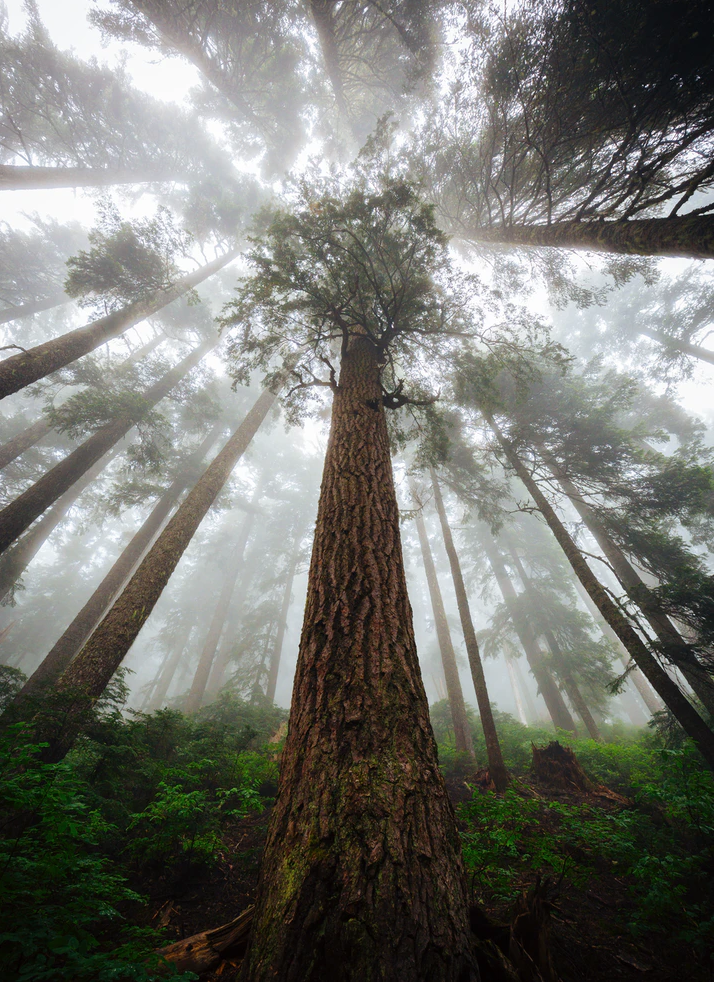
Is it possible there is a certain kind of beauty as large as the trees that survive the five-hundred-year fire the fifty-year flood, trees we can’t comprehend even standing beside them with outstretched arms to gauge their span, a certain kind of beauty so strong, so deeply concealed In relationship — black truffle to red-backed vole to spotted owl to Douglas fir, bats and gnats, beetles and moss, flying squirrel and the high-rise of a snag, each needing and feeding the other– a conversation so quiet the human world can vanish into it.
Earlier this summer, my daughter-in-law introduced me to Clint Smith‘s book, How the Word is Passed: A Reckoning with the History of Slavery Across America. I immediately bought a copy, but haven’t started it yet. Then I found the summer issue of Poets & Writers at my local book store, and there was Clint Smith on the cover. What an amazing backstory to how this book came into the world! The article made me curious about Smith’s poetry, which led me to this poem. Sadly, it’s all too appropriate for this week, this month, this year.
When people say, “we have made it through worse before” by Clint Smith
all I hear is the wind slapping against the gravestones of those who did not make it, those who did not survive to see the confetti fall from the sky, those who
did not live to watch the parade roll down the street. I have grown accustomed to a lifetime of aphorisms meant to assuage my fears, pithy sayings meant to
convey that everything ends up fine in the end. There is no solace in rearranging language to make a different word tell the same lie. Sometimes the moral arc of the universe
does not bend in a direction that will comfort us.
On August 1st, as many of you dove headfirst into The Sealey Challenge, reading a book of poetry a day, I drove to my son’s house to spend the week with my granddaughter. (And her parents, too, of course!) I planned on spending the week reading Goodnight Moon, The Pout Pout Fish, Babybug, and more. And I did. But on Monday afternoon, I realized I could download a book of poetry and read it during Hazel’s nap. It seemed worth a try. I don’t remember exactly how I stumbled across What We Carry, by Dorianne Laux. But her name was familiar and the title intrigued me, so I clicked “borrow,” and began to read.
Laux’s poetry is filled with odd, precise details, astute observations, painful questions, and brilliant, shimmering metaphors. Reading a book of her poetry a day would be like chugging a glass of water on a blistering hot day: initially sating, but not enough. There is too much to savor. Too much would be missed. So I am not participating in #TheSealeyChallenge this year. Besides, whoever decided this challenge should happen in August was clearly not a teacher. (Kudos to you all who are participating while getting ready to head back to the classroom!) I have been reading more of Dorianne Laux’s poetry, studying and learning from her craft. Here is one of my favorites.
Life of Earth by Dorianne Laux
The odds are we never should have been born. Not one of us. Not one in 400 trillion to be exact. Only one among the 250 million released in a flood of semen that glides like a glassine limousine filled with tadpoles of possible people, one of whom may or may not be you, a being made of water and blood, a creature with eyeballs and limbs that end in fists, a you with all your particular perfumes, the chords of your sinewy legs singing as they form, your organs humming and buzzing with new life, moonbeams lighting up your brain’s gray coils,
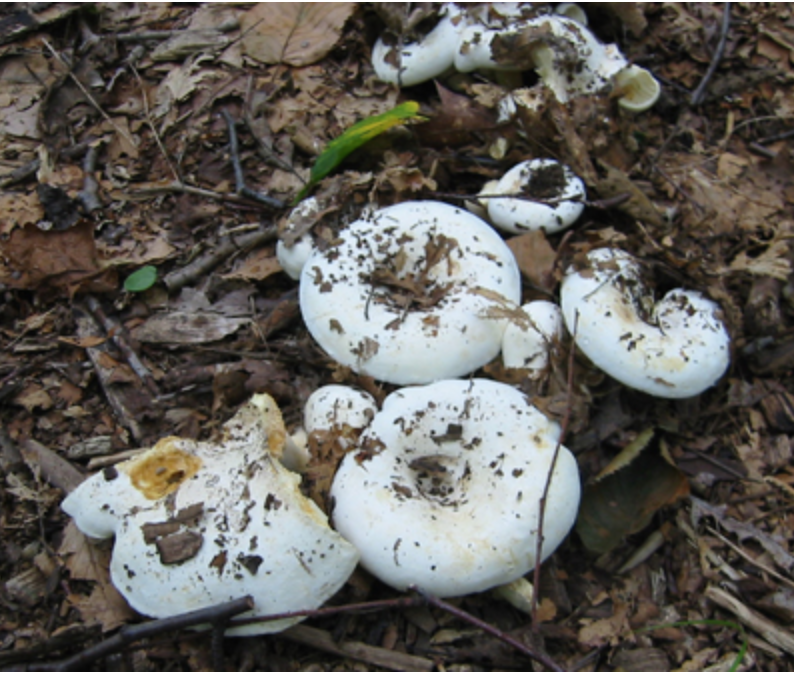
Earlier this week I took two of my great-nephews and my great-niece on a hike in a nearby nature preserve. We kept our eyes peeled for interesting leaves, flowers, insects, and more. We were surprised, though, by the profusion of mushrooms we found. They were everywhere! Most were creamy white or pale brown, but a few were yellow or orange-red. Many looked like a stereotypical toadstool, but others were quite exotic, with fluted edges, deep ridges, or coral-like branches. My niece exclaimed “That one looks like a potato!” She was exactly right. Because I have no expertise in mushrooms, I made it very clear that we could. not. touch. anything! That didn’t stop us from noticing them, and we soon lost count of the bounty at our feet.
This entire adventure seems like the perfect inspiration for a poem. But I’ve been distracted by other concerns (all good) this week. So I’m sharing a celebration of these mysterious, magical fungi by the inimitable Valerie Worth, the master of poems about small things. I am always in awe of her precise descriptions and her ability to find the perfect metaphor for the object of her attention.
mushroom
The mushroom pushes Its soft skull Up through the soil,
Spreads its frail Ribs into full Pale bloom,
And floats, A dim ghost Above the tomb
Where an oak’s Old dust lies Flourishing still.
by Valerie Worth
Please be sure to visit Kat Apel at her blog for the Poetry Friday Roundup.
Kimmerer laments our lost connections to the Earth, then, in an effort to heal the wounds we’ve inflicted on our precious home as well as to heal ourselves, points us toward a way forward. She states that language is “a prism through which to see the world” and that “language is our gift and our responsibility.” To me, this is a plea to choose and use our words with care and for the good of all.
Kimmerer goes on to say that in order to “create sustainable humanity” we must rediscover our “gratitude and our capacity for reciprocity.” As I grapple with the sad facts of our current world, this encourages me. Kimmerer also sees “the very facts of the world [as] a poem.” Reading and writing poetry help me build my capacity for gratitude, for reciprocity. I am grateful to this community for the encouragement it provides. Here then, as an act of reciprocity, is a poem from Naomi Shihab Nye, one of our greatest teachers of gratitude and reciprocity.
Every day as a wide field, every page
1
Standing outside staring at a tree gentles our eyes
We cheer to see fireflies winking again
Where have our friends been all these long hours? Minds stretching
beyond the field become their own skies
Windows doors grow more important
Look through a word swing that sentence wide open
Kneeling outside to find sturdy green
glistening blossoms under the breeze that carries us silently
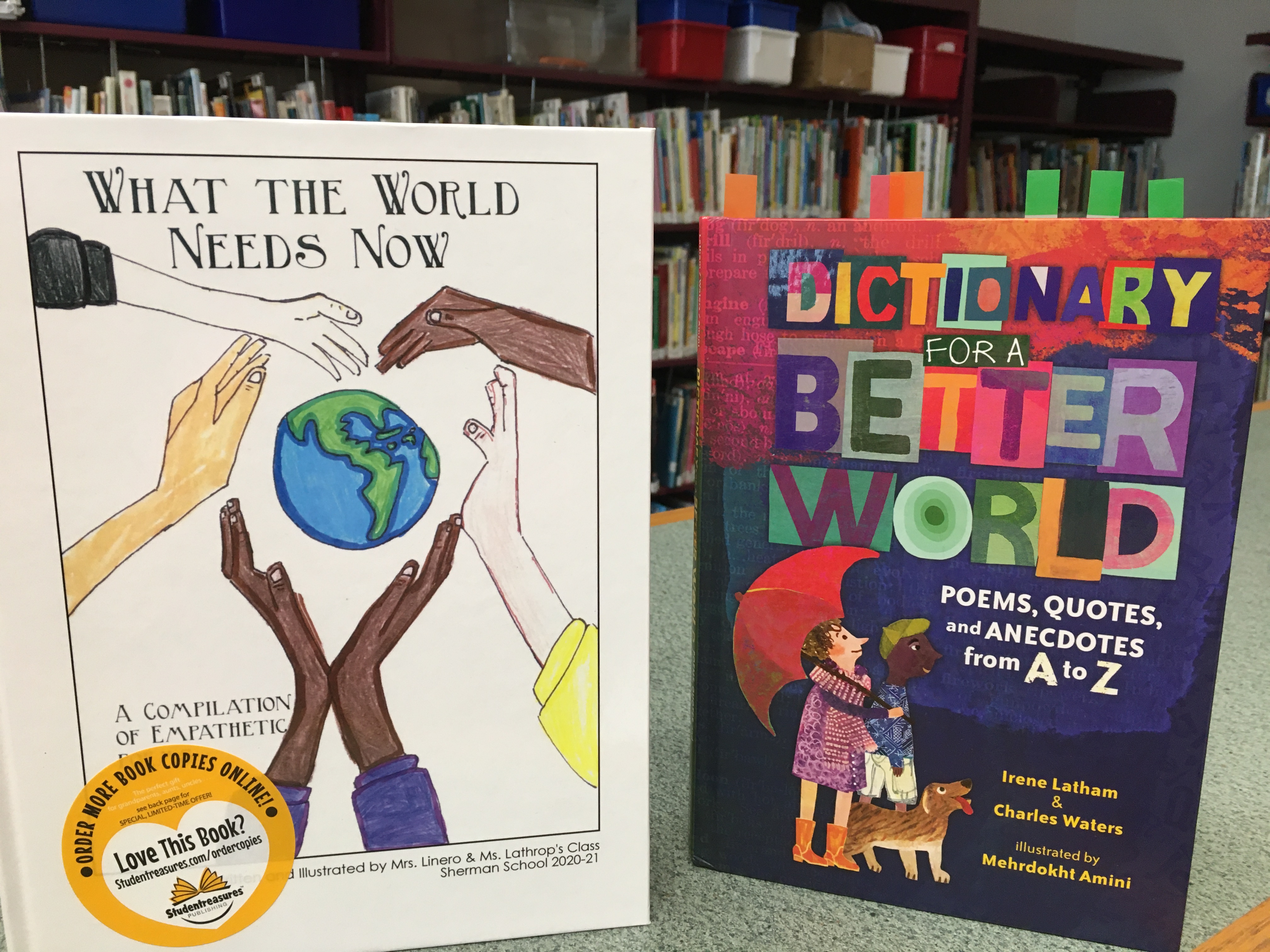
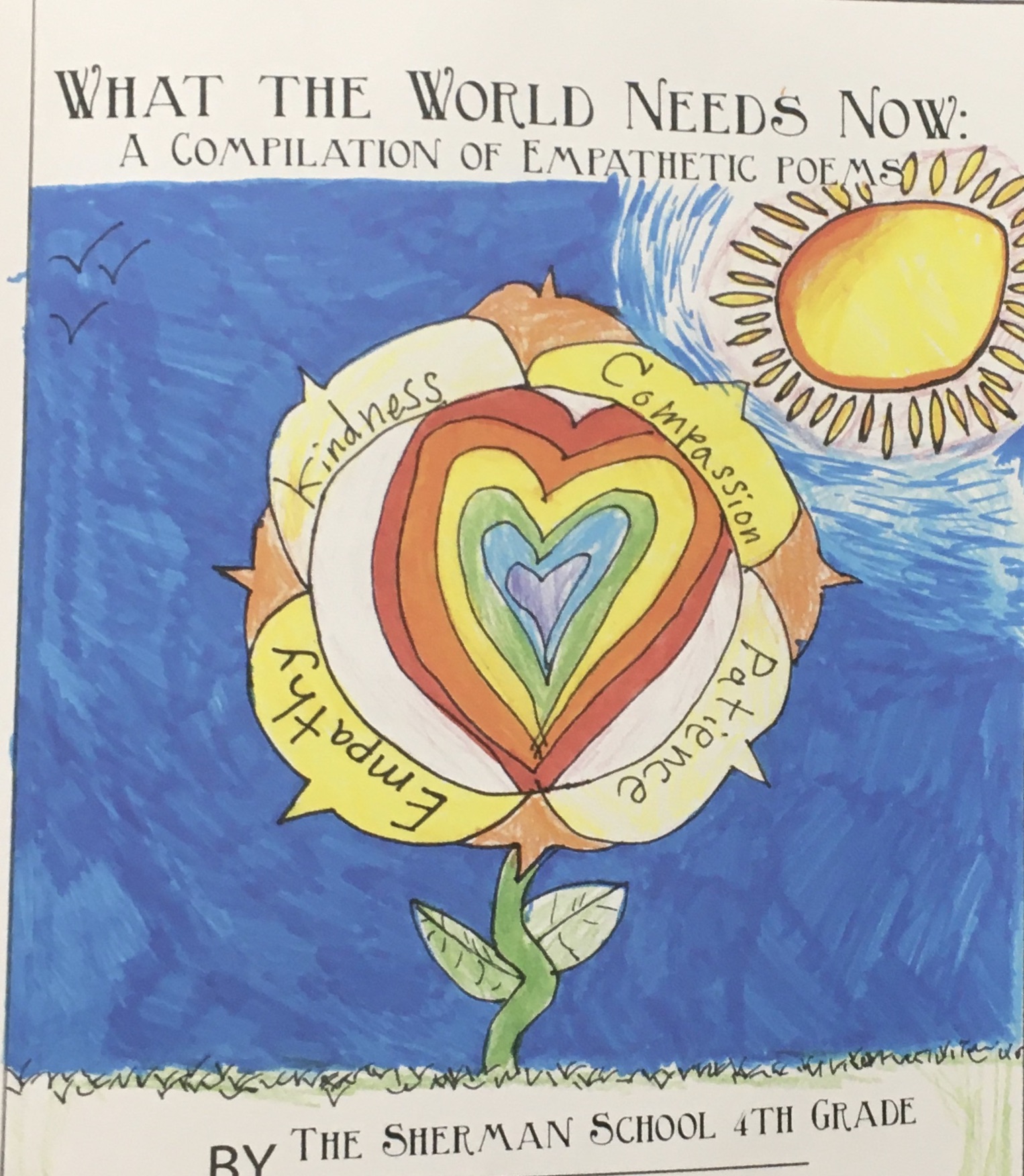
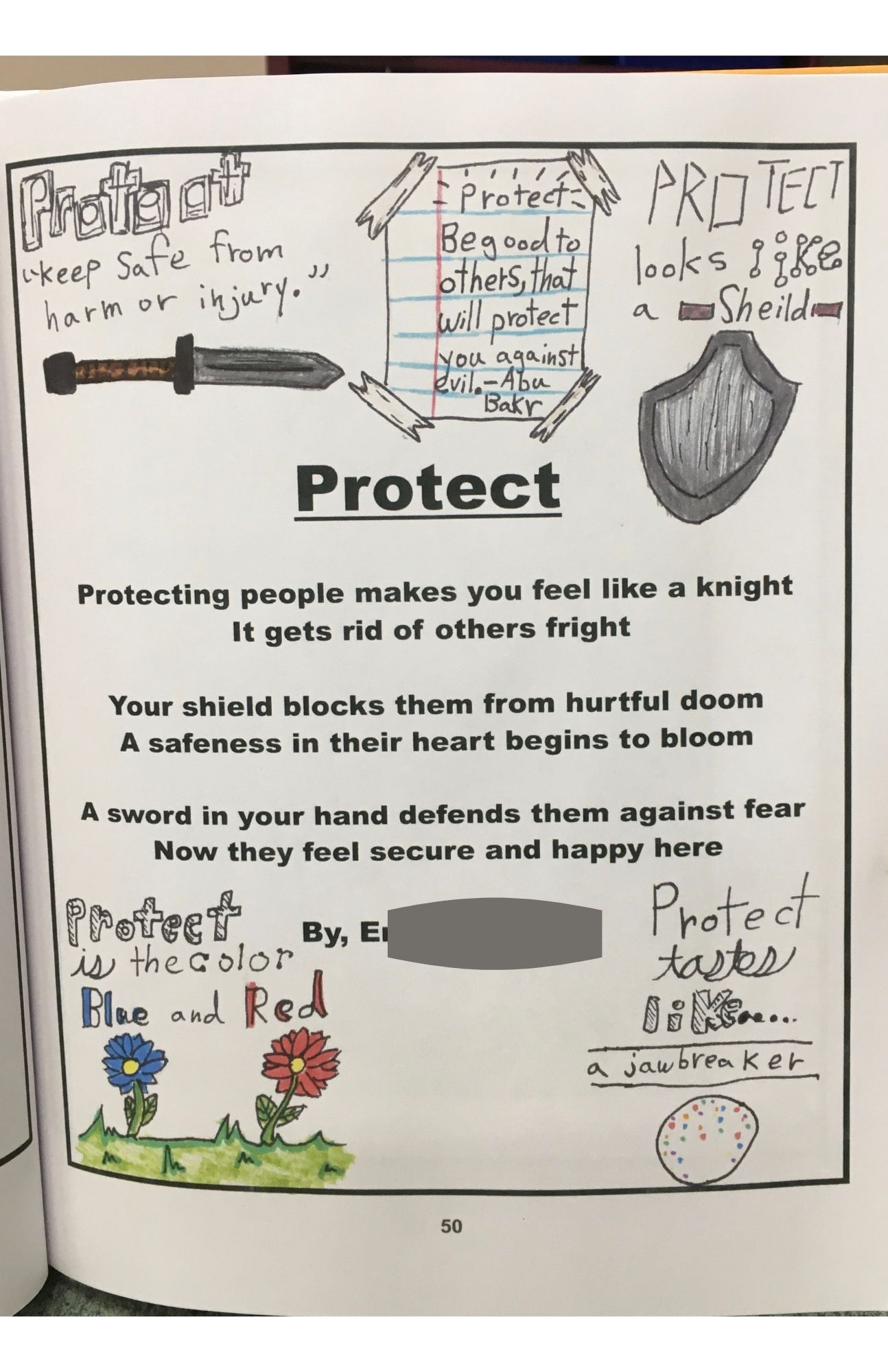
Back in March, Irene Latham and Charles Waters visited our school virtually to share their passion for poetry and to create “wordzines” with our students. Before their visit, teachers shared Dictionary for a Better World, Irene and Charles’s amazing collection of “poems, quotes, and anecdotes from A to Z.” We were all inspired by the wisdom and love that fills this book. Our fourth graders were so excited about their wordzines and the poems in Dictionary for a Better World that they decided to create their own book of “poems, quotes, and anecdotes.” And so What the World Needs Now was born. My friend and colleague Bernadette Linero, teacher extraordinaire, found a way to publish the book and all students have a copy to keep and treasure always. Here’s a peek into the creative work of our fourth graders:
Thank you to Irene and Charles for helping our students to think deeply about empathy, kindness, compassion and more. Thank you for inspiring them to create their own art and poetry that will, in the words of Nelson Mandela, “create a better world for all who live in it.”
Please be sure to visit Buffy Silverman for the Poetry Friday Roundup!
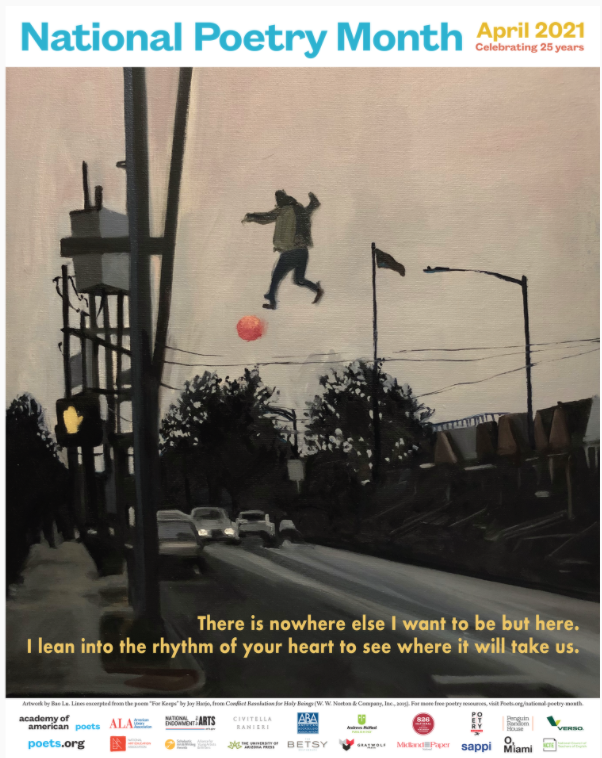
“Poetry gives us a place to make beautiful sense of life.” ~ Joy Harjo ~
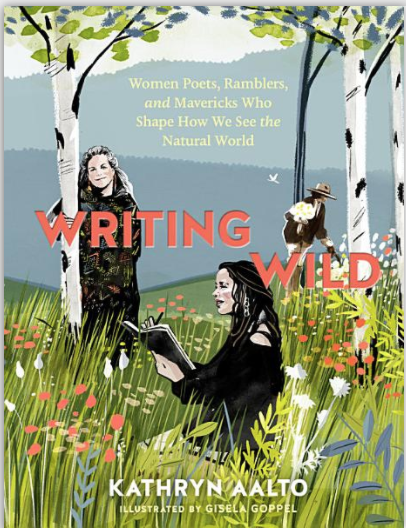
Welcome to the final Poetry Friday of National Poetry Month! Please be sure to visit Matt Forrest Esenwine at Radio, Rhythm, and Rhyme for the Poetry Friday Roundup. I can’t quite believe that April is over. One of the reasons I began this project was to find a way back into a daily writing habit. Although I didn’t post every day (“Because,” as my friend Heidi would say, “you know, life.“), I did write a poem in response to the work of all twenty-five writers profiled by Kathryn Aalto in Writing Wild. But somewhere along the way, this project morphed into something so much more. All of the women I met in this book are truly remarkable. Some have conquered overwhelming obstacles, including ne’er-do-well husbands, physical abuse and alcoholism. After spending a day or so with each of them, I found myself thinking, “She is my favorite.” Of course, I could never choose one over another. I am truly in awe of each and every one. Somewhere along the way, I read that Diane Ackerman calls herself a “poetic science storyteller.” I immediately thought, “that’s what I want to be when I grow up!” This work has changed me and inspired me in countless ways. I know it will be influencing my writing and my life for years to come.
For this final day, I decided to create a cento, drawing on all the poems I drafted this month. Italicized lines are directly from the work of other writers. Their names are listed in order at the bottom of the poem.
“A Complicated Beauty”
Things are at a tipping point. Earth, mother to all, weaves a web of memories. Know and say their names. Flood the world with empathy.
A bee buzzes hopefully around eager bursts of green, evidence of the wild wonder of the world.
In the day’s waning light, the world can shimmer. Winged creatures of the night with their own ways of being, chime a silent celebration.
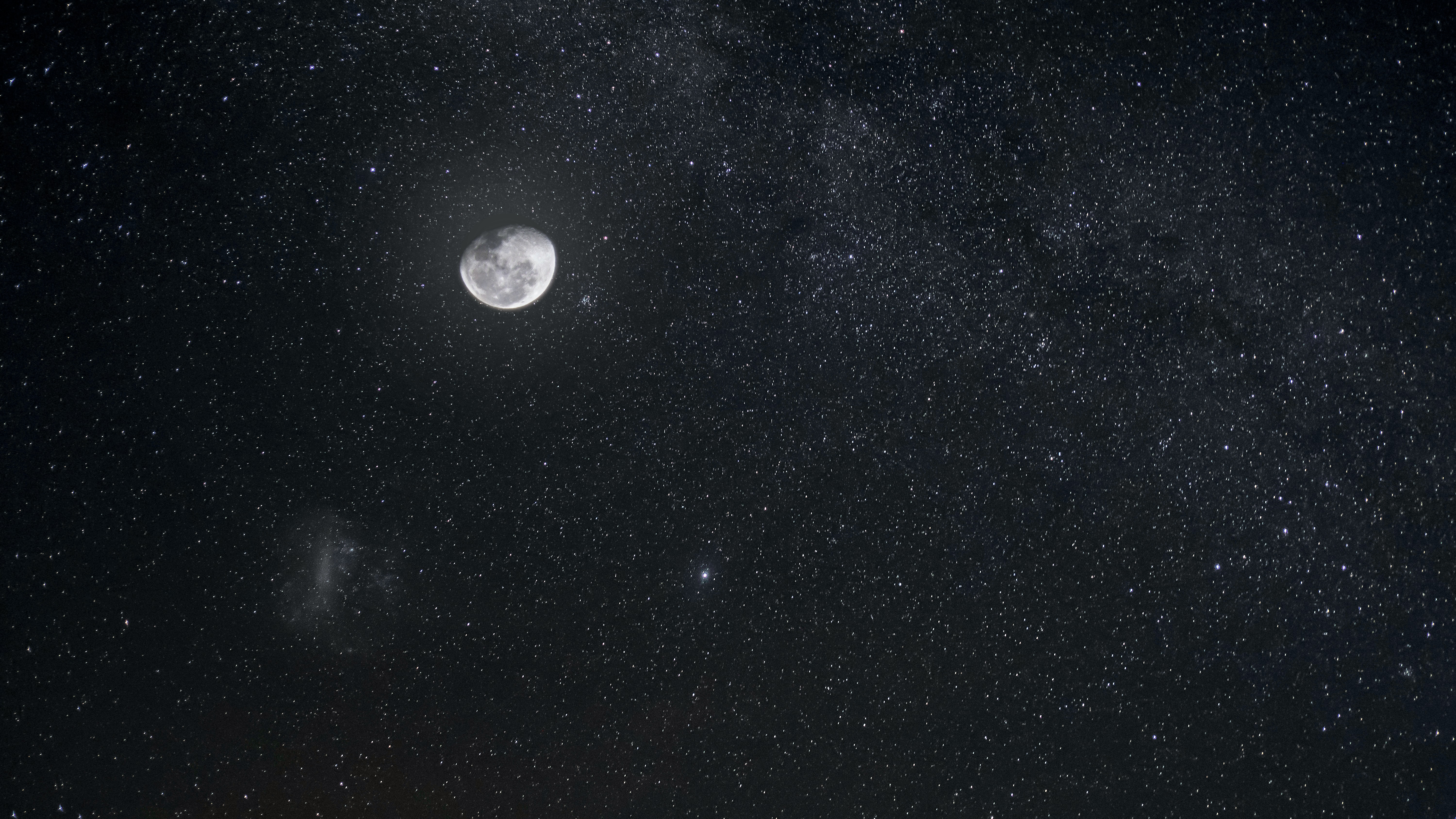
Star gazers look up in wonder, notice the ghost moon in the wide, pale sky.
Borders evaporate.
As daily life accepts the night’s arrest, a small spider, pearly and round with delicate legwork, plays the music of Nature.
Winding skyward along an ancient path heat, radiating, heart to heart resilience can emerge.
Alchemy powers earth’s enduring nature, promises for tomorrow. In twilight’s glimmer-glow, forge a new kinship with Earth. The most important magic lies within you.
I didn’t have time to read all of the books written by the women who have inspired me to write 26 poems in 27 days. But I did spend many hours listening to radio interviews, podcasts, and taped events. Not only did this allow me to become familiar with their work, it gave me a sense of their voice. I could listen to Elizabeth Rush’s voice all day. She brings a level of intelligence and compassion to her writing that is breathtaking. During an interview, she told Aalto that “writing and reporting about people–especially vulnerable ones–is an act of empathy.” (p. 244) I adapted this line to come up with the strike line for today’s poem, another Golden Shovel.
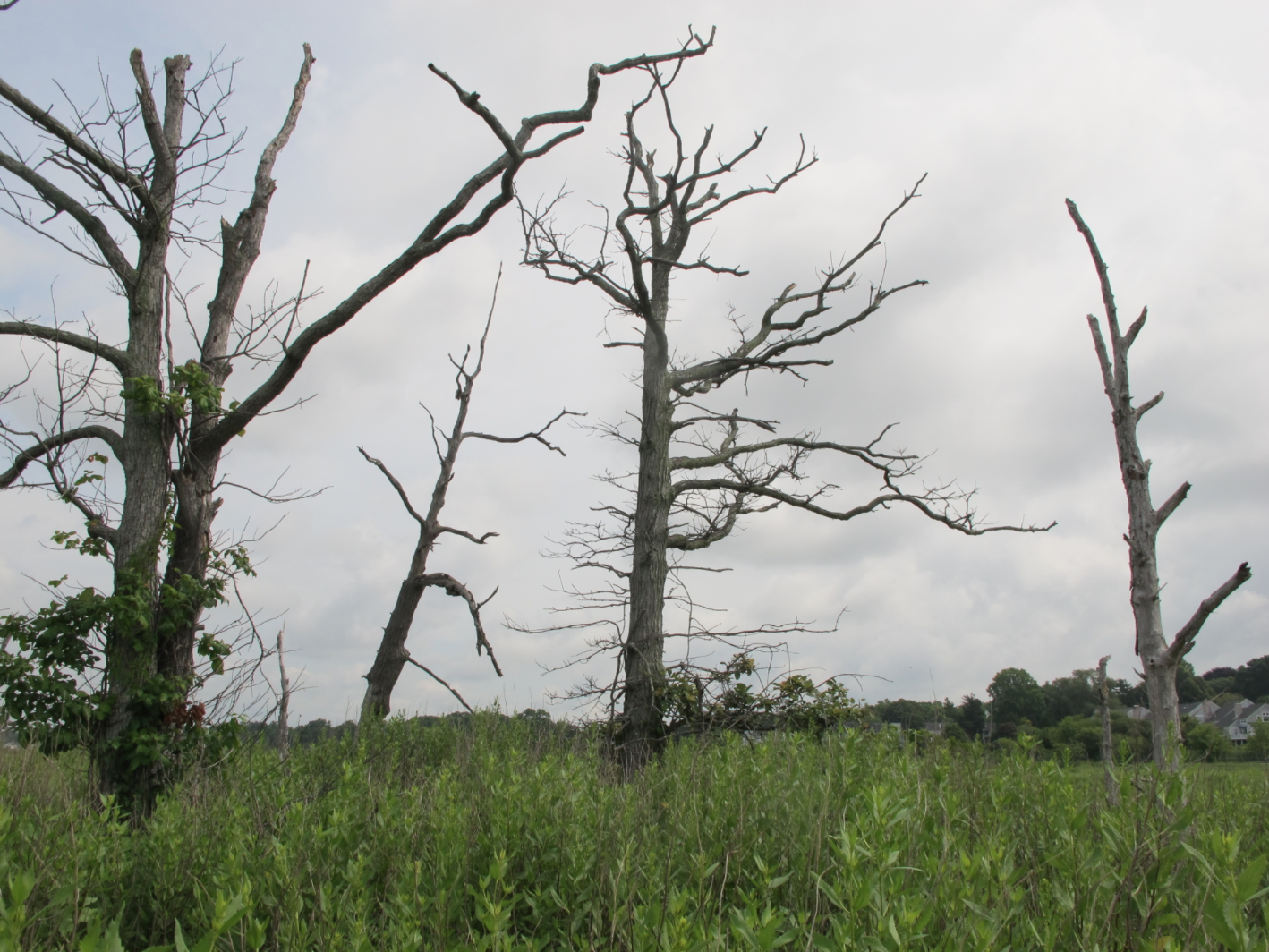
A tupelo tree in Rhode Island. Photo by Elizabeth Rush
What story is this rampike writing? Is it warning us that it is too late to save our planet from an apocalyptic sea change? Or an omen to act quickly, boldly? It whispers, “Listen to the earth with all of your senses, then flood the world with empathy.“
A rampike is a dead tree that is still standing. Rush writes about the proliferation of rampikes in areas where the salinity of the ground water due to rising seas is killing forests all along the east coast of the United States. You can learn more about this devastation here.
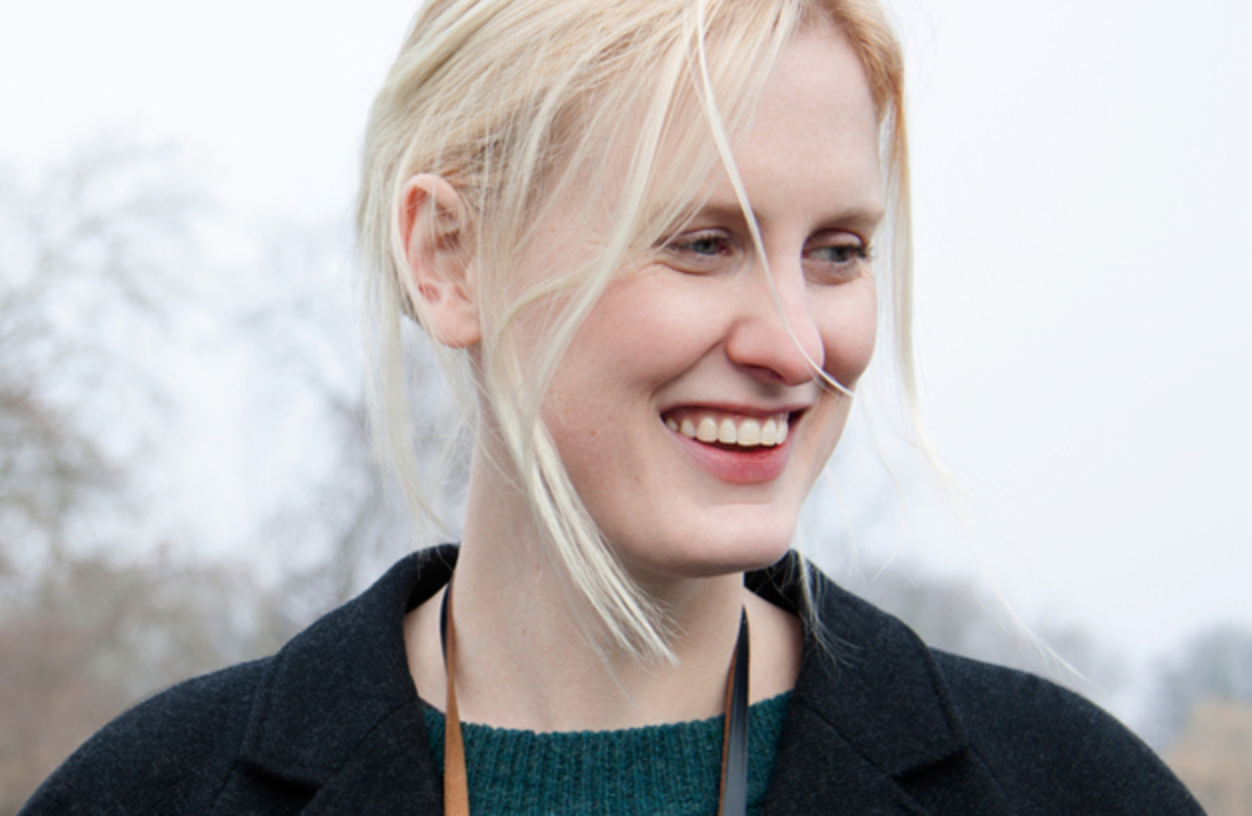
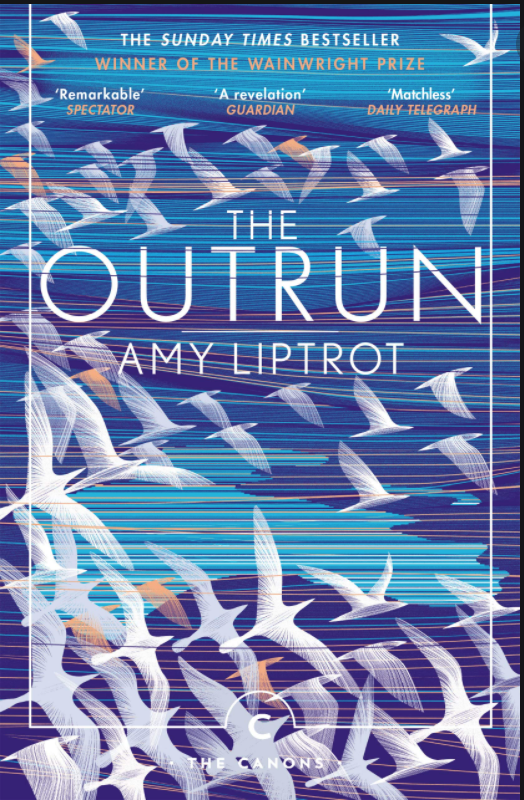
Amy Liptrot is one of the youngest writers profiled in Writing Wild, but the story of her descent into alcoholism and eventual recovery is riveting. Kathryn Aalto calls Liptrot’s memoir, The Outrun(2015), “both a modern recovery story and classic nature writing–a celebration of a particular place and the search for how best to live in the world.”
Photo Credit: Lisa Swarna Khanna
As I listened to Liptrot discuss her book on 5 x 15, I was captivated by her description of the grimlins, a word derived from Norwegian that means “twilight, the first or last gleams of daylight.” We have lovely twilights here in Connecticut, but apparently, the grimlins or “da simmer dims,” as they’re also called, are spectacular in the Orkney Islands. I couldn’t resist using this word to inspire today’s haiku.
at the edge of day twilight’s glimmer-glow enfolds the world in magic
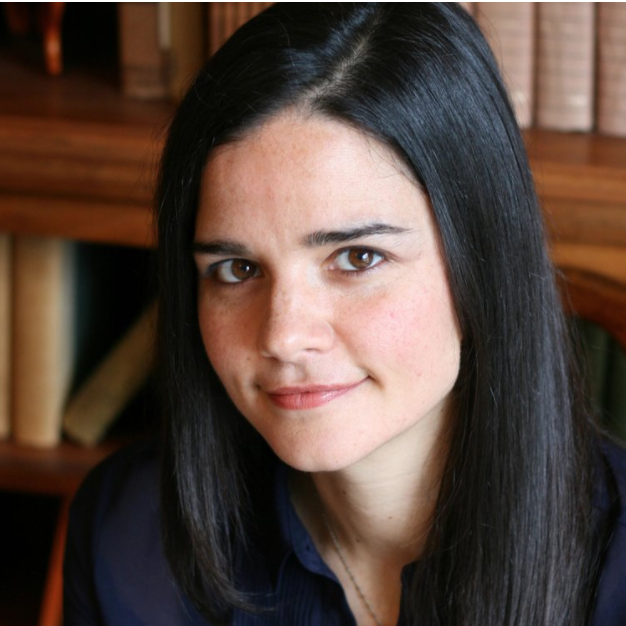
Kathryn Aalto says that Elena Passarello‘s book, Animals Strike Curious Poses (2017) “is the best book on animals I’ve read.” (p. 228) She goes on to say that “Passarello’s writing is playful” with “a tender poignancy” underlying each essay. Her writing is also infused with empathy, which is on full display in her first book of essays, Let Me Clear My Throat (2012). In this collection, Passarello writes “about the relationship of voice to identity.“
Photo credit Wendy Madar
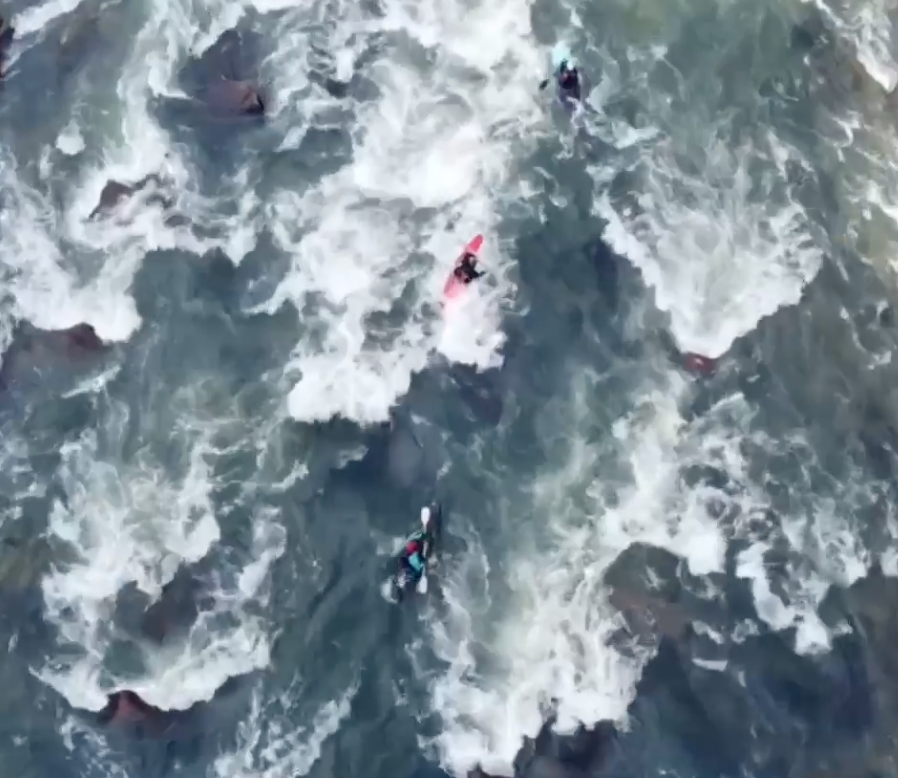
Exploring this relationship between voice and identity has emerged as a common thread between the writers profiled in Writing Wild. As I pondered how to write a poem in response to Passarello’s work, I watched a video my son posted on Instagram of him running a rapid on a river in North Carolina. I thought about the years of kayaking he’s done and how that experience allows him to “read” the river, to listen to the river’s voice, so he can safely navigate his way through the rocks. Every river has a distinctive voice, and unfortunately, we don’t always listen to what they are telling us. I decided to write a “scavenger hunt” poem, explained by Amanda Gorman in this video. I didn’t follow Gorman’s directions exactly, but I gathered a nice assortment of words (highlighted in bold) to include in my poem, which is still very “drafty.”
Slip into your boat. Borders evaporate. You and the river converge. Be still. Listen.
The murmuring river has a tale to tell. Tongues of water curl, vees form, marking a path through the wildtumult of froth and foam.


 Reading to the Core