Slice of Life: Read Alouds for Everyone

11454297503_e27946e4ff_h

Last night’s #readingjoy Twitter chat, led by Jennifer Seravallo, got me thinking about read alouds. Much has been written about the importance of parents reading aloud to children from the very start and making read alouds part of every classroom routine. I agree with every bit of this advice. I read to my own children from the day we came home from the hospital, and we never skipped read aloud time in my classroom. But I’ve also come to realize the importance of read alouds in my intervention lessons.

I left the classroom seven years ago to become our school’s literacy specialist. Because I work in a small district, this role includes many duties. One of these is working with tier 3 students. The children I work with are our youngest, most at-risk students who are typically non-readers when we begin working together. One of the biggest challenges they face is understanding why they should bother with reading at all. Usually this is because reading isn’t a priority at home. I meet with their parents to discuss the importance of reading to and with their children. I also give them pamphlets and links to websites with tips and information about how to make reading part of their routine at home. I send books home that children can keep. And yet, they still don’t read at home.

By the time these children arrive in my room, they’re convinced that I’m going to torture them. So I start by chatting with them about their pets, hobbies, and places they like to visit, just to break the ice. Once they are comfortable, I start asking about favorite books or subjects. Then I bring out my secret weapon. A book. I offer it as something I like, not as something I think they should like. Usually they ask for their own copy by the end of the week.

614a7cNL5EL

One of my first students was a first grade boy with a host of issues. (He was diagnosed with Autism during the time I worked with him.) He had no interest in anything other than Legos and hated school because he had to leave his Legos at home. He knew most of the letters and sounds, but didn’t know how to pull them apart or put them together to make words. For some reason, he took a shine to Emily Gravett’s Orange Pear Apple Bear (Simon & Schuster, 2007). I must have read that book to him a hundred times. Soon, he was reading it with me. And before long, he was reading lots of other books, too.
51wjVUX0s9L._SY300_

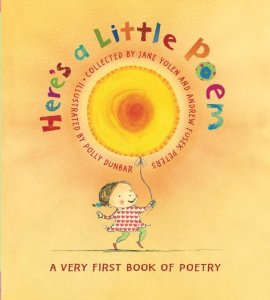
Another boy was adamant that he hated letters and wouldn’t learn to read. I told him that was his choice but that I was going to read to him. His “breakthrough book” was in fact a poem from Jane Yolen and Andrew Fusek Peter’s excellent collection Here’s a Little Poem: A First Book of Poetry (Candlewick, 2007). Peter’s own poem, “The No-No Bird,” introduced this child to a boy who liked the word “no” as much as he did. Maybe it was this flash of recognition that finally brought him around. Or maybe it was simply the fact that he could read the word “no.”
51R1jIhHu3L

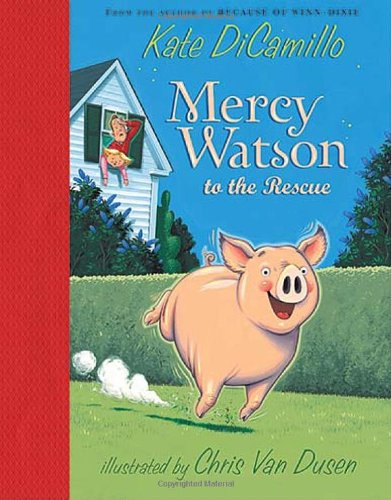
Last year I had a student who was so shy and quiet he barely spoke above a whisper. To break the ice, I began reading Kate DiCamillo’s Mercy Watson to the Rescue (Candlewick, 2005). He loved Mercy and her silly antics! Soon he was reading with me, asking questions, and thinking of further adventures for Mercy. Over the course of the year, we read every Mercy Watson book we could get our hands on. My heart was filled with joy at the look on his face when I presented him with his own copy of Mercy Watson at the end of the school year.

Do I know what it was about each of these books that made them the right books for these children? No. What I do know is that each child heard or saw something in them that made him happy. Something in these books helped him feel connected to another person and let him know he wasn’t alone. And that is, after all, why we read.

Thank you, as always, to StaceyTaraDanaBetsyAnna, and Beth for hosting Slice of Life each Tuesday. Be sure to visit Two Writing Teachers to read more Slice of Life posts.


It’s Monday! What Are You Reading? Bird Books

IMWAYR

One of the few memories I have of 2nd grade is learning about birds. My teacher, Mrs. Wheaton, must have been a bird-watcher, because she taught us about the song birds native to our area. I  don’t remember what specific facts about birds I learned from her, but I have clear memories of coloring pictures of the Baltimore oriole, red-wing blackbird, goldfinch, and more. The pages  had the purple ink and intoxicating smell of a mimeograph machine, and I loved them. At the end of the unit, all the pages were stapled together into a little book. 

9780763645618_p0_v1_s260x420I was reminded of this project recently when I read Look Up! Bird Watching in Your Own Backyard. (Candlewick Press, 2013) This book is filled to the brim with fascinating details about bird species, habitats, flight behavior, wing shape, beak shape, songs and more. Author and illustrator Annette LeBlanc Cate tells readers at the start that she is not a scientist; she just really loves birds. Her love shines through on every page of this fact-filled, engaging book.

One of my favorite things about Look Up! Bird Watching in Your Own, which won a Robert F. Sibert Honor, is that it encourages children to hone their powers of observation. Cate urges readers to go outside and “be amazed at just how thrilling it can be to see new birds, find out about them and learn their names.” Tips for successful birdwatching, as well as a bibliography for budding birders are included. Cate also recommends that readers visit the Cornell Lab of Ornithology’s website. This is an extensive resource, where you can search for information about almost any North American bird, hear its song and watch several species in the wild via their Bird Cam.

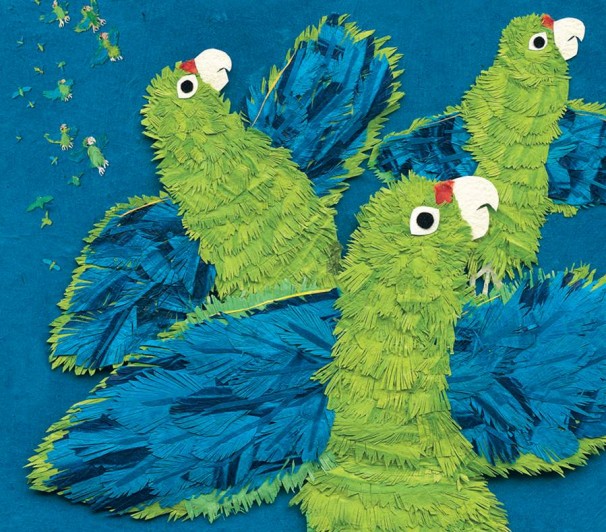
Parrots-over-Puerto-Rico1Parrots Over Puerto Rico (Lee & Low Books, 2013) by Susan L. Roth and Cindy Trumbore is a gorgeous book that tells the story of the Puerto Rican parrot. Called iguaca by the Tainos who arrived on the island over a thousand years ago, “hundreds of thousands of parrots flew over the island” before Puerto Rico was settled by humans. Roth and Trumbore’s description of this paradise is brought to life in Roth’s stunning collages. Using paper and fabric, she creates scenes that have such depth and texture you wouldn’t be surprised if the birds flew off the page.

By weaving the history of Puerto Rico together with the fate of these now extremely rare parrots,  Roth and Trumbore make it clear that humans have been the primary culprits in the birds decline. But they also devote almost half of the book to the efforts humans have taken since the late 1960s to save the Puerto Rican parrot. They describe the setbacks as well as the successes scientists have had as they fight to save the Puerto Rican parrot.

Winner of the 2014 Robert F. Siebert Medal for Most Distinguished Informational Book for Children, Parrots Over Puerto Rico has a lengthy afterword that describes the work of the Puerto Rican Parrot Recovery Program in greater detail and includes photographs of the birds in the aviaries and in the wild. There is also a timeline of events described in the book, as well as a list of sources.

mama-built-a-little-nest-9781442421165_lg

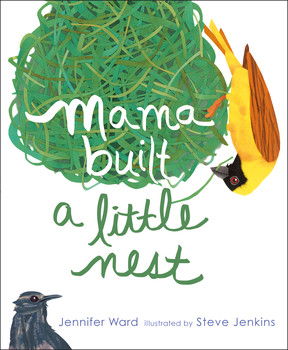
For younger bird lovers, Jennifer Ward has created the lovely Mama Build a Little Nest (Beach Lane Books, 2014). This rhyming book describes how many different species of birds build their nests. Some, like the hummingbird, are “wee and snug,” while others, such as the falcon, scrape “a simple nest/upon a craggy ledge.” Steve Jenkins’ beautiful collages are just right for Ward’s simple, straightforward text. Each page also includes an additional fact about the birds and their habits and a short author’s note provides additional information about nest construction and a list of websites to explore.

If you or your students weren’t bird watchers before, you definitely will be after reading these books. Mrs. Wheaton would have loved them!

Don’t forget to visit Jen at Teach Mentor Texts and Kellee at Unleashing Readers to find out what other people have been reading lately. Thanks, Jen and Kellee, for hosting!

Poetry Friday: Louise Erdrich’s “Advice to Myself”

poetry-friday-1-1

I’ve been captivated by Louise Erdrich’s writing for many years, since I first read her middle grade novel, The Birchbark House. This book was a favorite read aloud when I taught third grade.  Since then, I’ve read all of her children’s novels and most of her adult novels. For the past several days, I’ve been reading Erdrich’s National Book Award winning adult novel, The Round House (Harper, 2012).

Often called a “Native American Faulkner”, Erdrich has created in her fiction what Maria Russo calls an “indelible Yoknapatawpha, a fictional North Dakota Indian reservation and its surrounding towns, with their intricately interconnected populations” (New York Times Book Review, Oct. 14, 2012)

Erdrich uses the tools of a poet to tell these finely spun tales. Metaphor, imagery, repetition, and more are skillfully woven together to create passages like this one from The Round House:

“I lay down on the warm wood and the sun went right into my bones. I saw no herons at first. Then I realized the piece of reedy shore I was staring at had a heron hidden in its pattern. I watched that bird stand. Motionless. Then, quick as genius, it had a small fish, which it carefully snapped down its gullet.”

Such craftsmanship isn’t surprising, considering the fact that Erdrich began her writing career as a poet. Many of her poems can be read online, but “Advice to Myself” resonated with me in way the others didn’t after a week of attempting to clear away the clutter of winter.

Advice to Myself

by Louise Erdrich

Leave the dishes.

Let the celery rot in the bottom drawer of the refrigerator

and an earthen scum harden on the kitchen floor.

Leave the black crumbs in the bottom of the toaster.

Throw the cracked bowl out and don’t patch the cup.

Don’t patch anything. Don’t mend. Buy safety pins.

Don’t even sew on a button.

read the rest here

Be sure to stop by Life on the Deckle Edge, where Robyn Hood Black has the Poetry Friday Round Up.

It’s Monday! What Are You Reading?

IMWAYR

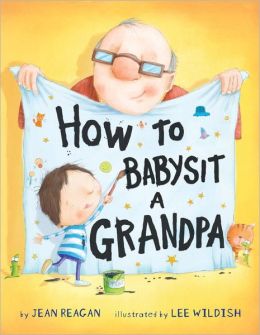
How to Babysit a Grandpa (Alfred Knopf, 2012), by Jean Reagan, with illustrations by Lee Wildish, is a charming story. The book opens with these words of wisdom from a little boy who is about to spend the day with his grandpa.

“Babysitting a grandpa is fun–if you know how.”

Our nameless hero goes on to explain all the highlights of a five-year old’s day: snacks, going outside, playing games, and more. He even suggests “bouncy music” to make clean up easier. Every other page or so provides additional tips for would-be grandpa-sitters, such as snack suggestions and ideas for lots of creative play. (I love that there is a T.V in one illustration, but it is never mentioned, let alone turned on.)

Adding to the appeal of Reagan’s text are Lee Wildish’s digital illustrations. His characters remind me of Melissa Sweet’s non-collage work–imbued with love and a sense of humor about the realities of life as a child. There are crumbs all over the table, and the boy’s tongue is set firmly in the corner of his mouth as he draws a picture for grandpa.

     9780375867132_p0_v1_s260x420   9780385753845_p0_v2_s260x420

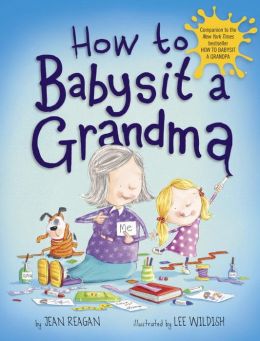
Reagan and Wildish have teamed up again for How to Babysit a Grandma (Alfred Knopf, 2014), and it is every bit as engaging as How to Babysit a Grandpa. The style and tone are the same (the boy and his grandpa even make a cameo appearance at the park), but our heroine has her own ideas for activities to “keep a grandma busy.”

Both of these books are perfect mentor texts for Kindergarteners and first graders learning to write how-to books. Children could also come up with their own versions of the lists Reagan has included, or add their ideas to hers. These books could just as easily be enjoyed as read-alouds, or shared in September in honor of Grandparents Day. The possibilities are endless. One thing is certain, though. If you have a 4-6 year old, know one, or teach them, these books should be on your list of How to Entertain a Child.

Don’t forget to visit Jen at Teach Mentor Texts and Kellee at Unleashing Readers to find out what other people have been reading lately. Thanks, Jen and Kellee, for hosting!

Why Poetry?

Chris Lehman recently invited teachers to join him in an online poetry workshop, TeacherPoets. He also invited people to respond to the question “Why poetry?” Many smart, insightful responses have been shared here. How to answer this question without restating what so many have already contributed? I decided to read through a few of my favorite poetry resources and create a found poem (some lines are slightly altered to work in the sequence).

By Phyzome is Tim McCormack (Own work) , via Wikimedia Commons

Why Poetry?

Feel in touch with that universal rhythm.

Lift the veil from the hidden beauty of the world;

Find the mystery in everyday things and objects.

Rekindle a latent sense of wonder.

Have a good eye and a sharp ear.

Find your own voice.

Discover the perfect word for your purpose.

Use fresh imagery that rattles the senses and

Some wordplay that makes it sparkle.

Group them together in a shape or rhythmical structure.

Poems hum,

The breathings of your heart.

And words are nets to capture

The secrets you didn’t know you were keeping.

Here are the authors and sources of these lines, in order:

Lillian Morrison, Seeing the Blue Between: Advice and Inspiration for Young Poets, compiled by Paul B. Janeczko; Candlewick Press, 2003

Percy Bysshe Shelley, A Defence of Poetry

Robert Farnsworth, Seeing the Blue Between: Advice and Inspiration for Young Poets, compiled by Paul B. Janeczko; Candlewick Press, 2003

Joyce Sidman, “Touching the World: The Importance of Teaching PoetryRiverbank Review, Spring 2002

Karla Kuskin, Seeing the Blue Between: Advice and Inspiration for Young Poets, compiled by Paul B. Janeczko; Candlewick Press, 2003

Michael Dugan, Seeing the Blue Between: Advice and Inspiration for Young Poets, compiled by Paul B. Janeczko; Candlewick Press, 2003

Mary Ann Hoberman, Seeing the Blue Between: Advice and Inspiration for Young Poets, compiled by Paul B. Janeczko; Candlewick Press, 2003

Nikki Grimes, Seeing the Blue Between: Advice and Inspiration for Young Poets, compiled by Paul B. Janeczko; Candlewick Press, 2003

Jane Yolen, Take Joy: A Writer’s Guide to Loving the Craft; Writer’s Digest Books, 2006

Lillian Morrison, Seeing the Blue Between: Advice and Inspiration for Young Poets, compiled by Paul B. Janeczko; Candlewick Press, 2003

Julie Larios “Playing with Poetry

William Wordsworth

Muhammed al-Ghuzzi, “The Pen

Robert Farnsworth, Seeing the Blue Between: Advice and Inspiration for Young Poets, compiled by Paul B. Janeczko; Candlewick Press, 2003


Poetry Friday: “I Wandered Lonely As a Cloud”

poetry-friday-1-1

Signs of spring are finally showing up here in my corner of Connecticut, and spring break begins TODAY! In honor of the season, I’m sharing “I Wandered Lonely As a Cloud” by William Wordsworth. This is one of the first “adult” poems I remember reading in high school that I really liked. Who wouldn’t want to be dancing with daffodils?

I wandered lonely as a cloud
That floats on high o’er vales and hills,
When all at once I saw a crowd,
A host, of golden daffodils;
Beside the lake, beneath the trees,
Fluttering and dancing in the breeze.


Continuous as the stars that shine
And twinkle on the milky way,
They stretched in never-ending line
Along the margin of a bay:
Ten thousand saw I at a glance,
Tossing their heads in sprightly dance.


The waves beside them danced; but they
Out-did the sparkling waves in glee:
A poet could not but be gay,
In such a jocund company:
I gazed—and gazed—but little thought
What wealth the show to me had brought:


For oft, when on my couch I lie
In vacant or in pensive mood,
They flash upon that inward eye
Which is the bliss of solitude;
And then my heart with pleasure fills,
And dances with the daffodils.
By Myrabella (Own work) [CC-BY-SA-3.0 (http://creativecommons.org/licenses/by-sa/3.0)], via Wikimedia Commons
Parc de Bagatelle, Paris By Myrabella, via Wikimedia Commons
Happy Blog Birthday to Michelle at Today’s Little Ditty! Be sure to visit and help her celebrate and to read the Poetry Friday round up.

It’s Monday! What Are You Reading?

IMWAYR

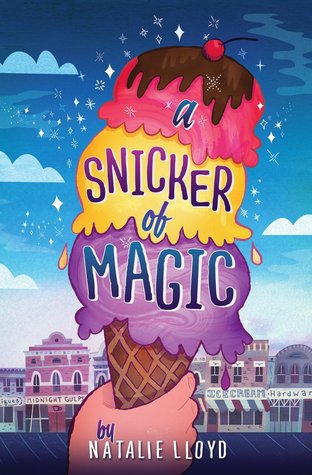
I feel like I’m late to the party for A Snicker of Magic (Scholastic, 2014), Natalie Lloyd’s debut middle-grade novel. Even though it’s only been out for a little over a month, A Snicker of Magic has gotten oodles of love on Twitter and kid lit blogs. This love is well deserved. 

18222556

A Snicker of Magic is one of those “good stories” that “take your heart someplace else.” Felicity Pickle, a 12 year old who “sees words everywhere,” is the heart of Lloyd’s story. After years of being “sweet gypsies,” Felicity, her mother, and sister arrive in the tiny town of Midnight Gulch, Tennessee. Tired from years of wandering, Felicity is ready to stay, but fears her mother will become restless and want to leave again at any moment. Midnight Gulch “used to be a secret place… because the people who lived there had magic in their veins.” But the magic is gone. Felicity is curious about why it left and where it went. With the help of her new friend, Jonah, and a colorful cast of characters, she does her best to find the magic and return it to the town. 

Felicity is a poet who knows that she holds “the finest magic, words worth spinning, stories worth telling.” Hope has perched in her soul, and she uses her gift with words to heal the pain caused by a century of anger and misunderstanding. Lloyd has spun a story filled with magic, a story well worth telling. A Snicker of Magic is a good choice for a read aloud in fourth or fifth grade and will likely inspire many students to become word collectors and poets themselves.

el-april14-left

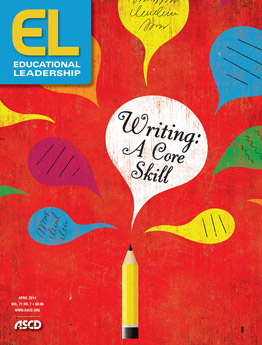
Educational Leadership, the monthly journal published by ASCD, always has timely articles by leading researchers, and the April issue is no exception. Devoted to “Writing: A Core Skill,” contributors include Carol Jago, Mary Ehrenworth, Kelly Gallagher, Penny Kittle, and more. I’m still reading, but can see already that this issue is a valuable resource. The articles I’ve read offer a succinct introduction to many elements of good writing instruction, including using mentor texts, teaching craft rather than formulas, types of writing, and more. I plan on sharing Jeff Anderson’s contribution, “What Writing Is & Isn’t,” with my colleagues. This article is the perfect springboard for a discussion about our understanding of writing instruction.

Don’t forget to visit Jen at Teach Mentor Texts and Kellee at Unleashing Readers to find out what other people have been reading lately. Thanks, Jen and Kellee, for hosting!

SOLC 2014: Things to do if You’re a Writer

11454297503_e27946e4ff_h

How to write this final post of the 2014 Slice of Life Challenge? Yesterday’s post was reflective and full of thanks to everyone who made this challenge possible and who encouraged me through their generous comments. I had planned to do a standard “It’s Monday! What Are You Reading?” post, but as often happens, life intervened and I knew that plan wasn’t going to work. 

I spent much of the day revising our fifth grade poetry unit and thought I could write about that, but that didn’t seem appropriate for my final slice. “In the end,” I decided to use a list poem (another list!) I read today, “Things To Do If You Are The Sun,” by Bobbi Katz, as a model for a poem that sums up how participating in this challenge has changed me as a writer.

Things To Do If You’re a Writer

Let words envelop you and swirl inside your head.

Look at a flower bud and see a diver poised on the brink of the board.

Hear an owl hooting and wonder what coded message he’s sending out

into the night.

Bite into a pear and taste summer in its sweetness.

Touch a puppy’s ear and feel the satiny edge of a well-loved blanket.

Breathe in the late winter air and sniff a hint of spring.

Gather these bits and pieces, like a magpie, and weave them

into something wonderful.

Share your creation with friends, who, through reading your words,

know what is in your heart.

© Catherine Flynn, 2014

Thank you, everyone, for an amazing month.

9781596432208

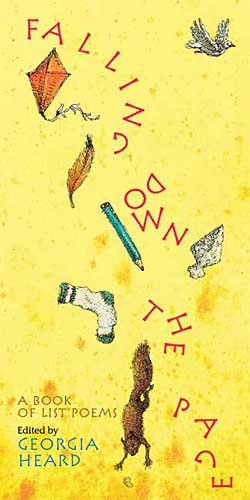
If you’d like to read “Things to do if You Are the Sun,” it can be found in Falling Down the Page: A Book of List Poems (Roaring Brook Press, 2009), edited by Georgia Heard. If you’d like to read other list poems and gather more ideas for using them as mentor texts with children, read Elaine Magliaro’s post at Wild Rose Reader.

SOLC 2014: The Perils and Pleasures of Writing

11454297503_e27946e4ff_h

“…there is nothing more wonderful than a list…”

~ Umberto Eco ~

As this month draws to a close, it seems natural to reflect on what I’ve learned. Lists have been popular this year.  I love lists and have tried a few different formats myself, and thought a compare/contrast style list would work to organize my jumbled thoughts about writing each day for the past 30 days. 

 The Perils of Writing Every Day

  • Chocolate on the computer–I guess as long as it doesn’t work its way into the keyboard or USB port, it really can’t hurt.
  • Almost driving into a snowbank as I watched a bobcat cross the road. (Thankfully, the snow is gone!)
  • Being so tired from reading and writing (not to mention life) that I could hardly see straight, yet when I finally got into bed and closed my eyes, words floated into my brain and I had to get up to write them down.
  • Washing my hair with body soap because I was still tired and distracted by my thoughts.
  • There was something else, but I can’t remember what it was because I didn’t write it down!

woman-writing1

The Pleasures of Writing Every Day

  • Finding exactly the right words to express my thoughts.
  • Reflecting on daily events through writing. This has helped me learn and deepen my understanding about a many topics.
  • Learning about myself as a writer–being conscious of my bad habits and trying to improve my writing.
  • Having the satisfaction of letting go of some self-doubt and accomplishing a goal — sharing an original poem each Friday was scary.
  • Being part of this supportive, nurturing community. Your comments and feedback have encouraged me and made me brave.

I am so grateful to Stacey, Tara, Dana, Anna, Betsy, and Beth for providing this space for us to share our writing, and to everyone on the support team who helped with all the details. I can only imagine the time and effort that have gone into making this month-long challenge a success. Thank you all for your generosity!

Finally, I am in awe of all of you. The writing that you have shared in response to the SOL challenge has been amazing. Your words have moved me to laughter and tears, and have given me new insights and understanding into life. Thank you so much for sharing.

SOLC 2014: Just Three Books?

11454297503_e27946e4ff_h

Last night, NPR aired an interview with Gabrielle Zevin, author of The Storied Life of A.J. Fikery (Algonquin Books, 2014). During the interview, Zevin explained that she wanted to write “a love letter to the joy of reading” and that she believes asking someone what they read “is a much more informative question” than any other question we might ask.

So NPR asked the question. On Thursday, they tweeted:

Screen Shot 2014-03-29 at 12.57.03 PM

This question has been asked of readers on social media many times in recent years, but it’s one that I always have difficulty answering. I believe, as Zevin does, that “We are not quite novels. We are not quite short stories. In the end, we are collected works.”

I have written before about the fact that Charlotte’s Web is the book that made me a reader because I recognized myself in Fern and her world.

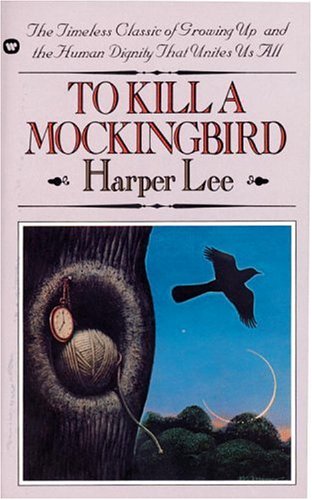
If Charlotte’s Web was my mirror, then To Kill A Mockingbird was my first true window: a book that showed me a way of life very different from the one I knew. And yet I understood Scout and her fears. 

               mockingbird           51RRKMW0QNL

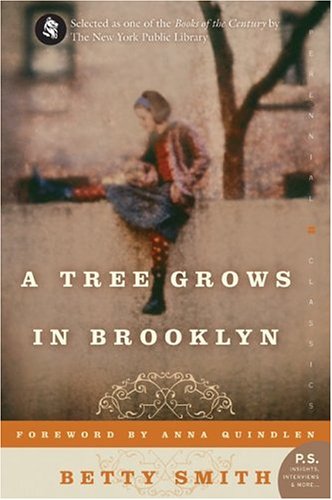
I read To Kill A Mockingbird when I was in eighth grade, and after that, my reading was wildly eclectic. I was “trying on” different personalities, trying to figure out who I wanted to be. A book I wish I’d read during those years to help me find an answer is A Tree Grows in Brooklyn. I think I would have loved Francie more then than I do now. I would have loved that she imagined herself “living in a tree” as she read her precious library books each Saturday afternoon. I would have loved the little stories she made up to make arithmetic tolerable. I even would have loved her for lying about her name to get the beautiful doll for which the other girls refused to beg.

Beyond these three books, it is impossible to choose: The Bean Trees, Bel Canto, The Book Thief, Middlemarch, and more. All of these books helped me, as Karen Armstrong writes in A Short History of Myth, “…make a painful rite of passage from one phase of life, one state of mind, to another.” They have taught me “to see the world differently; … how to look into our own hearts and to see our world from a perspective that goes beyond our own self-interest.” (Armstrong, p. 149)

Thank you, as always, to StaceyTaraDanaBetsyAnna, and Beth for hosting the Slice of Life Challenge. Be sure to visit Two Writing Teachers to read more Slice of Life posts.