When my son was a baby, he had an ear infection almost non-stop from the time he was six months old until just before he had tubes put in his ears six months later. Needless to say, we spent a lot of time at the pediatrician’s office. There were always stacks of picture books in the waiting room, and one day, A House is a House for Me (Viking, 1978), by Mary Ann Hoberman was on top of the pile, just waiting for us. It quickly became one of our favorites.
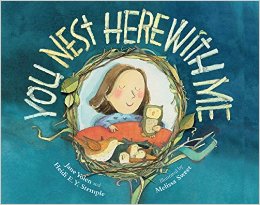
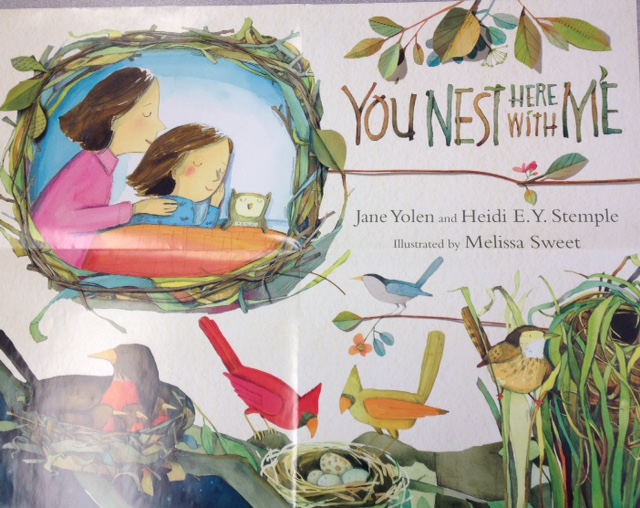
Now Jane Yolen, Heidi E.Y. Stemple, and Melissa Sweet have teamed up to create a book about homes that is every bit as wonderful as Hoberman’s classic. You Nest Here With Me (Boyds Mills Press, 2015) begins with a “little nestling,” carrying a copy of You Nest Here With Me being flown into bed by her mother. As the poem unfolds, we learn that “Pigeons nest on concrete ledges” while “Catbirds nest in greening hedges” but the mother always assures the child that “you nest here with me.”
Song birds, shore birds, birds of prey, and more are introduced through the gentle rhymes of Yolen and Stemple’s text. Readers will want to linger over Sweet’s inviting watercolor and collage illustrations. An author’s note explains that David Stemple, Jane’s late husband and Heidi’s father, was a “serious bird watcher.” This dedication clearly rubbed off, for their love of birds is present on every page.
Factual information about all the birds in the book is included, and there is a scavenger hunt of sorts included in the illustrations. Four kinds of birds are depicted in cozy nests, but not mentioned in the text. Children will have fun finding these favorite species tucked in with other familiar and some unfamiliar birds.
I got this beautiful poster at NCTE!
I would read this to Kindergarten and first grade students, but most of all I would love to share it with a toddler or preschooler nestled on my lap.
Thank you to Stacey, Tara, Dana, Betsy, Anna, and Beth for this space for teachers and others to share their stories each day during the month of March and on Tuesdays throughout the year. Be sure to visit Two Writing Teachers to read more Slice of Life posts.
I spent the day yesterday at the Rhode Island Convention Center where The Teaching Studio at The Learning Community, a public charter school in Central Falls, Rhode Island, held their 2nd Annual Educators’ Institute. Hundreds of teachers spent the day with noted educators Vicki Vinton, Cornelius Minor, and Sharon Taberski, learning new ways to improve their practice.
Opening doors to new possibilities was a thread that wove its way through all of the wisdom shared by Vicki, Cornelius, and Sharon. I’m excited to return to school tomorrow and talk with my colleagues about some of these ideas. Today, I want to share a peek inside those doors that were opened for me.
Vicki Vinton shared her latest work, which centers around three strands of meaning making: comprehension, understanding, and evaluation. Vicki talked about how we can help kids “make their thinking visible through a handful of simple charts,” and she urged us to share books that are accessible and “get kids involved doing the thinking right from the get go.” For those of you who don’t know Vicki, she is co-author with Dorothy Barnhouse of What Readers Really Do: Teaching the Process of Meaning Makingand shares her brilliance regularly on her blog, To Make a Prairie.
During lunch, Cornelius Minor, a staff developer at Teachers College Reading and Writing Project, talked about empowering kids to be the superhero of their own lives. He urged us to get rid of the idea of “my kids can’t…” because “we are the people who say the awesome things that help kids be awesome.” We have to respect kids and find ways to give them “a chance to live in text that is compelling and sustaining.” He cautioned us to be patient with this process, that learning is messy, and that kids will not get it right the first time. But through a cycle of doing, feedback, and encouragement, they will accomplish great things.
In the day’s final keynote, Sharon Taberski, author of On Solid Ground and Comprehension from the Ground Up, shared “Five Ways to Grow Critical, Engaged Thinkers.” Sharon urged us to “embrace the workshop model and its abundant opportunities for both balance and differentiation.”She reminded us that brain research shows that both explicit instruction and time to practice are critical if students are to master the skills they need to be independent readers, writers, and thinkers. Sharon also emphasized the need to “let the students do the heavy lifting” and to teach kids to be “purposeful and strategic.” Finally, she talked about aligning our “belief systems about teaching and learning” with our goals for student learning and to design our classrooms in ways that are physical manifestations of what we value.
Each of these keynotes and the breakout sessions presented by Vicki, Cornelius, and Sharon deserve their own post. But each opened a door in my mind, and I’ll be thinking and writing more about these ideas in the weeks to come.
Thank you to Stacey, Tara, Dana, Betsy, Anna, and Beth for this space for teachers and others to share their stories each day during the month of March and on Tuesdays throughout the year. Be sure to visit Two Writing Teachers to read more Slice of Life posts.
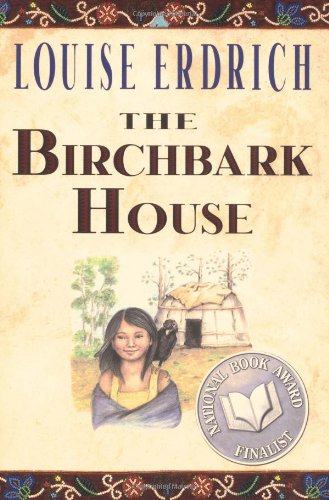
Earlier this week, I wrote about a piece in The New York Times that asked columnists to consider which books they read over and over again. There are many books I’ve reread, but one of the best by far is The Birchbark House (Hyperion, 1999), Louise
Erdrich’s middle grade novel about Omakayas, a young Ojibwa girl, and her family. Erdrich’s depiction of their life on the shores of Lake Superior in the mid-1800s, which was a National Book Award finalist, offers readers a window into a culture that has essentially disappeared.
When I taught third grade, I read The Birchbark House to my students every year. But it’s been almost ten years since the last time I read this book. This week, I revisited Erdrich’s lyrical prose and “found” this poem in the final chapter, “Full Circle.”
Although spring, with all the force of tender new buds,
opening magically,
touched her heart,
there would always be
a shadow to her laughter.
The ground harbored sunshine, spread warmth beneath their feet.
Omakayas felt the calm sweetness of the earth
and tears burned.
Where was Newoo?
She missed him.
There were birds, little birds with white throats,
sweet spring cries.
“I remember their song; their song was my comfort,
my lullaby.”
Piercing spring music. White throated sparrows
calling out to one another.
Their delicate song surrounded her, running in waves through the leafless trees.
Omakayas heard something new in their voices. She heard Newoo.
She smiled, as the song of the white-throated sparrow
sank again and again through the air
like a shining needle,
and sewed up her broken heart.
You can learn more about The Birchbark Househere, and find out more about found poetry here.
Please be sure to visit Laura Shovan at Author Amok for the Poetry Friday Round Up.
Thank you to Stacey, Tara, Dana, Betsy, Anna, and Beth for this space for teachers and others to share their stories each day during the month of March and on Tuesdays throughout the year. Be sure to visit Two Writing Teachers to read more Slice of Life posts.
My role as literacy specialist encompasses three main responsibilities. I work with teachers to develop and refine curriculum and instruction, conduct model lessons in classrooms, and work with tier 3 readers in grades K-3. I love everything about my job, but the best part by far is working with tier 3 students. They work hard and will try their best, even if I’ve overshot what I think they can accomplish. I am in awe of them.
On Monday, one of my first grade students had a breakthrough moment. She has been struggling with learning short vowel sounds, so we’ve been practicing them. A lot. The word work portion of our session involved a mixed short vowel sort. She was doing a great job stretching out each sound, then blending them back into the whole word.
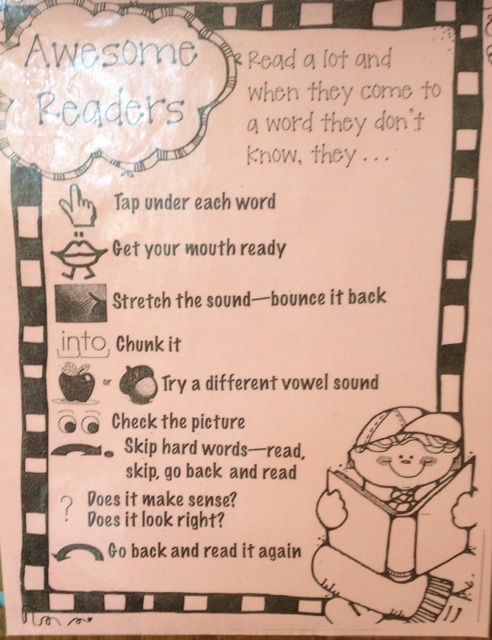
Then she came to the word “snug.” She covered up the -ug chunk, read sn, covered up the sn and read -ug. Then, with the confidence of a Hollywood star, she read “snug.” Hurrah! But she wasn’t finished. She turned to the “Awesome Readers…” chart right next toher, pointed to the “Chunk it” strategy, and proceeded to explain to me what she had just done and why it was better than stretching out each sound in the word!
To say that I was thrilled is an understatement. These kind of spontaneous metacognitive moments don’t happen every day. I praised her for using the strategy and the chart. I told her how proud I was of her for working so hard and for thinking about the strategies I’ve been teaching her. She was beaming!
I was never a cheerleader, but sometimes I feel like one as I work with my students. Of course I teach and model strategies for decoding and comprehension, but I also encourage students when they’re frustrated. I coach them through the hard parts. I celebrate their successes.
In her book Mindset: The New Psychology of Success, (Random House, 2007), Carol Dweck tells us “the view you adopt for yourself profoundly affects the way you lead your life.” In other words, my celebration and acknowledgement of my students’ hard work may be more important than the decoding skills they’re learning. For it is through this acknowledgement and celebration that they begin to see themselves as capable and confident. They begin to see themselves as readers.
Thank you to Stacey, Tara, Dana, Betsy, Anna, and Beth for this space for teachers and others to share their stories each day during the month of March and on Tuesdays throughout the year. Be sure to visit Two Writing Teachers to read more Slice of Life posts.
One of my favorite features of The New York Times Book Review is the “Bookends” column. Every week, two authors (from a group 15 journalists and novelists) “take on questions about the world of books.” These questions are varied and wide-ranging. Recent columns have addressed everything from “Why Do We Hate Cliché?” to “Does Fiction Have the Power to Sway Politics?” I’ve been thinking about this week’s question, “which books do you read over and over again?” since I finished reading the column.
I was not a voracious reader as a kid. I did read and love Charlotte’s Web and James and the Giant Peach, and I’m sure I reread them. But I don’t remember reading them to the point where I had passages memorized or the books fell apart. Columnist Dana Stevens clarifies this distinction in her response to “which books do you read over and over again?” when she says “there’s rereading a book, and then there’s inhabiting it as an alternate reality…”
This is where the power of reading lies. It’s through this habitation that we truly begin to, as Dorothy Barnhouse and Vicki Vinton suggest in their book What Readers Really Do, “think about how those lessons and ideas might impact and inform our own lives.” (p.183) While we do have these kind of transformational encounters with books as adults, it is the books we read as children that often have the largest impact on our lives.
But I don’t think this kind of habitation necessarily happens without help. Many kids do find that life-changing book on their own, but more often, they need our help and guidance. In order to help with this, we need to know books and our students. We need to foster the kind of interactions with books that, as Dorothy and Vicki also state, “gives us an opportunity to give voice to the way that text let us feel validated and less alone. And naming that for children allows them to go forth with more awareness of the role books can play in their lives.” (p. 180)
The list of books with the power to change lives is as long and varied as children themselves. But there are a number of books that turn up again and again on lists of transformational books. I would include anything by Kate DiCamillo on such a list, although The Tale of Despereaux and The Illuminated Adventures of Flora and Ulysses are my favorites. Pam Muñoz Ryan, Christopher Paul Curtis, Sharon Creech, and Jack Gantos all have written books that have the power to change young readers lives. And this year’s Newbery Medal winner,The Crossover, by Kwame Alexander is the latest wonderful addition to this list.
In her Newbery Acceptance speech for The Illuminated Adventures of Flora and Ulysses, Kate DiCamillo explained that everyone involved in making books for children has “been given the sacred task of making hearts large through story. We are working to make hearts that are capable of containing much joy and much sorrow, hearts capacious enough to contain the complexities and mysteries and contradictions of ourselves and of each other. We are working to make hearts that know how to love this world.”
Books that do that are books worth rereading.
Thank you to Stacey, Tara, Dana, Betsy, Anna, and Beth for this space for teachers and others to share their stories each day during the month of March and on Tuesdays throughout the year. Be sure to visit Two Writing Teachers to read more Slice of Life posts.
I love the feeling of possibilities on Saturday mornings. The whole weekend is ahead with time for tasks I didn’t get to during the week. There’s also time for reading. Like many of you, I’m always reading at least 3 or 4 books. Also like many of you, I’m always interested in what others are reading. Here is a quick picture of what I plan to read this weekend.
A Brain Pickings column I’ve been wanting to read.Poems from the Poetry Friday Round Up at Robyn Campbell’s website.Your slices!
Happy reading, everyone!
Thank you to Stacey, Tara, Dana, Betsy, Anna, and Beth for this space for teachers and others to share their stories each day during the month of March and on Tuesdays throughout the year. Be sure to visit Two Writing Teachers to read more Slice of Life posts.
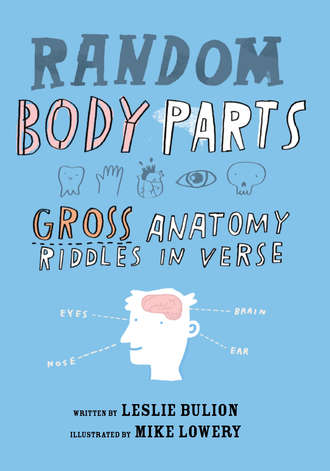
Today is an exciting day here at Reading to the Core! I’m so happy to welcome poet Leslie Bulion to talk about her third collection of nonfiction poetry, Random Body Parts: Gross Anatomy Riddles in Verse (Peachtree, 2015). Leslie is also the author of At the Sea Floor Cafe: Odd Ocean Critter Poems and Hey There, Stink Bug!, as well as four books of fiction. You can read about all of Leslie’s work on her website.
The words “gross” and “riddles” in the title of this collection will automatically lure readers who wouldn’t ordinarily pick up poetry. In the opening poem, Leslie invites readers to “Riddle Me This:”
“Of course you have a body,
But do you have a clue,
Where all the body parts you’ve got are found
And what they do?”
Leslie delivers on her promise of grossness. In “Lunchtime,” kids will learn which body part has “Mucus [oozing] from deep inside” and which makes “gobs of mucus disgusty.” (“The Gatekeeper”) Leslie’s poems are full of humor, and allusions to Shakespeare’s plays are woven into every poem. Side notes include the kinds of fascinating facts kids love. For example, didyou know your kidneys are the size of a gerbil?
Mike Lowery’s appealing illustrations blend cartoon-like drawings with photos and antique anatomical prints. Leslie included a glossary, as well as notes about the poetic forms used and the Shakespearean references. There is also a list of resources for further investigation.
Without further ado, welcome, Leslie!
Thanks so much for inviting me to your blog, Catherine!
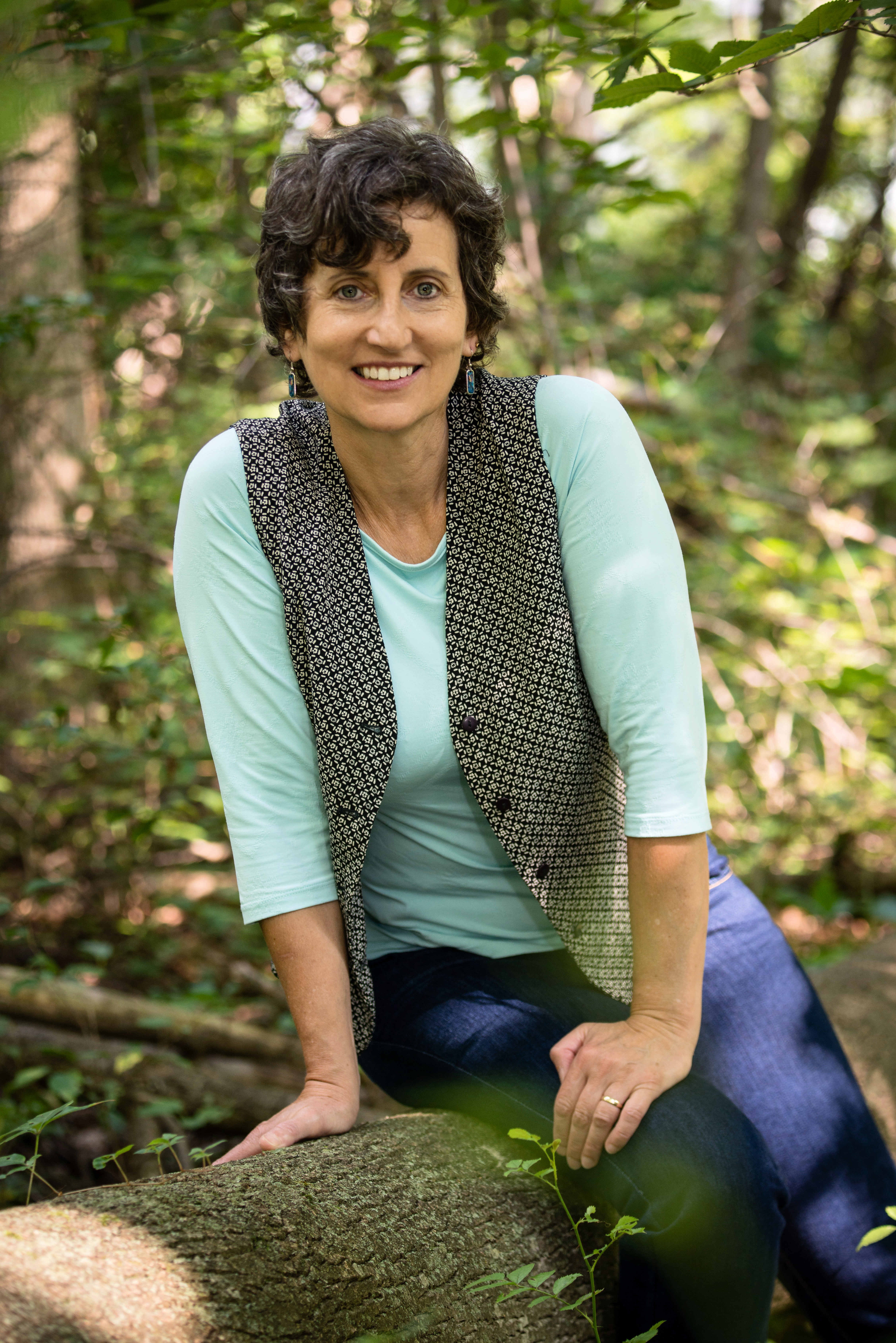
Photo by Jen Schulten
I’m always interested to learn where authors get their ideas. What made you decide to write a poetry collection about anatomy?
A week of summer entomology camp for grown-ups sparked my science poetry journey as I thought about pairing two wonderful things that come in small packages: hundreds of millions of years of evolution packed into a critter the size of a beetle, and a poem’s elegant arrangement of words and ideas. From HEY THERE, STINK BUG, the next obvious stop for me was AT THE SEA FLOOR CAFE: ODD OCEAN CRITTER POEMS, since I have a graduate background in oceanography. I always mine my subjects for their full grossness potential, so moving on to body parts was–well–a no-brainer.
One aspect I love about the collection is that each poem contains an allusion to one Shakespeare. Why?
In my collections, I am always working from what I call my “big idea.” In RANDOM BODY PARTS, the big idea is riddles, since the subject matter is fairly familiar. I am carefully selective about the forms of poetry I use for each individual subject. One obvious place to start this collection was with a sonnet about the heart. I chose Shakespeare’s Sonnet #18 as my mentor text. Fun! I decided to keep playing with Shakespeare’s words and moved on to “Grumble, grumble, roil and rumble” inspired by the witches’ speech in Macbeth. Shakespeare’s rich words and phrases are part of our English lexicon and will be enjoyed over and over again during the lifetime of any reader–it’s never too early to start sampling the banquet!
Can you describe the process you used to research these poems?
I read GRAY’S ANATOMY and other reference books, used many excellent online sources, and my favorite: I watched the UC Berkeley online “General Human Anatomy” lectures given by the inimitable Dr. Marian Diamond (here’s a link to a NYTimes article about the class http://www.nytimes.com/2010/04/18/education/edlife/18anatomy-t.html?_r=0 ). Back to school! YAY! I reread Shakespeare, and read many recent reference books about Shakespeare’s language, and combed through lists of quotations, revisiting the original sources when something caught my eye.
I became a dedicated list-maker: lists of disembodied parts, lists of favorite Shakespeare lines, phrases and his wealth of invented words, lists of poetic forms I wanted to include. Then I played the match game. Some of the Shakespeare references are more obscure than others–the process was a challenge!
What advice can you give to teachers and students who are inspired to use Random Body parts as a mentor text and write their own collection of nonfiction poems?
In all of my collections, I try to include a range of poetic forms. Some forms are simpler and some are more complex. They all use some sense of rhyme and/or rhythm, and those aspects touch on math and music as well as language. This may seem counter-intuitive, but paring a body of science research down to a coherent and elegantly brief poem is a wonderful way for students to seek and demonstrate an integrated understanding of their subject matter. Rather than listing “facts,” I suggest finding the juicy nugget of story you’d like to communicate about your particular subject. What is the most interesting thing you’ve learned in your research? What was surprising? What connections have you made? Those are the ideas that give science poems their shape. I love the readers’ theater possibilities with poetry, and especially with poems for two (or more) voices. Also, writing and solving riddles taps all kinds of other skills, and provides many classroom possibilities for learning fun. On the illustration side of things, I think the book’s multi-layered design and Mike Lowery’s illustrations provide endless mentor art possibilities–so accessible, fun, and visually literate!
Who are your poetic influences? Favorite poets?
There are so many wonderful poets writing now that I’m going to limit my answer to the poets who set me on this path from my childhood (thought I didn’t know it at the time): A.A. Milne and Theodor Geisel, aka Dr. Seuss.
You say on your blog that even though you wrote poetry when you were younger, you didn’t always want to be a writer. What finally helped you decide to become a writer?
My friend Pam told me to. That’s the real answer. She is a writer and editor and has been my friend since I was 12. Well into adulthood I wrote her a long letter about making choices as a parent, and she asked me to write for the magazine PARENTS. Somewhere along the way I told her a story about something that happened to one of my daughters and she said, “That would make a good children’s story.” I’ve never looked back since.
Leslie, thank you so much for taking the time to answer my questions! I know teachers will be happy to include this collection in their health/anatomy units.
It is absolutely my pleasure, Catherine. I am so excited to add this new collection to my body of work!
Thank you to Stacey, Tara, Dana, Betsy, Anna, and Beth for this space for teachers and others to share their stories each day during the month of March and on Tuesdays throughout the year. Be sure to visit Two Writing Teachers to read more Slice of Life posts.
Today I’m also joining Alyson Beecher of Kit Lit Frenzy and other bloggers who feature nonfiction picture books each Wednesday. Thank you, Alyson, for this round up of terrific new nonfiction!
The word challenge is a appropriate on so many levels for this Slice of Life Challenge! How do I make the time to write everyday? How to read all the terrific posts being shared? How do I come up with an idea of what to write about Every. Single. Day.
It’s not that I don’t have ideas. It’s that they don’t always cooperate, or I don’t have the time I need to develop them. So what to do on those days?
A few months ago, I received an intriguing postcard advertising Rip the Page! Adventures in Creative Writing (Roost Books, 2010) by Karen Benke. The jacket copy goes on to say that the book “Includes wordplay, open-ended writing experiments, encouragement from writers and poets, and enough blank pages to let your words roam…” I ordered it immediately.
To say that this book is full of inspiration is an understatement. I could open up to any random page and have a topic to write about in under a minute. Today’s slice is courtesy “Favorite Words,” a page with sixty random words. Benke describes this as “a list of some of my favorite words to snack on.” I chose the word “honeysuckle,” which unleashed this:
By Aftabbanoori (Own work) [CC BY-SA 3.0 (http://creativecommons.org/licenses/by-sa/3.0)%5D, via Wikimedia CommonsThe potential of this book for classroom use is endless. I can’t wait to see what my students come up with based on their favorite words!
Thank you to Stacey, Tara, Dana, Betsy, Anna, and Beth for this space for teachers and others to share their stories each day during the month of March and on Tuesdays throughout the year. Be sure to visit Two Writing Teachers to read more Slice of Life posts.
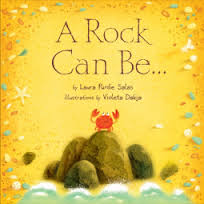
Yesterday, I wrote about the ripples created by sending blog posts out into the world. This is true of tweets, too. One of the connections I made last year thanks to blogging and tweeting was meeting Laura Purdie Salas. Laura is a prolific poet, and her new book A Rock Can Be… (Millbrook Press) was published yesterday! Congratulations, Laura!A Rock Can Be… is a companion book to Water Can Be… and A Leaf Can Be… All three of these books are gorgeously illustrated by Violeta Dabija.
“A rock is a rock, our Earth in your hand.”
In A Rock Can Be…, Laura turns her attention to an object that, at first glance, may seem mundane, even a little boring. But, look with Laura through her poet’s eye, and rocks turn into objects of beauty, useful tools, and more. Laura’s rhyming text is full of scientific truths (“lava flow-er” and “desert dune”) as well as whimsy (“lake skimmer” and “hopscotch marker”). Dabija’s inviting illustrations make you want to jump in and join the fun. A Rock Can Be… will inspire children to look at rocks in a new and creative ways.
Paragraphs giving factual information about each use of rocks mentioned throughout the book is included. There is also a glossary and a short list or resources for further reading.
Teachers, librarians, and others who spend time with kids in Kindergarten through second or third grade will want all of these beautiful books for their collections. Each will encourage students to, in the words of Naomi Shihab Nye, pay “attention to the world.”
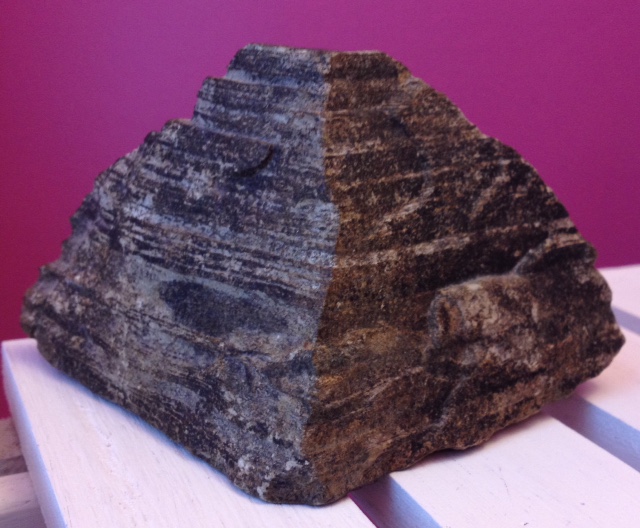
A rock can be…a pyramid! I found this rock on the shore of Beddington Lake in Maine.
Thank you to Stacey, Tara, Dana, Betsy, Anna, and Beth for this space for teachers and others to share their stories each day during the month of March and on Tuesdays throughout the year. Be sure to visit Two Writing Teachers to read more Slice of Life posts.
At Sherman School, we make March a month-long celebration of reading. We always pay homage to Dr. Seuss on March 2nd by reading old favorites such as Green Eggs and Ham and The Cat in the Hat. But we also use this day to launch a month-long theme related to reading. What better way to celebrate Read Across America than by doing just that…reading about each of the 50 states.
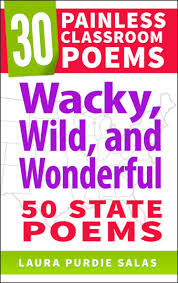
This year we’re incorporating Laura Purdie Salas’s new book, Wacky, Wild, and Wonderful: 50 State Poems, into the festivities! This wonderful collection of poems is as diverse as the country it celebrates. There are poems about geography, geology, and weather. There are poems about ecosystems, food chains, and history. In short, there is something for everyone in Wacky, Wild, and Wonderful: 50 State Poems.
Each class will choose a poem that supports a topic they have been studying. For example, second grade might choose “Wisconsin: Catch!” This poem, about a bald eagle’s swooping down to the water of the Mississippi to catch a fish, is a natural for their study of food chains. Students could illustrate Laura’s poem or use this as a mentor for their own food chain poem. The form, cinquain, is very accessible for second graders.
To share their learning with the rest of the school, each class will decorate their classroom door to highlight their study of Laura’s poem and how its related curricular topic. I can’t wait to see what each class comes up with. The possibilities are limitless. Best of all, the classes that create the best doors will Skype with Laura later this spring.
I’m really excited to be pairing Laura’s poems with Read Across America, and will be posting photos of the doors and the kids’ work throughout the month here and on Twitter.
Laura also shared our plans on her blog today. Please pay her a visit to learn more about Wacky, Wild, and Wonderful: 50 State Poems and the other poetry collections in Laura’s “30 Painless Classroom Poems” series.
Thank you to Stacey, Tara, Dana, Betsy, Anna, and Beth for this space for teachers and others to share their stories each Tuesday. Be sure to visit Two Writing Teachers to read more Slice of Life posts.







![By Aftabbanoori (Own work) [CC BY-SA 3.0 (http://creativecommons.org/licenses/by-sa/3.0)], via Wikimedia Commons](https://readingtothecore.com/wp-content/uploads/2015/03/honeysuckle-2.jpg)
 Reading to the Core