Slice of Life: A Weekend in Boston

                                          11454297503_e27946e4ff_h         f36176a2c4703110251c9b8c27654e22

My mind and heart are overflowing with all the passion, knowledge, and energy that was shared by the colleagues I was fortunate enough to learn with and from at the International Literacy Association Conference in Boston. I’ll be reading, digesting and thinking about the sessions for weeks to come. But while the experience is still fresh in my mind, I want to share some key take aways.

“We all have a life worth writing about.” Adora Svitak

“Give your students a little piece of sky; help them soar.” Kwame Alexander

“We get better by doing the best we can” Mark Overmeyer

“Invite students to live writerly lives.” Paula Bourque

“Play opened avenues in my brain that I didn’t know existed.” Jennifer Jacobsen

“Look for the surprises in your writing…that’s where the gold of the story is hiding.” Cynthia Lord

“Let kids know our passion for reading” Penny Kittle & Kelly Gallagher

“Books provide imaginative rehearsals for the real world.” Kelly Gallagher

“Let kids know that “what they have to say matters.” Linda Rief

“We want kids to be responsive to the characters & themselves” Bob Probst

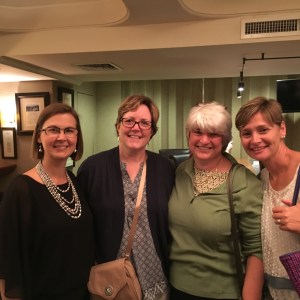
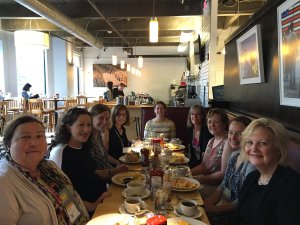
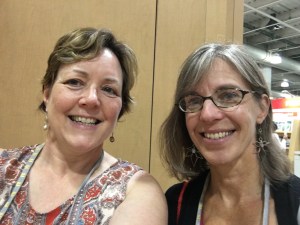
My weekend in Boston was also filled with seeing old friends and meeting online friends in real life.

IMG_0522
With Colette Bennett, Jan Burkins, and Kim Yaris.
CnAb31AWEAAztcN
Slicer Breakfast at the Trident Cafe.
So happy to meet Molly Hogan in real life!
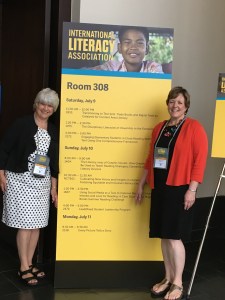
With Colette Bennett before our presentation.

If you’ve never attended a national conference, it’s an experience you’ll never forget. Thank you, ILA, for a wonderful weekend!

Thank you to StaceyDanaBetsyBeth, KathleenDeb, Melanie, and Lisa for this space for teachers and others to share their stories each Tuesday. Be sure to visit Two Writing Teachers to read more Slice of Life posts.

Poetry Friday: Slipping into Summer Mode

poetry-friday-1-1

Summer. Thoughts turn to mornings of clearing away the clutter of a busy school year and lazy afternoons with a book, days at the beach, adventures near and far. But most of all, TIME to write! It’s been a slow transition for me this year, though, as I’ve been writing curriculum and taking care of other work obligations that seem to have no end. I’ve been de-cluttering like mad, but my writing has come in fits and starts and feels stale and stilted. The best remedy for this? Read poetry, of course!

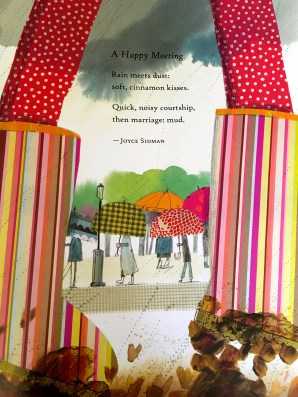
So I revisited one of my favorite anthologies from the past few years, Firefly July (Candlewick Press, 2014). This entire collection, selected by Paul B. Janeczko and brilliantly illustrated by Melissa Sweet, radiates joy. On every page, poets surprise and delight with perfect images and metaphors. “A Happy Meeting”, by Joyce Sidman, is just one example.

IMG_0476

Joyce’s poetry always gives me a jump start, and I remembered she has a new book coming out, so I went searching for more about that. As you may know, Before Morning, with illustrations by Beth Krommes, will be published by Houghton Mifflin Harcourt in the fall. And although I didn’t find too much about that book, I did find this interview, from 2010, with Julie Danielson at Seven Impossible Things Before Breakfast.

At the very bottom of the page, this treasure is waiting:

“How to Find a Poem”
by Joyce Sidman

Wake with a dream-filled head.
Stumble out into the morning,
barely aware of how the sun
is laying down strips of silver
after three days’ rain,
of how the puddles
are singing with green.

Read the rest of the poem here.

Wishing you all sweet, dream-filled summer days! Please be sure to visit Tabatha Yeatts at The Opposite of Indifference for the Poetry Friday Roundup.

Poetry Friday: “Stanzas for a Sierra Morning”

poetry-friday-1-1

Sometimes when we read a poem there’s an instant connection between us and the poet. Someone we’ve never met, maybe even never heard of, has managed a magical transformation of words into phrases into stanzas that reach into our heart, like the first rays of sunlight bathing the tips of tree branches in its yellow glow. In that moment we know we’ve found a treasure worth keeping.

In her poem “Wish”, Linda Sue Park captures this process perfectly:

Wish
by Linda Sue Park

For someone to read a poem
again, and again, and then,

having lifted it from page
to brain– the easy part—

cradle it on the longer trek
from brain all the way to heart.

From Tap Dancing on the Roof; Sijo Poems (Clarion, 2007) 

Not every poem we read, and certainly not every poem we write, makes that journey. And yet, we soldier on. We keep reading, we keep writing, because, as Katherine Bomer reminds us, “the journey is everything.”

When I first read this poem by Robert Haas, I knew I’d found a treasure that made that journey.

“Stanzas for a Sierra Morning”
by Robert Haas

Looking for wildflowers, the white yarrow
With its deep roots for this dry place
And fireweed which likes disturbed ground.

There were lots of them, bright white yarrow
And the fireweed was the brilliant magenta
Some women put on their lips for summer evenings.

The water of the creek ran clear over creekstones
And a pair of dove-white plovers fished the rills
A sandbar made in one of the turnings of the creek.

You couldn’t have bought the sky’s blue.

Read the rest of the poem here.

Photo by Sam Schooler via unsplash.com

Please be sure to visit Diane Mayr at Random Noodling for the Poetry Friday Roundup.

Slice of Life: Meeting Goals

11454297503_e27946e4ff_h

“Not everything that counts can be counted, and not everything that can be counted counts.”
Albert Einstein

After hours of collecting and analyzing data, looking for reading behaviors used or not, identifying vowel patterns known and unknown, after hours of planning lessons, carefully choosing books and poems to support student needs AND spark their interest, after hours of instruction, coaching and supporting strategies or sounds they’re using but confusing, after phone calls and parent meetings about how students are or aren’t progressing, we’ve arrived at the last week of school, and the last lessons with my students for this year.

And the question on everyone’s mind? Did they meet the goal? Not did they meet their personal goal, but did they meet the goal for first grade? In the case of the students I work with, intervention students who came into first grade below the grade level goal, the answer is no.

And yet, they have made tremendous personal progress. They are all confident readers. They read books at their independent level fluently and with expression. They understand what they’ve read and have ideas about why characters act the way they do. They read nonfiction with curiosity and enthusiasm.

Do I feel like I have failed these students? Yes and no. I know their classroom teacher and I did everything we could to support their progress. I know they worked hard when they were with me and made incremental gains on most days. But teachers are always second-guessing themselves. We feel like there must be something else we could have done. But very often, our best truly is enough. These five- and six-year olds just need more time to learn those diphthongs and -r controlled vowels. They need more time to remember to try a different vowel sound if they one they used doesn’t make sense.

I’m willing to give them that time, as long as they’re making progress along the way AND they are falling in love with reading. If both of those things aren’t happening, then something needs to change. If the teaching techniques I’ve been using aren’t meeting their needs, then it’s my responsibility to find a new strategy or technique that does meet their needs. Have I done this? Yes. So back to the original question: Did these students meet the goal?

In my mind, yes. They are readers who can problem-solve to read unknown words, they make meaning from the texts they read, and most importantly, they enjoy reading and are proud of their accomplishments. And isn’t that our goal for all our students?

Thank you to StaceyDanaBetsyBeth, KathleenDeb, Melanie, and Lisa for this space for teachers and others to share their stories each Tuesday. Be sure to visit Two Writing Teachers to read more Slice of Life posts.

The Perspective of Others: Salt to the Sea

slide11

This post is part of “DigiLit Sunday,” hosted by Margaret Simon at Reflections on the Teche. This week’s topic is PERSPECTIVE.

“Sympathy as a desirable quality is something more than mere feeling;
it is the cultivated imagination for what men have in common and a rebellion at whatever unnecessarily divides them.”
~ Thomas Dewey ~

It’s often said that history is written by the victors. This implies, of course, that only one side of a story gets told. What happens to the stories of the vanquished? Isn’t their perspective of events just as valuable? What truths are hidden within the stories that don’t get told?

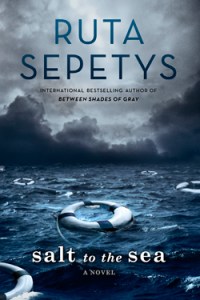
In Salt to the Sea (Philomel Books, 2016), Ruta Sepetys tells the “hidden history” of the sinking of the Wilhelm Gustloff  by a Soviet submarine in January of 1945. An estimated 9,000 people lost their lives in the icy waters of the Baltic Sea as a result. By giving voice to four teens fleeing East Prussia at the end of World War II, Sepetys masterfully weaves the story of the Wilhelm Gustloff together with their stories.

25614492

Three of the four narrators, Joana, Florian, and Emelia, tells the story their journey toward safety from their perspective. The fourth narrator, Alfred, is a German sailor aboard theWilhelm Gustloff.  Each chapter reveals a bit of the character’s history. But the bigger picture also begins to come into focus. The brutality of the Soviet Army as it advanced toward Germany. The selfishness of the Nazi leadership and their pernicious xenophobia. The sacrifices ordinary people from every country made for those they loved.

The tapestry that emerges gives readers a much deeper understanding of the events than any one of the narrators would have created individually. It also builds our sympathy for each of the narrators and their traveling companions.  As we get to know them, we realize that each of them carries a secret that haunts them. Just like every other human on the planet.

On this Memorial Day weekend, let’s resolve to find and share these untold stories with our students. It seems to me that the political hyperbole in the U.S. today makes it even more urgent that stories like Salt to the Sea be shared. These are stories that will broaden our perspective, and help us develop the imagination needed to see something of ourselves in the stories of others.

Listen to Ruta Sepetys discuss Salt to the Sea on NPR’s Morning Edition here.

Poetry Friday: “A Flower-Piece by Fantin”

poetry-friday-1-1

Maybe it’s because I recently spent a day at the Metropolitan Museum of Art, soaking in the beauty of two millennia worth of collected treasures. Or maybe it’s because of Laura Shovan’s ditty challenge to write a persona poem. Whatever the reason, I’ve been thinking about art a lot lately. But because of the nature of teaching, life hasn’t allowed me more than snatches of stolen time to write.

I’ve also been reading in those stolen moments, and found this lovely little poem in Art and Artists: Poems (edited by Emily Fragos; Everyman’s Library Pocket Poems).

“A Flower-Piece by Fantin”
by Algernon Charles Swinburne

Heart’s ease or pansy, pleasure or thought,
Which would the picture give us of these?
Surely the heart that conceived it sought
Heart’s ease.

Surely be glad and divine degrees
The heart impelling the hand that wrought
Wrought comfort here for a soul’s disease.

Deep flowers, with lustre and darkness fraught,
From glass that gleams as the chill still seas
Lean and lend for a heart distraught
Heart’s ease.

Henri Fantin-Latour [Public domain], via Wikimedia Commons
Please be sure to visit Margaret at Reflections on the Teche for the Poetry Friday Roundup.

Making Plans for Summer Reading

slide11

This post is part of “DigiLit Sunday,” hosted by Margaret Simon at Reflections on the Teche. This week’s topic is REFRESH.

By Winslow Homer (Memphis Brooks Museum of Art) [Public domain], via Wikimedia Commons

Teachers often have a long list of projects they want to work on, both personal and professional, that we’ve either put off or just haven’t had time for during the school year. And while I love finishing these tasks and the sense of accomplishment they bring, I don’t really find them refreshing. For me, being refreshed means having time to enjoy long, lazy afternoons reading and dozing.

Making plans for summer reading is one of my favorite activities. In January, I talked with fifth grade students about Reading Resolutions. This is the perfect time to revisit those resolutions, and, if necessary, make some new ones. I finished the Very Famous Children’s book back in February. Lately I’ve been thinking about Virginia Wolf’s To the Lighthouse. This is a book that has intimidated me as an adult, and I feel now’s the time to give it another try.

I have a long list of professional books I’m planning to read this summer. These books are currently at the top of the stack:

I’m also planning on getting caught up on journal articles I haven’t had a chance to read.

I’ll also be reading many picture books and middle grade novels, but I don’t have a specific list. I would love to get my hands on an ARC of Melissa Sweet’s upcoming book about E.B. White. (Hint, hint, ARC gods!) Louise Erdrich is one of my favorite authors, both for children and adults, and she has two new books out this year. Makoons is the fifth book in the series that began with The Birchbark House, one of my all-time favorites, so I’m excited to read this book, too.

There are many books on my shelves that I haven’t read, and sometimes I’ll just browse and see what strikes my fancy. I also like to visit the library and find new books there.

FullSizeRender-1
Last year’s shelfie.

Having plans for summer reading is great, but discovering new books along the way and having time to read them is another reason summer reading is such a gift. What are your summer reading plans?

Slice of Life: PD in My PJs

11454297503_e27946e4ff_h

“I have no special talents, I am only passionately curious”
~ Albert Einstein ~

Last Saturday, I took advantage of a great day of professional development available FREE and ONLINE. The Educator’s Collaborative, founded by Chris Lehman, sponsored a day full of inspiration for educators. More than forty educators and writers were on hand to share their ideas and insights. During her presentation, Linda Hoyt talked about ways to help kids see how ideas go together, to see the relationships between seemingly diverse topics. Over the course of the day, it was hard to miss the relationship between all the sessions. The ideas delivered by so many wise presenters went together like pieces of a giant jigsaw puzzle, and the finished puzzle spelled out: STUDENT ENGAGEMENT = STUDENT LEARNING

In one way or another, each session I watched stressed the importance of inspiring our students, sparking their curiosity, and encouraging them to ask questions. These steps will lead them to make new discoveries, discoveries about the world around them, but more importantly, discoveries about themselves. These discoveries, in turn, will help them dream and discover their passions.

It would be impossible to choose the best session, or the most inspiring idea, for they were all fantastic and full of inspiring ideas. I did love that all the presenters shared the research base and philosophy behind their ideas, then provided practical strategies that we could infuse into our lessons on Monday.

You really should just stop reading and go to The Educator’s Collaborative website and start watching. But in case you’re not convinced yet, here are a few examples of all the wisdom you’ll find there.

Harvey Daniels explained that Curiosity is a better motivator than grit. Working from the positive is always so much better.”

Amy Ludwig VanDerwater reminded us that “Each of has something only we can say” and we should “say it through poetry!”

Rebekah O’Dell and Allison Marchetti gave us ideas for including “notebook time” in our classrooms and explained that this time “is an invitation and a place to play.”

Dr. Mary Howard urged us to build our classroom libraries to ensure that “students have books that will make their hearts sing!”

Linda Hoyt pointed out that we can “ignite a sense of wonder with kids through visuals in nonfiction read-alouds.”

“It’s about generating and creating pathways for thinking. It’s about giving kids new opportunities,” Kristin Ziemke explained.

Maggie Beattie Roberts told us that “tools help us do more, become more, reach dreams we have for ourselves, & make things easier.”

I could keep going, but seriously, just go watch the sessions for yourself. You’ll be so glad you did.

You’ll also find a session I wasn’t able to see because of satellite interference by four of Two Writing Teachers fearless leaders, Stacey Schubitz, Dana Murphy, Betsey Hubbard, and Deb Frazier on “Maximizing Independent Writing Time by Creating Conferring Tool Kits.” I’m looking forward to watching their session later this evening. 

Thank you to StaceyTaraDanaBetsyAnnaBeth, Kathleen, and Deb for this space for teachers and others to share their stories each Tuesday. Be sure to visit Two Writing Teachers to read more Slice of Life posts.

Slice of Life: Poetry Collections I Love

11454297503_e27946e4ff_h

“Poetry reaffirms our common humanity by revealing to us that individuals, everywhere in the world, share the same questions and feelings.”
United Nations website
World Poetry Day announcement

Last week I shared a list of my favorite read-alouds. I realized, though, that there was no poetry on that list! Because poetry is meant to be read aloud, and because National Poetry Month is right around the corner, I decided poetry deserved its own list.

Early in my teaching career, my poetry collection consisted of Shel Silverstein’s Where the Sidewalk Ends, Jack Prelutsky’s The New Kid on the Block, and The Random House Book of Poetry. Thanks to the Scholastic book order, my collection started expanding to include collections by individual poets. My choices tended toward poetry about animals and nature, and Kristine O’Connell George and Marilyn Singer quickly became favorites.

Today my poetry collection takes up two long shelves in my bookcase. Here are a few of my favorites, both old and new.

Edited anthologies with selections by many poets:

Piping Down the Valleys Wild, edited by Nancy Larrick
Read-Aloud Rhymes for the Very Young, edited by Jack Prelutsky
National Geographic Book of Animal Poetry, edited by J. Patrick Lewis
National Geographic Book of Nature Poetry, edited by J. Patrick Lewis
Another Jar of Tiny Stars: Poems by More NCTE Award Winning Poets, edited by Beatrice Cullinan & Deborah Wooten
Knock at a Star: A Child’s Introduction to Poetry, edited by X.J. Kennedy
A Kick in the Head: An Everyday Guide to Poetic Forms, edited by Paul B. Janeczko
The Tree That Time Built: A Celebration of Nature, Science, and Imagination, edited by Mary Ann Hoberman
A Pet for Me: Poems, edited by Lee Bennett Hopkins (any collection edited by Hopkins is a treasure; Don’t miss Renée LaTulippe’s wonderful spotlight on him here.)
Any of the Poetry Friday Anthologies, edited by Sylvia Vardell and Janet Wong

Collections by individual poets:

A Writing Kind of Day, by Ralph Fletcher
Joyful Noise: Poems for Two Voices, by Paul Fleischman
Hailstones and Halibut Bones, by Mary O’Neill
A Stick is an Excellent Thing: Poems Celebrating Outdoor Play, by Marilyn Singer (Marilyn’s collections of reversos are also not to be missed!)
A Maze Me: Poems for Girls, by Naomi Shihab Nye
An Egret’s Day, by Jane Yolen
In the Spin of Things: Poetry of Motion, by Rebecca Kai Dotlich
You Read to Me, I’ll Read to You, by Mary Ann Hoberman (any book in this series)
Everything is a Poem: The Best of J. Patrick Lewis, by J. Patrick Lewis
Handsprings, by Douglas Florian
When the Sun Shines of Antarctica, by Irene Latham

This list just scratches the surface of the multitudes of wonderful poetry collections available from these poets and more. My 2015 Picture Book 10 for 10 post features more of my favorites.

Books for teachers and students about poetry:

Awakening the Heart: Exploring Poetry in Elementary and Middle School, by Georgia Heard
For the Good of the Sun and the Earth: Teaching Poetry, by Georgia Heard
Poetry Matters, by Ralph Fletcher
Seeing the Blue Between: Advice and Inspiration for Young Poets, edited by Paul B. Janeczko
Pass the Poetry, Please!, by Lee Bennett Hopkins 

There are also many websites that feature poets, poetry, and ideas for teaching poetry. A Year of Reading, Mary Lee Hahn and Franki Sibberson’s must-read blog, lists links to the weekly Poetry Friday Roundup. This is a great place to begin learning more about all things poetic.

(Edited to add) Here’s another great resource from Amy Ludwig VanDerwater’s top-notch blog, The Poem Farm: NCTE’s 2016 Notable Poetry List

What are your favorite poetry collections and resources?

 Thank you to StaceyTaraDanaBetsyAnnaBeth, Kathleen, and Deb for this space for teachers and others to share their stories each Tuesday throughout the year and every day during the month of March. Be sure to visit Two Writing Teachers to read more Slice of Life posts.

Slice of Life: Read-Alouds I Love

11454297503_e27946e4ff_h

I think it’s fair to say that I am a teacher today because of a read-aloud. I have written before about the impact of my fourth grade teacher reading Charlotte’s Web to us.

When I was a classroom teacher, reading aloud was non-negotiable. We did it every day. No. Matter. What. Now that I’m not a classroom teacher, sharing wonderful books with kids is still the best part of my day.

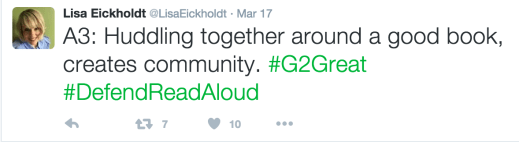
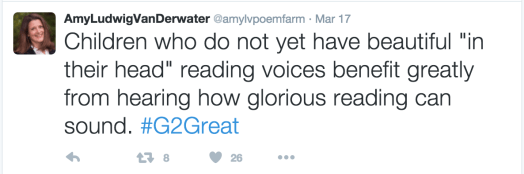
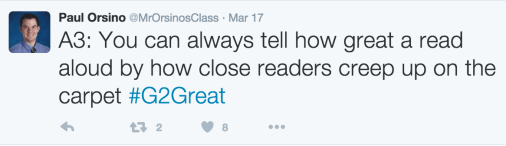
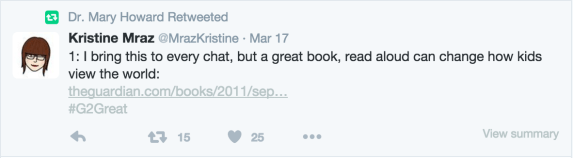
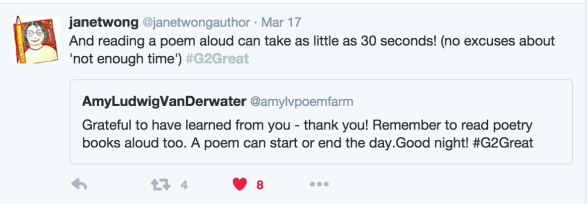
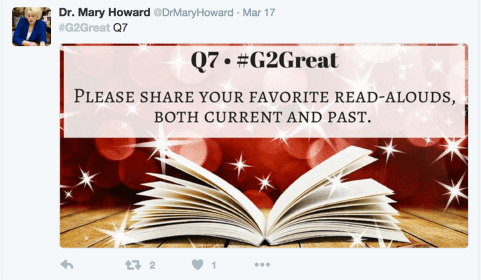
Because I love read-aloud so much, and because I love Dr. Mary Howard’s Thursday night #G2great Twitter chats, I was especially sad to miss last Thursday’s chat with Steven Layne about read-alouds. Scrolling through the archive of the chat, it’s easy to see that an incredible amount of wisdom was shared in one hour. Here are some tweets from the chat that I love:

Screen Shot 2016-03-20 at 7.21.05 AM

Screen Shot 2016-03-20 at 6.27.05 AM

Screen Shot 2016-03-20 at 6.28.11 AM

Screen Shot 2016-03-20 at 6.57.23 AM

Screen Shot 2016-03-20 at 6.36.14 AM

You can (and should!) read the Storify version of this chat here.

This was the last question of the chat:

Screen Shot 2016-03-20 at 6.38.15 AM

Linda Baie answered this question over at her blog, TeacherDance, this morning. I’m stealing Linda’s idea and answering Mary’s question from Thursday’s chat since I’m visiting my son this weekend and haven’t had time to write.

Chapter books my 3rd graders loved:

Charlotte’s Web
The BFG
The Prince of the Pond
The Birchbark House
The Tale of Despereaux
The Search for Delicious
Jeremy Thatcher, Dragon Hatcher
Stone Fox
How Whales Walked into the Sea

Recent chapter books I know kids love:

Home of the Brave
The Fourteenth Goldfish
The One and Only Ivan
Because of Mr. Terupt
Mercy Watson

Favorite picture books:

Knuffle Bunny
Boy + Bot
Brave Irene
Rugby & Rosie
The Old Woman Who Named Things
Farfallina & Marcel
Mrs. Katz & Tush
The Other Dog
The Gruffalo
Goodnight, Gorilla

I could go on all day. What are your favorite read-alouds?

Thank you to StaceyTaraDanaBetsyAnnaBeth, Kathleen, and Deb for this space for teachers and others to share their stories each Tuesday throughout the year and every day during the month of March. Be sure to visit Two Writing Teachers to read more Slice of Life posts.