Slice of Life: Trusting Myself

11454297503_e27946e4ff_h

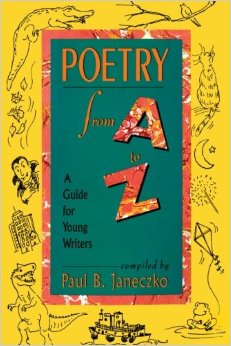
My school is undergoing some renovations this summer and several teachers are moving to new classrooms. Because of this, people were cleaning and weeding like mad during the last few weeks of school. I am not moving, but should have been doing my own weeding. Instead, I couldn’t resist going through other people’s discard piles. Unbelievably, I found a copy of Paul B. Janeczko’s Poetry from A to Z: A Guide for Young Writers (Simon and Schuster, 1994).
51MHmbefxrL._SY344_BO1,204,203,200_

I’ve been savoring this anthology, which includes poems by Valerie Worth, Myra Cohn Livingston, Ralph Fletcher, Eve Merriam, and more. Many poems are accompanied by notes of advice and guidance from the poets themselves. My favorite so far is this piece of wisdom from Georgia Heard:

“I write first drafts with only the good angel on my shoulder, the voice that approves of everything I write. This voice doesn’t ask questions like, ‘Is this good? Is this a poem? Are you a poet?’ I keep that voice at a distance, letting only the good angel whisper to me: ‘Trust yourself.’ You can’t worry a poem into existence.”

This is exactly the encouragement I need as I write the first draft of a poetry project I’ve been working on. School demands have been draining and distracting me for the past few months, so I haven’t gotten too far beyond pages of notes. But now that summer is here, I’ll be at my desk every day with that good angel on my shoulder, trying not to worry, trusting myself.

Thank you to StaceyTaraDanaBetsyAnna, and Beth for this space for teachers and others to share their stories each Tuesday. Be sure to visit Two Writing Teachers to read more Slice of Life posts.
Poetry Friday: From Cocoon Forth a Butterfly

poetry-friday-1-1

Did you know today is Butterfly Day? Emily Dickinson, herself elusive as a butterfly, wrote many poems about these awe-inspiring insects. This is one of my favorites.

From Cocoon Forth a Butterfly (354)
by Emily Dickinson

From Cocoon forth a Butterfly
As Lady from her Door
Emerged—a Summer Afternoon—
Repairing Everywhere—

Without Design—that I could trace
Except to stray abroad
On Miscellaneous Enterprise
The Clovers—understood—

Her pretty Parasol be seen
Contracting in a Field
Where Men made Hay—
Then struggling hard
With an opposing Cloud—

Where Parties—Phantom as Herself—
To Nowhere—seemed to go
In purposeless Circumference—
As ’twere a Tropic Show—

And notwithstanding Bee—that worked—
And Flower—that zealous blew—
This Audience of Idleness
Disdained them, from the Sky—

Till Sundown crept—a steady Tide—
And Men that made the Hay—
And Afternoon—and Butterfly—
Extinguished—in the Sea—

Jan van Kessel the Elder [Public domain], via Wikimedia Commons

Please be sure to visit A Year of Reading, where Mary Lee has the Poetry Friday Roundup.

Poetry Friday: Bells

poetry-friday-1-1

At the beginning of May, Michelle Heidenrich Barnes, of Today’s Little Ditty, posted a lovely interview with Nikki Grimes. At the end of the interview, Grimes challenged readers to write a “wordplay exercise and create your own free verse poem” based on a word chosen from a short list. Be sure to head over to Michelle’s blog to read all of the poems contributed for this challenge.

I’ve been playing with this all month. First I picked lemon, but wasn’t happy with the results. Once I started thinking about bell, the possibilities and references in popular culture seemed endless. If I had more time, I think it would be fun to create a found poem just from lines in songs and movies. Here is my current draft:

Bell is a heralding word—
Whether pealing in joy
or tolling in grief;
clanging on trains
or ding-donging on doors,
a bell says, “Listen to me!”

Bells are blue in the garden
and silver on sleighs.
Bells of brass
sound on ships at sea.

Bells wake us each morn,
they urge us to flee;
they can jangle our nerves
or proclaim angels’ new wings.

Once the town crier,
now they ping on our phones.
Whatever song they send
through the sky,
Bells cry out “Listen to me!”

© Catherine Flynn, 2015

Please be sure to visit Margaret Simon at Reflections on the Teche for the Poetry Friday Round Up.

Poetry Friday: Emily Dickinson’s “The Grass so little has to do–“

poetry-friday-1-1

The Grass so little has to do–
A sphere of simple Green
With only Butterflies to brood
And Bees to entertain–

And stir all day to pretty Tunes
The Breezes fetch along–
And hold the Sunshine in its lap
And bow to everything–

And thread the Dews, all night, like Pearls–
And make itself so fine
A Duchess were too common
For such a noticing–

And even when it dies–to pass
In Odors so divine–
Like Lowly spices, lain to sleep–
Or Spikenards, perishing–

And then, in Sovereign Barns to dwell–
And dream the Days away,
The Grass so little has to do
I wish I were a Hay–

Emily Dickinson

Evelyn Simak , via Wikimedia Commons

Please be sure to visit Diane Mayr at Random Noodling for the Poetry Friday Round Up

Poetry Friday: Spring Blossoms

poetry-friday-1-1

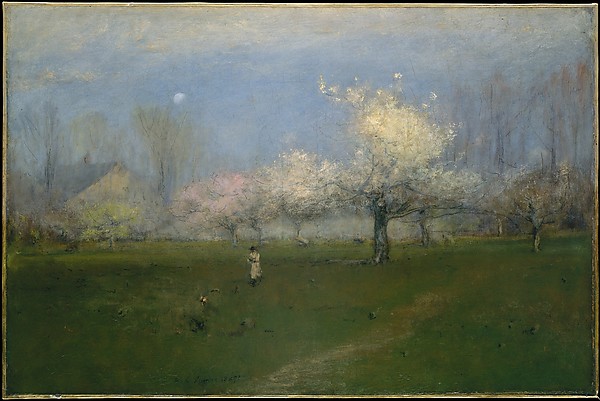
Spring has finally arrived in Connecticut. The weeping cherry trees, magnolias, and apple trees are in full bloom. Their beauty, and this painting by George Inness, inspired today’s poem.

Metropolitan Museum of Art, Gift of George A. Hearn, in memory of Arthur Hoppock Hearn, 1911

After “Spring Blossoms, Montclair, New Jersey” by George Inness, 1891

Beneath a sea of blue,
the orchard has unfurled
a delicate veil
of pink and white,
and the bees are all abuzz.

Under silken petals,
that soon will fall
like snow,
a farmer strides
toward the barn,
ready to tend
the newborn lambs.

© Catherine Flynn, 2015

Please be sure to visit Michelle Heidenrich Barnes at Today’s Little Ditty for the Poetry Friday Round Up.

Poetry Friday: Eileen Spinelli & Another Day As Emily

poetry-friday-1-1

I can’t believe how quickly April flew by. Because today is Friday, I feel like we have a bonus day of National Poetry Month!

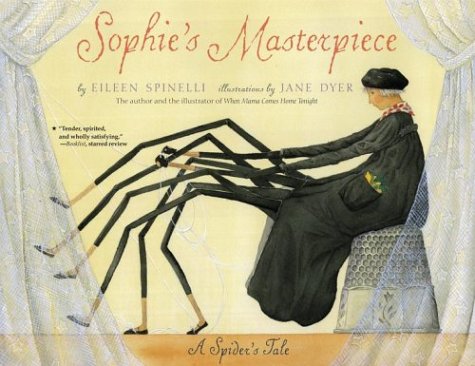
On her webpage, Eileen Spinelli has a list of tips for young writers. Her number one piece of advice? “Keep your eyes and ears and heart open.” There is no doubt that this is what drives Eileen’s writing as well. I first encountered Eileen’s writing in Sophie’s Masterpiece (Simon & Schuster, 2001). Sophie, the heroine of  this tale, is one of the most thoughtful and caring spiders this side of Charlotte. Sophie’s kindness and generosity inspired my third grade students to learn how to knit after 9/11 and, ultimately, create an afghan that we raffled to raise money for charity.

                     51X5BZ62W9L    519wFzxAgWL._SY344_BO1,204,203,200_

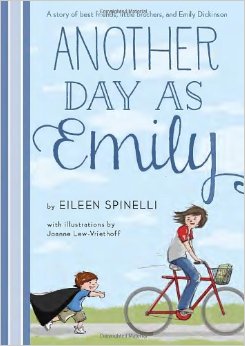
So when I wasn’t surprised when I saw that Eileen and her husband, Jerry Spinelli, would be part of a panel hosted by Janet Wong and Sylvia Vardell titled “Sharing Random Books of Kindness: The Power of Story” at NCTE last November. (Read Eileen’s heartbreaking “Poem for a Bully” in this post by Mary Lee Hahn & Janet Wong about the role of poetry in literacy learning here.) The next day, I waited in line to meet Eileen at a book signing and got a copy of her latest book, Another Day As Emily (Random House, 2014).

I finally found time recently to read this charming verse novel, and I’m so happy I did. Suzy Quinn is almost twelve. She collects rocks and loves the Philadelphia Phillies. She also has a pesky little brother named Parker, who saved their neighbor’s life and is now an official hero. Feeling left out because of all the attention Parker’s getting, Suzy plunges into a project for her library’s summer program and learns all she can about Emily Dickinson. At the same time, Suzy is trying to navigate the challenges of friendship. Overwhelmed when she isn’t chosen for a part in a play and devastated when her birthday trip to a Phillies game is cancelled, she retreats to her room “…to be left alone…Forever. Like Emily Dickinson.” Suzy dresses in white, bakes gingerbread, even renames her goldfish Carlo, after Emily Dickinson’s dog.

Spinelli spins a story full of realistic details about the trials and tribulations of adolescence. Suzy’s family and neighbors remain loving and supportive, even as Suzy pushes the limits of their patience. Eventually, Suzy decides there’s more to life “than being a twelve-year old hermit.” In the process, she discovers that she “missed herself,” even though the self she missed is forever changed.

One of the magical things about books is that they let you try on different personas. Lucky readers of Another Day As Emily get to try on two through the “eyes and ears and heart” of Eileen Spinelli. What a gift!

Here is another gift from the pen of Eileen Spinelli:

“The Month of May”

May is a merry month
a flower-into-berry month,
the month to skip outdoors to play,
to tuck your winter boots away,
to honor moms and aunties too
with cards and hugs for all they do.

Read the rest of the poem here.

Mary Lee at A Reading Year and Ellen at Elementary Dear Reader  have The Poetry Friday Round Up. Be sure to stop by for more poetic gifts.

Slice of Life: April Haiku

11454297503_e27946e4ff_h

A cool morning breeze,
warmed by the bright April sun,
dances with daffodils.

© Catherine Flynn, 2015

http://www.ForestWander.com [CC BY-SA 3.0 us (http://creativecommons.org/licenses/by-sa/3.0/us/deed.en)], via Wikimedia Commons
http://www.ForestWander.com [CC BY-SA 3.0 us (http://creativecommons.org/licenses/by-sa/3.0/us/deed.en)%5D, via Wikimedia Commons

Small-Blue-RGB-National-Poetry-Month-Logo_0

Thank you to StaceyTaraDanaBetsyAnna, and Beth for this space for teachers and others to share their stories each Tuesday. Be sure to visit Two Writing Teachers to read more Slice of Life posts.

Poetry Friday: An Egret’s Day

poetry-friday-1-1

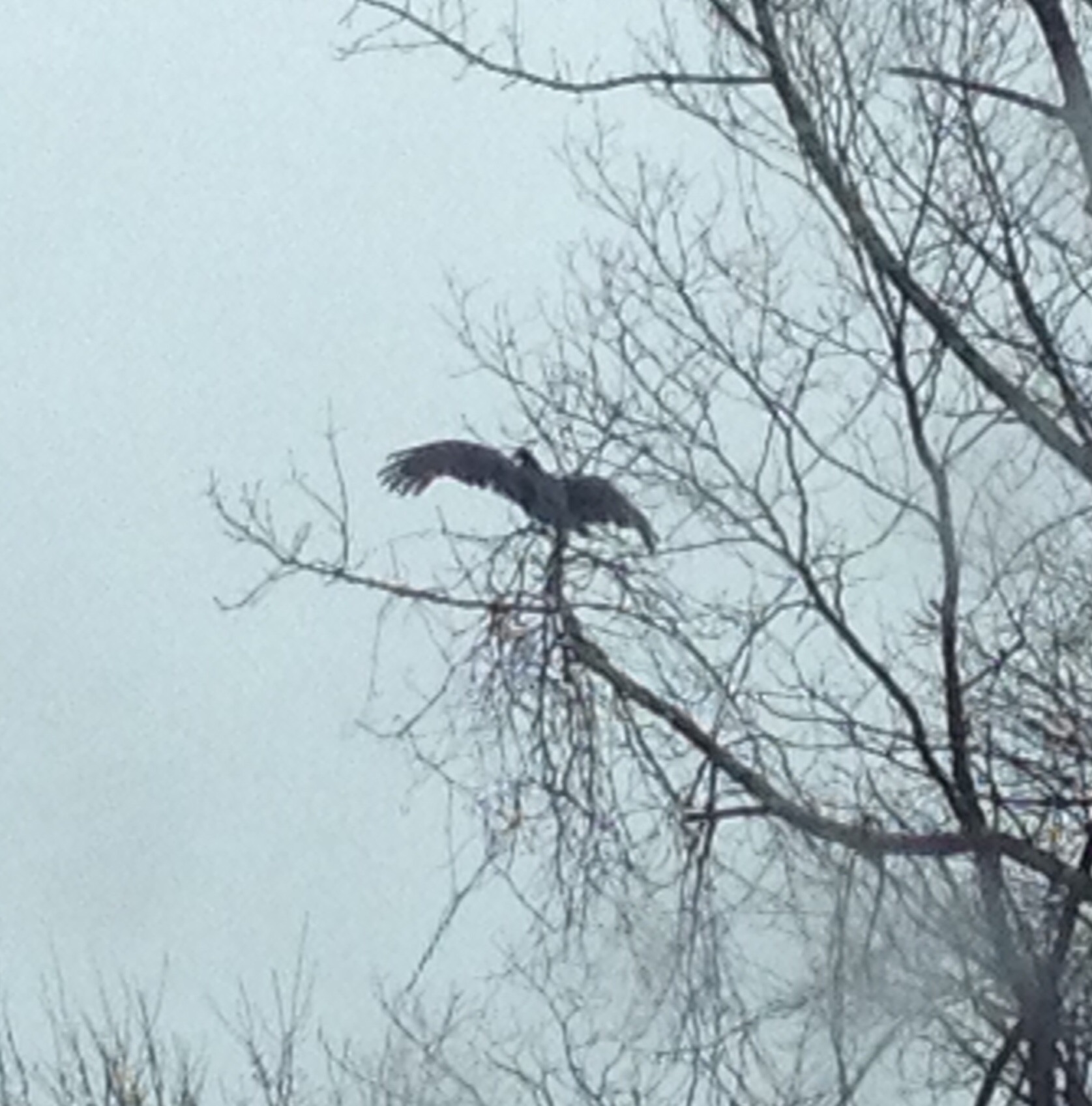
I’ve had birds on my mind this week because of an idea I hatched at the Highlights Foundation last week. One of Rebecca Kai Dotlich’s many wise pieces of advice was to research your topic. So I’ve been reading about birds, listening to birds, and watching for them whenever I’m outside. In fact, I almost drove off the road on Monday because of this bird:

FullSizeRender

I’m pretty sure this is a vulture, which are quite common where I live, but I have never seen one poised like this. After I pulled over to take this picture, I sat and watched this display. The bird stayed poised on this branch for at least five more minutes. Unfortunately, I had an appointment, so I couldn’t watch any longer.

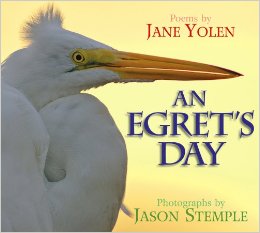
Rebecca also suggested reading poems about the topic you’re writing about, so I’ve been reading as many bird poems as I can find. One of my favorite collections is Jane Yolen and Jason Stemple’s gorgeous book, An Egret’s Day (WordSong, 2010). Yolen’s poetry follows egrets through their day and is accompanied by factual paragraphs about the poem’s topic. Stunning photographs by Jason Stemple, Yolen’s son, accompanies each poem, and gives readers a chance to observe these graceful birds up close.

511Ck0+HkZL._SX258_BO1,204,203,200_

Here’s a poem from this beautiful book:

“Egret in Flight”
by Jane Yolen

She’s an arrow
From a bow.
We watch in wonder
From below.

Origami
neck is folded.
All that we can do?
Behold it.

Read the rest of the poem here (It’s about 1/3 of the way down the page).

Small-Blue-RGB-National-Poetry-Month-Logo_0

I hope you have a chance to behold a beautiful bird or two today. There is always beautiful poetry to behold on Poetry Friday, so be sure to head over to Renee LaTulippe’s blog, No Water River, for the Poetry Friday Round Up.

Slice of Life: A Spring Poetry Retreat

11454297503_e27946e4ff_h

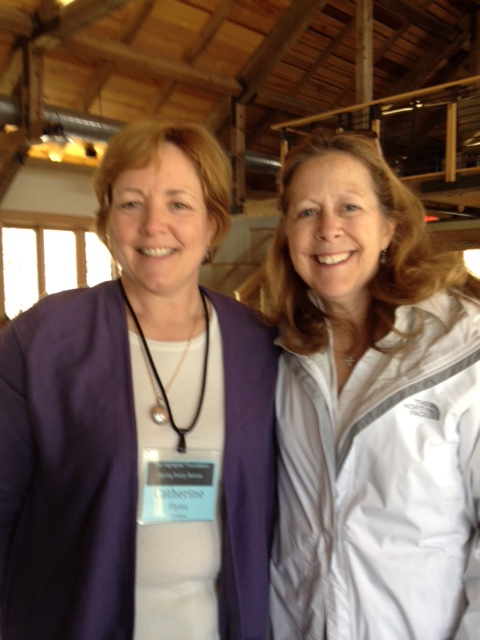
Last week I was fortunate enough to spend four days at the Highlights Foundation in northeastern Pennsylvania to study the craft of poetry with celebrated poet Rebecca Kai Dotlich. To say that this was an incredible experience is an understatement. To be immersed in poetry for four days, and to learn from a master poet, as well as from my fellow students, was an incredible gift. I kept pinching myself to make sure I wasn’t dreaming.

Rebecca is the author of many poetry collections, including In the Spin of Things (WordSong, 2010), and, with Jane Yolen, Grumbles in the Forest (WordSong, 2013). Her poems have appeared in many anthologies, including The Poetry Friday Anthology (2012), Falling Down the Page (Roaring Brook Press, 2009), and My America: A Poetry Atlas of the United States (Simon & Schuster, 2000). Rebecca’s graciousness and warmth put us all at ease, and she shared dozens of poems, both her own and by other children’s poets, as she taught us about the craft of poetry.

Stressing the importance of looking at objects in a new way, Rebecca sent us outside to collect anything that struck our fancy. She encouraged us to look at our object from different angles, with a magnifying glass, to think about its color and texture, in order to find those “precise details” that help make poetry powerful.

We learned about the power of revision when Rebecca Davis, a senior editor at Boyds Mills Press and WordSong, joined us on Saturday afternoon. She and Rebecca took turns reading drafts and revised versions of poems from an upcoming collection. Some of the revisions were subtle; some were significant, but all of the revisions improved the poems. Ms. Davis reiterated the message Rebecca had been stressing throughout our time at Highlights: “Work at your craft.” Nothing can replace the time you put in to drafting and revising, then revising again to “make your work as tight as possible.”

Another highlight of this Poetry Retreat was a Skype visit with poet Janet Wong, who co-edits the Poetry Friday Anthologies with Sylvia Vardell. Janet talked about her path to becoming a poet, as well as steps we could take to improve our chances of being published. Janet also emphasized the importance of writing daily. She encouraged us to “write a poem a day; it’s a sit up for your brain.”

It was easy to be inspired at the Highlights Foundation in the seclusion of the Pennsylvania countryside, but it was also impossible not to bring that inspiration home with me. One of the last pieces of advice Rebecca gave us on Sunday morning was to “let your imagination feed you.” Thank you, Rebecca Kai Dotlich, Janet Wong, Rebecca Davis, Kent Brown, and everyone at the Highlights Foundation for feeding my imagination and my soul!

IMG_2749

Thank you to StaceyTaraDanaBetsyAnna, and Beth for this space for teachers and others to share their stories each Tuesday. Be sure to visit Two Writing Teachers to read more Slice of Life posts.

Poetry Friday: Abraham Lincoln

poetry-friday-1-1

Poetry is an excellent way to introduce a subject. Concise, yet packed with meaning, poetry can convey the essence of a topic or subject in just a few lines. Often there are questions between those lines, pathways to a deeper knowledge and understanding of a subject.

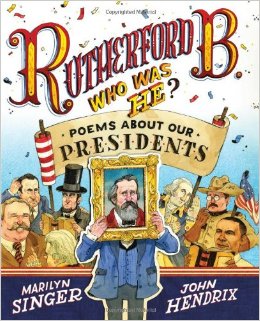
Marilyn Singer’s poem about Abraham Lincoln, from her collection of poems about our presidents, Rutherford B., Who Was He?: Poems About Our Presidents (Disney-Hyperion, 2013), is just such a poem. 

Abraham Lincoln
(Whig, Republican, 1861-1865)

By stovepipe hat, beard, large size,
       he’s the one we recognize.

By addresses of great note,
       he’s the one we often quote.

By leading through war—wrenching, bloody—
       he’s the one we always study.

By exercising his high station
       to proclaim emancipation,

then meeting such a tragic fate,
       he’s the one we rank as great.

“I am a slow walker, but I never walk back.”

Abraham Lincoln, 1809-1865

© Marilyn Singer, 2013
Shared with permission of the author

By the time kids are in 4th or 5th grade, they know who Abraham Lincoln is, but what is the address we often quote? Which war? What is emancipation? These are great introductory questions to a study of Lincoln and the Civil War.

   61XgPN6M6wL._SX258_BO1,204,203,200_ 51XtmW4iK3L._SX258_BO1,204,203,200_

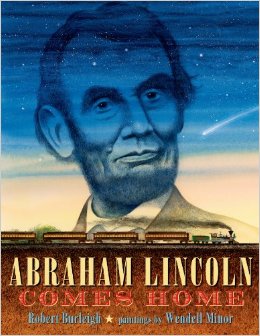
Wednesday was the 150th anniversary of Lincoln’s death. Our country was in the midst of celebrating the end of that “wrenching, bloody” war when John Wilkes Booth’s assassination of Lincoln plunged us into mourning once again. Young readers get a sense of how profoundly people grieved from Robert Burleigh’s Abraham Lincoln Comes Home (Macmillan, 2008). Burleigh tells the story of a boy and his father, up long before dawn, to travel “miles away” so they could view Lincoln’s funeral train and pay their respects to the fallen president. Wendell Minor’s illustrations depict crowds standing by bonfires along the tracks, waiting to get a glimpse of the train. This scene played out over and over again on the 13 day, 1,600 mile journey from Washington, D.C. to Springfield, Illinois, which is described in more detail in Burleigh’s afterward. There is also a map showing the route the train traveled, as well as a list of interesting facts.

Lincoln’s death inspired some Walt Whitman’s most memorable poetry. Here are the first lines of “When Lilacs Last in the Dooryard Bloom’d.”

When lilacs last in the dooryard bloom’d,
And the great star early droop’d in the western sky in the night,
I mourn’d, and yet shall mourn with ever-returning spring.
Ever-returning spring, trinity sure to me you bring,
Lilac blooming perennial and drooping star in the west,
And thought of him I love.
Read the rest of the poem here.
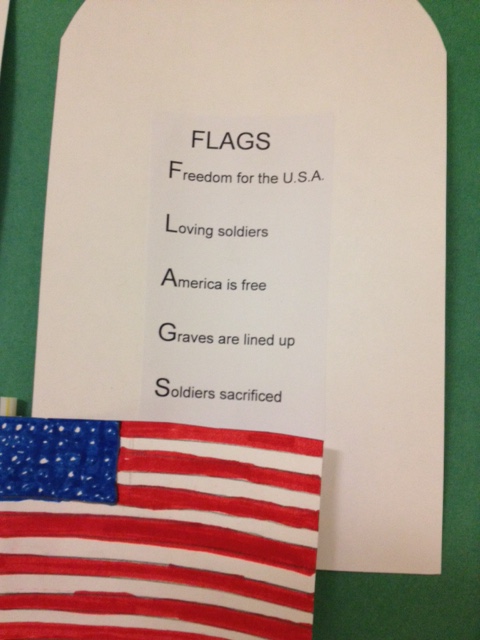
Finally, I’d like to share another poem from our 50 States Poem Project. Although this poem was inspired by Laura Purdie Salas‘s poem about Arlington National Cemetery, it seem a fitting way to close this post.
IMG_2732

Small-Blue-RGB-National-Poetry-Month-Logo_0

Please be sure to visit Robyn Hood Black at Life on the Deckle Edge for today’s Poetry Friday Round Up.