Like many of you, and hundreds of thousands of educators around the country, I’ve been busy preparing for the start of school next week. The buzz of anticipation at meeting new students, sharing new books, and embarking on our learning journey never fades. Unfortunately, there are always aspects of our teaching lives that we have no control over and don’t always agree with. What we can control, though, is our response to the situation.
I’ve always admired people who remain calm in every situation because I occasionally go to DEFCON 1 in an instant. I know this is not always appropriate or even warranted. It’s usually also never helpful. This is something I’m working on. I will carry the last line of this poem by the very wise and wonderful W.S. Merwin into the new year to help me.
“Beginners”
by W.S. Merwin
As though it had always been forbidden to remember
each of us grew up
knowing nothing about the beginning
but in time there came from that forgetting
names representing a truth of their own
and we went on repeating them
until they too began not to be remembered
they became part of the forgetting
later came stories like the days themselves
there seemed to be no end to them
and we told what we could remember of them
A quick scroll through the photos on my phone would let you know that I am fairly obsessed with birds. So when Christie Wyman, a true kindred spirit and fellow bird devotee, issued a “bird-related poem challenge…to anyone willing to fly along,” I knew I was in.
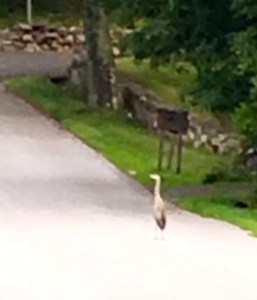
My contribution to Christie’s feather-filled roundup was inspired by a chance encounter earlier this summer.
The Heron
All at once, a heron is standing in the middle of the road. Maybe she thought flecks of mica in the pavement were fish darting back and forth in a creek.
But no quicksilver fish swim in this endless stream of asphalt.
Bewildered, she extends her graceful neck like a periscope, searching.
Suddenly, an alarm only she can hear buzzes and the moment is over.
Without a sound, her wings lift, beat the air, and she is aloft, her beak a compass needle pointing toward true north.
My first published writing was “Invasion of the Dinosaurs” an article that appeared in Connecticut Parent thirty years ago. It was inspired by my son’s love of dinosaurs and my own lifelong fascination with these prehistoric creatures. Although Michael’s interest waned as he grew older, mine never has.
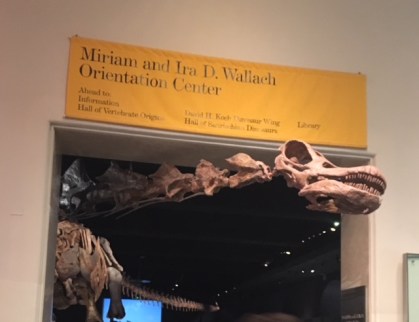
So it was that I spent a hot August afternoon roaming the halls of the American Museum of Natural History. Most of these exhibits are familiar to me, but I still love visiting them. Since my last visit, the museum has added a new resident: the titanosaur!
You can learn more about this truly massive specimen here.
Contemplating all these fossils reminded me of this poem, by Myra Cohn Livingston:
“Dinosaurs”
Their feet, planted into tar,
drew them down,
back to the core of birth,
and all they are
is found in earth,
recovered, bone by bone,
rising again, like stone
skeletons, naked, white,
to live again, staring,
head holes glaring,
towering, proud, tall,
in some museum hall.
Congratulations to Rebecca Herzog, Kimberly Hutmacher, and Amy Warntz! You are the winners of last week’s giveaway of Great Morning! Poems for School Leaders to Read Aloud! Thank you again to Sylvia and Janet for making this giveaway possible!
Please be sure to visit Mary Lee Hahn at A Year of Reading for the Poetry Friday Roundup!
“Poetry is a lovely gift we give to children that appreciates in value
and lasts throughout their lifetimes.”
~ Maria Brountas ~
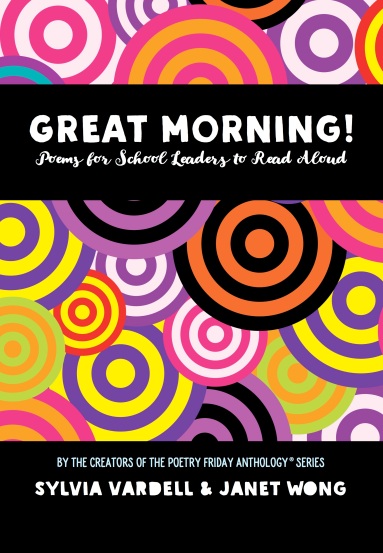
Welcome to the Poetry Friday Roundup! I am thrilled to be hosting today because I’m celebrating the book birthday of Great Morning! Poems for School Leaders to Read Aloud, the newest member of Sylvia Vardell and Janet Wong‘s Poetry Friday Anthology® Series. What kind of celebration would this be without gifts? Thanks to Sylvia and Janet’s generosity, three lucky readers will receive a copy of Great Morning! just in time for the beginning of the new school year! Everyone who leaves a comment before midnight, July 31st will be entered in the drawing.
For many years, the assistant principal and I have read poems during morning announcements. Usually we’d read poems to celebrate the arrival of a new season, or a fun “National (fill in the blank) Day.” I have dozens (and dozens) of poetry books that are full of wonderful poems that we’ve read over the years, including all of Sylvia and Janet’s previous Poetry Friday® books. And, like all of the Poetry Friday books, Great Morning! is full of poems perfect for sharing.
What makes this book so special is that these poems are tailor-made for every imaginable school occasion. Did you just have a fire drill? Read Janet Wong’s “We’ll Keep Safe” to reassure kids that everything is okay. Starting a recycling campaign? Sharing Susan Blackaby’s “Recycling” is the perfect way to kick off this effort. There’s even a poem, “Testing Blues” by Xelena Gonzalez, to lift everyone’s spirit during those dreaded assessment weeks. There are also poems to celebrate all the people who work so hard to keep schools running smoothly: secretaries, nurses, custodial staff, even volunteers.
Great Morning! is divided into two main sections. The first section includes 39 poems organized by topic. Each poem in this section includes a brief “Did You Know” paragraph that can be read to introduce the poem, as well as a “Follow Up” that encourages teachers and children to think more deeply about the poem and topic. There is also a “Poetry Plus” tip that offers suggestions of appropriate times to share each poem.
The second section of Great Morning! includes a second poem that is linked thematically to each poem in the first section. Also included in this section is a “Poetry Bonus” for every poem. This provides links to many additional resources, including audio versions of some poems, digital postcards, and more.
Finally, as if all this weren’t enough, there are almost 30 pages of ideas and tips for using poetry throughout the day, as well as information to share with parents. There are also lists with a plethora of additional resources.
This book, like all of the Poetry Friday® books, is a treasure. Great Morning! is unique because it’s aimed directly at school leaders. In the introduction, Sylvia and Janet write “our goal is to provide support for those who might be unfamiliar with today’s poetry for young people and might need guidance in how to begin.” By supporting school leaders in this way, this book will help send the message to students that they are valued so much we want to share the gift of poetry with them each and every day.
I love this book for all these reasons, but I am also extremely honored that a poem of mine is included. “Walking For a Cause” is especially meaningful for me because our school has held several 5Ks to raise money for a foundation started in memory of a beloved student who lost her battle with aplastic anemia.
“Walking For A Cause”
Hey, kids! Have you heard?
We are walking for a cause.
Ask your parents, neighbors, too,
if they would like to share.
Dollars, quarters, nickels, dimes,
every penny shows we care.
We’re spreading hope with every step,
supporting friends in need.
So lace your sneakers, tie them tight.
Come and help our walk succeed!
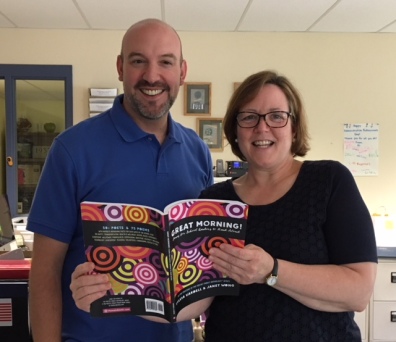
Mr. Schoefer and I getting ready to read “How to Make a Friend.”
I am excited to read these poems throughout the year with my enthusiastic Assistant Principal, Andy Schoefer, during our morning announcements. Here is the poem we’ve chosen for the first day of school, “How to Make a Friend,” by Jane Heitman Healy:
“How to Make a Friend”
You start by saying Hi there,
Hello, Aloha, Ciao– If someone answers back to you,
Smile and nod and bow.
You might try saying Hola,
Salut, Goddag, Shalom. If someone answers back to you,
They might be far from home.
A friend begins by greeting
Those they meet along the way
To make them feel welcome
At home, at school, at play.
Thank you, Jane, for allowing me to share your poem today. I think it is perfect for letting all students know they are welcomed and valued in our school. Poet Elizabeth Alexander calls poems “handbooks for human decency and understanding.” Thank you, Janet and Sylvia, for creating Great Morning! and all the Poetry Friday Anthology® anthologies and filling our schools with volumes and volumes of “decency and understanding.”
Want to know more? Read this post about Great Morning! Poems for School Leaders to Read Aloud at Sylvia’s website, Poetry for Children.
Thank you for stopping by to help celebrate Great Morning! Please leave your link below. Don’t forget to comment if you’d like to be entered in the giveaway.
Forty-Nine years ago, my family sat in front of our television and watched Neil Armstrong and Buzz Aldrin walk on the moon. This was, for me, one of the most thrilling event of my life. When I stood in front of the Apollo 11 command module at the Air & Space Museum thirty years later, I felt the same awe and excitement. So it felt appropriate to commemorate this day here.
J. Patrick Lewis memorialized the event in his poem, “First Men on the Moon.”
“The Eagle has landed!” —Apollo II Commander Neil A. Armstrong
“A magnificent desolation!” — Air Force Colonel Edwin E. “Buzz” Aldrin, Jr.
July 20, 1969
That afternoon in mid-July,
Two pilgrims watched from distant space
The moon ballooning in the sky.
They rose to meet it face-to-face.
Their spidery spaceship, Eagle, dropped
Down gently on the lunar sand.
And when the module’s engines stopped,
Rapt silence fell across the land.
The first man down the ladder, Neil,
Spoke words that we remember now–
“One small step…” It made us feel
As if we were there too, somehow.
When Neil planted the flag and Buzz
Collected lunar rocks and dust,
They hopped like kangaroos because
Of gravity. Or wanderlust?
In addition to the front page news articles, which you can read here, The New York Times also included a poem, “Voyage to the Moon,” by Archibald MacLeish.
Wanderer in our skies,
dazzle of silver in our leaves and on our
waters silver, O
silver evasion in our farthest thought–
“the visiting moon,” “the glimpses of the moon,”
and we have found her.
From the first of time,
before the first of time, before the
first men tasted time, we sought for her.
She was a wonder to us, unattainable,
a longing past the reach of longing,
a light beyond our lights, our lives–perhaps
a meaning to us–O, a meaning!
This draft is my response to the Teachers Write mini lesson that Kate Messner posted on Monday. In it, she asked writers to consider “how might different elements of [a] story look different to different characters?”
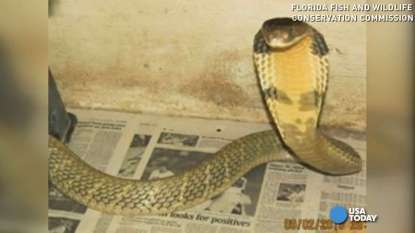
To inspire us, Kate shared the story of a king cobra that escaped from a Florida home a few years ago. Despite my irrational fear of snakes, I knew I wanted to write from the cobra’s perspective.
Kate’s new novel, Breakout, is a fictional version of the real-life drama of two inmates escaping from a prison near her home in upstate New York. Three characters tell the story from different points of view, giving readers a more complete picture of events. One character, Lizzie, often manages to find humor in this serious situation. The article about the escaped snake also included humorous Twitter and Facebook posts people wrote at the time, imagining where in the world the snake might be. But I found nothing humorous about the situation. I felt sorry for the poor woman who found the snake, and I really felt sorry for the snake.
My Great Escape
Stolen from my jungle home, stuffed into a barren box: no royal treatment for me. My days were spent in misery.
Desperate to stretch, uncoil my sleek brown body I watched for my chance, bolted from that ranch.
I slithered through suburbia, searching for a place to settle: a bamboo thicket or a fallen tree where I would be free.
But my dream was not to be…
I was found behind a dryer. Hissing, hood flared in warning, I rose up as if on a throne: Leave me alone!
I put up quite a fight before Animal Control officers caught me, ended my spree and returned me to captivity.
School ended last week and I spent a good part of last weekend reading and relaxing. As I sorted the stacks of books I’ve accumulated over the past few months, I found Searching for Stars on an Island in Maine, by Alan Lightman. In her rave review, Maria Papova called Lightman’s book “a splendid read in its entirety,” and I ordered it immediately.
The intersection of science and spirituality is endlessly fascinating to me, and Lightman’s poetic approach to the universe captivated me at once. One line was in my mind when I went for a walk at dawn the other day: “All is in flux.” I hope Mr. Lightman won’t mind that I “borrowed” his line to begin this poem.
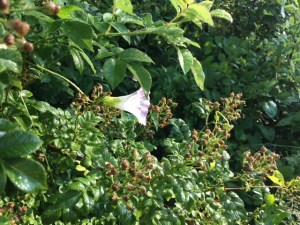
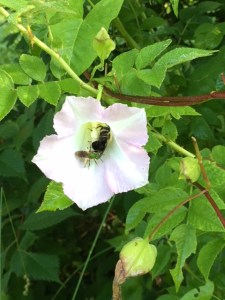
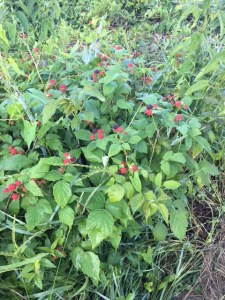
All is in flux. Shimmering in dawn’s golden light, morning glories hum with breakfasting bees. Raspberries ripen. Maples dazzle and beckon. One… two… three crows alight on the highest branches. Their caws echo across the countryside. I step into this dew-dappled morning, searchingfor what is true.
Our librarian has been culling our collections and leaving a box of books for us to look through before these withdrawn books are…(I’m not sure what, maybe sent to the Island of Withdrawn Books?) Of course I peruse the box each day, hoping to find a treasure or two. So you can imagine how happy I was to find this the other day:
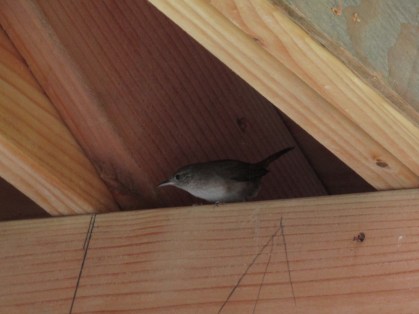
I’ve always loved Fisher’s poetry. Her keen observations and sense of humor make her work timeless. This spring, we have wrens nesting in the roof overhang of our new porch. They are dedicated parents, making countless trips back and forth from the nest to the nearby bushes for insects. As usual, Fisher gets their behavior exactly right in this sweet poem.
“The Wrens”
by Aileen Fisher
The wrens who rent our birdhouse
come back before it’s May.
They hang their hats inside the door
and settle down to stay.
We never have to send a bill,
so punctual are they…
They start each morning loud and clear,
to sing the rent away.
On another note, I am thrilled to share that two of my poems appear in The Quickwrite Handbook, Linda Rief’s new book full of mentor texts to “jumpstart…student’s writing and thinking.” Both poems first appeared here and here. Thank you, Linda, for including my work in your book!
Please be sure to visit Carol at Carol’s Corner for the Poetry Friday Roundup.
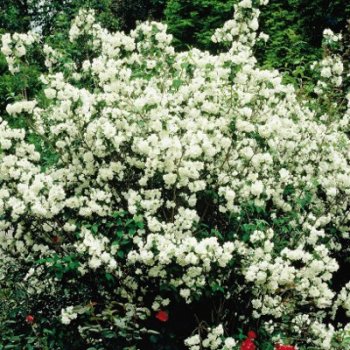
Syringa, which is also known as mock orange, is in full bloom here in my corner of Connecticut, and it always reminded of the massive bush in my grandmother’s yard. I grew up next door to my grandmother and spent as much time playing in her yard as I did in my own. Our shrubs and flowers were grown from cuttings and divided clumps of her shrubs and flowers, and I loved them all. So when my parents sold the house I grew up in, I divided as many of these heirlooms as I could. I still have peonies, iris, and poppies that once bloomed in both yards. The only plant that didn’t survive the move was my grandmother’s syringa (also known as mock orange).
We moved when Grandma’s syringa was blooming, its branches curved earthward by the weight of a thousand snowy blossoms. Their sweet, heady scent, the scent of my childhood is now tinged with sadness and longing for a home that exists only in my heart.






 Reading to the Core