The first month of school is in the books and it was a hectic one! Now that I’m back into that routine, maybe I can find a way back into a writing routine. Fingers crossed!
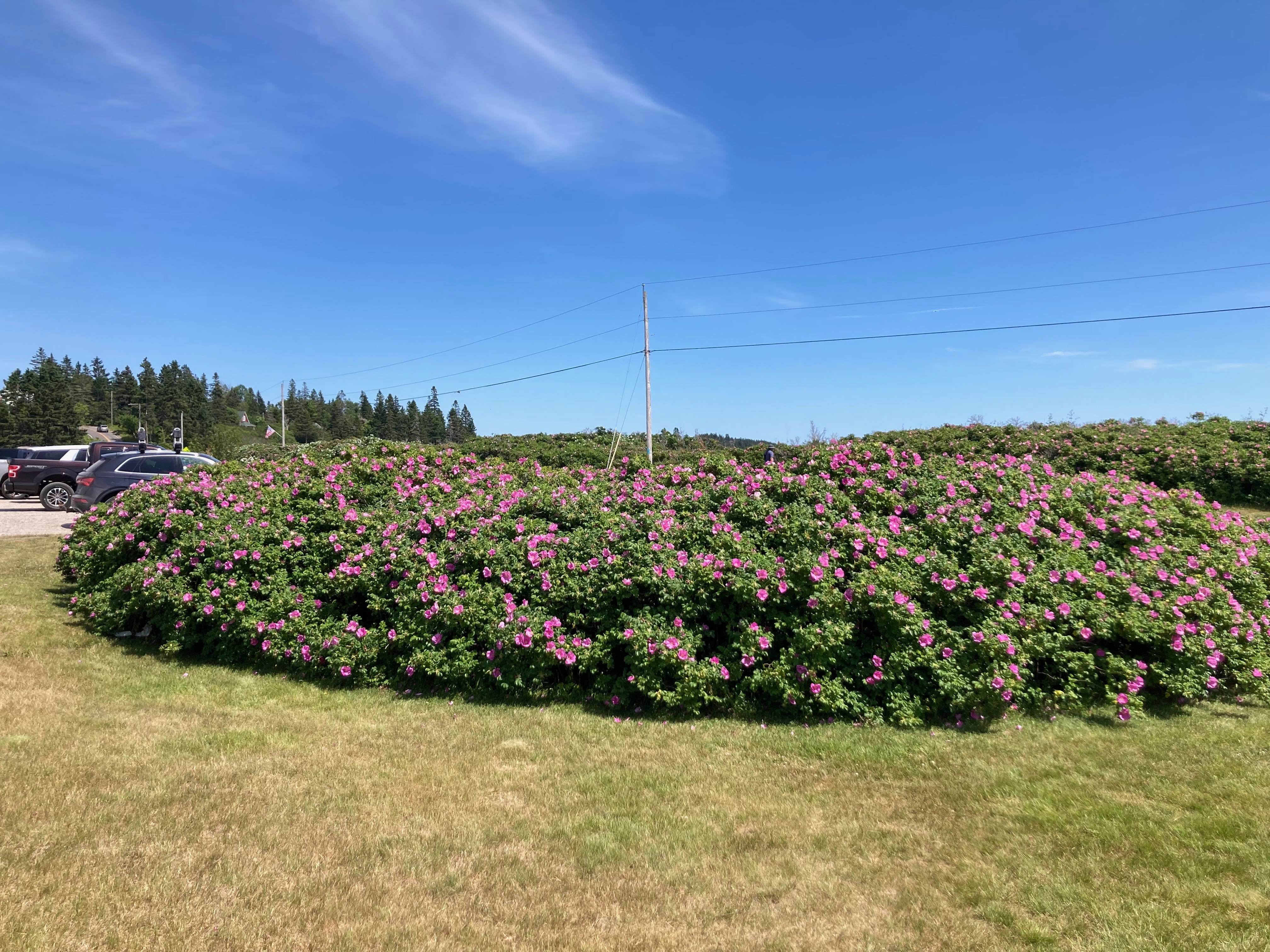
This month, Margaret challenged the Inklings to write a poem inspired by a photo shared by a fellow Inkling. I was lucky to receive three options from photographer extraordinaire, Molly Hogan. While all the images were intriguing, I couldn’t stop thinking about this one:
Here is my response:
In September, dried filaments of Queen Anne’s Lace curl inward like careworn hands folded in prayer.
A dragonfly, maybe a wandering glider, lands on the boll of seeds and stems to rest, reviving, reenergizing for the journey ahead.
This month, Molly challenged the Inklings to “Write a love note to something or someone or some place. Go big or go small!” She gave us several suggestions to use as mentor poems and shared that her real motivation was to “look at the world through a lens of love.”
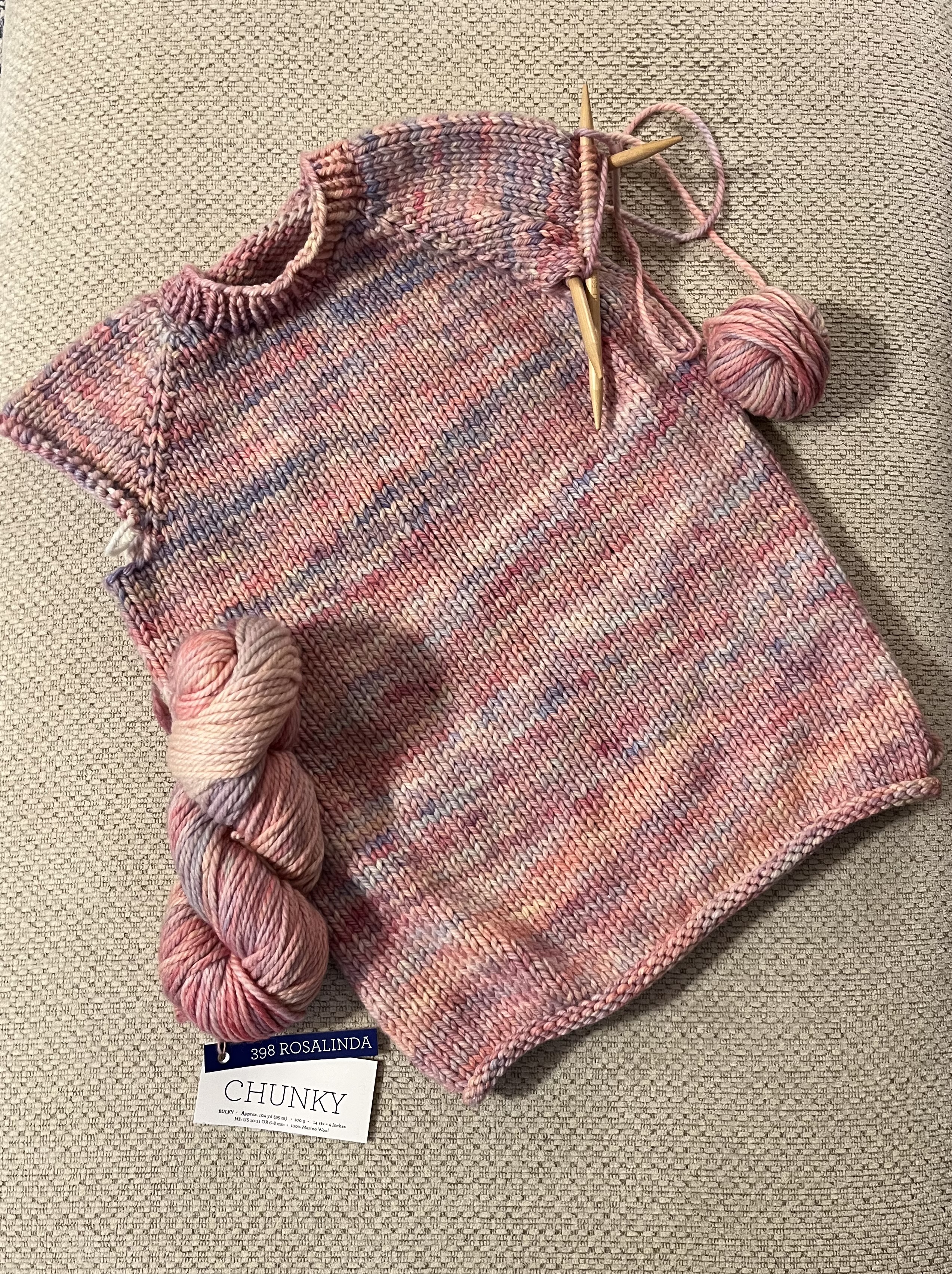
There are so many things in this world that I love: my family, trees, birds, books, knitting. The list is long (how lucky am I?) I even considered writing about the kitchen table! (I will come back to this idea soon.) In the end, though, time ran out and I found myself searching my notebook for anything that filled the bill. This poem, written last summer, isn’t exactly a love note, but I sure did love this bike.
A New Bike
I stumble off the bus into another summer confined to our dusty driveway on my rusty red bicycle.
Suddenly, I see a shiny new bike waiting. I scream with joy, drop everything and run.
“You’re old enough to ride on the road.” Mom’s words echo as I hop onto the silver seat and pedal away.
Smooth asphalt glides beneath me. I’m a blur of sparkly green paint, blending into the kaleidoscope of summer leaves.
Streamers – a rainbow of red, yellow, blue – fly out from the handlebars like a flag, proclaiming my independence.
Margaret Simon has the Round Up today at Reflections on the Teche. After you read her love note to silence, visit my fellow Inklings to read their love notes.
How is it the first Friday of August already? I have crossed off a number of chores from my to-do list, but it seems like the list keeps growing! Fortunately, I still have the entire month to finish the most important tasks. But now it’s time for poetry.
This month, it was my turn to pose the Inkling’s monthly challenge. My brain was still de-stressing from a challenging spring at the end of June, and I was floundering a bit to come up with a worthwhile prompt. Luckily, Irene Latham, posted a “Summer Triptych” last month. I was intrigued by the form, and Irene made it look so easy (as she does with everything!). So that was the challenge: write a triptych. (Thank you, Irene.)
I toyed around with several ideas, but kept coming back to an owl (owls?) who’ve always been in the woods behind our house. This summer, though, she (they?) have moved into the front yard! My husband has been lucky enough to see her on several occasions.
I
Just before dawn, an owl’s call threads its way through the trees before tapering off into a purr.
II
Bold in the noonday sun, an owl sits, poised and serene. She seems aloof to the comings and goings around her. But make no mistake: She is keenly aware of every imperceptible rustle of grass, every whisper of leaves.
III
A creamy, tan striped feather lies under the apple tree: Owl’s calling card.
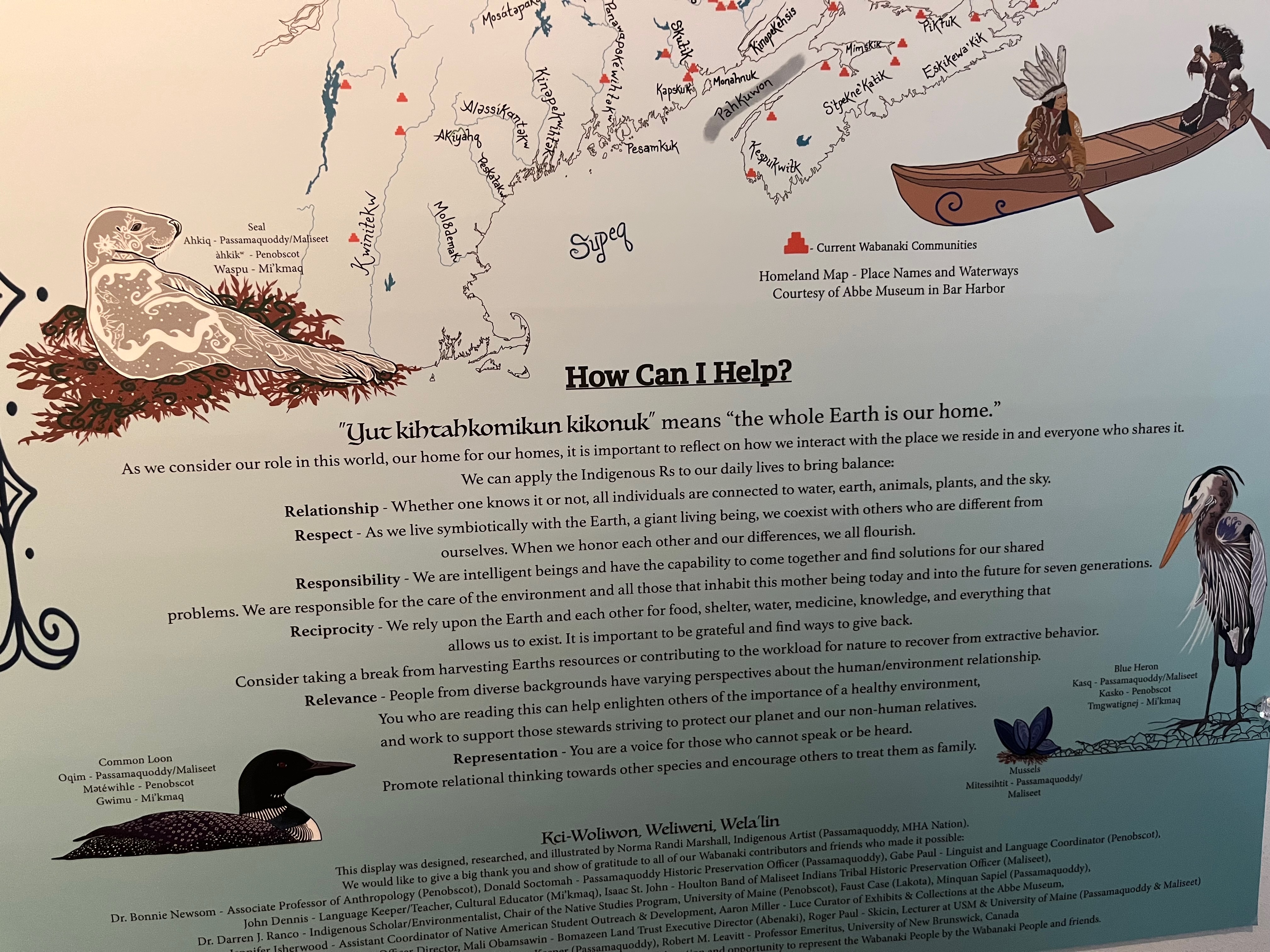
On a recent trip to Maine, my husband and I spent an afternoon at the Farnsworth Art Museum in Rockland. One of the exhibits, Re-Indigenizing Sacred Landscapes: From the Wigwam at Catawamkeag, included this graphic by Norma Randi Marshall, an indigenous artist and member of the Passamaquoddy, MHA Nation. (Sorry for the poor quality of the photo.)
For the first Round Up of July, Mary Lee challenged us to write “poems of protest for our nation’s birthday. Let’s use our voices and our art to make some noise! Feel free to write in praise of democracy and patriotism if you’re so moved, or write in frustration and befuddlement over the “leadership” in the White House and/or Congress and/or the courts and/or and/or and/or.“
I love the simple way Marshall presents the deeply complex ideas, so I decided to mine her words to create two opposing acrostics, one that offers hope, the other expressing the outrage I feel over the events of this week.
Respect: What It Isn’t
Reprehensible Evasion of a Sworn oath Putting millions in peril, Ensuring suffering, Claiming lie after lie, incapable of Telling the truth.
Respect: What It Is
Respectful relationships Ensure our ability to Sustain and Protect our precious planet Earth. It is our duty to Care for our home and each other, Treading lightly so we all can flourish.
Life throws us curve balls all the time. Some are minor upsets that we deal with and move on. Some completely upset the balance of our lives and take longer to recover from. Over the past year, two big curve balls have kept me from writing and posting regularly. Last year, after working as the literacy specialist in my school for 17 years, my assignment was changed to middle school language arts. I did my best to rise to this challenge. Then, last November, my mother fell ill and required round-the-clock care. This meant finding a nursing home, selling her house and all the headaches that went along with that. At first, it seemed like Mom was doing okay and we were prepared to settle into a new normal. Sadly, though, she took a turn for the worse and passed away in February. In addition to dealing with grief, there were now a myriad of other details to attend to, some of which are still unresolved. Through all of this, there were still lessons that were completely new to me to prepare and papers to grade. I had nothing left for poetry.
What I did make time and space for was my family, especially my grandchildren. They have buoyed me up when I needed it most. They never fail to make me smile, and they inspired this poem.
At the Creek–a nonet
Screams of joy erupt as kids plunge into a rain-swollen creek. Jumping, laughing, splashing; sprays of water cascade through the air. Everyone is drenched. Teeth chatter; campfire and s’mores await.
I’ve missed you all and am working on getting back to writing and blogging more often. Please be sure to visit Carol at The Apples In My Orchard for the Poetry Friday Roundup.
After an unexpected hiatus from writing, I’m trying to find my way back into a routine. As it’s the first Friday of the month, and the Inklings have been so supportive and kind, I decided posting today would be a good first step. I am cheating a bit, though, because the poem I’m sharing today was written in early November.
This month, Mary Lee challenged us to “Type a color into the search bar of public domain image archive and choose an image to write from.” I entered “white” and found this image, which I think matches my poem quite well:
“Full Moon with White Rabbit” Ohara Koson, ca. 1920 via Rijksmuseum
Last fall, I shared the picture book version of Ada Limón‘s magical poem, In Praise of Mystery, with gorgeous illustrations by Peter Sís with my sixth graders. We were reading A Rover’s Story, by Jasmine Warga, at the time, and I challenged them to write an ode to Mars. I wrote this poem as a model for them.
In Praise of Mystery: A Poem for the Moon (after Ada Limón)
Luna, Selene, Chandra, Moon Keeper of time, guardian of dreams You dazzle us with your charm.
We miss you each month while You’re off playing hide and seek with the sun. Your absence deepens your mystery And we wonder about your changing face.
Some nights you shine silver, Like a huge coin hanging in the sky. Other nights, your glow is as golden As a ripe apricot.
And always we wonder: is anyone there? We gaze at your surface and see Old men, rabbits, foxes, toads. We ask, what could those craters be hiding?
Tethered together. We are on this cosmic ride for eternity.
Someday I hope I’ll be able to get back to posting more often, but for now, I’m happy to keep up with the Inklings monthly challenges. This month, Linda challenged us to use “Fall Song” by Joy Harjo “as a mentor text in any way that makes your heart happy.”
This gorgeous poem could have taken me in many directions, but I kept coming back to this line: “Forever will be a day like this.” Since shorter is much more manageable for me these days, I decided to write a Golden Shovel using Harjo’s words as a strike line. Here is my “Fall Song”
Please be sure to visit my fellow Inklings to read their responses to Linda’s challenge:
“I’m so glad I live in a world where there are Octobers.” ~ L.M. Montgomery ~
How is it October already? Life is a whirlwind these days, but I couldn’t miss our monthly Inkling challenge. This month, Margaret challenged us to write Pythagorean poems. What on earth?! Here’s the lowdown (thank you, Linda!):
A Pythagorean Poem created by Shari Green
The math background: Pythagoras’ theorem is a2 x b2 = c2 One possible triple is 3,4,5.
3×3 + 4×4 = 5×5
9 + 16. = 25
Using the triple, the poetic form works like this: 1st stanza: 3 lines of 3 words each 2nd stanza: 4 lines of 4 words each 3rd stanza: 5 lines of 5 words each*
*The third stanza must be composed of all the words found in stanzas one and two (in any order; variations okay).
The third stanza should also be a progression of sorts, a product of the first two in thought or theme or meaning.
I love writing Fibonacci poems and pi poems, so this appealed to that part of my brain. What I found most challenging was using all the words in the last stanza. As already mentioned, life is a bit hectic these days, so I cheated just a bit and swapped she for the in the last stanza. Poetic license and all that.
Just before dawn, a barred owl calls his mate.
Perched in a pine she responds, her hoot echoing through the trees seeping into my dreams.
Through the pines, a barred owl’s hoot echoes. His mate, perched in a tree, calls her response just before the dawn seeps into my dreams.
Next time, I hope I’ll be settled into the routine of the new school year and actually post on Friday! In the meantime, here is my response to Mary Lee’s challenge to “use Next Time, by Joyce Sutphen as a mentor poem for your own Next Time poem.” Seems pretty straight forward, right? I had to make a conscious effort not to revisit every past mistake, real or perceived, to keep my own “Next Time” poem from devolving into a laundry list of guilt and shame.
So here instead is a gentle reminder to myself. Maybe you need it, too.
Next time I wander into the wild, I’ll leave my watch at home.
I’ll slip into shadows of oak and pine with only the sun to mark my passage.
I’ll leave my worldly cares on the threshold of a place where time grows slow, recorded in years, not seconds.
I’ll breathe in the patience of rocks and ferns and remind myself to just be.
Draft @ 2024, Catherine Flynn
Please be sure to visit my fellow Inklings to read their responses to Mary Lee’s challenge:
The first Friday of August means it’s time for another Inkling Challenge. This month it was my turn to pose a prompt for my fabulous critique group partners. I’ve been followingAda Limón’s Poet Laureate project “You Are Here: Poetry in the Parks” on Instagram and decided summer was the perfect season to join Limón’s effort to “deepen our connection to nature through poetry.”
In the introduction to You Are Here: Poetry In the Natural World, the anthology Limón curated as part of her project, she counsels that “nature is not a place to visit. Nature is who we are.” The epigraph to this stunning collection are these wise words from Robin Wall Kimmerer: “The land is the real teacher.” I kept thinking about these lines as my husband and I took a barnstorming tour of western South Dakota, south central Montana, and northern Wyoming. The vastness of this landscape is truly overwhelming, but it filled me up in so many ways. I was anxious to answer Ada’s question: “What would you write in response to the landscape around you?” and “offer something back to the earth” letting it know that I had noticed my “connection to the planet.”
One caveat: Threaded through our trip was a feeling of profound sadness at the loss of these extraordinary places to the Native peoples who called this area (indeed all of North America) home, and considered many of them sacred, before 1492. I don’t have the knowledge or cultural currency to address these wrongs at this time. I will keep reading and educating myself about this stain on our history.
At Lower Falls
I stand on the edge of the man-made world: concrete and stone designed to Keep. Me. Safe.
Below and beyond rock and river conspire in their ancient alchemy to carve a canyon.
An unrelenting cascade pours over the lip of a cliff, chiseling away, its work never done.
Columns of water foam and froth, roar a single, powerful note, drowning out the rest of the world.
I am in awe of this showy display, a peacock among hundreds of smaller, less spectacular falls.
Tucked into a forest of lodgepole pines, Mystic Falls aren’t as high, hum a softer, soothing tune,
reminding me the world needs both showy displays of grandeur and quiet, subtle beauty.