SOL: On Meeting Ursula Nordstrom

I took a circuitous route to the classroom. Although I always knew I wanted to be a teacher and writer, I considered other career options along the way, including interior decorator. However, when I graduated with my A.S. in 1980, jobs in this field were few and far between. Desperate for a job, I started working as a receptionist in a doctor’s office. In my mind, this was a temporary situation. I would find my dream job soon.

As the saying goes, everything is temporary. My stint at the doctor’s office only lasted fourteen years. But it turned out to be a good training ground for teaching. Dealing with parents is nothing compared to patients! I also met some pretty interesting people over the years, including William Styron. But one encounter I will never forget was with Ursula Nordstrom.

Ursula Nordstrom was, in the words of Maria Papova, “a fearless custodian of the child’s world and imaginative experience.”  An editor at Harper & Row (now HarperCollins) for many years, she edited classics such as Stuart Little, Charlotte’s Web, and Where the Wild Things Are. When Ms. Nordstrom came into our office, I was writing terrible picture book manuscripts on a weekly basis, and for me, it was as if the patron saint of all I aspired to had just walked in the door.

Of course, there are rules of professionalism that have to be followed, so I greeted her calmly and asked her to have a seat. She chose a seat quite close to the window, which was a little unnerving. We were very busy that day: the phone wouldn’t stop ringing, charts had to be typed, (Yes, typed, as on a typewriter. This was in the mid-80s.) and other patients needed attention.

During one lull in the action, she looked over at me and said, “You handle everything very well.” (Or something like that.)

In that brief moment I wanted to say, “I write picture books, too!” But of course I didn’t. I thanked her, and then answered the phone again.

Ms. Nordstrom didn’t return to our office, and passed away soon after this brief encounter. If you’re not familiar with her work, Leonard Marcus gave the world of children’s literature a gift when he published Dear Genius: The Letters of Ursula Nordstrom (HarperCollins, 2000). Included in the book is correspondence between Nordstrom and E.B. White, Laura Ingalls Wilder, and Margaret Wise Brown, among many, many others. I read Dear Genius when it was first published and was inspired by Nordstrom’s wit, intelligence, and compassion. Do yourself a favor and read this book. Spend time with “a deeply lovable spirit” who helped create the world of children’s literature as we know it today.

Thank you to StaceyBetsyBeth, KathleenDeb, Melanie, and Lanny for creating this community and providing this space for teachers and others to share their stories every day in March and each Tuesday throughout the year. Be sure to visit Two Writing Teachers to read more Slice of Life posts.
SOL 18: Another Slice of Poetry


I spent much of the evening working on a writing project that I hope to tell you about one day. After playing with one four-line stanza for the better part of an hour, it was time to step away. My brain was too muddled to make any more progress on this day. Then I realized I hadn’t written anything for Poetry Friday! I searched my recent jottings and found the bare bones of this poem hiding in my notebook. Since this is what I’d been doing all evening, it seemed appropriate to polish it up a bit and share it today.

Find a word
      write it down
play with its meaning
      listen to its sound.

Pick another
        do the same
string them together
         make it a game.

Soon you will have
         a new work of art
a story or poem
         straight from your heart.

© Catherine Flynn, 2018

Photo by Jon Tyson via Unsplash

Please be sure to visit Michelle Heidenrich Barnes at Today’s Little Ditty for the Poetry Friday Roundup. Also, a big thank you to StaceyBetsyBeth, KathleenDeb, Melanie, and Lanny for creating this community and providing this space for teachers and others to share their stories every day in March and each Tuesday throughout the year. Be sure to visit Two Writing Teachers to read more Slice of Life posts.
SOL 18: My Mother, My Mountain

My mother
is a shadowy mountain.
I scale her thick, furry limbs.
I ride along on the broad, flat ridge
of her back as we roam our rain forest home.
I snuggle into the cave of her arms,
safe, when we nest each night.
The mountain sustains me.
My mother.

© Catherine Flynn, 2018

Carving in charcoal, made in Uganda

This poem was inspired by the photo of a carved mountain gorilla mother and child shared by my partner-in-poetry and Slicing, Christie Wyman, for Laura Shovan’s Ekphrastic Poetry Project. For me, the facial expressions of these critically endangered animals brought this carving to life. It appealed to me immediately, and I had a general idea of what I wanted to write. What I needed was a form that suited my ideas.


There are many well known poetic forms that I could have tried, but I wanted something that would ring true to the African roots of this carving. I didn’t find anything suitable in a search through my poetry reference books, so I turned to Google. There I found an form called the “Eintou.”  Described as an “African American septet syllabic/word count form consisting of 2 words/syllables in the first line, 4 in the second, 6 the third, 8 the fourth, 6 the fifth, 4 the sixth, and 2 the seventh.” In addition, “Eintou” is from a West African dialect and means “pearl, as in pearls of wisdom.” The structure also reflects the African and African American philosophy that “life is a cycle. Everything returns to that from which it originates.”

An Eintou felt exactly right for this poem. Now my only problem was matching the word count. I drafted several versions that stuck to the structure explained online, but it just wasn’t working. In keeping with my efforts to develop my Habits of Mind,  I decided that by “creating, imagining, and innovating,” I could modify the structure and add a 10 word line in the middle and work back to two words from there. (This form has the added, unintentional bonus of being shaped like a mountain!) I think I maintained the spirit of the form. Also, I definitely stayed true to the purpose of Laura’s project, which “is to practice the habit of writing regularly,” the same purpose of the Slice of Life Challenge.

Thank you to StaceyBetsyBeth, KathleenDeb, Melanie, and Lanny for creating this community and providing this space for teachers and others to share their stories every day in March and each Tuesday throughout the year. Be sure to visit Two Writing Teachers to read more Slice of Life posts.

SOL: A Happy Accident

“Chance favors the prepared mind.”
Louis Pasteur

My One Little Word for 2018 is focus. At school, I’ve been focused on incorporating the growth mindset stances laid out by Kristine Mraz and Christine Hertz in their book, A Mindset for Learning, as well as the habits of mind explained in Learning and Leading with Habits of Mind, by Arthur L. Costa and Bena Kallick. This means I’m constantly on the lookout for opportunities to weave these habits into my lessons.

In Costa and Kallick’s work, this focus would fall under the habit of “creating, imagining, and innovating.” Maybe it’s the poet it me, but I prefer to think of this as “serendipity,” those happy accidents of chance that occur when we’re paying attention. Yesterday, such a moment occurred.

As I was working with a second grader, he noticed The Day the Crayons Quit in a basket on a nearby bookshelf. “Can we read this, too?” L. asked as he pulled the book from the basket. “Mr. M. read it to us in Library and it’s really funny.”

“Absolutely,” I replied. “Let’s finish our other work first.” He agreed, and I presented How Bear Lost His Tail from Fountas & Pinnell’s Leveled Literacy Intervention kit.

He wasted no time in reminding me that he’d already read this book. The advantages of rereading are well-known and many. Among other benefits, rereading increases fluency and deepens comprehension, my goal in this case. I explained to him I knew he’d read the book before, but that readers always find something new when they read a book a second, third, or even fourth time.

He launched into the book, and because it was his second read, he read it fairly fluently and with good expression. When he finished, I asked him if he had an idea about why Fox tricked Bear. He replied, “Maybe Fox was sad.” Seeing an opportunity to develop his vocabulary, I asked him if there were any other words he could use to describe how Fox felt. “Upset?” he said, with a hint of a question.

“Why would he be upset?” I asked him.

“Because Bear’s tail is bushier than his,” he replied, this time with more confidence.

I asked him if he knew the word “jealous.” He said he didn’t. I explained that if someone has something you would like to have, you might be jealous. I asked him if his sister ever had anything he wanted but couldn’t have. He remembered that at her last birthday party, he’d been upset that she was getting so many presents. “That’s what it feels like to be jealous,” I explained.

Seizing the opportunity he’d presented me with when he asked to read The Day the Crayons Quit, I asked, “Do you think any of the crayons were jealous?” He shrugged and said he couldn’t remember. “Let’s find out,” I suggested.

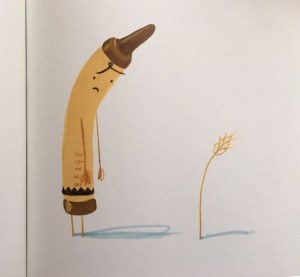
Working together, we reread the first few letters of protest from Duncan’s crayons. Lo and behold, there was Beige, feeling very left out because Brown got to color all the “bears, ponies, and puppies.”

“He’s jealous,” L. announced proudly.

From The Day the Crayons Quit, by Drew Daywalt, pictures by Oliver Jeffers

New learning sticks when learners apply “past knowledge to new situations” (Costa & Kallick, p. 28). Granted, this new situation was within five minutes of L.’s introduction to the word, but he made the connection between the two characters on his own and was articulated his thinking clearly. It’s unlikely that I would have planned this sequence of events ahead of time. But L. is more likely to remember this new vocabulary because a number of conditions were in place that engaged him in a meaningful way. Serendipity at its finest.

Thank you to StaceyBetsyBeth, KathleenDeb, Melanie, and Lanny for creating this community and providing this space for teachers and others to share their stories every day in March and each Tuesday throughout the year. Be sure to visit Two Writing Teachers to read more Slice of Life posts.
SOL18: By the Book

My Saturday morning routine almost always includes a first glance at The New York Times Book Review. It’s only a first glance because I always note which reviews I want to return to and read more carefully. The second read always begins with “By the Book.” This column, subtitled “Writers on literature and the literary life,” interviews authors about what they’re currently reading, which books they love, and other interesting questions related to their reading. Last week’s column featured beloved children’s book author, Brian Selznick, whose newest book, Baby Monkey, Private Eye (Scholastic, 2018) came out last week.

I always love to know what other people are reading, and I don’t know many teachers or writers who aren’t curious about this also. Last year, one of my March Slices was modeled after By the Book, and, since today is Saturday, I decided today was time for an update.

What books are on your nightstand?

At the moment, I’m alternating between Mary Oliver’s beautiful new collection Devotions and Voices in the Air by Naomi Shihab Nye. I am in awe of both of these poets and sometimes come away from their work wondering why I even bother. More often than not, though, the masterful imagery of these two women inspires me to keep writing.

Next is The Essex Serpent, by Sarah Perry. A friend gave me this book for my birthday in October and I’m just now getting to it. The jacket copy states this book “masterfully explores questions of science and religion, skepticism and faith, but it is most of all a celebration of love.” The Essex Serpent got great reviews when it was published and was on many “Best of 2017” lists last December. I’m only on page 17, so I’ll keep you posted.

There is always at least one professional book in the stack, and currently it’s Learning and Leading with Habits of Mindby Arthur L. Costa and Bena Kallick. My colleagues and I have been working this year to embed these habits of mind into our teaching. Costa and Kallick have countless suggestions for incorporating these habits into our days in thoughtful, meaningful ways that will help our students internalize them.

I’m embarrassed to confess I haven’t read this year’s Newbery Medal winning book, Hello Universe, by Erin Entrada Kelly yet. As soon as it’s in our library on a Friday afternoon, I’ll bring it home for the weekend. (I never take books until after the kids have left on Friday; if they want the book I want them to have it!)

What books are on your nightstand?

Thank you to StaceyBetsyBeth, KathleenDeb, Melanie, and Lanny for creating this community and providing this space for teachers and others to share their stories every day in March and each Tuesday throughout the year. Be sure to visit Two Writing Teachers to read more Slice of Life posts.

A Slice of Poetry


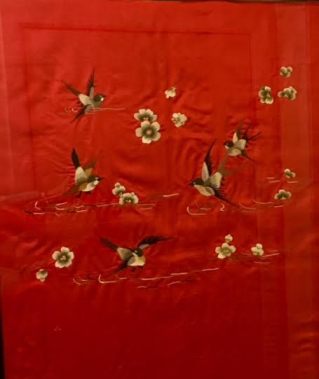
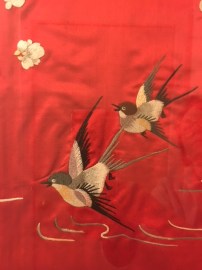
Have you ever had the experience of passing an object on a daily basis and not really seeing it? We get so wrapped up in our busyness that we fail to notice the beauty present all around us. This is certainly true of this silk embroidery. It was given to my husband’s grandfather, an Army major, when he served in Southeast Asia during World War II. (I’m embarrassed to admit I don’t know exactly where or by whom.) When our son, the first son of a first son, was born, Rodney’s grandparents gave it to us. It’s been hanging in our upstairs hallway ever since, but I never really stop to LOOK at it.

When Laura Shovan announced that her February Poetry Project would be ekphrastic poetry inspired by art in participant’s homes, I knew I wanted to share this embroidery. These playful birds and delicate petals deserve a poem. (Or a dozen or more!)


Playful swallows swoop
among dancing white blossoms
chittering, chirping
iridescent acrobats
tumbling on a spring breeze

© Catherine Flynn

Don’t forget to visit Renée LaTulippe at No Water River for the Poetry Friday Roundup. Also, thank you to StaceyBetsyBeth, KathleenDeb, Melanie, and Lanny for creating this community and providing this space for teachers and others to share their stories every day in March and each Tuesday throughout the year. Be sure to visit Two Writing Teachers to read more Slice of Life posts.


March SLO: The Breathings of My Heart

My father and grandfather built the house I grew up in when I was two years old. The house wasn’t completely finished when we moved in, and the closet in my bedroom remained unpainted for several years. That vast, empty expanse of sheetrock became my own personal graffiti wall. I can barely remember what I drew on those walls. If I wrote anything, it was the scribbles and loops of an emergent writer. Of course this drove my mother crazy, but I wouldn’t stop. I had a story to tell!

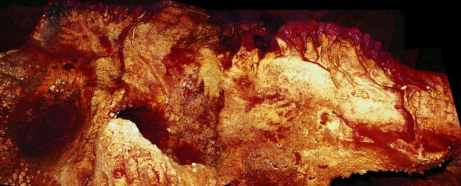
Humans have always been compelled to tell their story. Recently discovered cave paintings in Spain were made by Neaderthals, our close ancestor, at least 65,000 years ago! In his novel Waterland, Graham Swift writes, “Man—let me offer you a definition—is a storytelling animal. Wherever he goes he wants to leave behind not a chaotic wake, not an empty space, but the comforting marker buoys and trail signs of stories.” Those handprints deep inside caves around the world are the ancient equivalent of “Kilroy was here.”

Hand stencils in Maltravieso Cave in Spain made at least 66,000 years ago. (H. Dollado)

I stopped scribbling on my closet wall once my father painted it, but I’ve always filled notebooks with what Wadsworth calls “the breathings of my heart.” I love the joy I feel when I uncover a forgotten memory or make some other discovery about myself when I write. I love the clarity writing brings to my thinking about relationships, work, and the world around me. For the next month, I’ll be joining hundreds of writers and teachers around the world delve into the mysteries that writing uncovers as well tell our stories, one slice at a time. I hope you’ll join us.

Thank you to StaceyBetsyBeth, KathleenDeb, Melanie, and Lanny for creating this community and providing this space for teachers and others to share their stories every day in March and each Tuesday throughout the year. Be sure to visit Two Writing Teachers to read more Slice of Life posts.